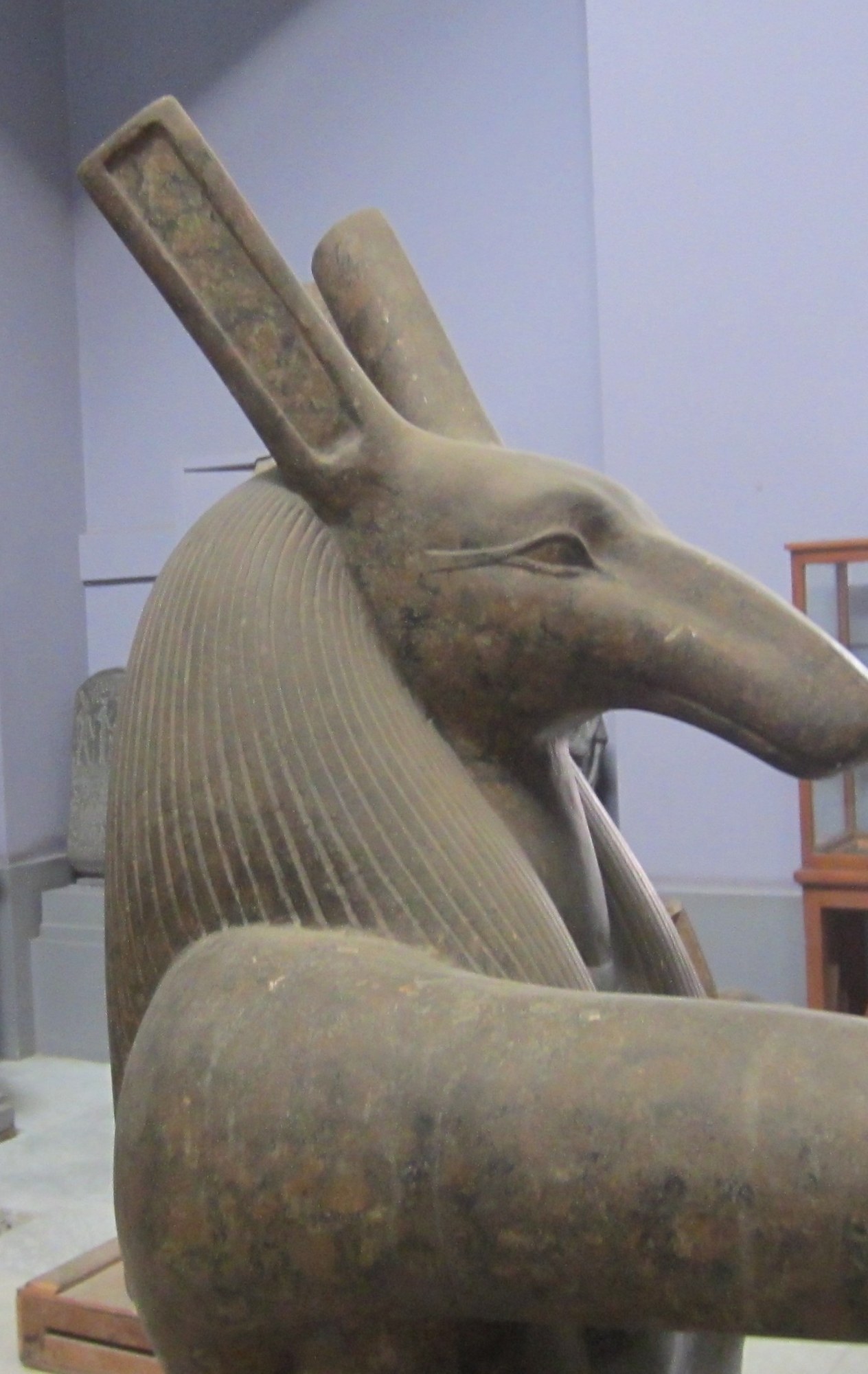
He was born wrong, and the manner of it told you everything you needed to know. He would not wait for the ordinary hour or the ordinary way. On the third of the five odd days that the year keeps outside its months, the child inside the sky-goddess tore an opening in her side and leapt out through the wound. That is how the Greek priest Plutarch, writing down the tradition more than two thousand years after Egypt first cut the god’s name in stone, remembers the coming of Set: not delivered but erupted, the first act of a life that would be one long refusal of order. His brother Osiris had been born first and gently, the good king. Set arrived like weather.
The Egyptians called him Swtẖ, Sutekh; the Greeks who came late to his country renamed him Typhon after their own storm-monster, and the swap did him a lasting injustice, because it flattened a complicated god into a single snarl of evil. He was the lord of the desert, the Red Land the Egyptians called deshret, the scorched waste that begins exactly where the black river-mud stops. He was the thunder in a dry sky, the sandstorm, the killing heat of the south wind that shrinks the Nile in its bed.
He was foreignness and violence and everything that would not stay in its place. Son of the earth-god Geb and the sky-goddess Nut, brother and eventually murderer of Osiris, husband of his sister Nephthys, rival of his nephew Horus. His city was Ombos in Upper Egypt, and the oldest texts name him plainly as Set of Ombos, the local power of a real place before he was ever the cosmic adversary.
Lifting the dead pharaoh toward the sky
And the oldest texts do not think he is simply evil. This is the part the later legend buries. In the Pyramid Texts, carved inside Old Kingdom tombs around the twenty-fourth century BCE and older by a full millennium than any connected story of his crimes, Set is also the king’s helper. He lifts the dead pharaoh toward the sky. His heart is said to fraternise with the risen king, to be at peace with him.
There is even a ladder of Set given to the dead so that he may climb into heaven, the storm-god’s own violence turned into a means of ascent. The Egyptians did not resolve this contradiction because they did not experience it as one. The desert both kills you and keeps the foreign armies out. The storm both wrecks and clears. Set was the necessary danger, the power you needed on your side precisely because it was terrible, and for most of Egyptian history he was worshipped, not exorcised.
Cast down at Nedit
Then there is the murder, and even the murder comes in two irreconcilable versions that the sources will not let us merge. The native Egyptian tradition is the older and the plainer. In the Pyramid Texts, Set kills Osiris at a named place called Nedit, and the killing is a felling: he casts his brother down on his side, throws him to the earth, and there in Nedit the stricken god lies until he stirs again. No box, no river, no scattering. Just one brother knocking the other to the ground at a particular spot the priests could name. That is the whole of it in the earliest sources, a murder with a location and no machinery.
A prize for whoever fit inside
The famous version, the one with the coffin, is Greek and a thousand years younger. Plutarch tells it as a plot worthy of a court intrigue. Set gathered seventy-two conspirators and a foreign queen named Aso, secretly measured his brother’s body, and had a beautiful ornamented chest built to those exact dimensions. At a banquet he offered it as a prize to whoever fit inside. Guest after guest tried and failed, because the box had been made for one man only, and when Osiris lay down in it the conspirators slammed the lid, drove home the nails, and sealed the seams with molten lead. They floated the coffin out to sea through the Tanitic Mouth of the Nile.
Later, when Isis had recovered the drifting chest, Set found the body again while hunting by moonlight, and this time he tore it into fourteen pieces and scattered them across the land. The one part never recovered was the phallus, thrown into the river and eaten by three fish. It is a vivid, elaborate, thoroughly Greek telling, and it is worth remembering that the fitted chest, the seventy-two plotters, the fourteen pieces and the number itself all belong to Plutarch. Egypt’s own texts give the felling at Nedit and the patient reassembly of the body, and they never count the pieces at all.
The torn-out eye against the wrenched-out manhood
What both traditions agree on is what came after: the war for the throne. Osiris dead, his son Horus grown, the two of them, uncle and nephew, went to law and to combat over the kingship of Egypt. The single most concrete image the ancient texts give of that struggle is a matched wound. Each combatant strikes the other’s signature part. Horus has moaned because of his eye, Set has moaned because of his testicles, the Pyramid Texts say, and the gods must act to bring Set his testicles back and to wrest the eye of Horus free of Set and return it to Osiris.
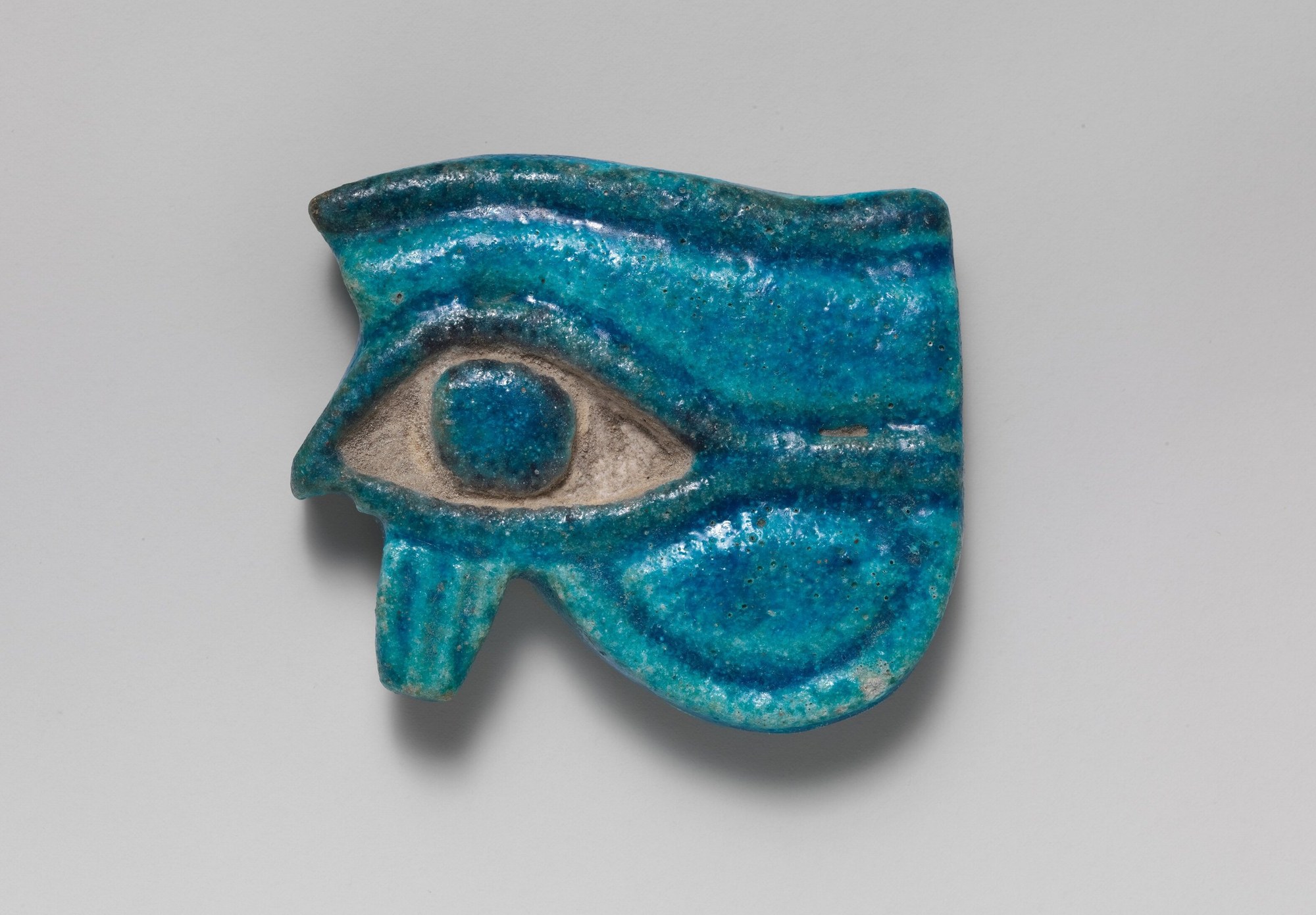
The torn-out eye against the wrenched-out manhood: the healed Eye of Horus would become the emblem of restored kingship and right order, while Set’s wound marks him as the power that must be checked, unmanned, brought to heel. In the New Kingdom tale known as the Contendings of Horus and Seth, the same dispute is fought out before the assembled gods, the Ennead, as a long series of contests. Horus wins them, and the kingship is his in the end.
An ass hurled over a cliff
So who was he, this red god? The later Egyptians and the Greeks after them made him the enemy of everything: drought, the barren sea, the salt the priests would not set on the table and called the spume of Typhon, the ass and the hippopotamus, the man with red hair and a complexion like the desert. At festivals they humiliated him, jeering at red-headed men and hurling an ass over a cliff. His demonisation was real, and it deepened as Egypt fell under foreign rule and the foreign god of foreigners became easy to hate.
But it was late, and it was partial, and it was never the whole truth. The Egyptians who cut his name into their oldest tombs knew a stranger god: violent and necessary, the storm that ruins and the storm that clears, the brother who murders and the strong arm that lifts the dead king to heaven. He was the god of disorder because a world without any disorder in it is a world that has stopped. They needed him. They feared him. They never quite decided, and that refusal to decide is the truest thing the sources preserve about Set.
“Horus has moaned because of his eye; Set has moaned because of his testicles.” (Pyramid Texts §594a, trans. Mercer)
- Pyramid Texts, c. 2350–2150 BCE (Old Kingdom mortuary spells), trans. Samuel A. B. Mercer, The Pyramid Texts (Longmans, Green & Co., 1952)the earliest attestation of Set as Osiris’s killer — the felling at Nedit (
cast him on his side,
§972b;felled him to the earth in Nedit,
§1256b; §1500a–b; §1699a); the Horus–Set mutual mutilation,Horus has moaned because of his eye; Set has moaned because of his testicles
(§594a), andmayest thou catch the testicles of Set
(§142b); Set conceived with Horus by Geb (§144b); the eyefree from Set
(§36a) andwrested from Set
(§39a); Set as royal helper who lifts the dead king (Horus carries N., Set lifts him up,
§1148a;the heart of Set fraternizes with thee,
§801c; §1016d) and theladder of Set
for the king’s ascent (§975a); and Set of Ombos / Hypselis (§1145b, §734d). Cited by canonical paragraph number. Public-domain full text on archive.org. - Plutarch, On Isis and Osiris (De Iside et Osiride), Moralia 351C–384C, c. 100 CE, trans. Frank Cole Babbitt, Loeb Classical Library vol. V (1936)the fullest connected narrative of the murder — the violent birth
with a blow he broke through his mother’s side
and the five epagomenal births (ch. 12, 355E–356A); the 72 conspirators, queen Aso, the fitted chest sealed with molten lead, the Tanitic Mouth, and the datethe seventeenth day of Athyr… in the twenty-eighth year
(ch. 13, 356B–357A); the dismemberment into fourteen parts and the phallus eaten bythe lepidotus, the sea-bream, and the pike
(ch. 18, 358A–B); Set red in complexion and hair, resembling an ass, the sacrifice of red cattle, salt asthe spume of Typhon,
the hippopotamus (ch. 22, 30–32, 359D–364A); and Set as drought and the scorching south wind that forces the Nilein retreat
(ch. 39, 366C–D). A late Greek, allegorising source that identifies Set with the monster Typhon; not an Egyptian text, and the connected chest-and-dismemberment plot survives only here. - The Contendings of Horus and Seth, Papyrus Chester Beatty I, Dynasty 20 (reign of Ramesses V, c. 1149–1145 BCE; from Thebes), ed. Alan H. Gardiner, The Library of A. Chester Beatty (Oxford, 1931); standard English translations Miriam Lichtheim, Ancient Egyptian Literature II (1976), and E. F. Wente in Simpson (ed.), The Literature of Ancient Egyptthe succession-contest myth — Horus and Set bring their rival claims before the Ennead, undergo a series of contests, and Horus is finally awarded the kingship. Summary consulted for the manuscript facts and plot outline; the individual contest episodes were not read verbatim here, and none of their wording or specific numbers is quoted.