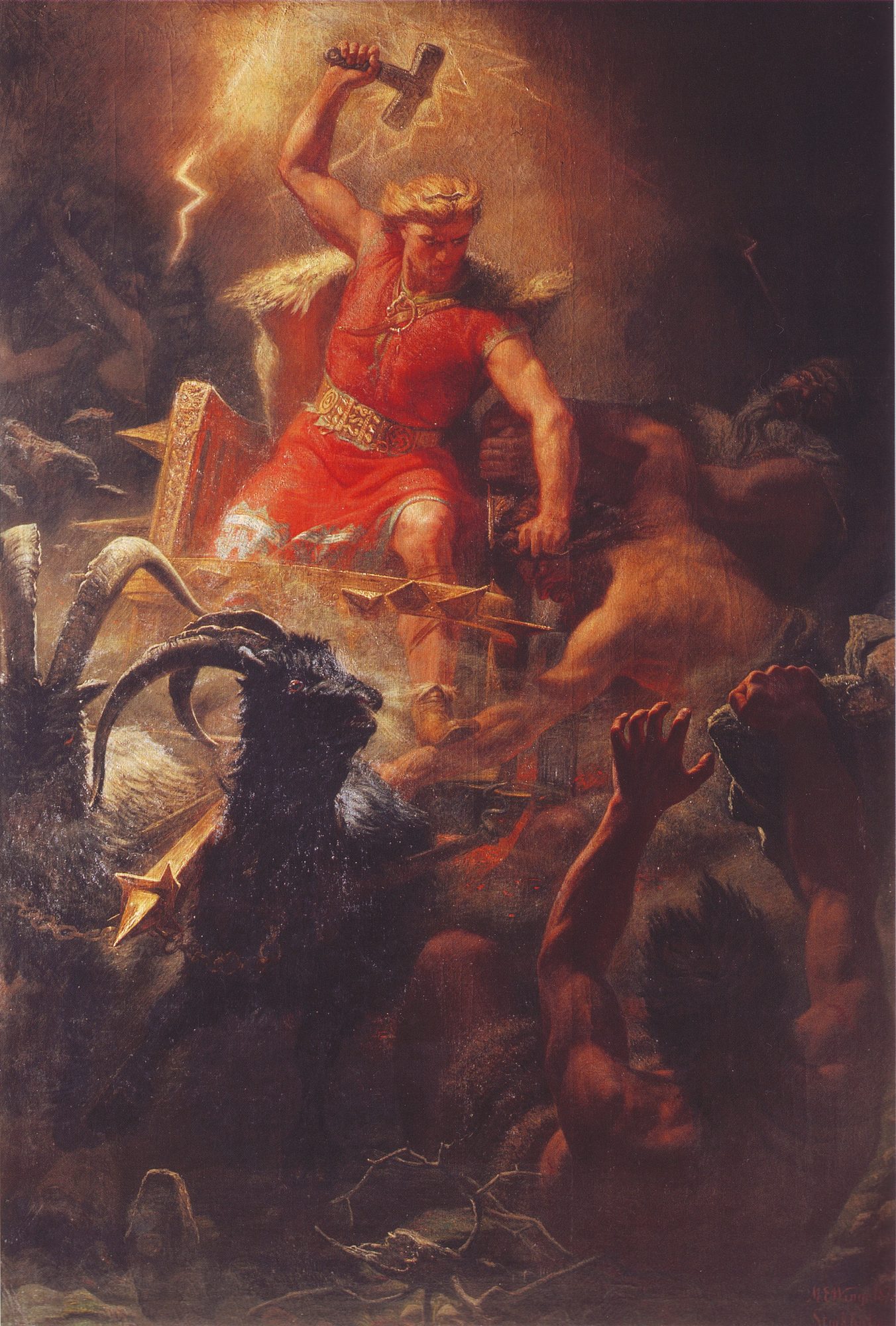
Wild is Vingthor when he wakes and finds his hand closing on nothing. The hammer is gone. He gropes for it in his beard and about the bed, and it is not there, and the strongest of all the gods and men feels something no giant has ever made him feel. His hair bristles; he shakes his beard. Mjöllnir is the thing the frost-giants and the hill-giants dread when it is raised on high, the thing that has bruised so many of their skulls, and it has been stolen out of the world while its owner slept. Somewhere it lies eight miles down, deep in the earth, and the giant who took it has already named his price. This is where the Norse imagination likes to put Thor: not enthroned above the storm, but robbed, furious, and about to be made ridiculous.
Three things of great price
He is the son of Odin and of Jörð, who is the Earth herself, and after his father he is the foremost of the Aesir, strongest of gods and men. His hall Bilskirnir is the greatest house anyone knows of, with five hundred rooms and forty. He keeps three things of great price. The first is the hammer. The second, better even than the hammer, is the girdle of might, Megingjörð, and when he buckles it on the godlike strength within him swells by half.
The third is a pair of iron gloves, and he cannot do without them when he grips the hammer-shaft. Two he-goats named Tooth-Gnasher and Tooth-Gritter draw his chariot, and he can kill and eat them at night and hallow their hides with the hammer in the morning so that they rise up whole, though one goes lame forever because a boy split a thigh-bone for the marrow. For that broken bone Thor took the farmer’s children, Thjálfi and Röskva, and they have followed him ever since.
That is the god who wakes to an empty hand. The theft is the work of the frost-giant Thrym, who sits on a burial-mound plaiting gold leashes for his hounds and combing the manes of his mares, and who will give the hammer back on one condition: he wants FreyjaThe goddess whom the giant Thrym demands as his bride in return for the hammer. for his wife. Freyja refuses so violently that her necklace, the BrísingamenFreyja's necklace, which bursts apart in her fury at the giant's demand., bursts from her throat, and the halls of the gods tremble.
Then Heimdall, the whitest of the gods, who can see what is coming, proposes the plan that no one else dares say aloud. Dress Thor as the bride. Bind the bridal veil on him and hang the Brísingamen at his neck, let the housewife’s keys rattle at his waist, put broad gems on his breast and a pretty cap on his head, and send him to Thrym’s hall in Freyja’s place.
They will call him unmanly
Thor’s answer is the funniest and most honest line in the poem. The gods, he says, will call him unmanly if he puts on a bridal veil. It is Loki who talks him round, warning that the giants will be living in Asgard within the hour if the hammer is not recovered, and Loki who goes along dressed as the bridesmaid. What follows is a comedy that never once forgets how dangerous its hero is.
At the feast the disguised Thor devours a whole ox and eight salmon and every delicacy laid out for the women, and washes it all down with three tuns of mead. Thrym recoils; no bride he has ever met eats like that. Loki, quick as ever, explains that Freyja has been so sick with longing for Thrym that she has not eaten for eight nights. When the giant stoops to steal a kiss under the veil he leaps back the length of the hall, crying that the bride’s eyes are terrible, that fire seems to burn out of them. The eyes, of course, are Thor’s.
Then the giant makes his mistake. To hallow the marriage he calls for Mjöllnir and lays it in the lap of his veiled bride. The heart in Hlorrithi’s breast laughs. He takes up the hammer, and the wedding becomes a slaughter: Thrym first, then all the folk of the giants, and last the giant’s sister who had come begging for the bridal fee and got an iron blow instead. So the son of Odin got his hammer back.
With an ox-head for bait
The hammer defines him, but so does the appetite, and so does the one enemy he can never quite finish. That enemy is the Midgard SerpentThe earth-encircling serpent, Thor's great adversary, who kills him at Ragnarök., the earth-encircling snake that lies coiled in the sea. In the Lay of Hymir, Thor rows out with the giant Hymir to fish, baiting his line with the torn-off head of a great black ox, and when the Serpent takes the hook he hauls it thrashing to the surface and smites the loathsome head from above with his hammer. Snorri tells it more fiercely still.
Thor braces so hard that both his feet go through the hull to the sea-bed; he drags the Serpent to the gunwale and glares fiery glances at it while it blows venom back at him, and he has the hammer raised to kill when the terrified Hymir cuts the line, and the Serpent sinks away. Whether it died that day the two Eddas do not agree, and Snorri says plainly that men tell it both ways; but the Serpent must live, because it is waiting for him at the end of the world.
What Gróa could not sing loose
His body already carries a souvenir of another duel. When the strongest of the giants, Hrungnir, a creature with a heart and head and shield of stone, met him in single combat and threw his whetstone as Thor threw the hammer, the two weapons met in the air. The hammer shattered the stone and split the giant’s skull, but a shard of the whetstone drove into Thor’s head and dropped him where he stood. A wise-woman named Gróa began to sing the sliver loose, until Thor, meaning kindly, gladdened her with news of her lost husband and she forgot her spell in her joy. The stone was never sung out. It stands in his head still.
One stride short of ten
And it will still be there on the last day. At RagnarökThe prophesied doom of the gods at the end of the world, when the old order falls and Thor slays the Serpent., Thor cannot come to his father’s aid against the wolf, because his hands are full: the Serpent has surfaced for the last time, and only he can meet it. He kills it. Then he walks nine paces from the place where it lies, exactly nine, and falls dead to the earth, poisoned by the venom the dying Snake has blown over him. The strongest of the gods dies on his feet, having killed the thing that killed him, one stride short of ten.
Wild was Vingthor when he awoke, / And when his mighty hammer he missed; / He shook his beard, his hair was bristling, / As the son of Jorth about him sought. (Þrymskviða 1, trans. Bellows)
- Poetic Edda, Þrymskviða (The Lay of Thrym) 1–33 (trans. Henry Adams Bellows, 1923; Wikisource, read verbatim)Thor wakes to find Mjöllnir stolen; the frost-giant Thrym has hidden it eight miles deep in the earth and demands Freyja as his bride; Freyja’s refusal bursts the Brísingamen from her neck; Heimdall proposes disguising Thor as the bride (veil, Brísingamen, keys, gems, cap); Loki overrules Thor’s objection and goes as bridesmaid; at the feast Thor eats an ox, eight salmon and every women’s dainty and drinks three tuns of mead, explained away as a fast of longing; the hammer is laid on the bride’s knees
to hallow
the marriage, whereupon Thor seizes it, kills Thrym first and then all the giants and the begging sister. - Poetic Edda, Hymiskviða (The Lay of Hymir) 1–40 (trans. Henry Adams Bellows, 1923; Wikisource, read verbatim)the gods need a kettle a mile deep to brew ale for Ægir’s feast; Thor and his companion fetch it from the giant Hymir, whose grandmother has nine hundred heads; Thor eats two of Hymir’s oxen at supper; on the fishing trip he baits with a black ox’s head, the Midgard Serpent takes it, and Thor smites the serpent’s head with his hammer from above (the outcome left ambiguous).
- Snorri Sturluson, Prose Edda, Gylfaginning XXI, XLIV, XLVIII, LI (trans. Arthur Gilchrist Brodeur, 1916; Wikisource, read verbatim)Thor as strongest of gods and men, son of Odin and of Jörð; his hall Bilskirnir of five hundred rooms and forty; his three treasures, the hammer Mjöllnir that the giants dread when raised on high, the girdle of might Megingjörð that doubles his strength, and the iron gloves; his goats Tanngnjóstr and Tanngrisnir, slaughtered and revived by hallowing their hides, one left lame, with Thjálfi and Röskva taken as recompense; the fuller fishing scene, in which Thor drives his feet through the boat, hauls up the Serpent, and is thwarted when Hymir cuts the line, with Snorri’s own doubt that the Serpent died; and Thor’s death at Ragnarök, slaying the Serpent and falling nine paces away, poisoned.
- Snorri Sturluson, Prose Edda, Skáldskaparmál IV and XVII (trans. Arthur Gilchrist Brodeur, 1916; Wikisource, read verbatim)the kenning-list naming Thor son of Odin and of Jörð, husband of Sif, father of Magni, Módi and Thrúdr, defender of Ásgard and Midgard and foe of the Midgard Serpent; and the duel with Hrungnir, the strongest giant, with his stone heart, head and shield and his whetstone weapon, beside the nine-mile clay giant Mökkurkálfi; the hammer shattering the hone and the giant’s skull while a shard lodges in Thor’s head; and Gróa, who begins to sing the shard loose but forgets her incantation, so that it
stands yet in Thor’s head
.