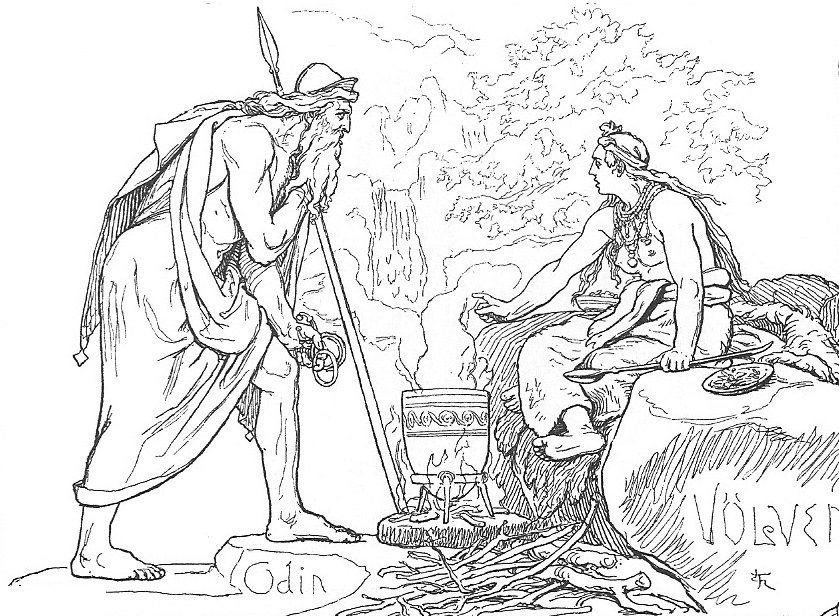
She is not alive, or not in the way the gods are. Odin has gone to a grave and called her up out of it, this wise-woman who remembers further back than any of them, and now she stands and demands a hearing before she will say a word. She asks it of the holy races, of Heimdall’s sons high and low, and she addresses the god who summoned her by one of his war-names, Valfather, father of the slain. She will relate the old tales she remembers of men long ago, and the god who already suspects how the world ends has raised the one witness who can tell him. What follows is the whole of it, spoken in the first person by someone who was there before there was anything: the making of the world, the gods’ own buried secrets, and then the fire.
Old tales from the giants of yore
She begins before the beginning, with what raised her. She remembers the giants of yore, the ones who gave her bread in the days gone by, and she remembers nine worlds and the great tree that holds them, its roots reaching down beneath the mould. This places her outside and beneath the gods’ own story, a creature of the older race looking in. Then she strips the scene bare.
There was an age when the primeval giant Ymir lived, and in that age there was no sea, no cool waves, no sand; earth had not been made, nor heaven above it, only a yawning gap and grass nowhere. The gap has a name, Ginnungagap, and it is the whole of what there was. Everything the seeress is about to describe has to be lifted out of that emptiness by hand.
Sun on the stones of a new land
The hands are the sons of Bur: Odin and his brothers Vili and Vé. They lift the level land out of the gap and raise Midgard, the middle enclosure, and the sun comes from the south and warms the stones of the earth so that the ground goes green with growing leeks. But the new-made sky is not yet ordered. The sun does not know where her hall is, the moon does not know his power, and the stars do not know their stations, so the gods take counsel and name the parts of time: night and morning, noon and evening and twilight, and they reckon the years.
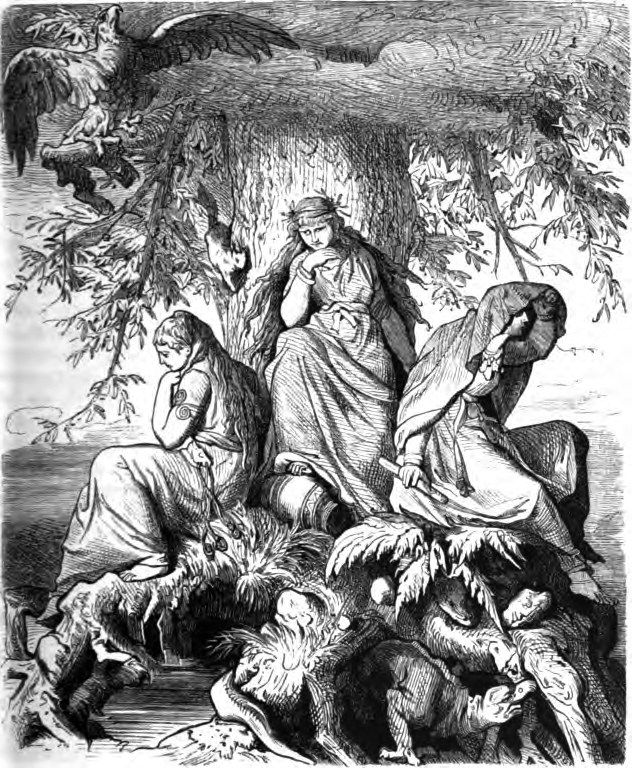
Then they gather at Ithavoll and build shrines and forges, work gold, and want for nothing, until three giant-maids come out of Jotunheim and the golden age is over. In this same first flush the gods shape the dwarfs and then find two trees on the shore, Ask and Embla, ash and elm, lying without fate. Odin gives them breath, Hœnir gives them sense, and Lothur gives them warmth and the flush of living colour. From beneath the world-ash by the well of Urth come three maidens, the NornsThe fate-maidens who shape the lives of men, the best known being Urðr, Verðandi and Skuld., and they cut the fates of men into wood: Urth for what is past, Verthandi for what is becoming, Skuld for what is owed.
A woman burned three times over
Now the seeress remembers a wound. There was a war, the first in the world, and its cause was a figure called Gullveig, gold-might, whom the gods met with spears and burned in the hall of the High One. They burned her three times and three times she was born again out of the ash, and the poem states the fact of it flatly: oft and again, yet ever she lives.
A wandering witch named Heith walks through the next lines, wide-seeing, a worker of charms, and the poem does not tell us whether she and Gullveig are one woman under two names. That silence is deliberate. What is certain is that Odin then hurls his spear out over the host, war breaks into the world, the wall that girdles the gods is broken, and the VanirThe Norse gods of fertility and prosperity; Njörðr, Freyr and Freyja are the ones the sources name most fully, and came among the Æsir by the settlement that ended the first war in the world., the rival race of gods, tread the field inside it. The gods sit in council over whether to pay tribute or share their worship, and the poem leaves the debate there, unfinished.
An eye pledged deep in Mimir’s well
This is where the seeress turns from the world’s secrets to Odin’s own, and she does it by naming the price he paid for foresight. She knows where his eye is hidden: deep in the wide-famed well of MimirKeeper of the well of wisdom under the world-tree, in whose water Odin's pledged eye lies hidden., and every morning Mimir drinks his mead from that pledge. Heimdall’s horn, the Gjallarhorn that will one day sound the last alarm, lies hidden under the bright tree as well.
These are not stories a god tells about himself gladly, and the seeress prises them out one by one until Odin, called Heerfather here, rewards her with necklaces and rings to keep her talking. She takes the payment and turns, and everything after this point is prophecy rather than memory. She sees the Valkyries mustered and ready to ride to the ranks of the gods. She has arrived at the future, and the future begins with a death.
The branch that seemed slender and fair
The death is Baldr’s, and it turns on the smallest thing in the poem. The mistletoe, the branch that seemed so slender and fair, becomes a harmful shaft, and the blind god Hoth hurls it, and Baldr the bleeding god falls. A brother one night old, unwashed and uncombed, comes to avenge him before he will rest, and Frigg weeps for her son in the marsh-halls of Fensalir. Then the seeress sees a captive in the wet woods, a lover of ill and to Loki like, with his wife Sigyn sitting at his side; she holds a basin against the venom that drips on him, and the Hauksbók manuscript makes the cruelty plainer still, saying he was bound with the entrails of his own son.
She counts off the halls of the damned: the corpse-strand Nastrond with its north-facing doors and its walls woven of serpents, where oath-breakers and murderers wade through venom rivers and the dragon Nithhogg sucks the blood of the slain. The refrain begins to toll under all of it now, one line she will return to like a bell: Garm howls before Gnipahellir, the fetters will burst, and the wolf run free.
Green from the waves again
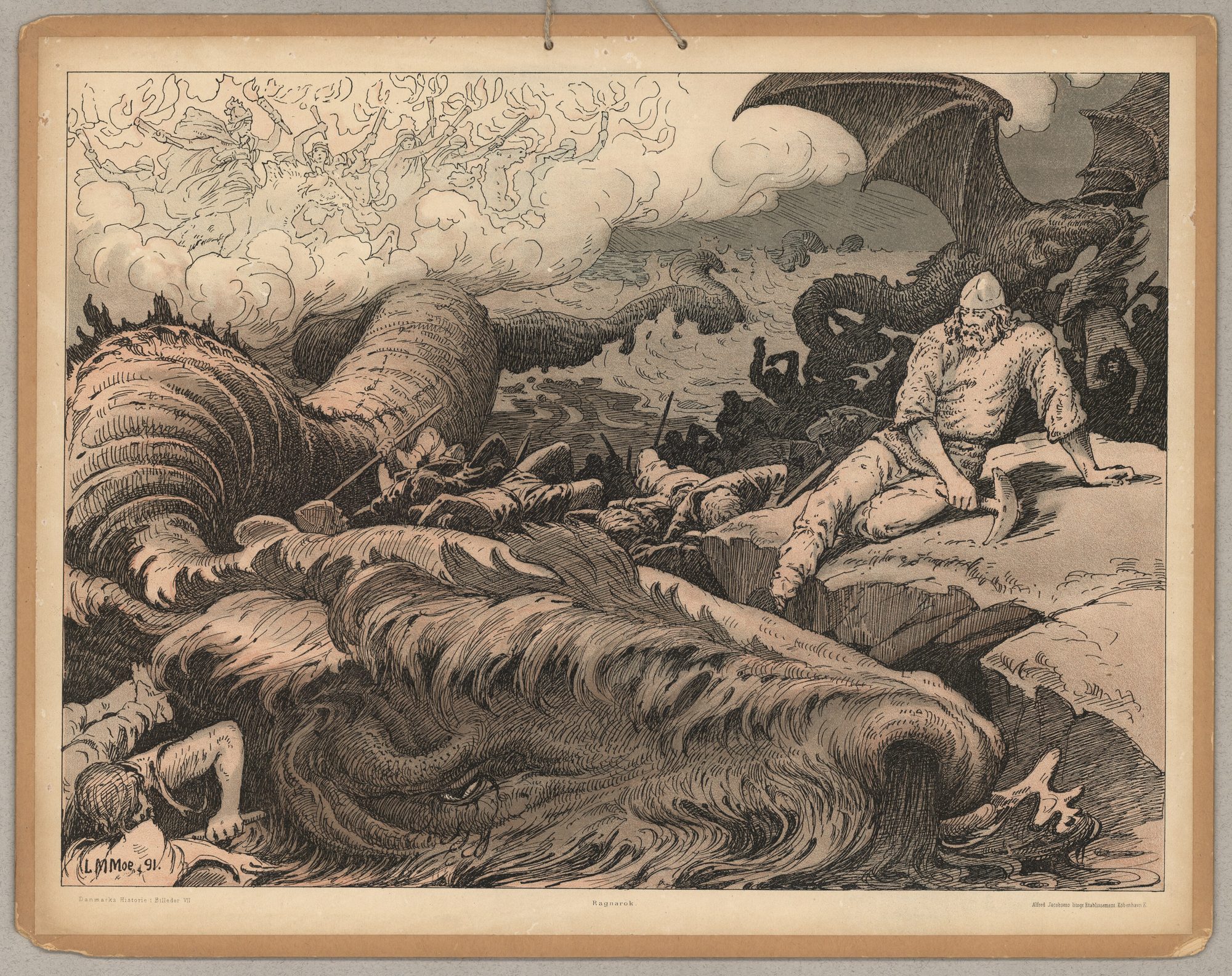
The end comes as a rising noise. A wolf steals the sun from the sky, storms gather, cocks crow the alarm from three worlds at once, and then brothers begin to kill each other for no cause the poem will name: an axe-time and a sword-time, a wind-time and a wolf-time, before the world goes down. Heimdall lifts the horn at last and blows, Yggdrasil shakes to its roots, and everything on the roads of HelThe Norse realm of the dead, ruled in Snorri's telling by Loki's daughter of the same name. begins to quake. Hrym steers up from the east; the Midgard-serpent churns the sea; the ship Naglfar, built out of the fingernails of the dead, breaks loose. Loki steers a ship of Hel’s people and Surt comes from the south with fire, his sword shining like the sun of the battle-gods, and the crags split and heaven itself is cloven.
Odin goes against the wolf Fenrir and falls, and his silent son Vithar drives a sword to the wolf’s heart to avenge him; Thor kills the Midgard-serpent and walks nine paces from its body before the venom drops him dead. Then the sun turns black, the earth sinks into the sea, the hot stars fall out of heaven, and fire leaps up around heaven itself. And after all of that the seeress sees the earth rise a second time, green from the waves again, an eagle fishing beneath its cliffs. The surviving gods gather once more at Ithavoll and find the golden game-boards they had owned in the days of old lying in the grass. Fields no one sowed bear ripe grain, all ills grow better, and Baldr comes home. Only then, her whole errand done, does she say she must sink, and as she goes the dark dragon Nithhogg rises from the crags below, bearing corpses on his wings.
Now do I see | the earth anew Rise all green | from the waves again; The cataracts fall, | and the eagle flies, And fish he catches | beneath the cliffs. (Völuspá 59, trans. Bellows, 1923)
- Poetic Edda, Völuspá (Codex Regius text, GKS 2365 4to, c. 1270), full poem, 66 stanzas (trans. Henry Adams Bellows, 1923,
Voluspo
; read verbatim)the base text of this retelling and the seeress’s entire recitation, in Codex Regius order — the yawning gap of Ginnungagap before creation; Bur’s sons (Odin, Vili, Vé) lifting the land and raising Midgard while the sun greens the ground; the ordering of time and the golden age at Ithavoll broken by the three giant-maids; the shaping of the dwarfs and of Ask and Embla, given soul, sense and hue by Odin, Hœnir and Lothur; the Norns Urth, Verthandi and Skuld cutting fate beneath Yggdrasil; the first war and the thrice-burning of Gullveig (oft and again, yet ever she lives
); Odin’s eye pledged in Mimir’s well and the hidden Gjallarhorn; the death of Baldr by the mistletoe shaft and the one-night-old avenger; Loki bound with Sigyn at his side; the hell-hall Nastrond and Nithhogg; and the whole march of Ragnarök to the earth risen green again, the golden game-boards found in the grass, and Baldr’s return. - Poetic Edda, Völuspá (Hauksbók text, AM 544 4to, c. 1300), variant version (documented via Bellows’ collation notes)differs materially in stanza order and in specific lines. Load-bearing here: at st. 35 Hauksbók replaces the opening couplet with
I know that Vali his brother gnawed, / With his bowels then was Loki bound
, making explicit that Loki was bound with his own son’s entrails; its refrain (st. 44) reads its third lineFarther I see and more can say
against Regius’sMuch do I know, and more can see
; and it gives the golden-tables stanza (st. 61) differently. Hauksbók also omits sts. 28–34, 36 and 37 and reorders several blocks. This piece follows Codex Regius, which Bellows judgesmore logical
. - Snorri Sturluson, Prose Edda (Gylfaginning), c. 1220 (read here via Bellows’ notes paraphrasing Snorri, not from Snorri direct)supplies the surrounding prose that Bellows’ apparatus leans on — Baldr’s death by the overlooked mistletoe; the binding of the wolf Fenrir with the fetter Gleipnir and the price of Tyr’s right hand; Loki bound with his son’s entrails while Sigyn holds a basin against the serpent’s venom; and Ask and Embla as the first man and woman shaped from trees. Snorri also quotes many of these stanzas, which is part of how their text is anchored.
- Henry Adams Bellows (trans.), The Poetic Edda, American-Scandinavian Foundation, 1923,
Voluspo
, pp. 1–27the translation actually read for this piece, whose stanza-by-stanza critical apparatus collates Codex Regius, Hauksbók and Snorri and flags the interpolations — the dwarf-catalogue (sts. 10–16) asclearly interpolated
and themighty lord from on high
(st. 65) asprobably spurious
and absent from Regius. All Anglicised spellings here (Othin
,Mithgarth
,Nithhogg
,Voluspo
) are Bellows’; proper names have been normalised to their conventional English forms for the retelling.