First there is a killing season, and then there is a winter that will not end. Before the world falls, brothers turn on brothers and sisters’ sons stain their kinship with blood, and the old prophecy names the age in four hard strokes: an axe-time, a sword-time, a wind-time, a wolf-time, before the world goes down. Snorri sets a chronology under the verse. First come three years of great wars in which men slay each other for gain, and then the Fimbul-winter arrives: snow driving from every quarter, frost so severe and winds so keen that there is no joy in the sun, and it comes three times over, three winters running with no summer between them. The world does not end in a single stroke of fire. It is starved and frozen and turned against itself first, and only then does the sky begin to break.
The name has been softened over the centuries into a twilight of the gods,
a dying fall, a dimming of the lights. That is a later colour, closer to Wagner than to the Norse. The old words ragna rök mean the doom or the fate of the powers, the reckoning owed to the gods, and it is worth keeping the harder sense. This is not a slow dusk. It is a foretold, appointed ending that the gods have known about all along and can do nothing to stop.
Stars hurled from their places
The unmaking begins in the heavens. Two wolves that have chased the sun and moon across the sky since the beginning finally run them down: one devours the sun, the other swallows the moon, and the stars are hurled from their places. Then the ground itself gives way. The earth and the mountains shake so violently that trees are torn up by the roots and the peaks topple, and in that heaving every bond and fetter in the world snaps at once.
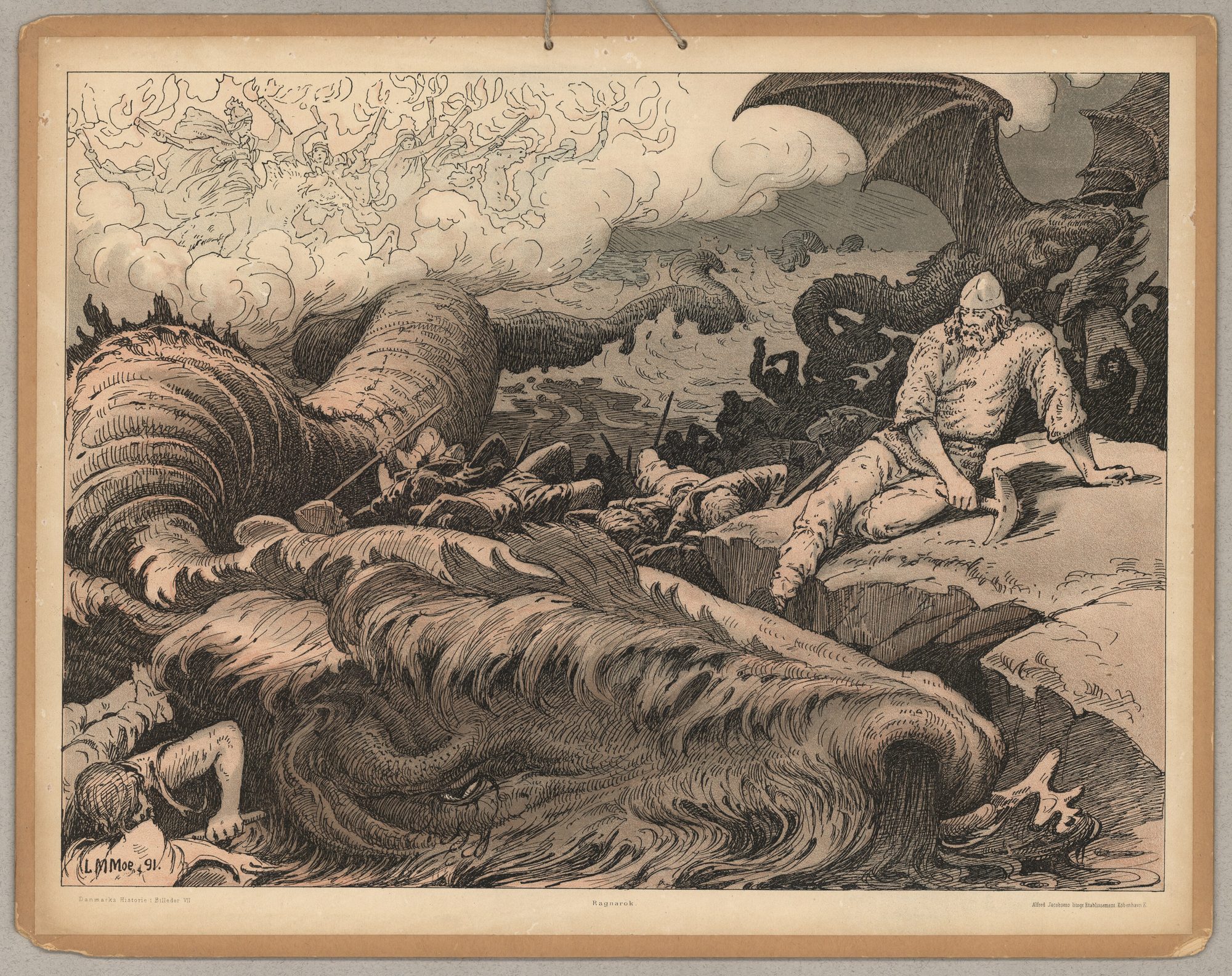
This is the moment the whole doom has been waiting for, the line the old poem keeps tolling like a bell: the fetters will burst, and the wolf runs free. Fenrir is loose. His lower jaw is on the earth and his upper jaw reaches to heaven, and he would gape wider still if there were room; fire flashes from his eyes and nostrils as he comes.
Timber of uncut nails
The muster of the doomed is under way, and it comes by sea. The Midgard-serpent, the world-encircling snake, thrashes toward the shore in a giant’s fury, flooding the land and spewing venom that fouls the air and the water alike. A ship works loose from its moorings, and it is the most dreadful vessel in the North: Naglfar, built from the uncut nails of the dead.
This is why the old telling warns that a man who dies with unpared nails supplies its timber, a ship both gods and men wish to see finished as late as possible, because when it sails the end has come. It is steered by the frost-giant Hrym. A second ship of the dead comes on with the people of HelThe Norse realm of the dead, ruled in Snorri's telling by Loki's daughter of the same name. aboard, and here the two great sources part ways on a small point: the poem has it sail from the north with Loki at the helm, while the stanza Snorri quotes brings it from the east with the hosts of Muspell. North or east, the ship is the same, and so is its cargo.
Bifröst shatters under the riders
Then the sky itself is torn in two. Through the opening ride the sons of Muspell, the fire-giants, and at their head comes Surt with fire burning before him and behind, wielding a sword that shines brighter than the sun. As that host gallops out across Bifröst, the rainbow bridge that joined the worlds to heaven, the bridge shatters to pieces under them. High above, Heimdall the watchman stands and blows the Gjallarhorn with all his strength, and the blast wakes every god; on the roads of Hel the dead quake to hear it.
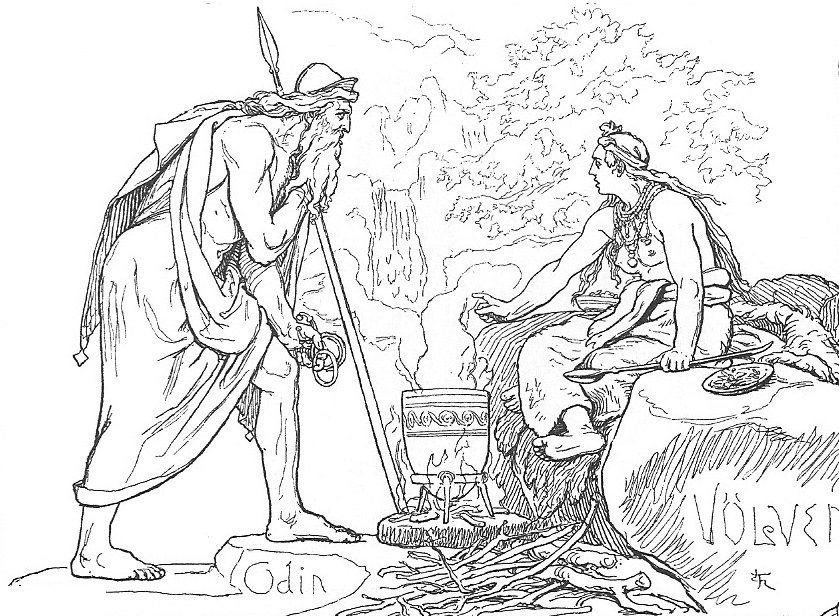
Odin rides to Mímir’s well to seek one last counsel, and the great ash Yggdrasil groans and shudders to its roots, so that nothing in heaven or on earth is free of fear in that hour. All the hosts are converging now on one place, a plain called Vigrid, and it is vast beyond reckoning: a hundred miles on every side, room enough for the whole of creation to come to grief.
Each god matched with his killer
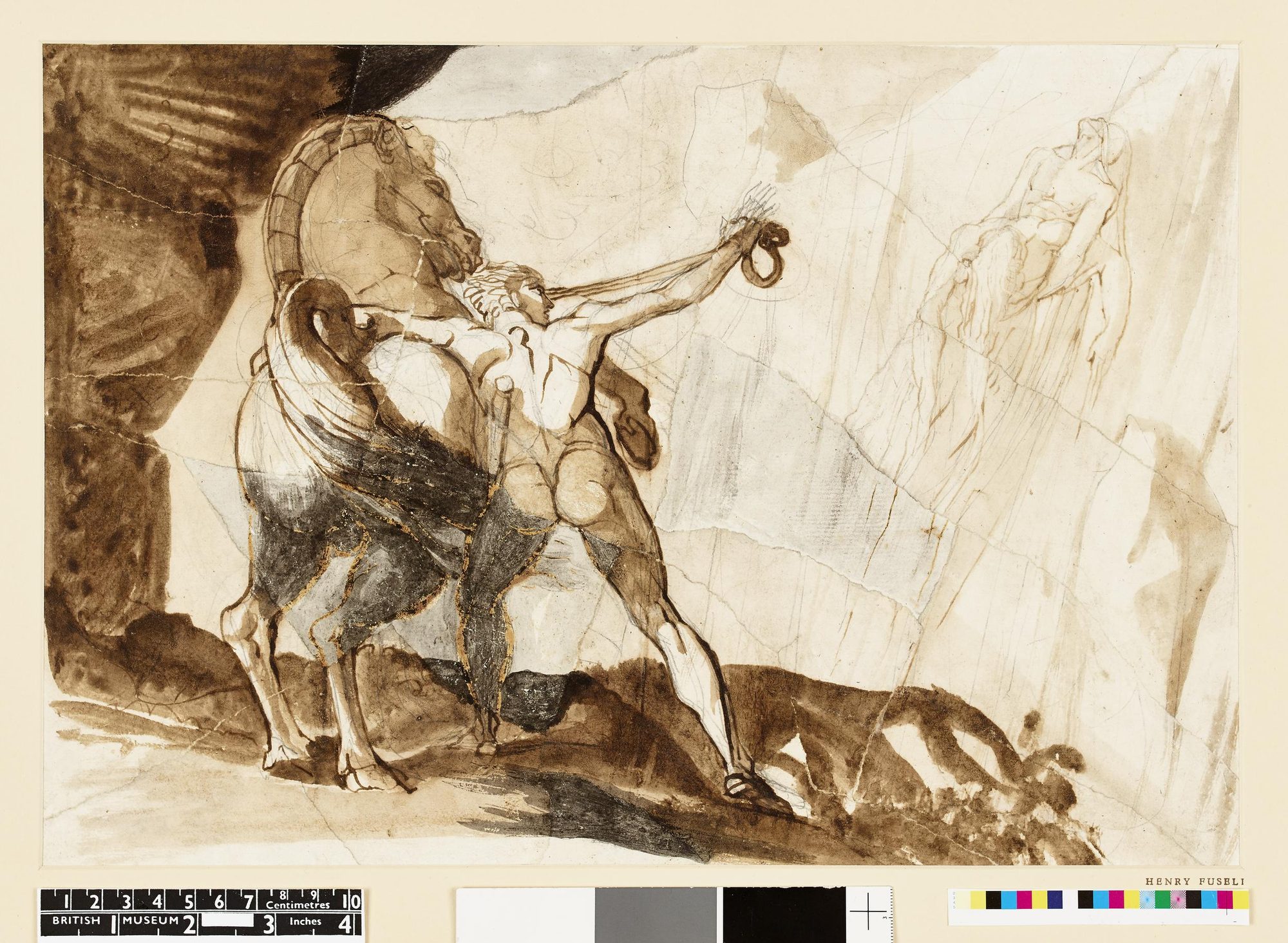
What follows on that field is not a melee but a set of appointed single combats, each god matched with the thing fated to kill him. Odin rides out first in his gold helm with the spear Gungnir, straight for the wolf, and the wolf swallows him: the joy of Frigg falls, and the highest of the gods is gone in a single gulp of those heaven-and-earth jaws. His son Vidar turns at once and avenges him. He sets one foot on the wolf’s lower jaw, a foot shod in a shoe cobbled together through all the ages from the leather scraps that men cut from their own shoes and cast aside, then seizes the upper jaw in his hand and tears the beast’s mouth apart, and so Fenrir perishes. Close by, Thor meets the Midgard-serpent, the old enemy.
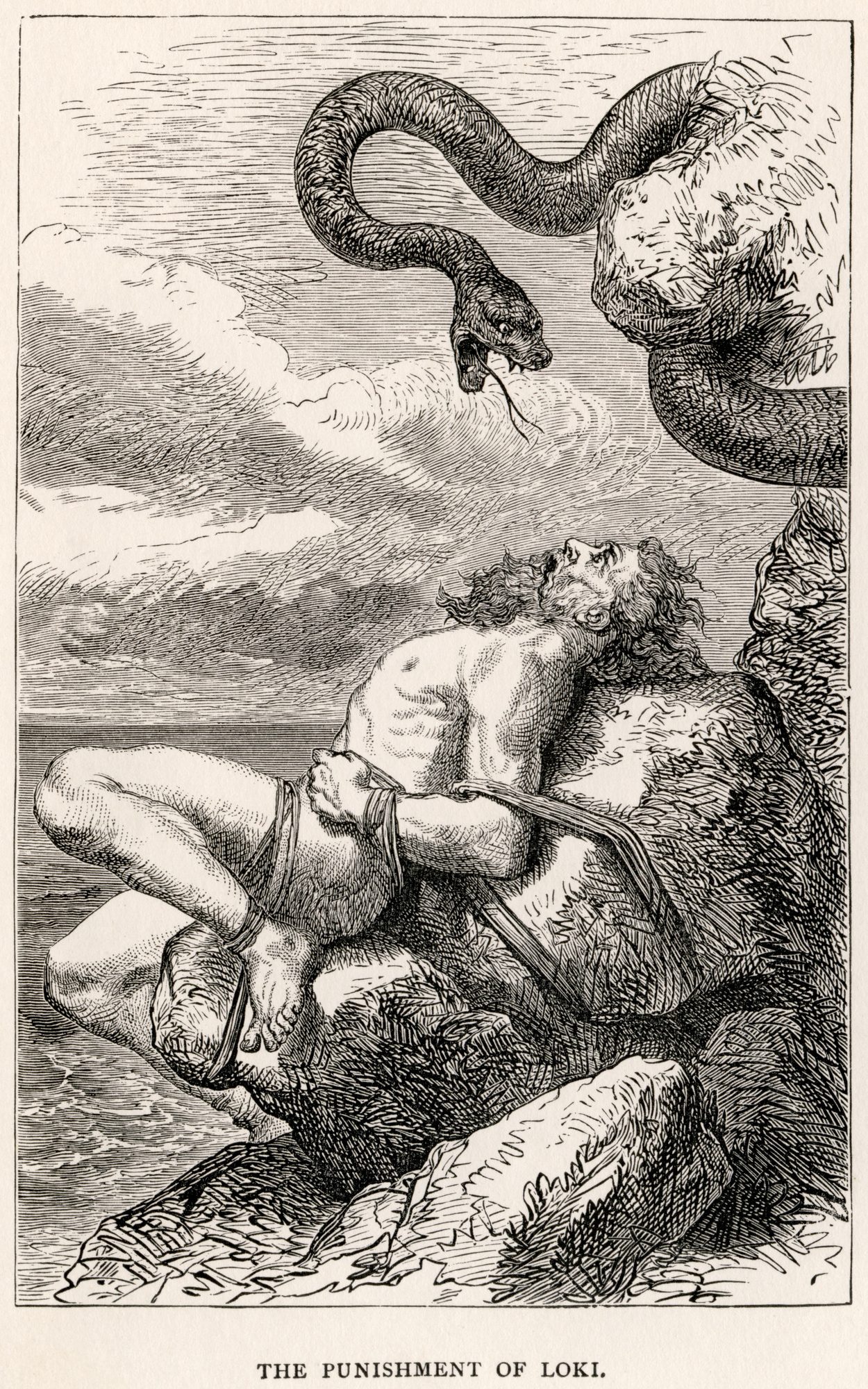
He kills it, and he wins great renown for the killing, but the serpent’s venom is already in him: he walks nine paces from the dead coils and falls, and no more. Frey faces Surt and trades heavy blows before he goes down, undone by an old bargain, because he no longer has the good sword he gave to Skírnir. The god Tyr and the hound Garm, loosed from his cave, close on each other and both die of it. Loki and Heimdall, watchman and traitor, meet at the last and kill each other too. And when the gods are down, Surt does the thing he came to do: he flings his fire out over the whole earth and burns up the world. The sun turns black, the earth sinks into the sea, the hot stars fall from heaven, and flame leaps high about the sky itself.
Golden game-pieces in the new grass
That should be the end, and in most doom-tales it would be. What sets the Norse vision apart is that the seeress keeps looking, past the fire, into what comes after. She sees the earth rise a second time out of the water, green again and fair, and the unsown fields bearing their harvests of themselves. The gods who were fated to survive gather where Asgard once stood: Vidar and Vali, whom neither the sea nor Surt’s fire could harm, and Thor’s sons Modi and Magni, who inherit their father’s hammer Mjölnir.
Up out of Hel come Baldr and his brother Höd, the murdered god and the blind hand that killed him, returned together to a world that has burned away the old grievances. The survivors find, lying in the tall new grass, the golden game-pieces that the gods had owned in the ancient days, as though the toys of a lost childhood had been left out overnight and found again in the morning. Snorri’s account is fuller and more orderly than the poem’s here, laying out who lives and who returns; the poem foregrounds Baldr’s coming-back, the tables in the grass, and a hall roofed with gold, fairer than the sun, standing on Gimlé, where the righteous shall dwell forever.
Fed on nothing but morning dew
And humankind is not finished either. Through all the burning, two people lie hidden in a place called Hoddmimir’s-holt, a man and a woman, Lif and Lifthrasir. They feed on nothing but the morning dew, and they come out into the washed and greening world to become the parents of a race so numerous that their children fill the whole earth again. Even the sun has left an heir: before the wolf caught her, she bore a daughter as fair as herself, and this daughter now rides her mother’s road across the reborn sky.
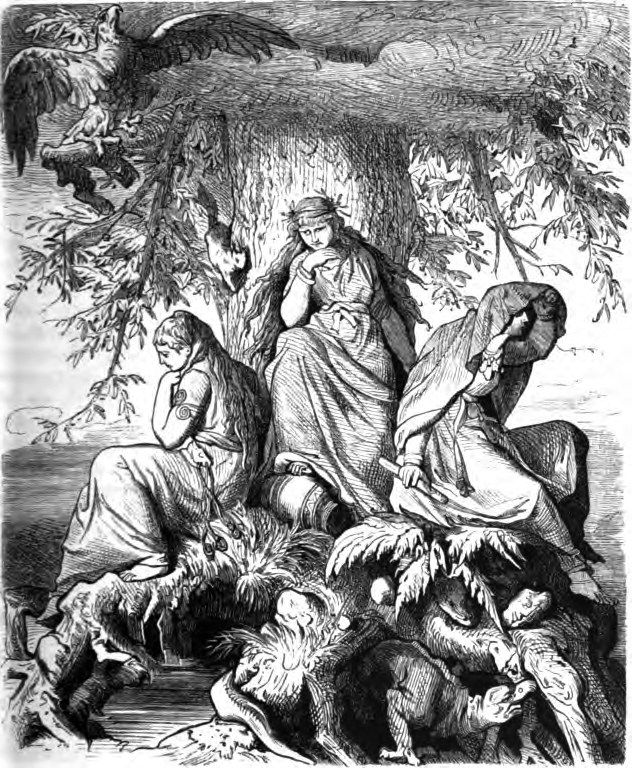
The prophecy that opened on brothers killing brothers closes on a new sun, a green earth, and a golden hall. But the seeress does not let us leave on pure light. Her last vision, as she sinks back down out of sight, is of a dark dragon rising: Níðhöggr, flying up from the black cliffs of Niðafjöll with the bodies of the dead borne on his wings. The world is remade, and something old and hungry still moves under it.
Now do I see | the earth anew / Rise all green | from the waves again; / The cataracts fall, | and the eagle flies, / And fish he catches | beneath the cliffs. (Völuspá 59, trans. Bellows)
- Poetic Edda, Völuspá (
The Wise-Woman’s Prophecy
) 44–66 (trans. Henry Adams Bellows, The Poetic Edda, American-Scandinavian Foundation, New York 1923; Project Gutenberg #73533, read verbatim)the primary poetic account of the doom, narrated by the völva who sees the whole vision. The doom-refrainNow Garm howls loud before Gnipahellir, the fetters will burst, and the wolf run free
(44, repeated 49 and 58); the age of moral collapse,Brothers shall fight and fell each other… Axe-time, sword-time… Wind-time, wolf-time, ere the world falls
(45); Heimdall raising the Gjallarhorn aloft so that all who are on Hel-roads quake (46), and Yggdrasil groaning (47); the corpse-gnawing eagle and Naglfar loose (50); the ship from the north with Loki at the helm (51); Surt faringfrom the south with the scourge of branches
, his sword shining likethe sun of the battle-gods
(52); Odin faring to fight the wolf and the fall ofthe joy of Frigg
(53), and Vidar thrusting his sword to the wolf’s heart to avenge his father (54); Thor,the son of Fjorgyn
, stepping nine paces and sinking, slain by the serpent (56);The sun turns black, earth sinks in the sea… Till fire leaps high about heaven itself
(57); the earth rising anew, green from the waves (59); the golden tables found in the grass (61); Baldr’s return,Baldr and Hoth dwell in Hropt’s battle-hall
(62); Gimlé, the hallmore fair than the sun, roofed with gold
, where the righteous dwell (64); and the closing image ofNithhogg flying from Nithafjoll
, bearingthe bodies of men on his wings
as the seeress sinks (66). - Snorri Sturluson, Prose Edda, Gylfaginning, chs. XV–XVII (Anderson’s numbered §§55–58,
Ragnarok
andRegeneration
; the sun-and-moon wolves at §11/ch. XII) (trans. Rasmus B. Anderson, The Younger Edda, Chicago 1880; Project Gutenberg #18947, read verbatim)the systematized prose narrative that supplies the chronology and the fullest survivor roster. The three years of war,Brothers slay each other for the sake of gain
, and the three Fimbul-winters,when snow drives from all quarters… there is no joy in the sun… three such winters in succession, without any intervening summer
; the wolf thatdevours the sun
and the other that willdevour the moon
, and the starshurled from heaven
; the earthquake in whichall bonds and fetters will be broken and snapped
andthe Fenris-wolf gets loose
, his gape from heaven to earth withfire flashes from his eyes and nostrils
; the Midgard-serpent thatvomits forth venom, defiling all the air and the sea
; Naglfar,made of the nails of dead men
, steered bythe giant Hrym
; Surt andthe sons of Muspel
, before and behind whom burns fire, his swordbrighter than the sun
, breaking Bifröst as they ride; Heimdall whoblows with all his might in the Gjallar-horn
; Odin ridingto Mimer’s well to ask advice
; the plainVigrid… one hundred miles (rasts) on each side
(Snorri quoting Vafthrúdnismál 18); the paired duels —The wolf swallows Odin, and thus causes his death
; Vidar who sets a foot on the nether jaw andrends asunder his mouth
; Thor whoretreats only nine paces… poisoned by the venom
; Frey who falls to Surt for want ofthat good sword which he gave to Skirner
; Garm and Tyr whokill each other
;Loke fights with Heimdal, and they kill each other
; and thenSurt flings fire over the earth and burns up all the world
; the regeneration — the earth thatrises again from the sea, and is green and fair
, thefields unsown
thatproduce their harvests
, Vidar and Vali unharmed bythe sea nor Surt’s fire
,Mode and Magne
with Mjölnir,Balder and Hoder from Hel
, the golden tableswhich the asas once had
,Lif and Lifthraser
who feedon the morning dew
in Hoddmimer’s-holt (§58, quoting Vafthrúdnismál 45), and the sun’s daughter whorides in the heavenly course of her mother
(§58, quoting Vafthrúdnismál 47). - Vafthrúdnismál (
the Lay of Vafthrudner
), stanzas 18, 45, 47 (read only as quoted within Snorri’s Gylfaginning 55–58, not from the standalone poem in the Poetic Edda)Vigrida hundred miles it is every way
(18); Lif and Lifthrasir who survive Surt’s fire andfeed on the morning dew
(45); the sun’s daughter,born of the sun ere Fenrer takes her
, who rides her mother’s course (47). The wording is reliable as Snorri’s embedded text; if these are to be cited directly by Vafthrúdnismál stanza, re-verify against Bellows before printing exact lines.