He is the best-looking creature in the hall and the worst company in it. The Icelandic sources are careful to tell you both things at once: Loki is beautiful and comely to look upon, and evil in spirit, very fickle in habit, and he outstrips every other god in the kind of cunning they call sleight, with an artifice ready for any occasion. He is reckoned among the Aesir, sits at their benches, eats at their feast, and Snorri hands him the least flattering introduction any god receives. He is the mischief-monger of the Aesir, the first father of falsehoods, the blemish of all gods and men. Nothing about him is stable except the pattern he cannot break: he brings the gods into great hardship, and then gets them out of it again with crafty counsel. Aid and ruin, from the same hand, over and over.
The brood he got on Angrboða
His blood is mixed from the start. His father is the giant Fárbauti; his mother is Laufey, sometimes called Nál; his brothers are Býleistr and Helblindi. He has a wife among the gods, faithful SigynLoki's faithful wife, who holds the basin that catches the venom dripping over her bound husband., and a son by her, Nari or Narfi. But the children that matter to the doom of the world he fathered with the giantess AngrboðaThe giantess of Jötunheim who bears Loki's monstrous children, among them the wolf Fenrir. in Jötunheim, and they are monsters. The gods, warned by prophecy that great misfortune would come from this brood, did not wait.
They flung the serpent into the deep sea, where it grew until it lay coiled round all the land and bit upon its own tail. They cast Hel down into the mist to rule the dead of sickness and old age, half her body flesh-coloured and half blue-black. And the third child, the Fenris-Wolf, they bound. Every one of those precautions is also a countdown. The father of these three has, in a sense, already fathered the end.
A foal with eight feet
Even his gifts to the gods arrive by disaster. When a giant builder wagered to raise the wall of Asgard, it was Loki who had talked the gods into letting the mason use his great stallion SvaðilfariThe giant builder's stallion, whose tireless hauling of stone all but completes the wall of Asgard., and Loki who watched in horror as the horse hauled stone so fast the work was nearly won.
So he fixed his own advice the only way he could: he turned himself into a mare, lured the stallion off into the woods, and later gave birth to a grey, eight-legged foal, the horse Sleipnir, the best among gods and men, which became Odin’s own mount. This is the whole shape of him in a single episode. The problem is his fault, the solution is his body, and the profit is enormous.
The pattern holds through his best-remembered rescues. He once cut off all of Sif’s golden hair for sheer mischief, and Thor nearly throttled him when he saw what he had done, so Loki went down to the dwarfs called Ívaldi’s Sons, who spun new golden hair and made besides the ship Skíðblaðnir and the spear Gungnir. Then, not content, he wagered his own head that the dwarf Sindri could not match those three. He lost. While Sindri’s brother Brokkr worked the bellows, Loki turned himself into a fly and bit the smith at his labour, but the dwarf held the metal true and forged the boar Gullinbursti, the ring Draupnir and the hammer Mjöllnir, whose handle came out short only because the fly had stung his eyelid until the blood ran.
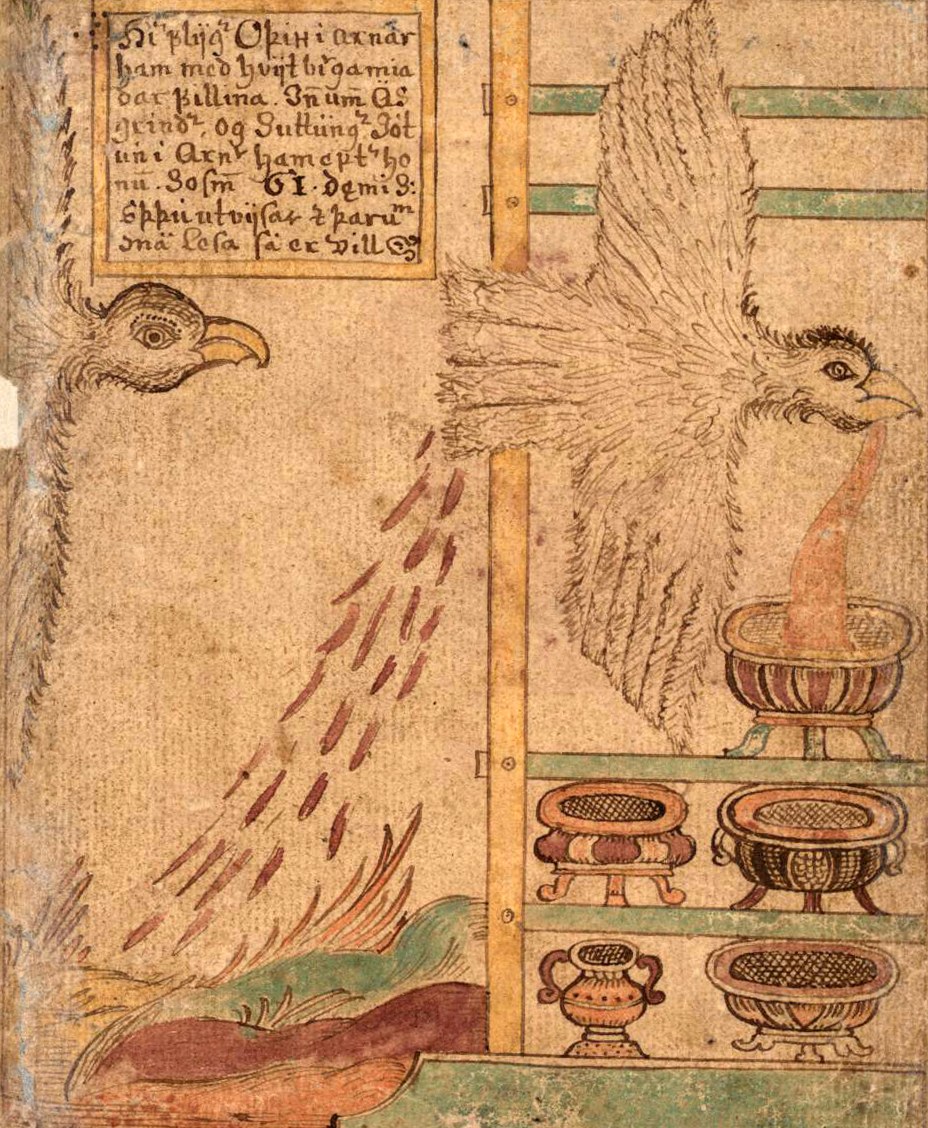
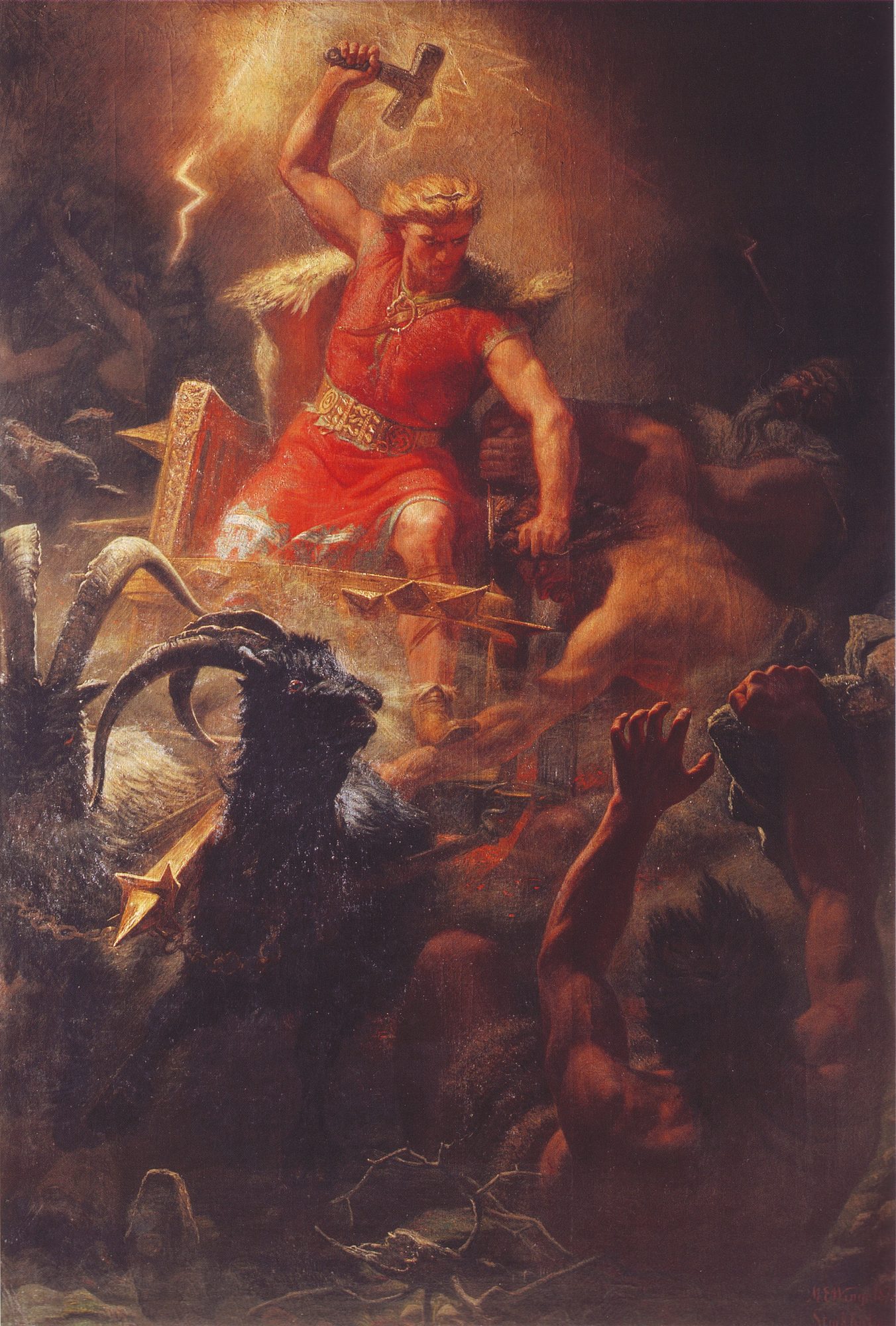
Mjöllnir was judged the finest treasure of the six, and the wager was lost. Loki escaped losing his neck all the same, so the dwarfs sewed his lips shut instead with a thong called Vartari, which he promptly tore out. When the giant Thjazi, in eagle-shape, blackmailed him into luring IðunnThe goddess who keeps the age-staying apples; while she is away the gods grow grey and old. and her age-staying apples out of Asgard, and the gods went grey and old without them, it was Loki again, under threat of death, who put on Freyja’s borrowed hawk-feathers, flew to Jötunheim, turned Iðunn into a nut and carried her home a wingbeat ahead of the burning eagle. And when Thrym stole Mjöllnir, it was Loki who found out where and devised the ruse of dressing Thor as a bride to get it back. The gods cannot do without him. That is precisely the trap.
The shaft put in a blind hand
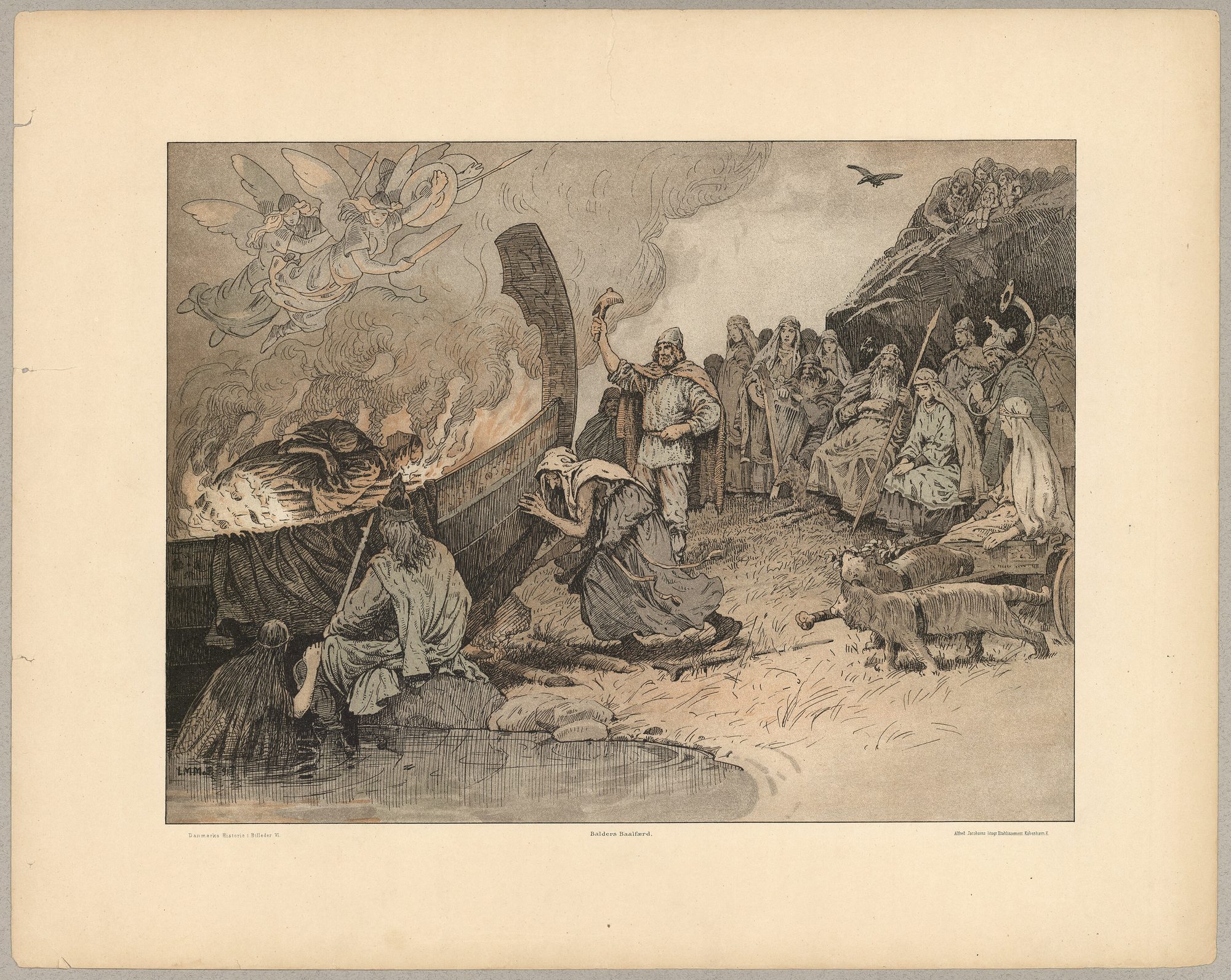
Because the same ingenuity turns, and when it turns it is lethal. Frigg had gone through the whole world exacting an oath from every thing not to harm her son Baldr, and skipped only the mistletoe, thinking it too young to swear. Loki, in a woman’s shape, coaxed that one omission out of her, cut a shaft of the plant, and put it in the hand of the blind god Höðr at the games where the gods were amusing themselves by hurling harmless things at the invulnerable Baldr.
The shaft flew through Baldr, and he fell dead. It was, Snorri says, the greatest mischance that has ever befallen among gods and men, and Loki compounded it: when all creation was asked to weep Baldr out of Hel, one giantess refused, and men reckon she was Loki. At Ægir’s feast he went further still, killing the serving-man Fimafeng and then standing in the doorway to slander every god and goddess present, promising to mix venom into their very mead.
A salmon in Fránangr-Falls
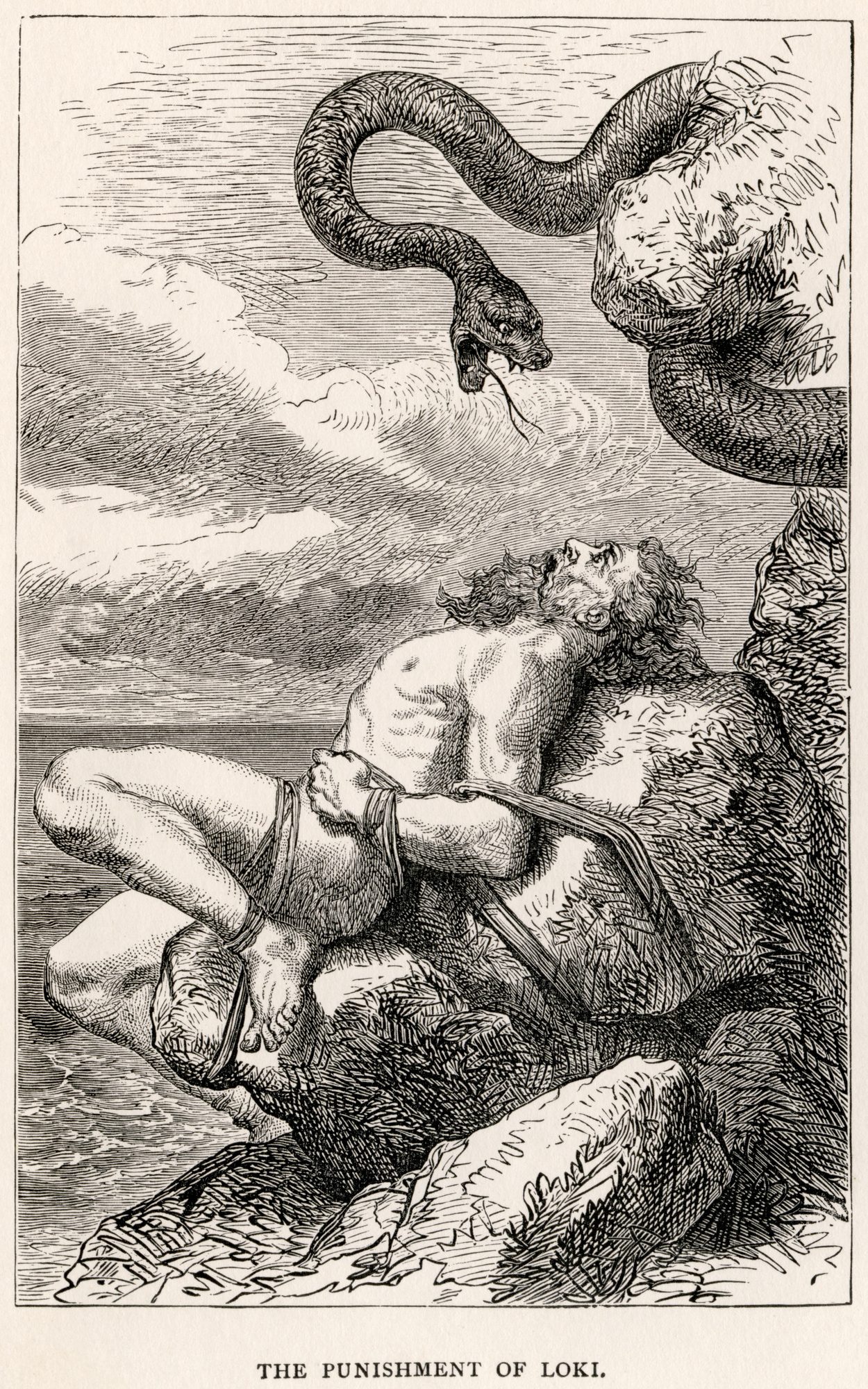
For that the gods finally ran him down. He had fled and hidden as a salmon in Fránangr-Falls; they caught him, and the vengeance was made to fit the man. He was bound across three stones with the entrails of his own son, and a venom-snake was fixed above his face to drip.
Here the traditions split, and the split is worth keeping: Snorri says the gods turned the son Váli into a wolf to tear apart his brother Narfi, and bound Loki with Narfi’s guts, while the Poetic Edda reverses the roles, binding him with Váli’s bowels and making Narfi the wolf. What both agree on is Sigyn. His faithful wife stands over him holding a basin to catch the poison, and only when she turns aside to empty it does the venom strike his face, and he writhes so hard that the whole earth shakes. That, the story says, is what an earthquake is.
Steering Naglfar to the last battle
He lies there until the world ends, and then he is loosed for the ending. At Ragnarök Loki breaks his bonds and steers Naglfar, the ship built from dead men’s uncut nails, bringing all the champions of Hel to the last battle. There he meets Heimdallr, the watchman he had mocked at the feast, and the two of them kill each other. It is a fitting close for the blemish of gods and men: the trickster who made himself indispensable, whose cunning saved the gods from a dozen ruins, spends his freedom at the finish leading the enemy against them, and dies with the door-warden of heaven, each the slayer of the other.
Bale and hatred I bring to the gods, / And their mead with venom I mix. (Lokasenna 3, trans. Bellows)
- Snorri Sturluson, Prose Edda, Gylfaginning XXXIII–XXXIV, XLII, XLIX, L and §§426–427 (trans. Arthur Gilchrist Brodeur, 1916; Wikisource, read verbatim)Loki’s nature as the mischief-monger of the Aesir who brings hardship then rescue; his parentage from the giant Fárbauti and Laufey (Nál), with brothers Býleistr and Helblindi, wife Sigyn and son Nari/Narfi; the three monstrous children by Angrboða and the gods’ pre-emption of them; the mare-shape and the birth of eight-legged Sleipnir off the stallion Svaðilfari; Baldr’s death by the mistletoe guided into blind Höðr’s hand,
the greatest mischance that has ever befallen among gods and men
; the salmon-capture at Fránangr-Falls, the binding over three stones with a son’s entrails, Sigyn’s venom-catching basin and the earthquake etiology; and the loosing at Ragnarök, Naglfar of dead men’s nails, and the mutual slaying of Loki and Heimdallr. - Snorri Sturluson, Prose Edda, Skáldskaparmál XVI (§380) and XXXV (§§911–913), with §§9–13 (trans. Arthur Gilchrist Brodeur, 1916; Wikisource, read verbatim)the Loki kenning-catalogue (Foe of the Gods, Contriver of Baldr’s Death, the Bound God, Wrangling Foe of Heimdallr); the coerced theft and hawk-plumage recovery of Iðunn’s age-staying apples from the eagle-giant Thjazi; and the shearing of Sif’s hair, the head-wager, the six treasures forged by Ívaldi’s Sons and by Sindri with Brokkr at the bellows, the biting fly that leaves Mjöllnir’s handle short, and the lips sewn with the thong Vartari.
- Poetic Edda, Lokasenna (trans. Henry Adams Bellows, 1923; voluspa.org, read verbatim)Ægir’s hall lit by glittering gold, the killing of the serving-man Fimafeng, Loki’s expulsion and return to revile every god and goddess in turn, his self-declaration that he brings bale and venom, and the closing prose on the salmon-capture and binding (in which he is bound with Váli’s bowels and Narfi becomes a wolf, the roles reversed from Snorri).
- Poetic Edda, Þrymskviða 1–5, 16–20 (trans. Henry Adams Bellows, 1923; voluspa.org, read verbatim)
the son of Laufey
borrowing Freyja’s feather-dress, uncovering Thrym’s theft of Mjöllnir, and contriving the bride-disguise recovery of the hammer, attending Thor himself as the serving-maid. - Poetic Edda, Völuspá 31–35 (trans. Henry Adams Bellows, 1923; voluspa.org, read verbatim)the mistletoe that kills Baldr, the one-night-old Váli who avenges him, and the oldest surviving image of Loki bound in the wet woods with Sigyn seated beside him.