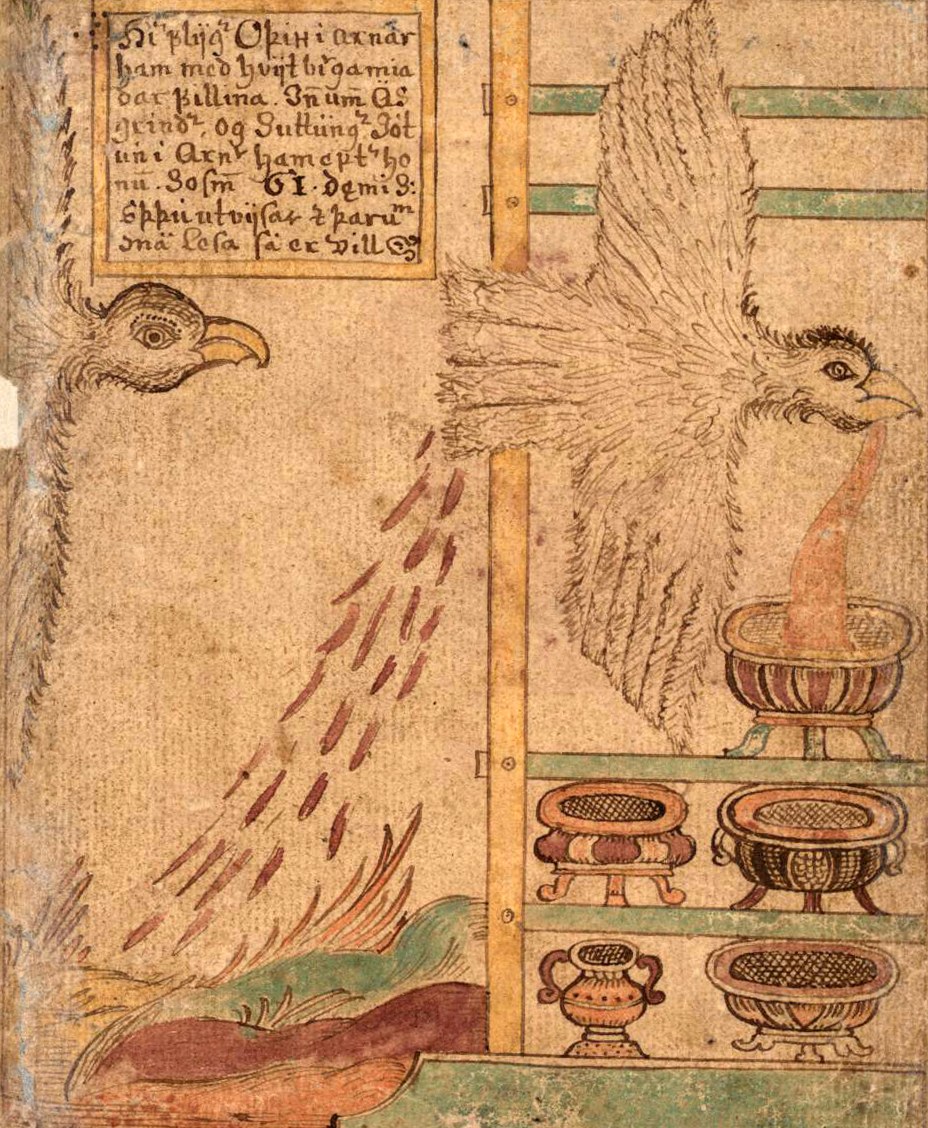
There is a woman under a mountain, sitting on a golden stool, and she is the last thing standing between a disguised god and the thing he has crossed the world to steal. Her name is Gunnlöð, and what she guards is a mead so potent that a single mouthful makes a poet of whoever swallows it. Odin has already killed nine men to reach this room. He has laboured a whole summer under a false name, turned himself into a snake to wriggle through the rock, and now he lies down beside her for three nights, because the price of the mead is her. This is the Norse account of where poetry comes from, and it is not a pretty origin. It begins in a jar of spit and ends in a betrayed girl and a crude joke, and the god at the centre of it is a liar and a thief who happens also to be the patron of every skaldThe Old Norse word for a poet, one who composes the verse the mead inspires. who ever strung a verse.
Blood of the wisest man
To understand what the mead is, you have to go back to a truce. The oldest gods, the Æsir and the Vanir, had fought and then made peace, and to seal it every one of them spat into a single vat. Rather than let that token of goodwill go stale, they took the spittle and shaped it into a living man, KvasirThe wisest being ever made, shaped from the gods' truce-spittle and murdered by the dwarfs for his blood., the wisest being that ever was; no question could be put to him that he could not answer, and he wandered the world teaching.
Two dwarfs, Fjalar and Galar, invited him aside and murdered him. They drained his blood into two jars and a kettle, mixed it with honey, and brewed from it the mead that whoever drinks from it becomes a skald and sage.
Then they told the gods that Kvasir had choked on his own wisdom, there being no one clever enough to keep exhausting his knowledge. Poetry, in this telling, is quite literally the blood of the wisest man who ever lived, drawn off by his killers and cut with honey.
The dwarfs were not finished being murderers. They took a giant named Gilling out to sea, capsized the boat, and let him drown because he could not swim; then, home again, Fjalar killed Gilling’s wife by dropping a millstone on her head as she passed under the door, being tired of her weeping. That was a murder too many.
Gilling’s son Suttung caught the pair, rowed them out, and left them on a skerry that the tide would swallow. To buy back their lives they handed over the mead. Suttung carried it home, hid it deep inside a rock called HnitbjörgThe mountain in which Suttung hides the mead, set under his daughter's guard., and set his daughter Gunnlöð to keep it. So the drink brewed from Kvasir’s blood passed from its makers to the giants, locked in a mountain, waiting.
Nine scythes and one whetstone
Odin wanted it, and the way he went about getting it is a small masterclass in the kind of cunning the Norse called wickedness to its face. He came first on nine thralls mowing hay for Suttung’s brother Baugi, offered to hone their scythes with a whetstone off his belt, and sharpened the blades so keenly that all nine wanted to buy the stone. He threw it into the air.
In the scramble to catch it the nine men swung their scythes and cut one another’s throats. Then Odin, calling himself Bölverk, which means Evil-Doer, went to Baugi, who had just lost his entire workforce, and offered to do the work of nine men through the summer for a single drink of Suttung’s mead. Baugi warned him he had no say over the mead, but agreed to ask. When winter came and the work was done, Suttung refused flatly. Not a drop.
Beside Gunnlöð on the golden stool
So Bölverk produced an auger called Rati and had Baugi bore into the mountain. Baugi tried to cheat, boring most of the way and blowing the chips inward to fake a finished hole, but Odin blew into the bore and the chips flew back in his face, and he made the giant drill clean through. Then he turned himself into a serpent and slid into the hole. Baugi stabbed after him with the auger and missed.
Inside was Gunnlöð on her golden stool, and here the poem that Odin himself narrates lingers where the prose hurries. Rati made room for my passage, and space in the stone he gnawed; above and below the giants’ paths lay, so rashly I risked my head.
He slept three nights with her, and for each night she granted him a draught. In three swallows he emptied all three vessels, ÓðrœrirThe kettle among the three vessels holding the mead, drained in Odin's three draughts. and Boðn and Són, and drank the mountain dry.
The share of poetasters
Then he became an eagle and beat for home. Suttung saw, took eagle-shape himself, and gave chase. The Æsir, watching the two birds come, hauled their vats out into the courtyard, and Odin reached the wall and spewed the mead down into them. But Suttung was close behind, and in his haste some of the mead escaped through his rear, and this portion he did not trouble to save.
It is free to anyone, and it is called the share of poetasters: the origin, the story says with a straight face, of bad poetry. The good mead Odin kept, and gave to the gods and to those men who can make verse. That is why the Norse called poetry Odin’s prey, Odin’s find, Odin’s drink, the drink of the Æsir.
A harsh reward for a heroic heart
It would be neat to leave it there, on the joke. The poem will not let you. Snorri’s prose is an adventure with a punchline, but the older, terser version in the Hávamál is spoken by Odin in the first person and remembers a cost the prose forgets entirely. This Odin swore an oath on his sacred ring and broke it.
Who now his troth shall trust?
he asks, and answers himself: he sought Suttung’s ruin with drink, and Gunnloth to grief he left.
He does not spare himself the girl on the golden stool. A harsh reward did I let her have for her heroic heart, and her spirit troubled sore.
The theft that gave humankind its poetry was also a seduction and a broken vow, and the god who profited from it is the one who tells you so.
The two witnesses do not, in fact, tell the same story, and it is worth saying plainly. The whole back-story of Kvasir and the dwarfs, the millstone and the skerry, survives only in Snorri; the Hávamál never mentions Kvasir at all, and opens with the mead already in Suttung’s keeping. The name Óðrœrir slips between meanings, a kettle in Snorri and the mead itself in one stanza of the poem.
Even the dwarf Fjalar shares his name with a figure the poem’s translator reads as Suttung. The tidy single narrative that most retellings give, Snorri’s plot fused with the poem’s guilt, is a modern editorial marriage of two sources that never quite agree. What they do agree on is the shape of the thing: that poetry came into the world stolen, brewed from a murder, and carried off by a god who left a grieving woman behind him in the dark of the mountain.
On his ring swore Othin the oath, methinks; / Who now his troth shall trust? / Suttung’s betrayal he sought with drink, / And Gunnloth to grief he left. (Hávamál 110, trans. Bellows)
- Snorri Sturluson, Prose Edda (Younger Edda), Skáldskaparmál,
The Origin of Poetry
(Bragi to Ægir) §§3–6 (trans. Rasmus B. Anderson; Project Gutenberg eBook 18947, read verbatim)the full connected narrative — the Æsir–Vanir truce sealed by spittle and shaped into the sage Kvasir; the dwarfs Fjalar and Galar who murder him and brew the mead from his blood and honey; the drowning of the giant Gilling and the millstone dropped on his wife; Suttung’s tide-skerry ransom and the hiding of the mead in Hnitbjörg under Gunnlöð’s guard; Odin as the labourer Bölverk, the thrown whetstone and the nine self-slain thralls, the bargain with Baugi, the auger Rati and the serpent-passage; the three draughts draining the three vessels Óðrœrir, Boðn and Són; and the eagle-flight, the spewing into the vats, and the share of poetasters. - Poetic Edda, Hávamál 13–14, 104–110, 140–141 (trans. Henry Adams Bellows, 1923; Project Gutenberg eBook 73533, read verbatim)Odin’s terse first-person telling, which never names Kvasir and begins with the mead already Suttung’s — the drink given
on a golden stool
, Rati thatmade room for my passage
andspace in the stone he gnawed
, the ring-oath sworn and broken, and the confessed guilt,a harsh reward
let to Gunnlöðfor her heroic heart
, whomto grief he left
.