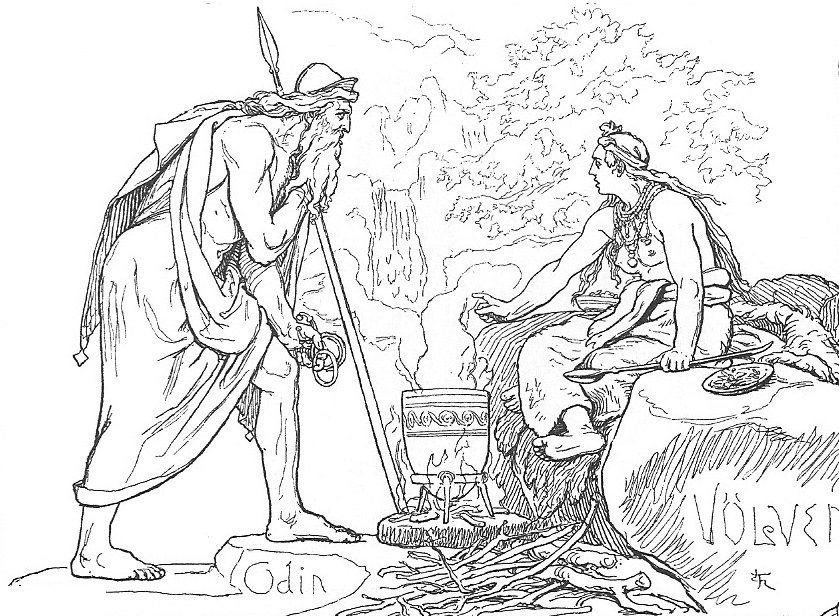
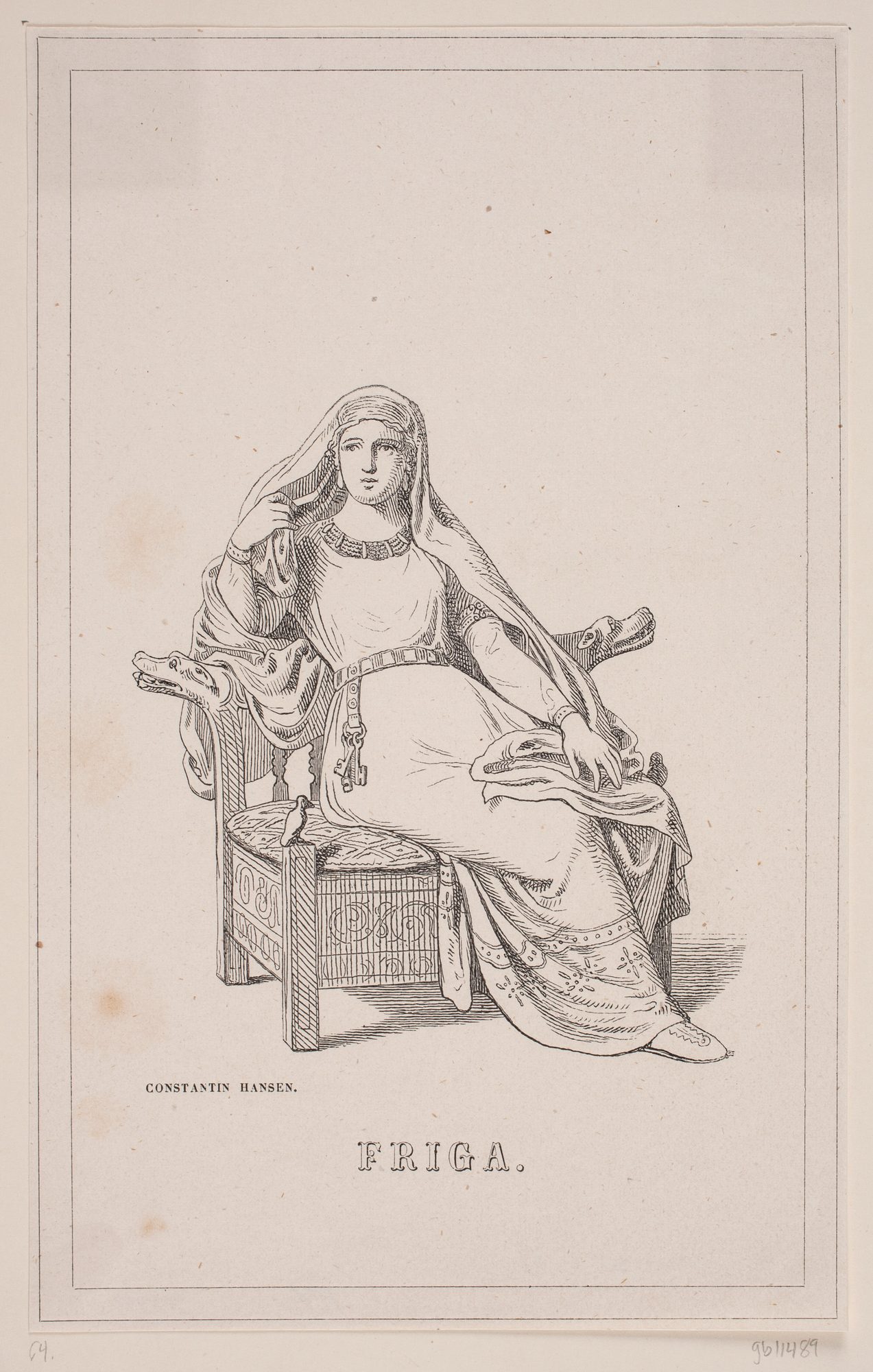
She knows how it ends, and she says nothing. Not out of cruelty, and not out of calm, but because that is simply the shape of her: Odin himself says of his wife that she knows the fate of all men, though she tells it not, and when the trickster Loki wants to wound her at the feast it is her own kinswoman Freyja who throws the same line back like a warning, that the fate of all does Frigg know well, though herself she says it not. Twice in the sources, from an admiring husband and from a rival goddess, the north agrees on the one thing that defines her. She is the queen who carries every ending inside her and keeps them all sealed behind her teeth.
Confidences kept, errands run between worlds
Frigg is Odin’s wife and the first of the goddesses, the AsynjurThe Norse goddesses as a group, of whom Snorri ranks Frigg and Freyja highest., and Snorri gives her the lordliest dwelling among them, a hall called FensalirFrigg's hall, whose name means 'Fen-halls' or 'sea-halls', where she weeps for Baldr., the Fen-halls or sea-halls. She is the daughter of Fjǫrgynn, and no mother is named for her anywhere in the old poems. Around her moves a small court that tells you what kind of power she keeps. Her handmaid FullaFrigg's handmaid, who carries her chest, tends her shoes and knows her secrets. goes with her hair flowing and a golden band about her head, carries Frigg’s chest, tends her shoes, and knows her secrets.
Her messenger Gná she sends on errands into the various worlds on a horse named Hofvarpnir that runs through the air and over the sea, so that onlookers cry out, what flies there, what fares there, what glides in the air? Hers is a household of confidences kept and errands run between worlds, a queen of hidden knowledge served by maidens who guard it.
An oath from fire and iron
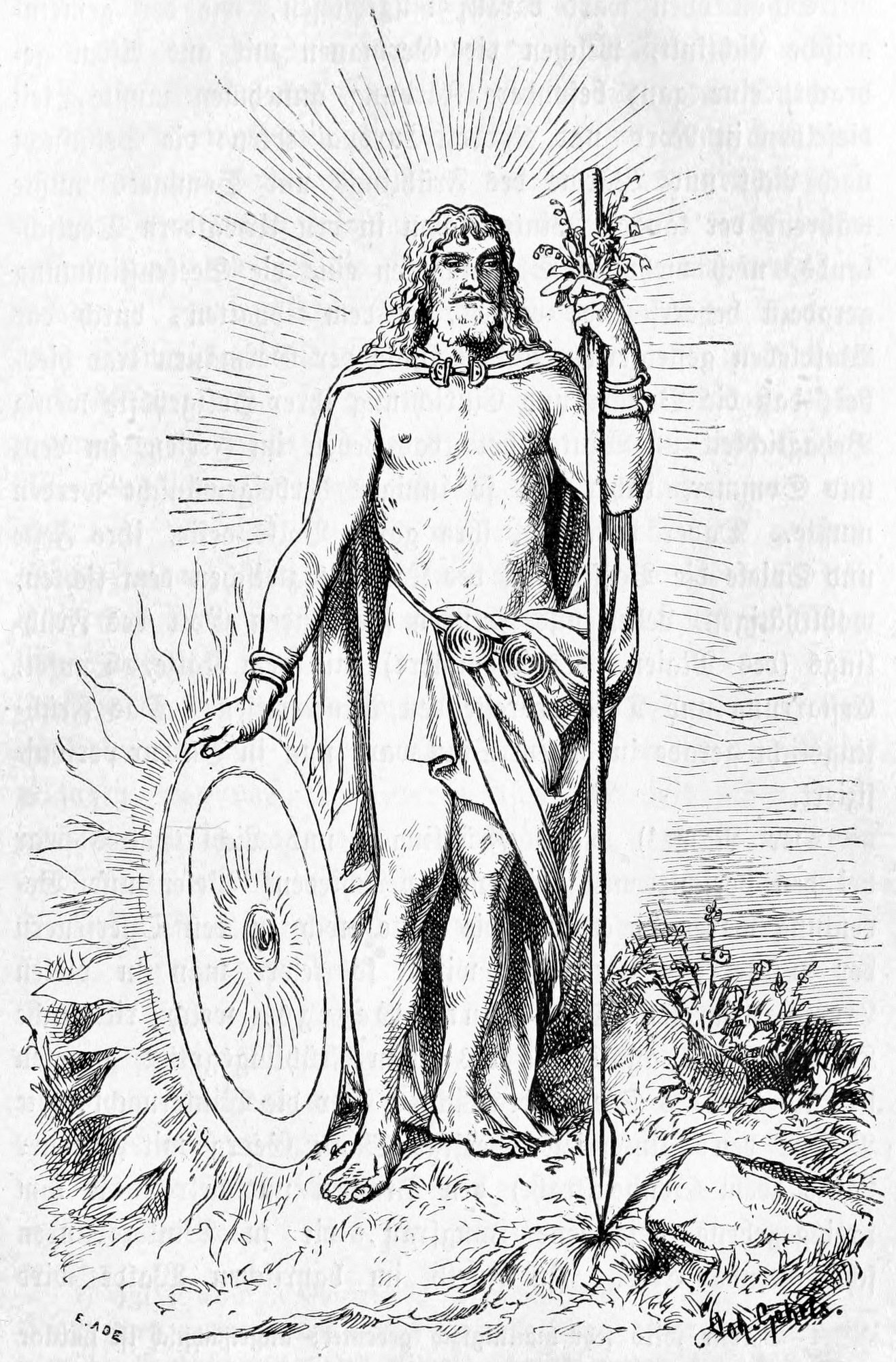
That foreknowledge is the tragedy of her one great myth. Her son Baldr, the best and brightest of the gods, begins to have dreams heavy with danger to his life, and the gods take counsel over them, because in the north an ill dream about a god is a matter of state. Frigg acts on the warning in the only way a mother who knows too much and can change too little knows how: she goes out across the whole of creation and exacts an oath.
From fire and water, from iron and every kind of metal, from stones, earth and trees, from sicknesses, beasts, birds and creeping things, she takes a solemn promise that not one of them will harm her son. The world swears. And because the world has sworn, the gods invent a cheerful game: they stand Baldr in their ring and hurl weapons and stones at him, and everything glances off, and Snorri says this seemed to all a great honour. It is the strangest scene in the myths, a mother’s dread turned into the gods’ entertainment.
A little shrub called the mistletoe
One thing was never asked. Loki, who cannot bear the sight of universal goodwill, takes on the likeness of a woman and comes to Frigg in Fensalir, and the scene that follows is quiet and terrible, an interrogation disguised as gossip between women. He coaxes from her the single exception she made. West of Valhalla, she confides, there grows a little shrub called the mistletoe, and it seemed to her too young to swear an oath from.
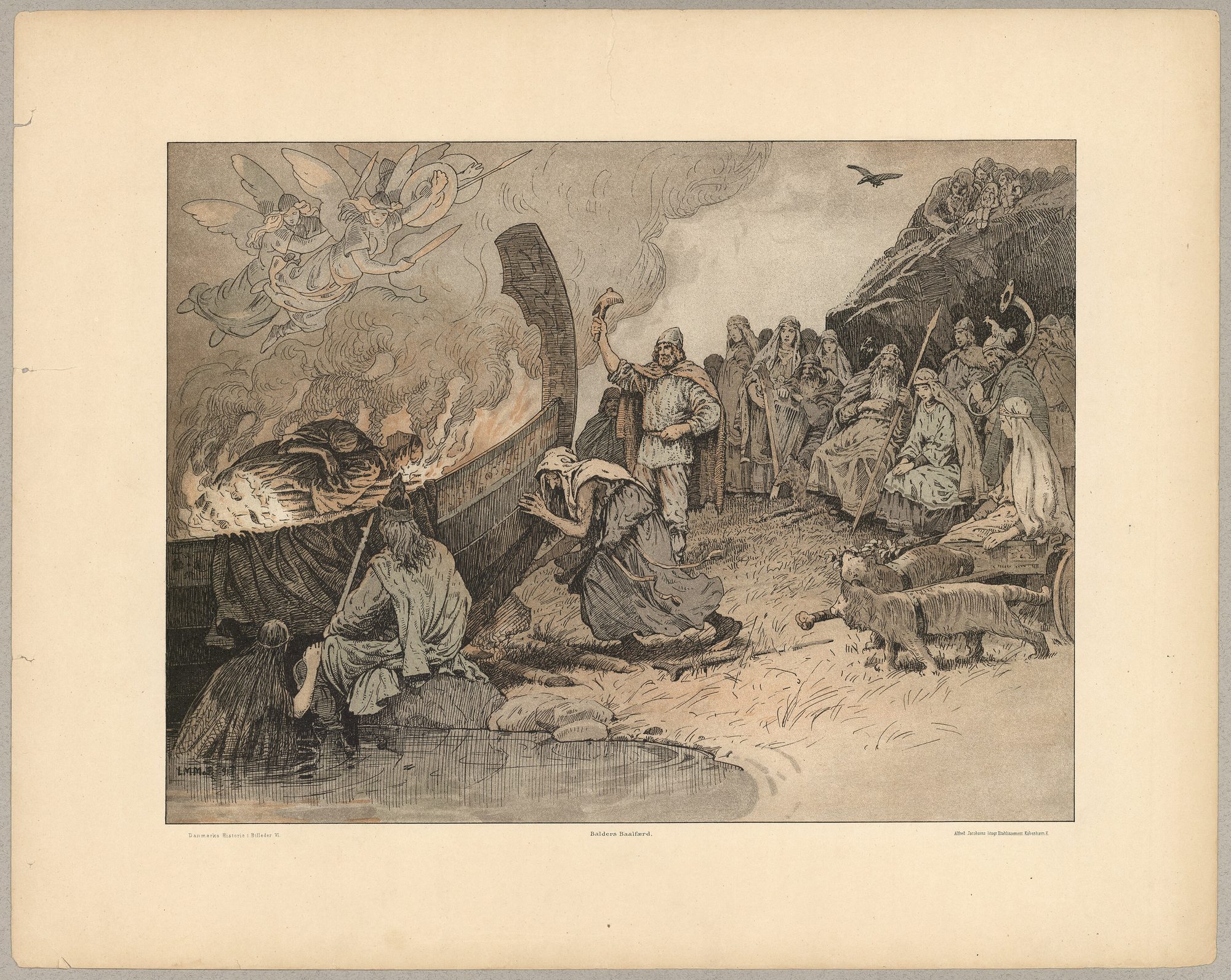
That is all he needs. Loki pulls up the shrub, brings it to the blind god HöðrBaldr's blind brother, whose hand Loki guides to throw the fatal mistletoe shaft., Baldr’s own brother standing apart from the sport because he cannot see to join it, and guides the dark hand that throws. The dart the whole world forgot to fear runs Baldr through, and he falls dead. It is, Snorri writes, the greatest misfortune that has ever happened to gods and men, and the Vǫluspá remembers where the grief pooled: in Fensalir did Frigg weep sore.
Who will ride the road to Hel
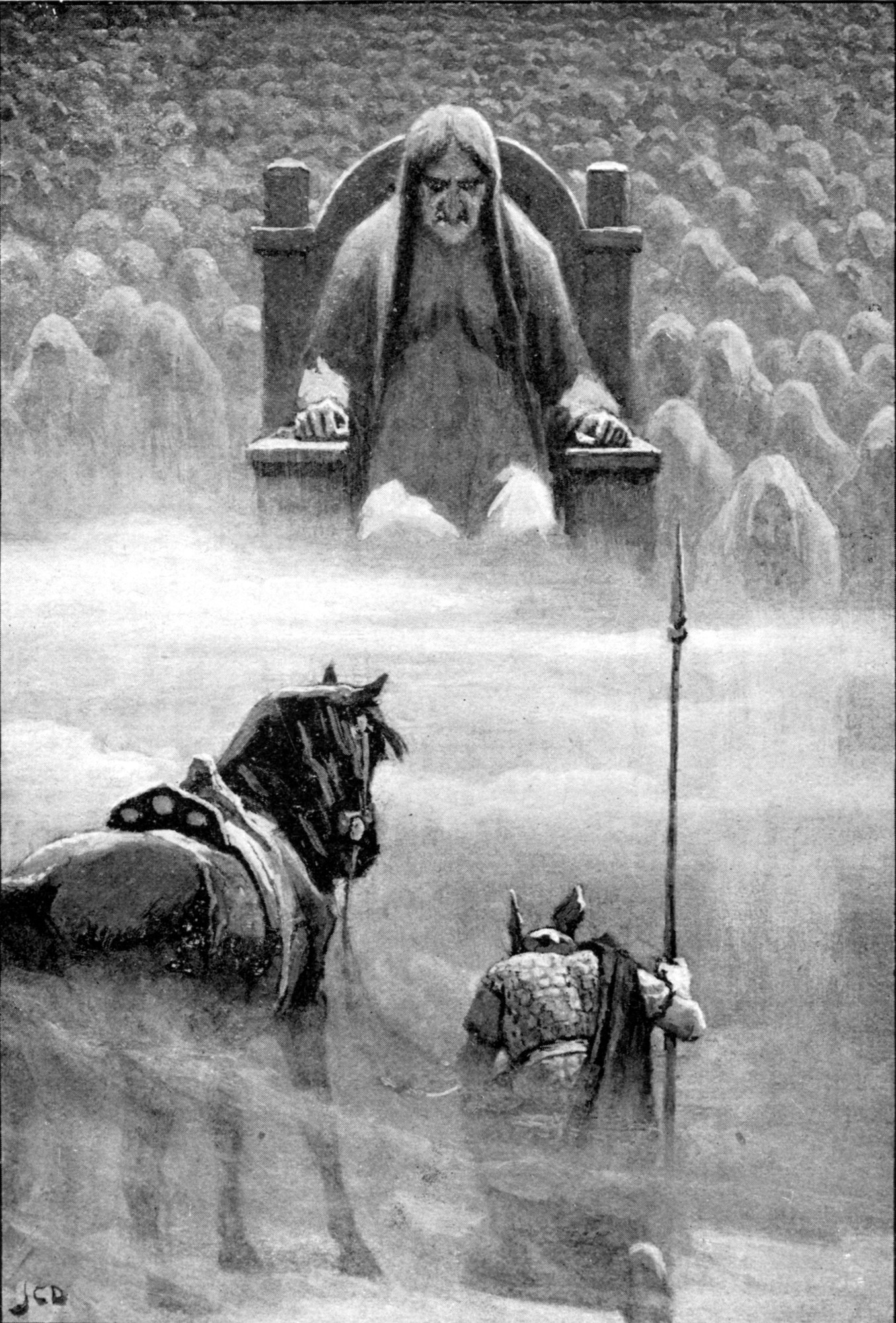
But here is the detail that lifts her above a mourning mother, because grief is not the last thing she does. It is Frigg, not Odin, who moves first to undo the loss. She stands among the Aesir and asks who will win all her love and favour by riding the road to Hel to offer the death-goddess a ransom for Baldr, and it is Odin’s swain Hermóðr who takes up the charge, mounts Odin’s eight-legged Sleipnir and rides down into the dark.
The rescue fails, in the end, on one dry-eyed refusal in one cave, and Baldr stays below. Yet Frigg is the one who tried. At the funeral she comes with Odin, and later, from the world of the dead, Baldr’s wife Nanna sends her a kerchief and other gifts, a small tenderness passed back across the border no one else could cross.
We should be honest about what she is and is not. The Frigg of later folklore, the goddess of marriage, motherhood, the household and the spinning-wheel, is not the Frigg the Eddas actually describe; those domestic offices are largely a later reconstruction, and the old poems give her foreknowledge and primacy, not a distaff. The sources are not tidy about her, either.
In Lokasenna the trickster taunts her with a scandal, that in one of Odin’s long absences his brothers Vili and Vé took her to themselves, a slander the euhemerised prologue to the Prose Edda echoes as history; it belongs to the tradition as an insult and a variant, not as settled biography. Even her identity blurs at the edges, since scholars have long suspected that Frigg and the Vanir goddess Freyja were once a single figure split in two. What the poems hold to, through all of it, is the woman who knows every fate and will not tell.
Twice she loses what she loves
Her story ends on a second grief that rhymes with the first. The same poem that showed her weeping for Baldr in Fensalir returns to her at the end of the world, when Odin rides out to meet the wolf Fenrir and does not come back. Now comes to her yet another hurt, the Vǫluspá says, for there must fall the joy of Frigg, and the joy of Frigg is Odin himself.
Twice she loses the thing she loves most, the shining son and the one-eyed husband, and both times she has known it was coming since before it began. That is the peculiar cruelty the north reserved for her. She was given sight of everything and the power to stop almost none of it, and the truest picture of the queen of the Aesir is a goddess who foresaw both her sorrows and walked to meet them with her mouth closed.
The fate of all does Frigg know well, though herself she says it not. (Poetic Edda, Lokasenna 29, trans. Bellows)
- Snorri Sturluson, Prose Edda, Gylfaginning 9, 20, 35–36, 49–53 (trans. Rasmus B. Anderson, The Younger Edda, Chicago 1880; Project Gutenberg #18947, read verbatim)Frigg as Odin’s wife who
knows the fate of men, although she tells not thereof
and the first of the goddesses; her descent from Fjǫrgynn; her hall Fensalir; the handmaid Fulla with flowing hair and a golden band who carries Frigg’s chest and knows her secrets; the messenger Gná on the air-running horse Hofvarpnir; the universal oath from fire, water, iron, metals, stones, earth, trees, sicknesses, beasts, birds and creeping things; the gods’ invulnerability-game; Loki’s woman-disguise at Fensalir and the mistletoetoo young
west of Valhalla; the blind Höðr’s guided dart; Frigg’s call for a rider to ransom Baldr and Hermóðr’s ride to Hel on Sleipnir; the funeral attendance with Odin, and Nanna’s kerchief to Frigg and ring to Fulla from Hel. - Poetic Edda, Vǫluspá 32–34 and 53 (trans. Henry Adams Bellows, American-Scandinavian Foundation 1923; Project Gutenberg #73533, read verbatim)the mistletoe shaft and
in Fensalir did Frigg weep sore / For Valhall’s need
; and the second sorrow at Ragnarök, when Odin goes to fight the wolf andthere must fall the joy of Frigg
(Bellows glossingthe joy of Frigg
as Odin andHlin
as Frigg). - Poetic Edda, Lokasenna intro prose and 25–29 (trans. Henry Adams Bellows, 1923; Project Gutenberg #73533, read verbatim)the guest-list at Ægir’s feast; Frigg’s rebuke of Loki; Loki’s slander that Vili and Vé
both in thy bosom have lain
; Frigg’s wish that a son like Baldr were by her; and Freyja’sThe fate of all does Frigg know well, / Though herself she says it not
, with Bellows’ note attributing the Vili/Vé affair to the Ynglinga saga. - Poetic Edda, Vafþrúðnismál 1–4 (trans. Henry Adams Bellows, 1923; Project Gutenberg #73533, read verbatim)Frigg as Odin’s counsellor, urging that she would keep Heerfather at home rather than let him seek the giant Vafthrúðnir, then blessing his going,
safe mayst thou go, safe come again, and safe be the way thou wendest
. - Snorri Sturluson, Prose Edda, euhemerist Prologue (trans. Rasmus B. Anderson, 1880; Project Gutenberg #18947, read verbatim)the frame equating Odin with Priam of Troy and his queen with Frigida/Frigg, and the report that during Odin’s long absence his two brothers
took his wife Frigg to themselves
before he returned and took her back. A euhemerised variant, corroborating the Lokasenna slander but not to be presented as settled fact.