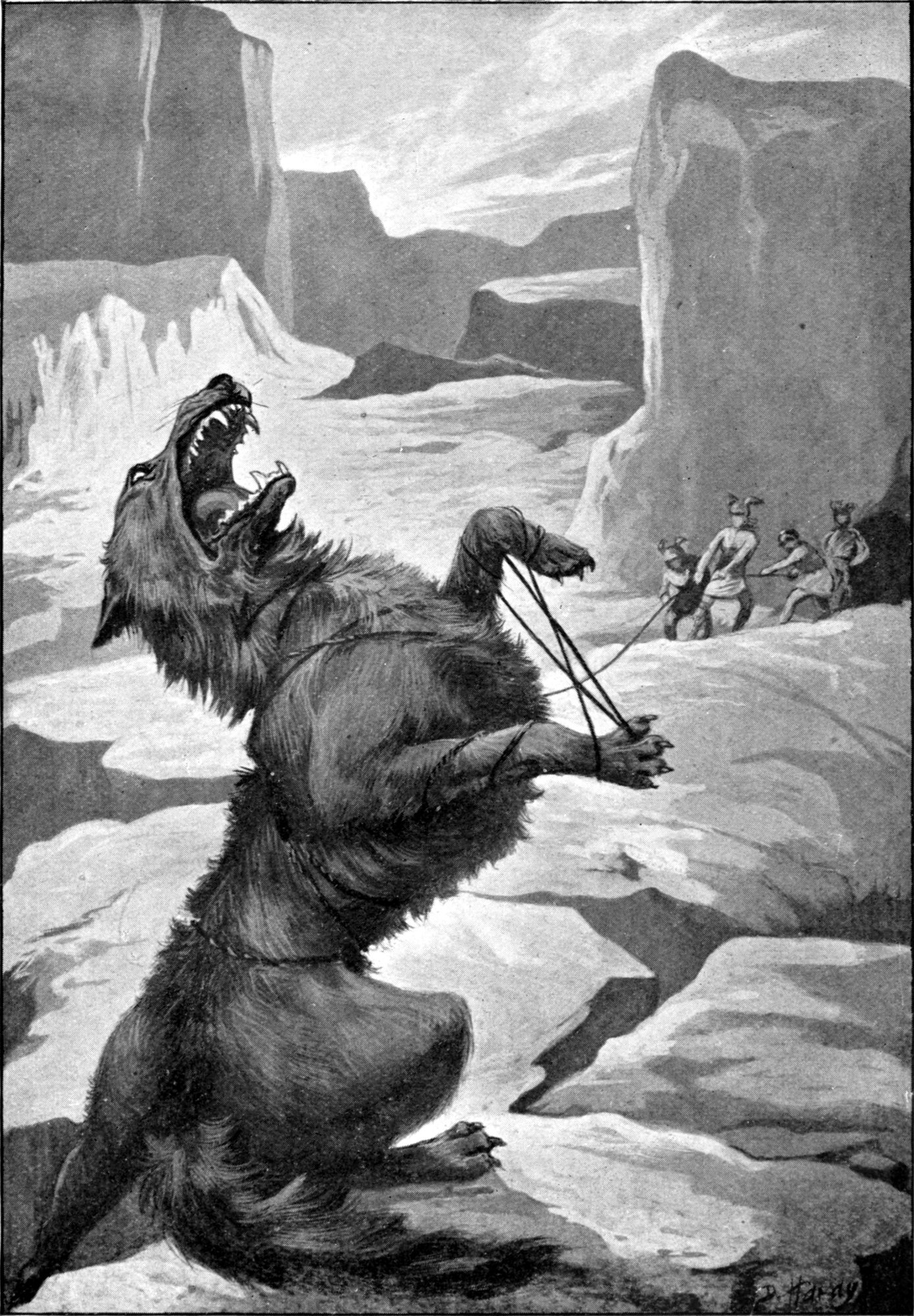
There was a wolf-cub growing up inside the walls of Asgard, and only one god would go near enough to feed him. The gods had reason to keep the creature close. Prophecy had told them that Loki’s brood would bring nothing but woe and misfortune upon them, and this was the eldest of that brood: the Fenris-wolf, got by Loki on the giantess AngrboðaGiantess of Jötunheim, mother of Fenrir, the Midgard-serpent and Hel by Loki. in Jötunheim, brother to the serpent that lies coiled round the world and to Hel who rules the dead below. Odin had dealt with the other two already, flinging the serpent into the deep sea and casting Hel down into the cold of Niflheim to rule the dead. But the wolf he had them rear at home, and every day it took a little more courage than the last to bring him his meat, until one god still dared and the rest did not. That was TýrThe Norse god of war, the only one of the gods brave enough to feed the wolf..
A fetter of iron called Læðingr
He did not stay small. He grew at a rate that frightened them, and the old warnings came back with a sharper edge: this beast was fated to be their undoing. So the gods decided to chain him, and because they could not simply fall on a creature they had fostered, they made a game of it.
They forged a huge fetter of iron and called it Læðingr, and carried it to the wolf and asked him, in the tone of friends admiring his strength, whether he thought he could break it. Fenrir looked the thing over and reckoned he could. He let them lock it onto him, and when they had stepped back he braced himself and strained once, and Læðingr burst apart. He had freed himself from the first fetter before they had finished congratulating him on wearing it.
They tried again, harder. The second fetter was called Drómi and it was made half again as strong as the first, and this time the gods worked on the wolf’s vanity rather than his goodwill. Surely, they told him, a beast that could shrug off a chain like this would be famous the world over; no one had ever been so strong. Fenrir considered the offer.
The fetter was formidable, but so, he judged, was he, and a little fame was worth the risk. He let them bind him, then shook himself and threw his weight against the iron and dashed it to the ground so violently that the broken pieces flew a long distance. He walked out of Drómi as he had walked out of Læðingr, and the north has kept a saying for a thing extraordinarily hard ever since: to dash out of Drómi.
Six things that are not there
Now the gods were afraid in earnest, because it looked as though they could not bind the wolf at all. So Odin sent Skírnir, who ran errands for Freyr, down to the dwarfs of SvartálfaheimThe home of the dwarfs, the master-smiths who forged Gleipnir. to have them make something no forge of the gods could match. The dwarfs made it out of six things that are not there: the sound of a cat’s footfall, the beard of a woman, the roots of a mountain, the sinews of a bear, the breath of a fish and the spittle of a bird.
That, says the old telling with a perfectly straight face, is why you will never find any of those things now, and why a cat moves without a sound and a woman has no beard and a mountain has no roots: they were all used up in the making. And the band, this thing spun from what does not exist, came out smooth and soft as a silken string, slim as a ribbon you could have tied round a gift. Its name was GleipnirThe dwarf-forged fetter of six impossible ingredients, smooth and soft as a silken string, that finally held the wolf..
Out to an island called Lyngvi
The trouble was getting it onto a wolf who had already broken free of two honest chains and had learned to be careful. They took him out to an island, a bare rock called Lyngvi in a lake named Ámsvartnir, and there they produced their pretty cord and dared him to snap it. Fenrir was not a fool.
He looked at how slight it was and said what any suspicious creature would say: a band this slender either breaks at a touch, in which case snapping it wins me no glory, or it is made with craft and guile, in which case for all it looks so soft it will never come onto my feet. He could smell the trap. He would submit to the test, he said, on one condition: one of the gods must lay a hand in his mouth, and keep it there, as a pledge that the whole thing was done in good faith and without deceit.
Only Týr steps forward
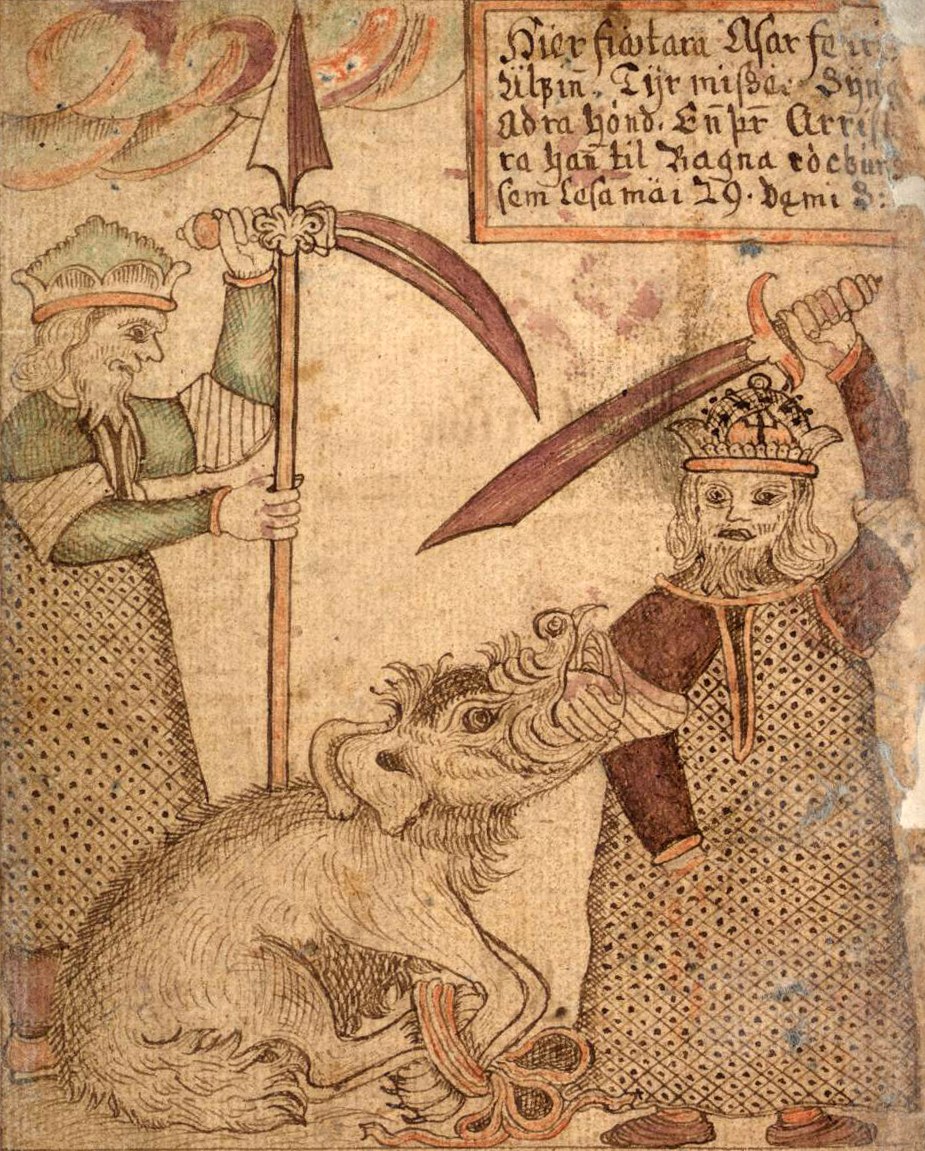
That was the moment the ring of gods fell silent. They knew, every one of them, that the pledge was a lie: they had no intention of loosing the wolf if the cord held, and they were fairly sure it would. To put a hand in his mouth was to lose it when he understood. So they stood there exchanging looks, a choice of two evils and nobody willing to pay, until Týr stepped forward, the god who had fed the wolf when no one else would, and laid his right hand between the wolf’s teeth.
They bound him. And when Fenrir kicked against Gleipnir the way he had kicked against the iron, he found that the harder he fought, the tighter the soft cord drew: the more he strained, the more it bit. The silk that had looked like nothing held him fast, and he could neither shake it nor break it.
He was caught, and he knew who had helped catch him. Every god on that island laughed with the pure relief of it. Every god but one. Týr did not laugh, because Týr had felt the jaws close, and his sword-hand was gone at the wrist. That is the line the story rests everything on, plain and short: they all laughed except Týr; he lost his hand.
A sword upright in his mouth
They made sure of him after that. They drew the chain fixed to Gleipnir, a chain called Gelgja, through a hole in a great rock named Gjöll, sank that rock deep into the earth, and drove a second boulder, Þviti, deeper still to anchor the whole thing.
Fenrir gaped and snapped, trying to bite, so they jammed a sword upright into his mouth, the hilt braced in his lower jaw and the point in the upper, to hold the raging mouth open. He howls there, and the slaver that runs down from his propped jaws pours off as a river, and the river has a name: Ván, which is to say Expectation, or Hope. There he lies, and there he will lie until Ragnarök.
They could have killed him instead, and did not. The gods would not shed his blood, monstrous and doomed-making as he was, because the place was a sanctuary and they would not stain their peace-stead with a killing, not even of the beast the prophecies named as the bane of Odin. So they chose the chain over the sword and left the thing that would end them alive and bound, waiting.
When the last day comes and every fetter in the world snaps at once, the wolf runs free and runs straight for the one he was always fated to find. The old poem keeps returning to it like a bell under everything else: the hound howls before the cave-mouth, the fetters will burst, and the wolf run free.
Bound with a lie and a limb
There is a coda, long after, when Loki comes into the hall of the gods to insult them each in turn and reaches Týr. He jeers, offering to tell how Fenrir once tore the right hand from him. Týr does not flinch. He answers that he lacks a hand and the wolf lacks his freedom, and that the loss brings longing to both.
He calls the wolf by an old name there, Hróðvitnir, the fame-wolf, and it is a fair name. The beast wanted glory and would not stoop to breaking a ribbon for less; in the end he got a kind of fame anyway, though not the kind he bargained for. The wolf that could not be killed and could not be trusted was bound with a lie and a limb, and his name outlasts the strength that snapped two iron chains.
My hand do I lack, but Hrothvitnir thou, / and the loss brings longing to both. (Lokasenna 39, trans. Bellows)
- Snorri Sturluson, Prose Edda, Gylfaginning 34–35 (trans. Rasmus B. Anderson, The Younger Edda, Chicago 1880; Project Gutenberg #18947, read verbatim)the only connected narrative of the binding. Loki’s three children by Angrboða in Jötunheim — the Fenris-wolf, Jörmungand the Midgard-serpent, and Hel — and the prophecy of
much woe and misfortune
from the brood; Odin casting the serpent into the sea and Hel into Niflheim while the wolf is reared at home; Týr as the only god with the courage to feed him; the fetter Læðingr, burst at the first strain, and Drómione-half stronger
, dashed to pieces thatflew a long distance
, with the proverbs drawn from both; Skírnir sent to the dwarfs of Svartálfaheim for Gleipnir; the six ingredients (a cat’s footfall, a woman’s beard, a mountain’s roots, a bear’s sinews, a fish’s breath, a bird’s spittle) and Snorri’s teasingproof
that this is why those things cannot now be found, the bandsmooth and soft as a silken string
; the islet Lyngvi in the lake Ámsvartnir; the wolf’s suspicion ofcraft and guile
and his demand that a god lay a hand in his mouthas a pledge that this is done without deceit
; Týr’s right hand and its loss,they all laughed except Tyr; he lost his hand
;the more he strained the tighter it got
; the chain Gelgja through the rock Gjöll and the anchoring stone Þviti; the sword-gag, hilt in the lower jaw and point in the upper; the river Ván of his slaver; the gods’ refusal to stain their sanctuary with his blood though he mustbecome the bane of Odin
; andthere he will lie until Ragnarok
. - Poetic Edda, Völuspá 40 and 44 (trans. Henry Adams Bellows, The Poetic Edda, American-Scandinavian Foundation 1923; Project Gutenberg #73533, read verbatim)the giantess old in Ironwood who
bore the brood of Fenrir
, and the wolf-brood one of whom steals the sun (st. 40 — the sun-swallower is one of the brood, not necessarily Fenrir himself); and the refrainNow Garm howls loud before Gnipahellir, the fetters will burst, and the wolf run free
(st. 44, repeated at 49 and 58), the loosing at Ragnarök. Allusive corroboration only; the full binding is Snorri’s. - Poetic Edda, Lokasenna, introductory prose and 38–39 (trans. Henry Adams Bellows, 1923; Project Gutenberg #73533, read verbatim)
Tyr, who had but one hand, was there
, with the prose note thatthe wolf Fenrir had bitten off his other hand when they had bound him
; Loki’s taunt of the severed right hand and Týr’s reply,My hand do I lack, but Hrothvitnir thou, and the loss brings longing to both
; and the byname Hróðvitnir for the same wolf.