There was a gap, and nothing else. No earth beneath and no heaven above, no sea, no cool waves, no sand along any shore, and grass nowhere at all. The oldest poem of the North names the emptiness by piling up everything it lacked, sea nor cool waves nor sand, earth had not been nor heaven above, but a yawning gap and grass nowhere, so that the void arrives already itemised, a list of absences with a hollow at its centre. That hollow was Ginnungagap, the yawning gap, and for a long age it was all there was to speak of.
Eleven rivers out of Hvergelmir
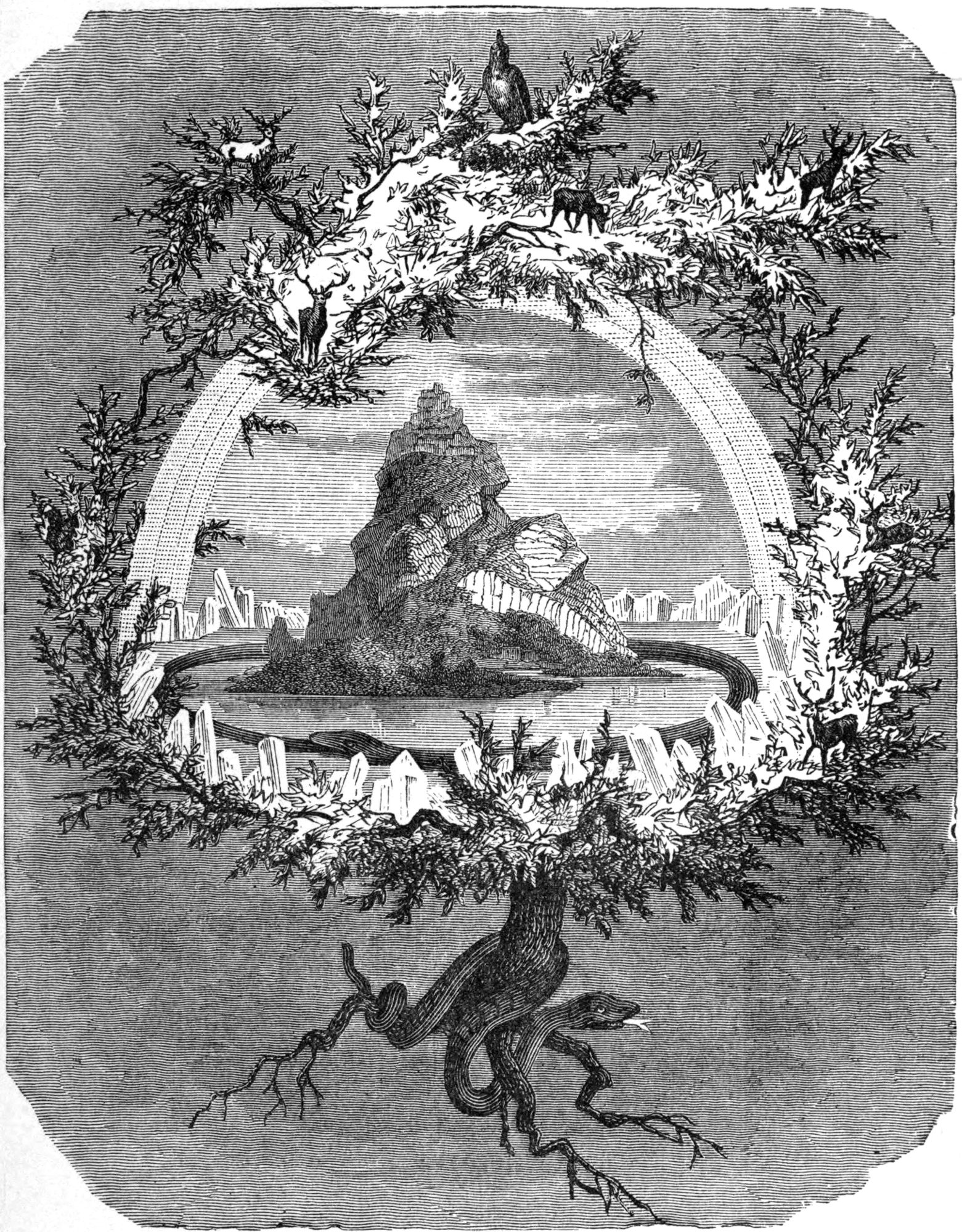
It was not, however, entirely alone. Two regions flanked the gap, older than the world though not older than the void. Away to the north lay Niflheim, a country of mist and cold, and at its heart bubbled the well Hvergelmir, out of which ran eleven rivers, which Snorri names one by one. Elsewhere he names the venom-laden streams called ElivagarThe venom-bearing streams whose waters hardened into the ice that filled Ginnungagap; Snorri does not say where they rise., without saying whether they are among these eleven.
Niflheim had existed for uncounted ages before the earth was ever thought of. Away to the south lay its opposite, MuspelheimThe southern realm of fire and heat, whose sparks became the sun, moon and stars., a land so light and hot, so bright and dazzling, that no stranger who is not native there can bear to stand in it. On its border sat a watcher named Surt, a flaming sword in his hand, and though his work belongs to the end of the world rather than its beginning, he was already there, waiting to burn everything down when the time came.
Then the two regions began, very slowly, to meet. As the Elivagar rivers ran on far from their source, the venomous matter that flowed in them thickened and hardened, the way dross hardens as it runs off molten metal from a fire, and it froze. Layer of ice settled upon layer of ice, building up clear into the gap, and with the ice came drizzling rains and gusts of wind, so that the northern part of Ginnungagap filled with rime and cold.
But the southern part lay open to Muspelheim, and the sparks and glowing heat that drifted off that burning country warmed it, until the middle of the gap, where the freezing north reached toward the blazing south, was as warm and mild as windless air.
Where the heat met the rime
In that mild seam between fire and ice, something happened. Where the heat met the rime, the frost melted into drops, and the drops did not simply run away as water. By the might of whatever sent the heat, they gathered and quickened and took the likeness of a living thing, shaped like a man. This was Ymir, whom the frost-giants call Aurgelmir, the first being in all the worlds.
The verse of the elder poets puts it plainly: down from Elivagar the venom dropped, and waxed until it was a giant, and from that giant came all the race of giants. That is worth marking. The older poems say only that the venom dripped and grew; the fuller prose telling, written down centuries later by a Christian scholar recording the old belief, adds a directing hand behind the heat, a first cause that sends the warmth on purpose. The poems know of no such purpose. They give you only the drops, the thaw, and the thing that stirs.
Ymir was not good. He was the ancestor of the frost-giants and shared their nature, and the manner of his increase was strange and monstrous. As he slept and sweated, a man and a woman grew together beneath his left arm, and one of his feet begot a son upon the other. From him, sideways and unbidden, the whole giant-brood came. And Ymir was not the only thing the melting rime produced.
Out of it there also formed a cow, AudhumlaThe primeval cow melted from the rime, who fed Ymir with four streams of milk and licked the first god free from the stones., and from her four teats ran four rivers of milk, and on that milk the giant fed. So the first two creatures of the world stood together in the thawing gap, the giant drinking, the cow giving, neither of them made by any craftsman, both simply melted into being between the heat and the cold.
Buri steps free of the stones
The cow, in turn, had to be fed, and she fed by licking. The stones around her were crusted with salt and rime, and she licked at them, and something began to appear in the ice under her tongue. On the first day the hair of a man came out of the stones. On the second day a whole head.
On the third day the rime gave up an entire man, and he stepped free: Buri, fair of face, tall and strong. He was the first of another line entirely, the line that would set itself against the giants. Buri had a son, Bor, and Bor took a wife from among the giant-kin, Bestla the daughter of the giant Bolthorn, and Bestla bore Bor three sons. Their names were Odin, Vili and Ve.
These three looked at Ymir, the huge evil first-father of the giants, and they killed him. It was the first killing, and it drowned a world. So much blood poured from the giant’s wounds that it flooded out across everything and swept the whole race of frost-giants away, every one of them but a single household.
That household belonged to BergelmirThe only frost-giant to survive the flood of Ymir's blood, escaping by boat with his wife and household., who had been born countless winters before the earth and who now climbed aboard a boat, an ark, with his wife and his people, and rode out the deluge of blood while all his kindred perished around him. From Bergelmir and his wife the later frost-giants are descended, which is the reason there are still giants at all. It is a strange note to find at the very beginning: a flood, a single ark, one family saved to carry a doomed race forward.
Taken apart and re-laid as landscape
Now the sons of Bor had a body on their hands, and out of it they made the world. They carried Ymir into the middle of the gap and took him apart, and every part became a piece of the cosmos. His blood became the seas and the lakes. His flesh became the earth itself. His bones became the mountains and crags, and his teeth and jaws and the fragments of his shattered bones became the stones and scree.
The blood that ran free they laid all the way round the edge of the land in a ring, the encircling world-ocean, so wide that most men would think it impossible to cross. Here the traditions do not quite agree on which part became which. One old poem says the seas came from his blood; another, that they came from his sweat, and adds that the trees grew from his hair. The prose account, written to reconcile them, keeps both. What every version holds in common is the bare and brutal shape of the thing: the world is a corpse, taken apart and re-laid as landscape.
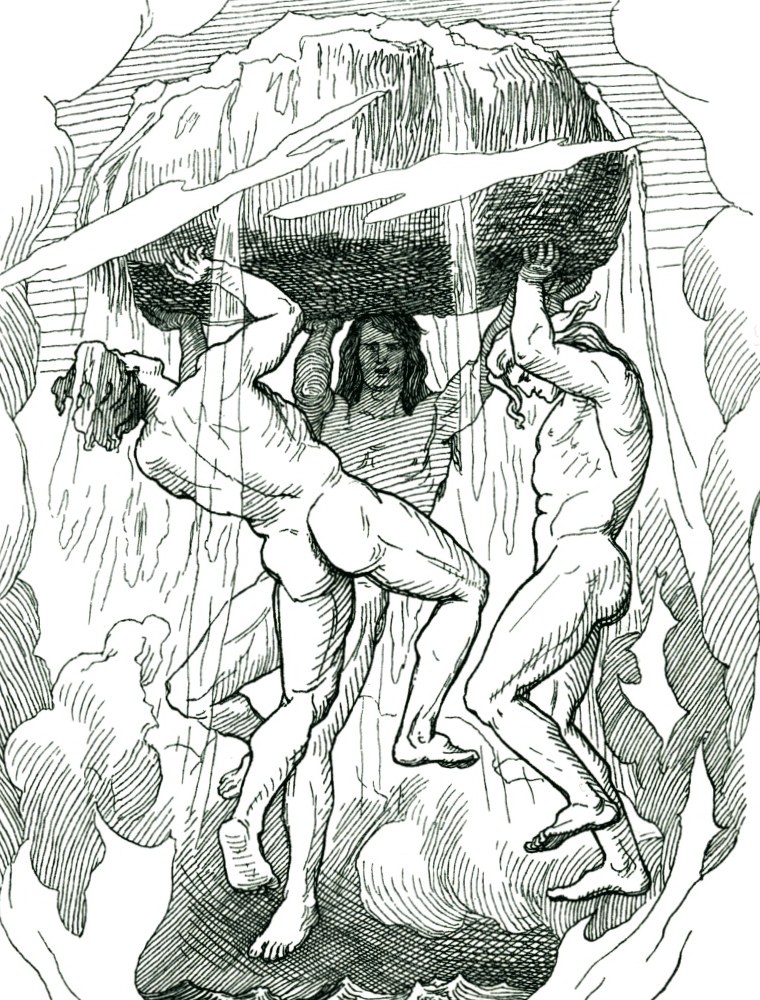
From the dome of Ymir’s skull the brothers made the sky, and lifted it up over the earth with its four corners raised on high, and under each corner they set a dwarf to hold it: Austri in the east, Vestri in the west, Nordri in the north, Sudri in the south, the four quarters of heaven propped on four bent backs. From his brains, tumbled up into the air, they made the clouds. Then they went back to Muspelheim for light. They gathered the loose glowing sparks and cinders that had been thrown out of that burning land, and they set them in the sky above and below to light the heaven and the earth, some fixed in their places, some given a path to travel.
In the old Norse reckoning the sun is female, the sister of the moon, and the moon is male, and neither of them yet knew what they were for. On that first day the sun did not know where her hall stood, the moon did not know what power was his, and the stars did not know where they were meant to rest. But from the setting of those sparks, time began: days could be counted, and years, because now there was something moving overhead to count them by.
Two logs of driftwood on the shore
The brothers were not finished. From Ymir’s eyebrows they raised a stronghold in the middle of the world and called it Midgard, the Middle Enclosure, a walled burg set within the ring of ocean to keep the surviving giants out and shelter what would live inside. And what would live inside was not yet there. Walking one day along the sea-strand, the sons of Bor found two trees, two logs of driftwood cast up on the shore, and from these they made the first two people, the man Ask and the woman Embla.
The gods gave them their gifts in turn: breath and life, then wit and movement, then face and speech and hearing and sight, until the driftwood stood up as a man and a woman and looked about them. The sun came warm from the south over the new-made ground, and the bare stones warmed, and the earth went green with the first growing things, the leek among them, which the old people held for a sign of fine and vigorous growth. So the ground was green, the sky was lit, the ocean ringed the land, and two people made of trees stood in the middle of it, in a world that had been, not very long before, a giant nobody mourned.
Out of Ymir’s flesh was fashioned the earth, / And the mountains were made of his bones; / The sky from the frost-cold giant’s skull, / And the ocean out of his blood. (Vafþrúðnismál 21, trans. Bellows)
- Poetic Edda, Völuspá 3–5 (trans. Henry Adams Bellows, The Poetic Edda, American-Scandinavian Foundation 1923; Project Gutenberg #73533, read verbatim)the oldest and most compressed cosmogony. The void where there was
sea nor cool waves nor sand
andgrass nowhere
;Bur’s sons
wholifted the level land
and raised Midgard; the sun thatfrom the south warmed the stones of earth
so the ground wasgreen with growing leeks
; and the first day’s three ignorances — the sun thatknew not where her hall she had
, the moon thatknew not what might he had
, the stars thatknew not their resting-places
. Bellows notes that theyawning gap
(Ginnunga-gap)is sometimes used as a proper name
, that in Old Norse the sun is feminine (the sister of the moon
) and the moon masculine, and that the leek was a symbol of fine growth with reputed magic power. - Poetic Edda, Vafþrúðnismál 21, 28–35 (trans. Bellows, 1923; read verbatim)the body-of-the-world in verse — earth from Ymir’s flesh, mountains from his bones, the sky
from the frost-cold giant’s skull
, the ocean from his blood; Aurgelmir,the frost-giants’ name for Ymir
, quickened whendown from Elivagar did venom drop, and waxed till a giant it was
; the man and woman grown beneath his arm and the son begotten foot with foot; and Bergelmir, born countless winters before the earth, whosafe in his ark lay
(alsoin a boat of old was borne
) when the flood came. Bellows’ notes flag that the poem supplies no directing first cause behind the heat, and that Thruthgelmir (st. 29) isotherwise unknown
. - Snorri Sturluson, Prose Edda, Gylfaginning 4–9 (trans. Rasmus B. Anderson, The Younger Edda, Chicago 1880; Project Gutenberg #18947, read verbatim)the fullest connected narrative. Niflheim with the well Hvergelmir and its eleven rivers; Muspelheim,
light and hot
, so brightthat no stranger, who is not a native there, can stand it
, with Surt and his flaming sword at the border; the venom that hardenedas does dross that runs from the fire
and the rime builtlayer of ice upon the other clear into Ginungagap
, the middle of the gap stayingas warm and mild as windless air
; the drops that quickened into Ymirby the might of him who sent the heat
; the cow Audhumla and her four milk-streams, and the three-day licking-free of Buri from the salt-stones; Bor and Bestla daughter of Bolthorn, and their sons Odin, Vili and Ve; the slaying of Ymir, the blood-flood that drowned the frost-giants, and Bergelmir’s escape by boat; the world shaped from Ymir’s body (blood→seas, flesh→earth, bones→rocks, teeth and broken bones→stones, free blood→the encircling oceanlaid in a ring
); the sky from his skull with the four corner-dwarfs Austri, Vestri, Nordri and Sudri; the Muspelheim sparks set as heavenly lightssome fixed, some made to go free
so thatfrom that time days and years were reckoned
; Midgard from his eyebrows and clouds from his brains; and Ask and Embla, the first man and woman, made from two trees on the strand and given spirit, reason and form in turn. Snorri’s directing first cause and his harmonising of the two body-part traditions are his own framing — he wrote c. 1220, a Christian recording pagan belief — and are not in the older verse. - Poetic Edda, Grímnismál 40–41, quoted by Snorri at Gylfaginning 8 (Anderson tr.)the variant body-parts list, in which the seas come from Ymir’s sweat rather than his blood, the trees from his hair, Midgard from his eyebrows and the clouds from his brains — details found only in this poem, which Snorri folds into his prose. (Read here only as quoted within Gylfaginning; the standalone stanza-numbering should be re-checked against an independent edition of Grímnismál before the line numbers are relied on.)