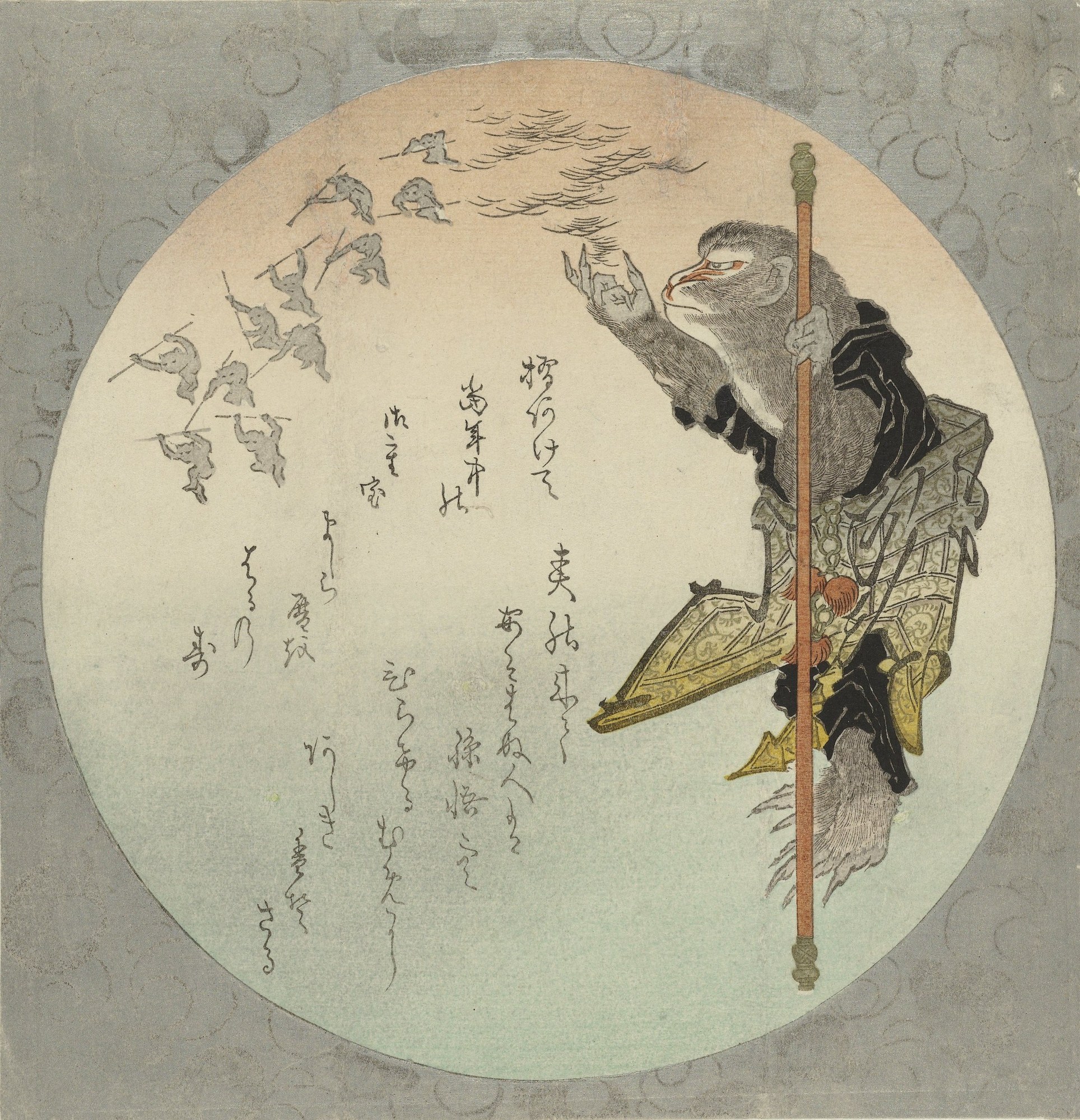
Before Sun Wukong wages war on Heaven, he begins as stone on Flower-Fruit Mountain. The rock stands on the chief peak of Flower-Fruit Mountain, in the sea east of the world, and it is not shaped like other rocks. It is thirty-six feet and more tall, to match the three hundred and sixty-five degrees of the turning sky; twenty-four feet round, for the twenty-four divisions of the farmer’s year; and bored through with nine apertures and eight holes, for the Nine Palaces and the Eight Trigrams. The most famous trickster in Chinese fiction is born, in other words, from a stone already shaped to the pattern of the cosmos, and the novel gives his measurements before it gives his name.
Since the parting of chaos the rock has drunk the essence of Heaven and Earth and the seed of sun and moon, until one day it splits and lays a stone egg the size of a ball. The wind works on the egg until it becomes a stone monkey, whole in his five senses and four limbs, who crawls and walks and bows to the four quarters.
He is a newborn, yet the first thing he does is register on the instruments of Heaven: his eyes shoot two beams of golden light that pierce to the Star Palace. The Jade Emperor sends officers to look, decides the creature is merely one more thing the world’s essence has thrown up, and pays it no mind. It is his only cosmic notice for a long while, and a serious under-reading.
What a waterfall bought him
The monkey wins his kingship by nerve, not force. Where a waterfall curtains the cliff and the others hang back, he leaps through it and finds a dry grotto furnished in stone, with an iron bridge and a tablet naming it the cave-heaven of Water-Curtain Cave. For finding them a home the monkeys make him king, and here he performs his first act of self-fashioning: he drops the word stone
from his description and styles himself instead the Handsome Monkey King. It is a small vanity, and also the pattern of his whole character. He is a creature who edits what he is called.
For three or five hundred years he is happy. Then, at the height of a feast, he suddenly weeps. For all their joy, he explains, they are not free, because in secret Old Man YamaThe lord of the dead in Chinese belief, the bureaucrat-king whose clerks keep the ledger of every allotted lifespan and come to collect when it runs out. governs them, and one day the summons will come. This is the engine of everything that follows, and worth marking how unheroic it is. His founding terror is the plain dread of a death he cannot argue with, already written in the ledgers of the dead. An old gibbon tells him only three kinds of being slip the register: Buddhas, immortals and sages, who have stepped off the wheel of rebirth. So the monkey builds a raft and sails off to learn not to die.
The mountain that spells out “mind”
Years of wandering bring him to a master whose very address is a joke the novel expects you to catch. The mountain is Spirit-Terrace Heart-Inch Mountain, the cave the Cave of the Slanting Moon and Three Stars, and both names are riddles whose answer is the single graph for mind.
The patriarch waiting inside, SubhutiThe immortal patriarch of the origin chapters who grants the monkey his surname, his powers and his cloud, then vanishes from the novel and is never seen again., is half Chan Buddhist and half Daoist adept, and the enlightenment allegory is baked into his address before a word is spoken.
His first gift is the monkey’s name, minted by carpentry on the written characters. The creature resembles a macaque, whose name carries the beast
radical; strip that radical away and the strokes left spell little child,
so the master grants him the surname Sun. The given name comes from a fixed verse his school uses to name its pupils in order; the monkey lands on the word for awaken,
and becomes Wukong, Awakened to Emptiness. This is a dharma-name, conferred here and nowhere else, and worth stating plainly against centuries of muddled retelling: the pilgrim monk he later serves does not give it to him. He already holds it before they meet.
The teaching is as sly as the geography. The master raps the monkey three times on the head and walks off with his hands behind his back, and the pupil alone reads the code: come at the third watch, by the back door. In secret he receives the arts, the seventy-two transformations and the somersault cloud that carries him a hundred and eight thousand li in a leap.
The novel is careful about why he needs them. A creature who has stolen a share of Heaven’s workings draws down the Three Calamities, blows of thunder, fire and wind sent to execute him for the theft, and the transformations are how he ducks them. His shape-shifting, source of a thousand tricks, is first of all a dodge from cosmic execution.
Yu the Great’s flood-gauge
An immortal now, he still wants a real weapon, and goes down to the crystal palace of Ao Guang, Dragon King of the Eastern Sea. What he carries off is no ordinary blade. It is a black iron rod capped with two gold bands, with a first career long before him: the depth-gauge Yu the Great used to measure the rivers and seas when he tamed the primal flood.
Its inscription names it the As-You-Will Gold-Banded Cudgel and gives its weight as thirteen thousand five hundred catties, and here the retellings garble a detail: the magic is not that its weight is boundless but that its size obeys his will, growing to prop up the sky or shrinking to a needle he tucks behind his ear.
The last thing to notice is what finally makes Heaven treat him as a problem. Two life-snatchers drag his soul to the Region of Darkness on the grounds that his span is used up, and the monkey is outraged, because dodging exactly this was the whole point. He has leapt clear of the Three Realms, he tells them, and is not within the Five Phases; then he clubs his way into the Hall of Judgment to demand the books.
His entry stands under the register of Souls, at number 1,350: Heaven-born stone monkey, allotted lifespan 342 years, a peaceful death. He seizes the brush and strikes it out, and not only his own line but every entry bearing a monkey’s name, then throws the ledger down. The whole terror at the feast was aimed at this single page, and he simply crosses it out. The Ten Kings of the underworld appeal over his head to Heaven, and the war can begin.
Since the parting of chaos it had received the essence of Heaven and Earth, the seed of sun and of moon, until it conceived.
Before the stone, a scholar
The stone-born titan is younger than he looks. Reach back two or three centuries before the 1592 novel, to the Song-dynasty Tale of Tripitaka Fetching Scriptures, and the monkey is a wholly different creature: not born from cosmic rock but arriving as a courteous white-robed scholar who greets the pilgrim monk politely and names himself the Macaque King of Purple Cloud Cave.
No stone birth, no patriarch, no cudgel wrung from a dragon, no crossing-out of the ledger. He is a pious helper who warns the monk that two earlier incarnations died on this road, and offers to guard him. Only the mountain of flowers and fruit and a macaque king with a cloud-cave survive into the later book; the trickster who tore up the register of the dead is a Ming reimagining, two hundred and fifty to five hundred years on.
Where the character came from before even that, scholars genuinely disagree. Hu Shih pointed west, to the Hindu monkey-god Hanuman of the Rāmāyaṇa, a foreign influence carried along the very roads the pilgrimage commemorates. Lu Xun pointed the other way, to a native water-demon named WuzhiqiA monkey-shaped water-demon of the Chinese floods, subdued by the hero Yu the Great, whom some scholars propose as a native ancestor of the Monkey King., subdued in the old stories by the flood-tamer Yu the Great. That both the native candidate and the finished novel’s cudgel tie the Monkey King to the same flood-hero is a happy coincidence, not a proof. The origin chapters say it best: he is a creature assembled from older pieces, shaped to the cosmos, who began his career trying not to die and never entirely stopped.
- Xiyouji 西遊記 (Journey to the West), traditionally and disputedly ascribed to Wu Cheng’en 吳承恩; earliest extant print c. 1592 (Shidetang 世德堂, Jinling), ch. 1 「靈根育孕源流出 心性修持大道生」: the stone built to 365 degrees of the sky and the 24 solar terms; the stone egg and stone monkey; the golden eye-beams to the Star Palace; Water-Curtain Cave and the Handsome Monkey King; the fear of Old Man Yama; the voyage to Subhuti and the coining of Sun Wukong. Classical Chinese read verbatim (zh.wikisource 西遊記/第001回); English throughout is the author’s labelled literal gloss, no public-domain translation existing.
- Xiyouji ch. 2 「悟徹菩提真妙理 斷魔歸本合元神」: the third-watch, back-door transmission; the seventy-two Earthly-Fiend transformations (地煞數) chosen over the thirty-six Heavenly-Star set; the somersault cloud (觔斗雲) of 108,000 li; the Three Calamities of thunder, fire and wind. Chinese read verbatim (zh.wikisource 西遊記/第002回).
- Xiyouji ch. 3 「四海千山皆拱伏 九幽十類盡除名」: the crystal palace of Ao Guang 敖廣; the As-You-Will Gold-Banded Cudgel (如意金箍棒), Yu the Great’s flood-gauge of 13,500 catties; the extorted armour; the descent to the Region of Darkness and the striking-out of his name and every monkey’s from the ledger (「天產石猴,該壽三百四十二歲,善終」, Soul-number 1,350). Chinese read verbatim (zh.wikisource 西遊記/第003回).
- Da Tang Sanzang Qujing Shihua 大唐三藏取經詩話 (Tale of Tripitaka of the Great Tang Fetching Scriptures), §2 行程遇猴行者處: the Song/Yuan antecedent (surviving Song 巾箱本 print; dating debated, most often placed 12th–13th c.). The monkey as a white-robed scholar and pious helper, the Macaque King of Purple Cloud Cave, with no stone birth, no Subhuti, no cudgel and no war. Chinese read verbatim (zh.wikisource 大唐三藏取經詩話 校排本).
- Origin debate (secondary): Hu Shih 胡適 on Hanuman-influence; Lu Xun 魯迅 on the native flood-demon Wuzhiqi 無支祁; Anthony C. Yu, The Journey to the West, rev. ed. (Univ. of Chicago Press, 2012), on Wuzhiqi as a prototype; Hera S. Walker, Indigenous or Foreign? (Sino-Platonic Papers 81, 1998); Ramnath Subbaraman (SPP 114). Each a scholarly argument, not a settled fact; the origin is genuinely disputed.