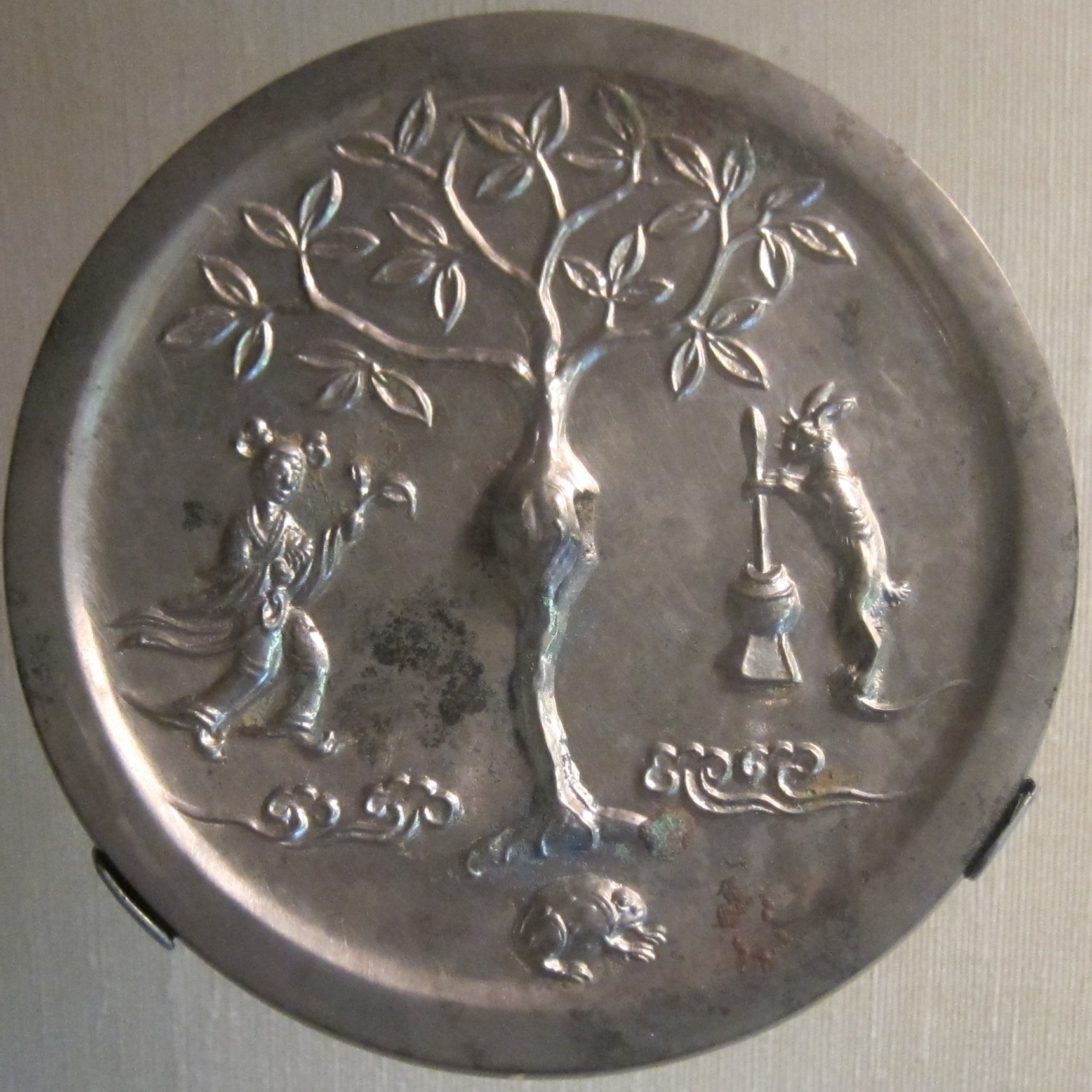
The moon has a workshop in it, and the workshop has a labourer. Look up at the full disc and the old tradition tells you where to find him: a white hare standing upright in the shadows, a stone mortar before him, a long pestle in his forepaws, pounding and pounding without rest at the one drug that defeats death. He does not tire and he does not finish. The elixir is used up as fast as it is made, and so he begins again, and this is what the hare of the moon has been doing, in the popular picture, for as long as there has been a moon to hold him. Beside him, in that same picture, sits the exiled woman who first carried deathlessness up into the sky. But the picture is younger than it looks, and the labour in it younger still, and the oldest question anyone asked about the moon does not mention a hare with a pestle at all.
What benefit, that the creature is in its belly
Go back to the earliest layer and you do not find a story. You find a riddle with no answer attached. In the Tian WenThe "Heavenly Questions" of the Chuci, a Warring-States poem that poses the cosmos as a chain of riddles rather than answering them., the great chain of unanswered questions in the Chuci, a Warring-States voice looks up and asks two things of the moon in a single breath: by what virtue does the night-light die and yet be reborn, and what benefit is there, that the creature is in its belly?
That is the whole of it. There is a creature in the moon and the poem wants to know what it is for. It does not say the creature pounds anything. It does not put a drug in the moon or a mortar under the creature’s paws. It asks a question and moves on to the next, and the answer we now take for granted, the tireless hare at the mortar, is nowhere in the Warring-States text that first noticed there was anything up there to explain.
The word the poem uses for the creature is gu-tuThe ambiguous creature the oldest moon-question places in the lunar disc (顧菟); read by the received tradition as a hare, but argued by some moderns to mean a toad., and it is a genuinely slippery word. The graph can be read as hare, and that is how the received tradition took it: by the Tang, the standard anthologies were writing the line with the unambiguous character for rabbit, and the hare had won. But some modern scholars, most prominently Wen Yiduo in the early twentieth century, have argued that gu-tu here means not a hare at all but a toad. The oldest name for the thing in the moon may not even have been the animal everyone now pictures.
A rabbit and a toad, and a rabbit and a toad
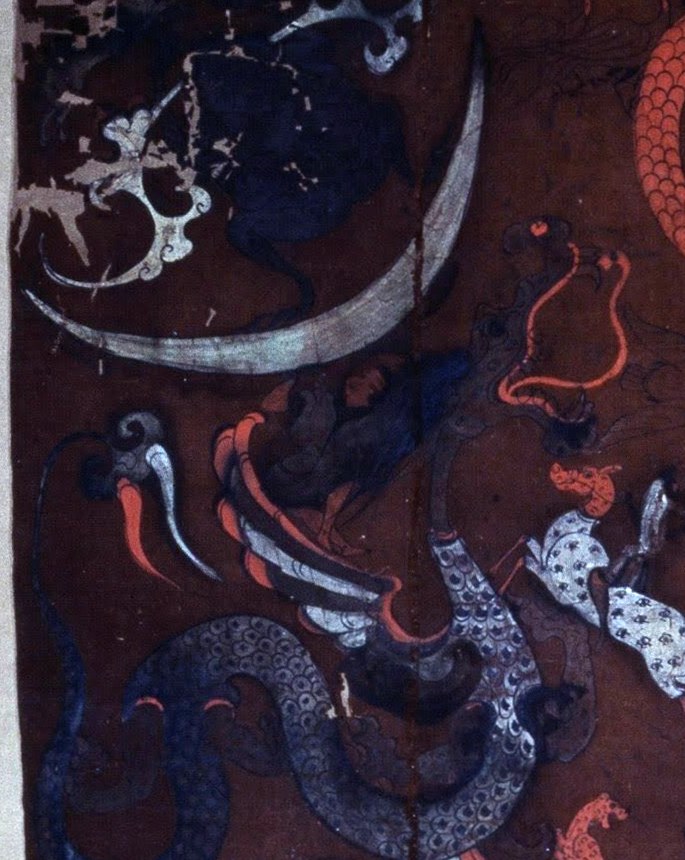
The dispute is old because for a long time nobody had to choose. In the earliest datable evidence the moon holds both creatures at once, side by side, the beautiful and the grotesque sharing a single crescent. The MawangduiThe Western Han tomb complex near Changsha whose Tomb 1 silk banner, buried around 168 BCE, carries the earliest surviving picture of the lunar creatures. silk banner, buried around 168 BCE, paints the moon with a toad and a rabbit upon it together, and it is the oldest surviving picture we have of the lunar face. It shows two tenants, not one replacing the other.
The texts of the same era agree. Liu Xiang, in the first century BCE, states it flatly: in the moon there are a rabbit and a toad. And he tells us why both, in a logic that has nothing to do with cuteness. The moon is yin, the pole of everything dark and watery and female; the toad he reads as yang; and the two are set together on the lunar disc precisely to show yin bound to yang, the moon holding both principles in one body. The pairing is a cosmological statement, a menagerie of principles rather than of pets.
So habitual was the pairing that ordinary people spoke of the moon simply as its animals. A poem from the Nineteen Old Poems of the Eastern Han does not say the moon waxes and wanes; it says the toad-hare waxes and wanes, using the two creatures welded into a single word as the plain name for the thing in the sky. To a Han reader, the moon was the toad-and-hare. Both were always there.
The hand that finally lifts the pestle
When does the hare pick up its tool? Later than almost anyone assumes. The first text that puts a pestle in the rabbit’s paws is a poem by Fu Xian, who lived in the late third century CE, five to six hundred years after the Tian Wen asked its question. He wrote an imitation of that ancient poem, keeping its question-and-answer shape, and to the old riddle of what is in the moon he supplied the answer the tradition had been missing: a white rabbit pounds the drug, and it raises up blessing and sends down good fortune.
That is the whole pedigree of the image the modern moon is crowded with. The creature in the moon is Warring States. The pounding of the elixir is Western Jin, an elaboration set down more than half a millennium later by a poet answering a question a much older poet had only posed. And notice what Fu Xian’s rabbit is for: its labour is beneficent. The pounding is not idle repetition but the manufacture of blessing, a drug that sends fortune down onto the world below. The hare is a benefactor at a workbench, turning out fortune rather than merely marking time.
The older creature was the punished one
There is a sharper irony buried in the dates. The cuddly version, the graceful lady with a devoted white rabbit at her side, is not only late; it is later than a far darker reading of the same moon. Around the early second century CE, a good hundred and fifty years before Fu Xian’s blessing-making hare, the astronomer Zhang Heng gave the moon’s amphibian a terrible identity. In his account the toad in the moon is no mere co-tenant. It is Chang’e herself. The woman who stole the drug of no-death and fled to the moon lodged her body there, Zhang Heng writes, and became the toad.
Set the two readings in their true order and the sentiment inverts. The oldest developed telling of the moon-creature is a punishment: the elixir-thief transformed, at journey’s end, into a squat cold thing crouched on the lunar face. The tidy tableau of a lovely exile served by a diligent rabbit is the softening that came afterward. The reason there is a drug of no-death in the moon for any rabbit to pound is the same theft, told in the Huainanzi around 139 BCE, that stranded the woman there in the first place.
Fuse the three strands, the creature of the riddle, the thief of the elixir, and the pounding hare of the Jin poem, and you get the scene everyone knows: the rabbit brews, endlessly, the very drug the woman beside it once stole. No single ancient text ever states that fused scene. It is a later synthesis of three motifs that began apart, and its softest, most familiar element, the industrious little hare, is the youngest thing in the moon.
What is in the moon? A white rabbit pounds the drug; it raises up blessing and sends down good fortune. (Fu Xian, Ni Tian Wen; author’s rendering from the Chinese)
- Chuci (楚辭), Tian Wen (天問,
Heavenly Questions
), attr. Qu Yuan, Warring States, c. 3rd century BCE: the oldest textual trace of the moon-creature, framed as a question —By what virtue does the night-light die and yet be reborn? What benefit is there, that the gu-tu (顧菟) is in its belly?
(夜光何德,死則又育?厥利維何,而顧菟在腹?). 顧菟 is ambiguous; the text names no drug in the moon and no rabbit pounding, only asks what the creature is for. By the Tang the received anthologies write the line with the unambiguous 顧兔 (rabbit). Chinese read verbatim (zh.wikisource, Wang Yi recension). - Fu Xian (傅咸, 239–294 CE), Ni Tian Wen (擬天問), Western Jin, late 3rd c. CE: the earliest explicit rabbit-at-the-mortar —
What is in the moon? A white rabbit pounds the drug; it raises up blessing and sends down good fortune
(月中何有?白兔擣藥。興福降祉). The load-bearing source for the pounding-hare premise, roughly five to six centuries after Tian Wen. Survives quoted in the Yiwen Leiju (藝文類聚) juan 1 (compiled 624 CE). This is 傅咸 Fu Xian, son of the poet 傅玄 Fu Xuan; the two are routinely confused, and the Yiwen Leiju moon section attributes this line to the son. Chinese read verbatim (zh.wikisource). - Liu Xiang (劉向, 79–8 BCE), Wujing Tongyi (五經通義), 1st c. BCE: the explicit early co-attestation —
In the moon there are a rabbit and a toad
(月中有兔與蟾蜍) — with the yin/yang gloss, the toad as yang joined to the rabbit as yin to show yin bound to yang. A fragment surviving in later quotation. Chinese read verbatim (via zh quotation). - Zhang Heng (張衡, 78–139 CE), Ling Xian (靈憲), early 2nd c. CE: the rival, older-than-the-pounding-hare tradition in which the moon’s toad is the transformed goddess —
Chang’e then lodged her body in the moon, and this is the toad
(嫦娥遂託身於月,是為蟾蜍). Preserved as a quotation in the Taiping Yulan (太平御覽) juan 4 (983 CE); the wording was read via a zh quotation of that excerpt, the Taiping Yulan vehicle not independently opened. - Mawangdui Tomb 1 silk funerary banner (馬王堆一號漢墓帛畫), buried c. 168 BCE, Western Han: the earliest surviving pictorial witness, painting the crescent moon with a toad (蟾蜍) and a rabbit (玉兔) together. Described here from a scholarly summary; the object and a museum catalogue record were not independently inspected, so the
rabbit and toad together
reading should be confirmed against a Hunan Museum catalogue before it is printed as settled fact. - Liu An (劉安, ed.), Huainanzi (淮南子), Lanming xun (覽冥訓), 139 BCE: the connective source for the drug being in the moon at all — Yi requests the drug of no-death from the Queen Mother of the West, and Heng’e steals it and flees to the moon (姮娥竊以奔月). It contains no rabbit and no pounding; the flight is narrated by the companion posts and used here only as the seed that places the elixir where the hare works. Chinese read verbatim (zh.wikisource).
- Gushi Shijiu Shou (古詩十九首,
Nineteen Old Poems
), Eastern Han, 1st–2nd c. CE: #17 uses the kenning 蟾兔 (toad-hare) as the plain name for the moon —at the fifteenth the bright moon is full, at the twentieth the toad-hare wanes
(三五明月滿,四五蟾兔缺). Chinese read verbatim (via zh quotation).