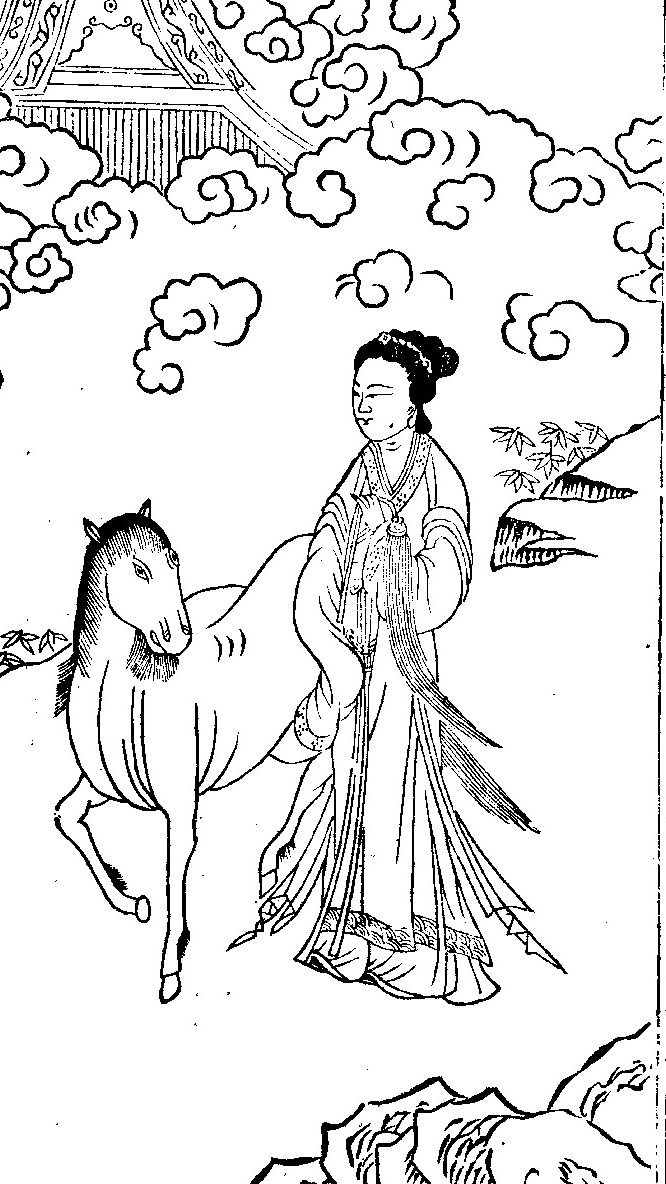
The house was empty except for a girl and a horse. Her father had gone far away on campaign, and there was no one left to keep her company but the single stallion she fed and watered herself. She missed him badly, and one day, half in jest, she said a thing to the animal that she would have given anything to unsay. If you can bring my father home to me, she told the horse, I will marry you. She meant nothing by it. The horse took her at her word.
It broke its own tether and galloped off, and it went straight to the father, far off wherever he was, and would not leave him until he mounted and turned for home. On the ride back the beast kept twisting its head to look behind it and neighing without stop, so mournfully that the man hurried the pace, uneasy at a horse that grieved.
Back in the courtyard it refused all food. Whenever the girl came near it reared and struck at her, until the father pressed her for the reason and she told him what she had said. The promise, he decided, must never be spoken of again, for it would shame the household. Then he took a crossbow, shot the horse dead from ambush, and spread its raw hide out in the courtyard to dry.
A promise spoken to an animal
That is where the oldest full version of the story, in Gan Bao’s Records of an Inquiry into the Spirits, refuses to let the reader look away. The girl walks out to the drying hide and kicks it. You are a beast, she says, so how could you think to take a human being for a wife? At the taunt the flat dead skin rears up off the ground, folds itself around her, and carries her away. A neighbour girl watching is too frightened to move. Days later they find her high in the branches of a great tree, girl and horse-hide grown together and wholly changed into a silkworm, spinning its thread on the wood.
The cocoon it made was thick and heavy, coarse and large, quite unlike the cocoons of ordinary silkworms. A neighbour woman gathered the strange worms and raised them, and her yield of silk came out several times greater than anyone else’s. And the tree in whose branches the girl was found got its name from what had happened there. It was called sang, mulberry, because sang also means loss and mourning. The mulberry is, in the most literal sense the language allows, the tree of grief.
The tree of grief
Gan Bao ends there, in the fourth century, with a dead horse, a transformed girl, a coarse and generous silk, and a bitter pun. There is no goddess in his telling and no heaven. What he gives is an origin-story: this, he says, is where the domestic silkworm came from and why the mulberry is named as it is. It is worth being exact about this, because much later the same story grew a second half.
Roughly six centuries after Gan Bao, a Tang collection now lost, quoted in the Song encyclopaedia Taiping guangji, tells the tale again with a name and an ending. Now the maiden is called Cannü, the Silkworm Woman, and she lives in the land of ShuThe old name for the Sichuan region of southwest China, where the later tradition places the maiden's home and her shrine. in the age of the sage-emperor Gaoxin, though her family name no one remembers.
Everything up to the transformation runs as before. But then the grieving parents look up and see their daughter come down out of the sky on a rolling cloud, riding the very horse whose hide had seized her, with dozens of heavenly attendants around her. The Supreme One, she tells them, has seen that her devotion carried her father home and that her heart never once forgot what was right, and for this she has been given an office among the immortals and life without end in heaven. Then she rises into the void and is gone.
Six centuries to a goddess
This apotheosisThe raising of a mortal into a god; here the ascent the maiden makes only in the later tellings, not in the oldest one. is a real change over time, not two versions of a single fixed thing, and the honesty of the story depends on marking it. Gan Bao’s silkworm-girl of about 350 CE is not yet a goddess. The goddess with a biography and a heaven is a Tang accretion, some six hundred years younger, laid over the old folktale like the hide over the girl. The Ming Complete Compendium of Deities of the Three Teachings keeps the ascent and gives her a slightly different heavenly title, immortal handmaiden of the Nine Heavens, confirming that by then she was firmly a deity with a cult and an image.
The image is the strangest thing about her, and it too belongs to that later Sichuanese cult rather than to the oldest tale. In the temples of Shifang, Mianzhu and Deyang, where each year the silk-farmers came from every direction like gathering clouds to pray for a good harvest of worms, her statue was carved as a young woman with a horse’s hide drawn over her, and she was called Matouniang, the Horse-Head Lady. The rejected suitor never quite lets her go. The skin that killed her and carried her off is the same skin she wears as a goddess and rides in her ascent.
The horse in the worm
None of this is as arbitrary as it first sounds, because the horse and the silkworm were bound together long before anyone told the story of the girl. The riddle-poems of the Xunzi, from the third century BCE and so some seven hundred years older than Gan Bao’s tale, already ask their listener to name a creature whose body is a comely woman but whose head is a horse’s.
That is the silkworm, its blunt head and its pale soft body, and the image of the horse-headed woman is there in the oldest layer of all.
The ritual books push the link further. The office of the Horse-Assessor in the Zhou li is charged, oddly, with forbidding a second brood of silkworms in a year, and the Han commentators explain that silkworm and horse are of one essence, so that a thing cannot be allowed to flourish twice over in both. The folktale did not invent the marriage of horse and worm. It found that marriage already sitting in the almanacs and the rites, and gave it a girl, a crossbow, and a tree.
The reverence ran to the top of the state. At the xiancanThe "First Silkworm" rite, at which the Han empress herself gathered mulberry and sacrificed to the silkworm goddess., the First Silkworm
rite, the Han empress herself went out to gather mulberry and offer sacrifice to the silkworm goddess, so that even the palace kept a version of the debt the folktale accounts for.
There is a quiet trace of her left in ordinary speech too. Silkworm-raisers, the old commentary notes, would call their worms the girls,
a survival of ancient usage, as though every tray of feeding silkworms in a farmhouse still remembered whose daughter they were.
There was a woman who, moved by that dead horse, became a silkworm and clothed the world. (Ji sheng fu, quoted in Taiping guangji 479; author’s rendering from the Chinese)
- Xunzi (荀子),
Fu pian
(賦篇, Rhapsodies), the silkworm riddle, c. 3rd c. BCE: the earliest attestation of the silkworm as a woman-bodied, horse-headed creature — the answer to the riddle is the thingwhose body is a comely woman but whose head is a horse’s
(身女好而頭馬首者), with its threefold transformations (三俯三起). This image is roughly seven hundred years older than the narrative folktale; the two must not be read as one ancient unit. Chinese read verbatim (zh.wikisource). - Cantshu (蠶書,
Silkworm Book
), quoted in the Tang commentary to the Xunzi and in the Soushen ji commentary: the doctrine thatthe silkworm is the essence of the dragon
and thatsilkworm and horse are of the same qi
(蠶為龍精;蠶與馬同氣). Note that this vivid formulation belongs to the commentary, not to the Warring-States Xunzi text itself, and the Cantshu survives only as quoted in those commentaries; cite it at second hand. - Zhou li (周禮),
Xiaguan · Mazhi
(夏官·馬質): the office of the Horse-Assessor endsprohibits second-brood silkworms
(禁原蠶者), which Zheng Xuan’s Han commentary explains by the shared essence of horse and silkworm. The ritual-astrological root of the horse–worm link the folktale dramatises. Chinese read verbatim (zh.wikisource). - Gan Bao (干寶), Soushen ji (搜神記), juan 14, c. 350 CE: the oldest surviving full prose telling — the vow to the stallion, the crossbow killing and the drying of the hide (伏弩射殺之,暴皮於庭), the hide rearing up to seize and carry off the girl (馬皮蹷然而起,卷女以行), the transformation into a silkworm whose cocoon is
thick and large, unlike ordinary silkworms
(綸理厚大,異於常蠶), and the mulberry named for mourning (桑者,喪也). This version has no apotheosis and names no goddess. Includes the commentary on the Zhou li, the Cantshu, and the Han xiancan rite to Wanyu furen (菀窳婦人) and Yushi gongzhu (寓氏公主). Chinese read verbatim (zh.wikisource). - Taiping guangji (太平廣記), juan 479, entry
Cannü
(蠶女), compiled 978 CE, quoting the lost Tang Yuanhua zhuan shiyi (原化傳拾遺): names the maiden Cannü, sets her in Shu under Emperor Gaoxin, and adds the heavenly ascent on a cloud (riding the horse, with dozens of attendants) and her appointment to a celestial office (九宮仙殯之任). Gives the earliest attestation of the cult title Matouniang (馬頭娘) and the horse-hide statue, with the Sichuan shrine sites of Shifang, Mianzhu and Deyang. Chinese read verbatim (zh.wikisource). - Sou shen daquan (三教源流搜神大全), juan 3, entry
Cannü
(蠶女), Ming dynasty: an abbreviated retelling ending in the apotheosis, with the heavenly title given here asimmortal handmaiden of the Nine Heavens
(九天仙嬪). Confirms the tale as an established deity-biography with a cult image. Chinese read verbatim (zh.wikisource). - Hou Han shu (後漢書), juan 94 (Fan Ye, 5th c. CE): corroborates the Han imperial xiancan (先蠶,
First Silkworm
) rite, at which the empress gathered mulberry and sacrificed, and the goddess-names Wanyu furen and Yushi gongzhu, independently of the Soushen ji. Cited as corroboration; the Hou Han shu passage was not read verbatim this session, so re-verify the exact wording and juan before quoting it directly.