A woman had carried her pregnancy for three years and six months, and when the labour finally came she gave birth not to a child but to a ball of flesh, whirling round and round the room like a wheel, flooding the chamber with red light and a strange perfume. Her husband, a garrison commander who had been dreading a demon, drew his sword and struck the thing. It split open with a ringing sound, and out sprang a boy already wearing a gold bracelet on his wrist and a length of red silk about his belly. This is how the Investiture of the Gods introduces Nezha, and it is worth pausing on what it does not do. It does not tell you he is a lord of anything, or a patron of any trade. It gives you a monster in a nursery.
Nezha is one of the most beloved gods in the Chinese popular pantheon, the boy-hero of temple carvings, opera, and a run of blockbuster animated films. He is also, for a god of his fame, oddly rootless. There is no ancient scripture behind him. Every scene that matters comes from vernacular prose novels written between the fourteenth and seventeenth centuries, and those novels do not agree with one another on the details that matter most.
The name that came from Sanskrit
Start with the name, because the name gives the game away. Journey to the West offers a charming explanation: the newborn had the graph ne on his left palm and zha on his right, and so they called him Nezha. It is a good story and it is not true. The name is a worn-down Chinese transcription of the Sanskrit Nalakūvara, a yakṣaA nature-spirit of Indian religion, often a guardian or attendant of a god; fierce, wealthy, sometimes benevolent, sometimes dangerous.-prince who was the son of Vaiśravaṇa, the Buddhist heaven-king known in China as the god Kubera.
That figure reached China through the esoteric Buddhist translations of the Tang dynasty, in the eighth century, which is where the modern scholar Meir Shahar traces both the name and the pagoda-bearing father. It matters for dating. The novels that made Nezha famous are late, but the god they inherited was already six to nine centuries old when the earliest of them was written. Nezha was not invented by the Ming. He was reworked by it, twice, and in two different religions.
Flesh to the father, or flesh to both
The scene every version keeps is the one where the boy takes his own body apart. As a child he provokes the dragon kings of the sea, killing a dragon prince and stripping out its sinews to make his father a belt, and the reprisal falls on his parents. To spare them, Nezha unmakes himself. He cuts open his belly, scrapes the flesh from his bones, and hands his body back to the people who gave it to him, cancelling the debt of his own birth. His defiant motto in the Fengshen Yanyi is a single blunt line: one person’s deeds, one person bears them.
Here the three sources pull apart, and they are worth setting side by side because they are not contemporaries. The Sou shen daquan, whose Nezha entry is the oldest full life we have, is a late-Yuan compendium surviving in a Ming reprint of the fifteenth or sixteenth century; the Fengshen Yanyi was written around the 1620s. Between the earliest and the latest telling lies something on the order of a century and a half to two and a half centuries, and across that gap the accounting of the body changes every time.
In the Sou shen daquan the boy returns flesh and bone to his father alone. In Journey to the West, printed in 1592, he cuts his flesh to return to his mother and scrapes his bone to return to his father, splitting the debt between them. In the Fengshen Yanyi he gives belly, entrails, flesh and bone back to both parents at once. There is no single formula to print as the myth. There are three settlements of the same terrible account.
Reborn of lotus, by the Buddha or by an immortal
Then he is remade from a plant, and this is the deepest divergence of all, because it turns on religion rather than detail. In the two earlier, Buddhist-framed tellings the resurrector is the Buddha himself. The Sou shen daquan has the World-Honoured OneA common Chinese Buddhist title for the Buddha (Sanskrit Bhagavat), the Enlightened One honoured by all the worlds. break lotus stalks for the boy’s bones, lotus-root for his flesh, fibres for his sinews and leaves for his clothing. Journey to the West keeps the same hand at work, the Buddha using green lotus-root for bones and lotus-leaves for a garment and chanting a resurrection mantra over the drifting soul.
The Fengshen Yanyi writes the Buddha out entirely. Here it is a Daoist master, Taiyi ZhenrenA Daoist immortal of the Golden-Light Cave; in the Investiture of the Gods he is Nezha's master and the one who rebuilds him from lotus. of the Golden-Light Cave, who builds the new body, and he does it with a cosmologist’s care: two lotus flowers and three lotus leaves, the stems folded into three hundred bone-joints, the leaves set as Heaven, Earth and Man, a pellet of golden elixir placed at the core, the soul worked back in. The prince springs up a full body-length and more in height, face powder-white, lips vermilion, eyes flashing light.
This is the version modern film and television draw on, and it is the youngest and most sectarian of the three. The lotus-rebirth was not one ancient myth that Daoism preserved. It was a Buddhist story that Daoism captured and re-attributed, and the Daoist retelling is the latecomer, not the source.
The pagoda and the war-form
What survives all three is a particular shape: the terrifying, self-dismembering child who has to be leashed. After his rebirth Nezha hunts the father who let him be broken, and the tradition needs a way to stop him. It reaches for a glowing tiered golden pagoda, given to the father to cow the vengeful son into calling him father
again. Journey to the West has the Buddha hand it over, telling Nezha to take the Buddha as his father instead, and this, the novel says, is why the man is called the Pagoda-Bearing Heavenly King. The Fengshen Yanyi stages the same leash by other hands but keeps the pagoda, and keeps the outcome.
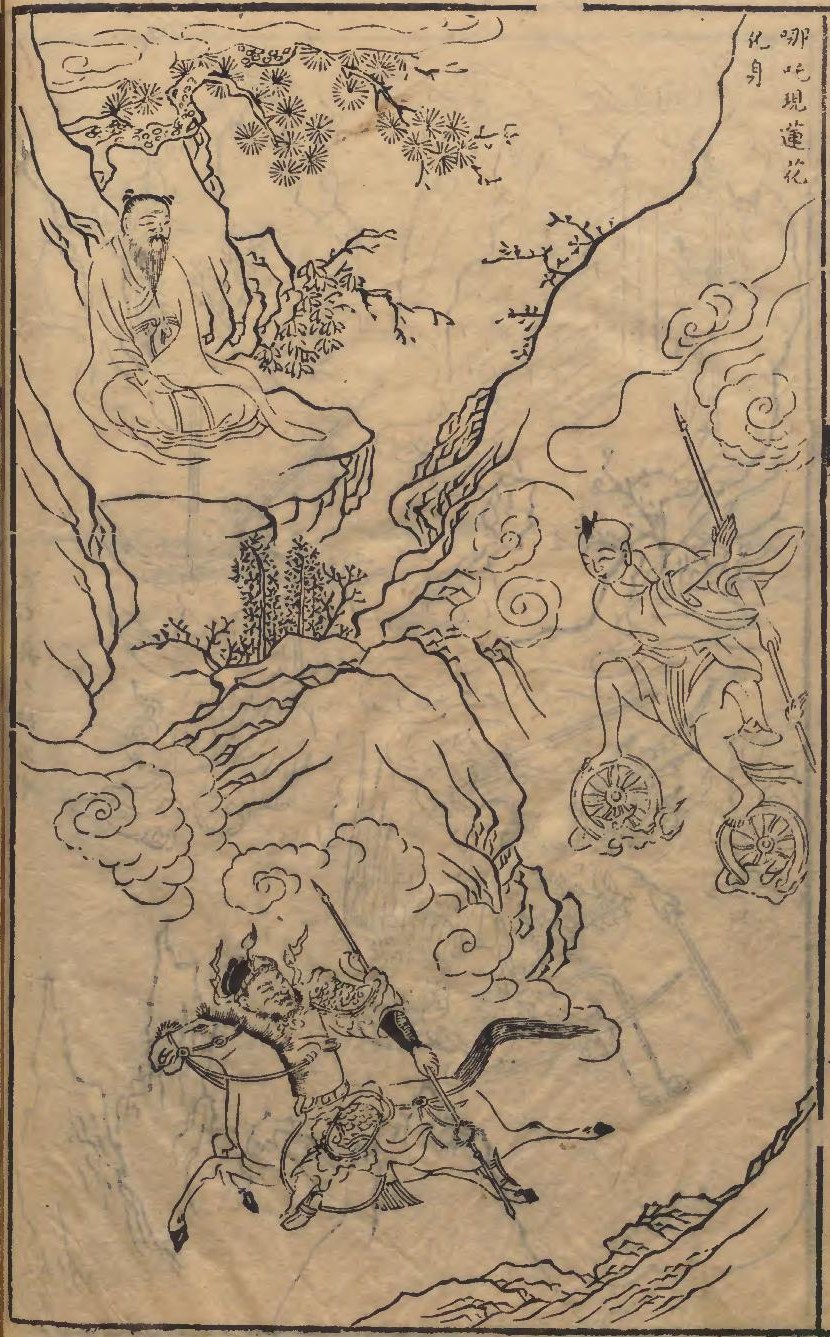
The rest of his iconography is armament. He fights on two Wind-and-Fire Wheels that carry him through the air, levels a fire-tipped spear, and hurls the gold ring and red sash he was born wearing. In his battle-fury he takes on a war-form of three heads and multiple arms: eight arms in both the Sou shen daquan and the Fengshen Yanyi, the earlier text adding nine eyes and a blue cloud pouring from his mouth.
The popular phrase gives him three heads and six arms, but that count is a general Chinese idiom for a superhuman, not what these sources actually assign him. Read closely, the boy who un-owed his own body is armed with the objects he was born holding, and rides to war on wheels of wind and fire.
Today I cut open my belly, gouge out my entrails, and scrape off my flesh and bone to return them to my parents, so as not to burden them. (Fengshen Yanyi, ch. 13; author’s rendering from the Chinese)
- 三教源流搜神大全 (Sanjiao Yuanliu Soushen Daquan,
Complete Compendium of the Deities of the Three Religions
), 那叱太子 (Prince Nazha
) entry, juan 7: a Ming reprint (c. 15th–16th c.) of a late-Yuan (c. 14th c.) hagiographic compendium, and the earliest full prose life of Nezha. Buddhist in frameflesh and bone returned to the father alone (割肉刻骨還父); the World-Honoured One rebuilding him from lotus stalk, root, fibre and leaf (折荷菱為骨、藕為肉、系為脛、葉為衣); the three-head, nine-eye, eight-arm war-form (三頭九眼八臂). Chinese read verbatim (zh.wikisource.org). - 西遊記 (Xiyouji / Journey to the West), ch. 83: first printed 1592 (Shidetang edition), attributed to Wu Cheng’en. The compact, best-known backstory, still Buddhist in framethe palm-graph name etymology (哪/吒); the sea-trouble and flood-dragon sinew-belt (抽筋為絛子); flesh returned to the mother, bone to the father (割肉還母,剔骨還父); the Buddha rebuilding him from green lotus-root and lotus-leaves (碧藕為骨,荷葉為衣); the golden pagoda given to Li Tianwang and the command to
take the Buddha as father
(以佛為父). Chinese read verbatim (zh.wikisource.org). - 封神演義 (Fengshen Yanyi / Investiture of the Gods), ch. 12–14 (war-form in ch. 76): Ming, c. 1620s, attributed to Xu Zhonglin / Lu Xixing. The longest, most detailed version, re-skinned as Daoist. The three-and-a-half-year pregnancy and flesh-ball birth (一肉毬,滴溜溜圓轉如輪); the Universe Ring (乾坤圈) and Sky-Muddling Sash (混天綾); the self-evisceration before the Four Dragon Kings (剖腹、剜腸、剔骨肉,還於父母); the Daoist master Taiyi Zhenren, not the Buddha, building the lotus body (蓮花二枝,荷葉三個…三百骨節). Chinese read verbatim (zh.wikisource.org).
- **Meir Shahar, *Oedipal GodThe Chinese Nezha and His Indian Origins* (2015):** modern scholarship on origins only, cited for the derivation of Nezha from the Buddhist yakṣa Nalakūvara (那吒鳩伐羅), son of Vaiśravaṇa / Kubera, imported through Tang esoteric Buddhist translations of the eighth century — the ultimate root of the name and of the pagoda-bearing father, some six to nine centuries before the earliest of the three novels above.