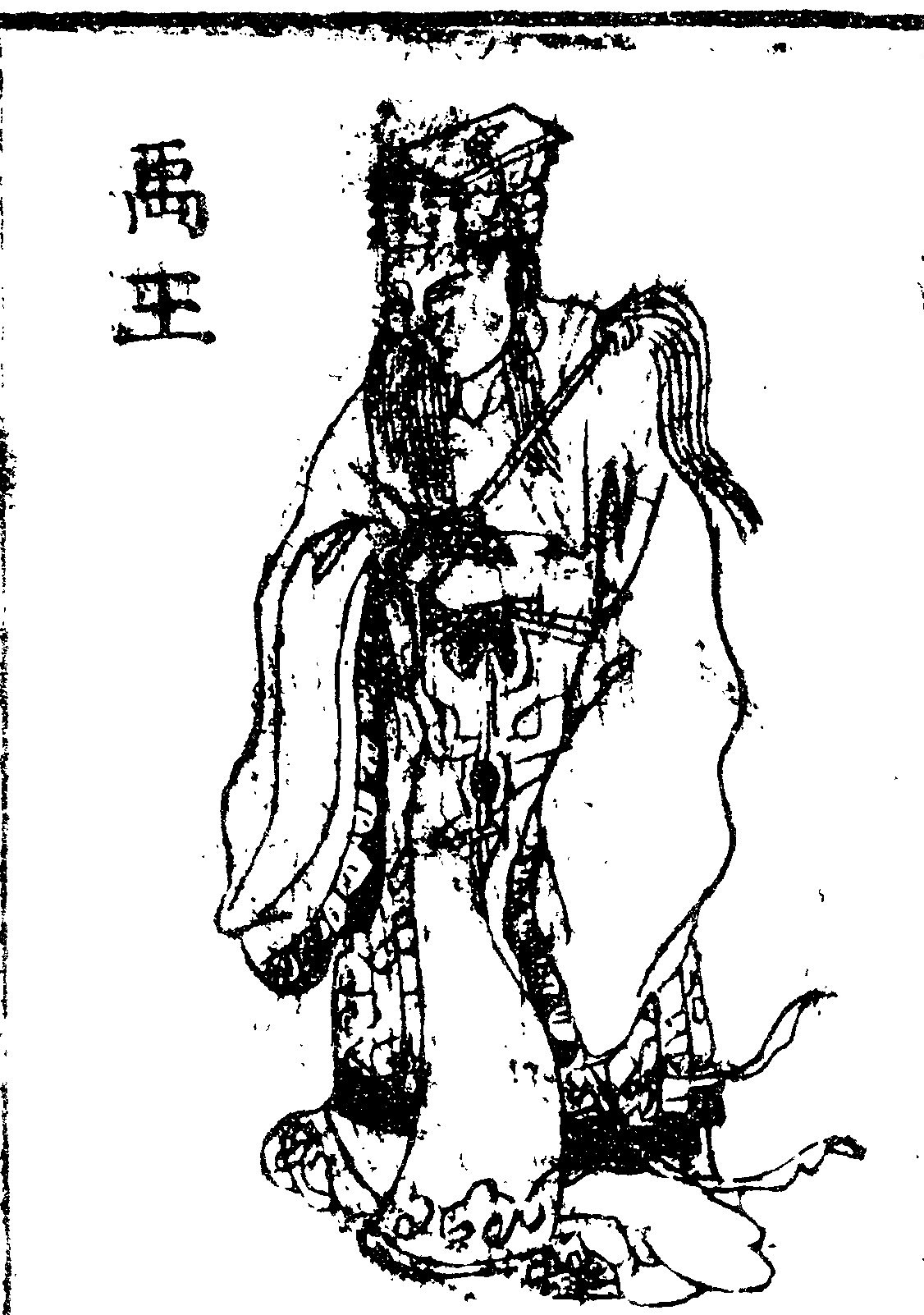
The court had a problem no one wanted, and the man they handed it to was a man the throne distrusted from the first. When the flood-waters climbed towards heaven and the people below cried out to be saved, the emperor Yao asked who could master them, and his counsellors answered with a single name he did not like. Gun. Yao said plainly that the man was perverse, disobedient to orders, quick to injure his peers. The counsellors pressed anyway. Try him, they said, and see. So the salvation of a drowning world was entrusted to a candidate the sovereign had already judged unfit, and the record keeps Yao’s misgiving on the page beside the appointment, as if to warn what is coming.
How Gun then fought the flood, and how his son later beat it, is told at length in the companion piece Gun, Yu, and the Great Flood,
which follows the water from the first dam to the last channel. This is not that. This is the far narrower and stranger thing that runs between the two men themselves: a charge that killed the father and was then handed, still warm, to his son; a corpse that produced its own heir; and the fact that the tradition could never agree who was responsible for Gun’s death. The flood is only the weight the two of them carry, one after the other. This piece is about that handover.
The weight one throne handed twice
Gun worked to control the flood for nine years, and at the end of nine years it stood no lower than when he began. For that failure he was put to death. What the relationship turns on is what happened next, in a single sentence of the court history so compressed it is almost cruel to read slowly: the same ruler who had just put Gun to death raised up Gun’s son and ordered him to continue his father’s undertaking.
Continue Gun’s undertaking. Execution and promotion in one breath, from one hand. The throne killed the man for failing at the flood and in the next moment set the identical charge, the same drowning world, on the shoulders of the dead man’s child.
Nothing about that is softened by the sources. The Shiji states it flat, as administration: the merit was absent, so the father was punished; the son was able, so the son was appointed. But laid out plainly it is the whole of the bond in miniature. The father shows what the task cost. The son shows who was given it next. Between them there is no inheritance of property or of name, only of the work itself, and the work has already proved it can kill.
What Heaven withheld, and then gave
The older cosmological reckoning tells the same succession in a graver key, and here the sheer distance between the witnesses matters. The Book of Documents, in the stratum called the Great Plan, is separated from Sima Qian’s court history by something on the order of six hundred years or more, and it does not describe a justice ministry at all. It describes a verdict in heaven.
Gun, by walling the flood, threw the ordering of the Five PhasesThe five agents (wood, fire, earth, metal, water) whose ordering governs the cosmos; by damming the flood Gun is said to have thrown their arrangement into disorder. into disorder, and for that the High God was roused to anger and withheld from him the Great Plan of governance, the nine categories by which a ruler holds the world in order. The father is not merely killed. He is denied the very knowledge that would have let him govern.
And then, in the same breath, that knowledge is granted to the son. Gun rose up no further; his son Yu rose up in his place, and to Yu Heaven gave the Great Plan it had refused the father. This is the succession stripped to its metaphysics: one identical office, one identical world to be set right, and two men standing in opposite relation to the power above. The father was refused the Great Plan; the son received it. Same task, same earth, opposite standing before Heaven, and only death lies between the two verdicts.
Three hands on the killing
The tradition cannot even agree who did the killing, and the disagreement is not a scribe’s slip. It is the record splitting along the seams of its own centuries. Three sources name three different agents at one place, Feather MountainThe remote place (羽山) where the sources agree Gun was killed or exiled, and where, in the Zuozhuan, his spirit sinks into the Feather Abyss below it., the bleak height where Gun met his end: the fire-officer ZhurongThe High God's fire-officer, sent in the mythic register of the Shanhaijing to kill Gun at Feather Mountain: fire despatched against the failed master of water., the emperor Shun, and the emperor Yao. They agree on nothing else.
In the mythic reckoning of the Shanhaijing, whose earliest stratum reaches back to the Warring States around the fourth century BCE, the death is a divine execution: the High God orders his own fire-officer to kill Gun at the wild outskirts of the mountain. Move forward some six hundred years to the Shiji of around 91 BCE and the god has vanished from the scene; now it is the sage-emperor Shun who inspects the failed work, finds it without merit, and puts Gun to death, and all under heaven holds the sentence just.
The Zuozhuan, older than the Shiji, names a third hand again: not Zhurong, not Shun, but Yao, the very emperor who first appointed him. A god’s fire-deputy in one age, a successor’s court of justice in another, the appointing sovereign’s own hand in a third. The three cannot be reconciled. To write that Gun was executed
and stop is to paper over exactly the fracture the record has kept.
Even the manner refuses to settle. The word the chronicles use for what was done to him can mean put to death, and it can equally mean banished for life, so that whether Gun perished at Feather Mountain or was only exiled there to die is a genuine fork in the ancient language, not a modern quibble. The relationship survives every version of it: however Gun went, and by whosever hand, the charge outlived him and fell to his son.
The inheritance that came out of the body
The oldest telling makes the succession literal in a way no genealogy would dare. It does not have Yu inherit the task as a living son inherits from a dead father. It has him come out of the father. Gun’s body did not decay where it lay; out of it came Yu. The sibling story dwells on this as a marvel; here it is something else, the succession carried to its limit.
The father does not merely pass the work on. He becomes the one who takes it up. The dead flesh of the failed method is the very stuff the new man is made from, so that the line from father to son is not a handing-over at all but a single continuous body, failing and then trying again.
The poets of the south, generations on, could only turn the thing into questions they refused to answer, and the fact that they were already asking is the proof that this was old and strange long before they reached it. What the questions leave standing is the shape that matters for the two men: the son is a second attempt by the very same substance, sent back to the same water with the same commission. He carries his father forward into the work, which is why his success is also, quietly, his father’s, and his father’s failure is the ground he stands on.
Condemned in one book, worshipped in the next
There is a last fork, and it decides how heavily the whole inheritance weighs. In the Book of Documents Gun is filed among the Four Criminals, a malefactor whose punishment secures the new sovereign’s order.
But the Zuozhuan gives the executed man a sequel the criminal register would never allow: his spirit changed into a yellow bear, or, as many old readers insisted the Chinese character should be read, a three-legged turtle, and sank into the Feather Abyss below the mountain, and there the man who failed became the Xia’s suburban sacrifice, honoured by three dynasties after. The father the son inherits from is thus two fathers at once, a condemned failure and a worshipped spirit, and the son’s own standing shifts depending on which one is meant.
That is the tension the honest telling holds and does not resolve. Between father and son runs one unbroken line: the same water, the same commission, the same throne. Everything else forks. The father is condemned and the son is blessed; the father is denied Heaven’s Plan and the son is given it; the father is a criminal in one book and a god in another. And the son does not stand beside the father so much as continue him, made from his body, sent to finish his work, so that the family saved the world across two lives and paid for it with the first of those two lives.
Thereupon Shun raised up Gun’s son Yu and had him continue Gun’s undertaking. (Shiji, “Xia benji”; author’s rendering from the Chinese)
- Shanhaijing (山海經), Hainei jing (海內經), comp. c. 4th–1st c. BCE: the mythic register — Gun steals the High God’s swelling-soil (xirang, 息壤) to dam the flood without waiting for the Lord’s command (鯀竊帝之息壤以堙洪水,不待帝命), the God has the fire-officer Zhurong kill Gun at the outskirts of Feather Mountain (帝令祝融殺鯀于羽郊), Yu is then born from Gun (鯀復生禹), and the God commands Yu to finish spreading the soil and settle the Nine Provinces (帝乃命禹卒布土以定九州); also the pedigree Yellow Emperor → Luoming → Bai Ma = Gun (黃帝生駱明,駱明生白馬,白馬是為鯀). Chinese read verbatim. EnglishAnne Birrell, The Classic of Mountains and Seas (Penguin, 1999).
- Shujing (書經 / 尚書, Book of Documents), Canon of Yao (堯典): the court’s nomination of Gun over Yao’s stated doubt that he is perverse and disobedient, and the nine fruitless years (九年). Chinese read verbatim. EnglishJames Legge, Sacred Books of the East vol. 3 (1879).
- Shujing, Canon of Shun (舜典): Gun held prisoner till death on Feather Mountain (羽山) among the Four Criminals, whose punishment secures the realm’s assent (殛鯀于羽山,四罪而天下咸服). Chinese read verbatim. EnglishLegge, SBE 3.
- Shujing, Hong fan (洪範, The Great Plan): Gun’s failure framed cosmologically — he dammed the flood and threw the Five Phases into disorder, so the High God withheld the Great Plan from him; Gun was executed and his son Yu rose up to succeed him and receive it (鯀陻洪水,汩陳其五行…鯀則殛死,禹乃嗣興). Chinese read verbatim. EnglishLegge, SBE 3.
- Shiji (史記, Records of the Grand Historian), Xia benji (夏本紀), Sima Qian c. 91 BCE: the court-history register — the genealogy through Zhuanxu, Yao’s objection that Gun defies orders and ruins his kin (鯀爲人負命毀族,不可), the nine-year failure (九年而水不息,功用不成), Shun’s execution of Gun at Feather Mountain (乃殛鯀於羽山以死), and the hinge sentence in which Shun raises up Gun’s son Yu and has him continue Gun’s undertaking (舉鯀子禹,而使續鯀之業). Chinese read verbatim; no complete public-domain English of the Shiji, so the renderings above are the author’s literal translations of the quoted Chinese.
- Zuozhuan (左傳, Zuo Commentary), Duke Zhao year 7 (昭公七年), c. 4th c. BCE compilation: of old Yao punished Gun at Feather Mountain and his spirit became a yellow bear that entered the Feather Abyss (羽淵), becoming the Xia suburban sacrifice honoured by three dynasties (昔堯殛鯀于羽山,其神化為黃熊,以入于羽淵,實為夏郊,三代祀之). Chinese read verbatim. Notethe received graph 熊 (bear) is widely read by commentators as 能 (nai), a three-legged aquatic creature rather than a bear; both readings circulate.
- Chuci (楚辭), Tian wen (天問, Heavenly Questions), c. 3rd c. BCE: the sympathetic register posed as unanswered questions — why Gun’s body was held three years at Feather Mountain without decaying (永遏在羽山,夫何三年不施) and how the transformation from Gun to Yu occurred (伯禹愎鮌,夫何以變化). Chinese read verbatim. EnglishDavid Hawkes, The Songs of the South (Penguin, 1985).