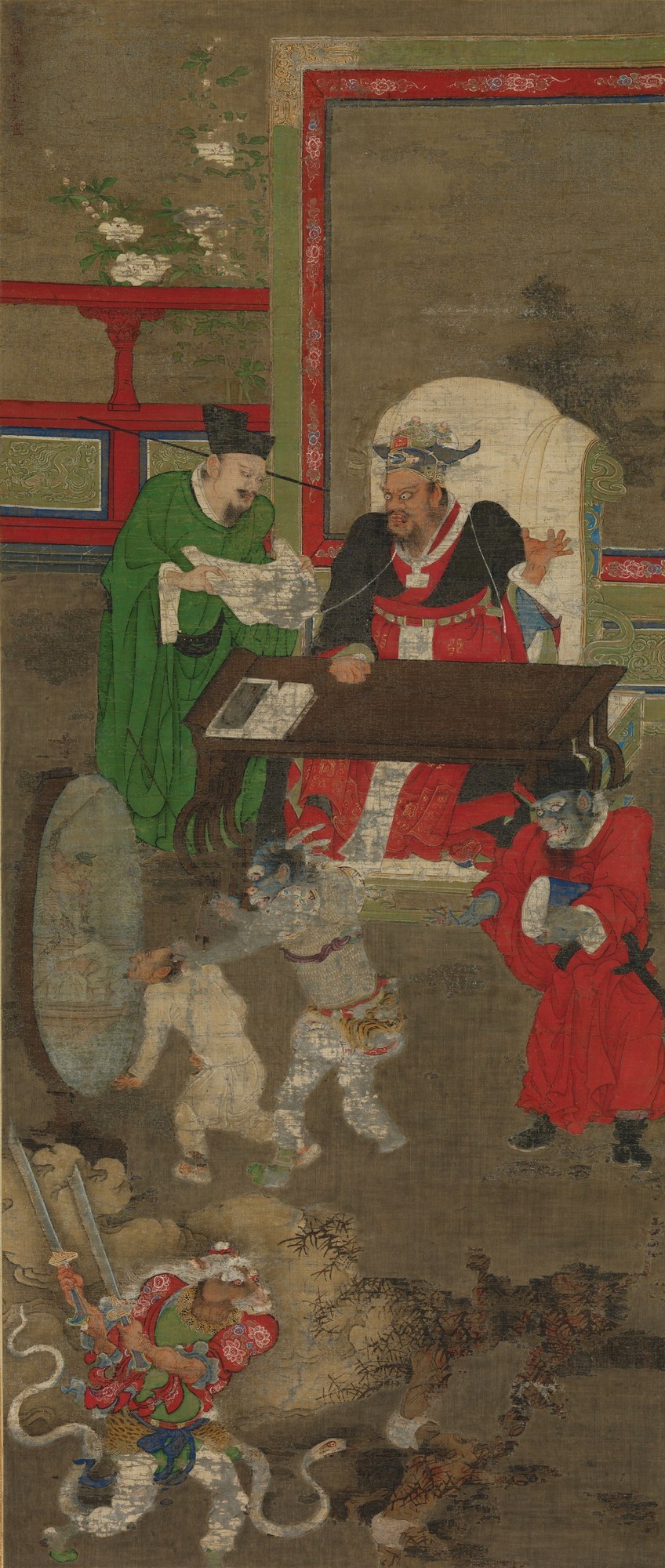
Three times a day and three times a night, in the oldest Chinese account of him, a great copper cauldron appears and the king of hell is dragged from his throne. The wardens of his own prison lay him on scorching iron, force his mouth open with iron hooks, and pour molten copper down his throat, burning lips and tongue and belly, before releasing him to his palace until the next watch. This is Yama, the death-judge the Buddhist translators brought into China around the fifth century, and the first surprising thing about him is that he is not omnipotent. He rules the dead and he suffers among them, a sovereign under sentence working off a karmic debt of his own, his authority the authority of a magistrate who is himself on the books.
His name arrived as a sound before it arrived as a meaning. Yanluo Wang is a Chinese transcription of the Sanskrit Yama Rāja, King Yama,
padded out from the foreign syllables; wang alone means king. The translators who could not resist a meaning rendered him a second way, by sense rather than sound, as Pingdeng Wang, King of Impartiality.
Huilin’s early-ninth-century dictionary of Buddhist terms gives exactly this sense-translation, and it holds the whole promise of the office: whatever else the dead lose, they face the same scales.
The three messengers on the road
In the Āgama sutras, translated into Chinese around the turn of the fifth century, Yama does one specific thing before he sentences a soul. He asks it a question. Did you not see, walking in the world, the three heavenly messengers? Not gods with wings, but the three warnings any living person passes and pretends not to recognise: an old person bent and toothless, a sick person wasted by fever, a corpse three days dead and swelling. These were sent to you, Yama says, as plainly as a summons, and you looked away. The judgement is not an ambush. It is the settling of an account the dead person spent a lifetime refusing to read.
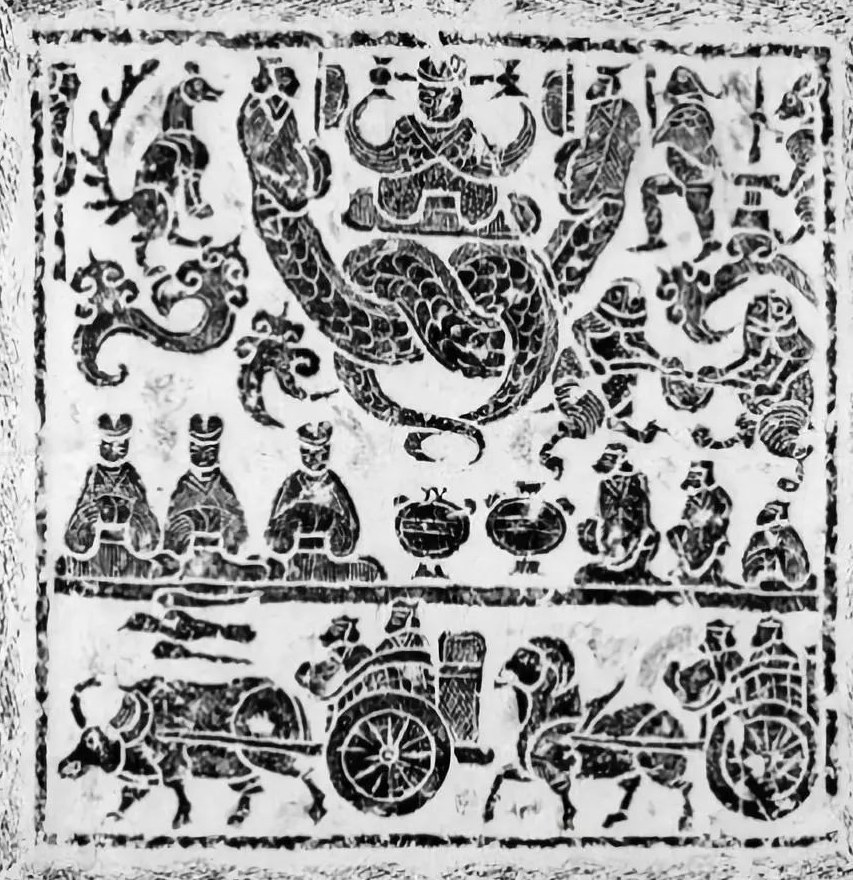
This early Yama is Buddhist and Indian to the root, and China at first had no place for him. Before Buddhism arrived there was no single lord of the dead here at all: the dead were thought to gather at Mount Tai in the east, or at Fengdu, or at the Nine Springs (Jiuquan) underground, presided over by no one judge. Yama’s cult as hell-sovereign spread only in Buddhism’s wake, laid over an older, vaguer geography of the grave. Everything vivid that follows is what China did to him once he was inside the gate.
Cut into ten
What China did, chiefly, was multiply him. Under the Tang, folk religion and Daoism took the one Buddhist Yama and split his single throne into ten, the Ten Kings of the Ten Courts, each a magistrate presiding over one court of DiyuThe Chinese underworld, literally "earth-prison": not a place of eternal fire but a bureaucratic, purgatorial transit where finite sentences end in rebirth., each appointed to his hell by the Jade Emperor. Yanluo, who had been the whole of hell’s sovereignty, was slotted in as merely the fifth: the absolute Indian judge became a middle manager in a Chinese ministry.
The earliest text for this system is a pair of scriptures attributed to a monk named Zangchuan, of a monastery in Chengdu, in the ninth century. They are apocrypha, Chinese compositions dressed as translated sutra, and they follow the soul through the ten courts during the antarabhavaThe intermediate state a Buddhist soul passes through between one death and the next rebirth, in China lasting the forty-nine days of the mourning schedule., the intermediate state between one death and the next rebirth.
What makes them unmistakably Chinese is the calendar they bolt on. The soul is tried court by court on a fixed schedule of mourning: the first seventh day after death, then each seventh day in turn to the forty-ninth, then the hundredth day, the first anniversary, the third. Ten judgements, ten memorial feasts, the family commissioning Buddhist merit-works at each to buy the sentence down. This is the exact seam where an Indian doctrine of karmic reckoning was sewn into the Chinese rite of ancestral mourning, and it is why the passage through hell takes precisely as long as a Chinese family grieves.
None of this is ancient, and none of it is Buddhist canon. It is a ninth-century development, heavily Daoicised, and it stands better than a thousand years downstream of the Indian Yama who suffers in the copper cauldron. When a later reader meets the ten kings of hell
and imagines something China believed from the beginning, the reader is off by the better part of a millennium and by a whole religion of the afterlife.
Why the compassionate judge was demoted
The folk imagination noticed the demotion and, in its way, explained it with a story. The Jade Record, a Qing illustrated morality tract that dresses itself in Song robes, says Yanluo once held the first court, the court of intake, but was moved down to the fifth by the Highest God because he proved too compassionate: he kept letting the souls of murder victims go back to the world for another life, and mercy on that scale is a flaw in a magistrate. He was demoted for kindness, and given a Tower to View the World, from which the dead watch their own families curse their memory and quarrel over the estate.
The Jade Record is where the popular cosmology of hell is fullest, and it should be dated for what it is. It presents itself as a Song text but the illustrated editions people actually read are nineteenth-century Qing, and the demotion tale is folk aetiology, not Buddhist doctrine. In the first court the newly dead face the Mirror Platform, which shows them every sin they committed, and the catalogue of sins is a Qing moralist’s own: mocking the tract itself, drinking, gambling, cheating, killing living creatures, drowning baby girls.
At the far end of all ten courts, before the soul is returned to the world, the goddess Meng Po serves her broth of oblivion at the Naihe BridgeThe narrow plank-bridge over the river of the dead, crossed on the way to rebirth; in folk telling Meng Po serves her soup of forgetting at its far end., and the dead forget everything and are born again clean.
Judgement of a living emperor
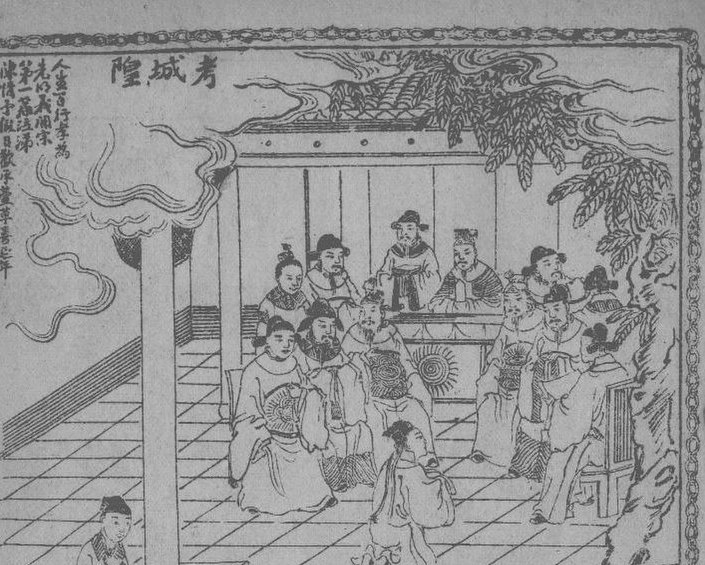
The single most famous scene of Yanluo in court is not scripture but a Ming novel. In Journey to the West, the emperor Taizong is hauled to judgement over a broken promise: he had sworn to spare a condemned dragon-king, and his own minister beheaded the dragon anyway, in a dream, over a game of chess. The dragon’s ghost drags the emperor down. Two black-robed pages carry the invitation, and over the city gate of the dead, in golden letters, stands the inscription: THE GATE OF GHOSTS WHO ENTER THE UNDERWORLD.
What happens inside is pure Chinese bureaucracy. The ten kings descend the steps and bow, hosts to a living guest, and seat the emperor in the Senluo Hall: your majesty is a ruler among men, they tell him, and we are only rulers among ghosts. A judge named Cui, a former Tang official now serving in the underworld’s registry, searches the register of lifespans, finds the emperor down for thirteen years of reign, and quietly turns the thirteen into thirty-three, two strokes of the brush.
On the way out the emperor is led past the Naihe Bridge, three narrow planks over a thousand feet of black water with no rails, and past a city of those who died unjustly, where he must borrow a dead man’s buried gold to buy off the ghosts blocking his road. He wakes in his coffin charged with founding a great Mass for the homeless dead, the pretext that will launch the whole pilgrimage.
The novel cannot keep its own hell consistent, and the inconsistency is worth keeping rather than smoothing. Elsewhere in the same book, when Monkey storms the underworld, the ten kings name themselves off one by one and Yanluo is plainly one of the ten. Yet in the emperor’s audience Yanluo speaks as chief judge over the whole assembly. He is both the fifth of ten and the head of all ten, because he was one thing for six hundred years and then another, and the novel simply prints both without choosing.
An office, not a man
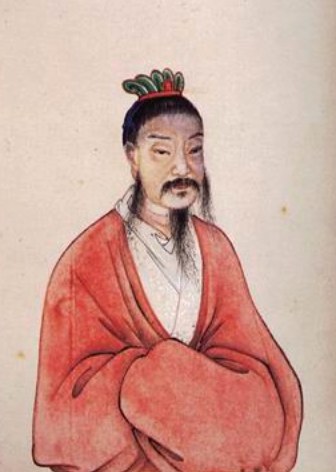
Underneath all the variation runs one durable Chinese idea: Yanluo is less a person than a post, and an upright man could be appointed to it. The Sui general Han Qinhu, the Book of Sui reports, declared on his deathbed that to have been a Pillar of State in life and Yanluo Wang in death was honour enough. More often the office falls to the Song magistrate Bao Zheng, who in legend judges the living by day and the dead by night. Above the whole apparatus stands the bodhisattva Dizang, who vowed not to become a Buddha until hell itself is emptied, the one figure in the machine whose mercy is unlimited rather than a demotable flaw.
That is the shape of Yanluo Wang: a red-faced, bulging-eyed magistrate in a cap marked with the character for king, printed today on the underworld’s hell money where a living nation prints its president. He is the Indian death-judge who came to China as a single sovereign and was reorganised into a committee, the impartial scale reissued as a filing system. He does not damn the dead forever. He processes them, on a schedule, toward the bridge and the soup and the road back into the world.
“Your Majesty is a ruler among men on earth; we are only rulers among ghosts and demons in Hell.” (Journey to the West, ch. 10–11; Timothy Richard, trans., 1913, p. 119)
- 長阿含經 卷19 世記經·地獄品 — Dīrgha Āgama (Chang Ahan jing), Hell chapter (Chinese trans. c. 413 CE): the pre-sinicised Buddhist Yama. Yama is himself a sufferer, seized three times a day and night by hell-wardens who lay him on hot iron and pour molten copper down his throat, then restored to his palace; and the interrogation of the dead on the
three heavenly messengers,
old age, sickness and death. Chinese read verbatim via CBETA, relayed through zh.wikipedia 閻羅王. - 中阿含經 卷12 天使經 — Madhyama Āgama (Zhong Ahan jing),
Sutra of the Heavenly Messengers
(Chinese trans. c. 397–398 CE): the three warnings Yama puts to the newly dead soul. Chinese read verbatim via CBETA. - 《佛說預修十王生七經》 & 《佛說地藏菩薩發心因緣十王經》 (abbr. 預修十王經 / 地藏十王經) — Scripture(s) of the Ten Kings, attributed to the monk Zangchuan 藏川 of Dashengci Monastery, Chengdu, late Tang (9th c. CE): apocryphal (疑偽經), surviving among the Dunhuang manuscripts. Establishes the ten courts and the 49-day
seven sevens
(七七齋) judgement schedule. The attribution is traditional, so given here asattributed to.
Chinese title and authorship read via zh.wikipedia 十殿閻羅 / 地藏十王經. Standard studyStephen F. Teiser, The Scripture on the Ten Kings and the Making of Purgatory in Medieval Chinese Buddhism (Honolulu: Univ. of Hawaii Press, 1994) — in copyright, cited as the authority for the purgatorial 49-day framing, not quoted. - 《西遊記》 ch. 10–11 — Journey to the West (Xiyouji), Wu Cheng’en (attrib.), Ming, c. 1592: Emperor Taizong’s death and descent, the audience with Yanluo and the Ten Kings in the Senluo Hall (森羅殿), the gate inscription, the life-register altered from thirteen to thirty-three years by the judge Cui (崔珏), the tour past the Naihe Bridge (奈何橋) and the city of the unjustly dead, and the charge to found a Mass for All Souls. English read verbatim from **Timothy Richard, A Mission to Heaven (ShanghaiChristian Literature Society, 1913), pp. 38 & 113–127** (archive.org id
cu31924074502034) — a loose, abridged, Christianising 1913 rendering with idiosyncratic romanisation (Yen Lo = Yanluo, Tai Chung = Taizong, Sun Lo Hall = Senluo Hall, Nai Ho Kiao = Naihe Bridge); public-domain and quotable, but not a modern scholarly translation (Anthony C. Yu and W.J.F. Jenner are the standard modern renderings, in copyright). - 玉曆寶鈔 — Yuli baochao / Jade Record (
Precious Records of the Jade Calendar
): folk morality tract, self-dated to the Song but circulating in 19th-c. Qing illustrated editions. Source for Yanluo’s compassion-demotion from the first court to the fifth, the Tower to View the World, the Mirror Platform (孽鏡臺) of the first court, and Meng Po’s (孟婆) soup of forgetting at the tenth. Content here is relayed from the Wikipedia Jade Record / Meng Po summaries and NOT verified against G. W. Clarke,The Yü-li,
JNCBRAS n.s. 28 (1893–94), pp. 233–400; described as tradition, no wording quoted. - Huilin, 一切經音義 (Yiqiejing yinyi), c. 807 CE: glosses Yama by semantic calque as 平等王,
King of Impartiality
(「義翻為平等王」). Chinese read verbatim via CBETA (T54n2128), relayed through zh.wikipedia. - 《隋書》卷五十二 — Suishu (Book of Sui), ch. 52: the Sui general Han Qinhu 韓擒虎, greeted on his deathbed by attendants come
to welcome the king,
declaring that to be a Pillar of State in life and Yanluo Wang in death is honour enough — the earliest of the traditions naming a great minister who became Yanluo. Chinese read via zh.wikipedia 閻羅王 / 十殿閻羅.