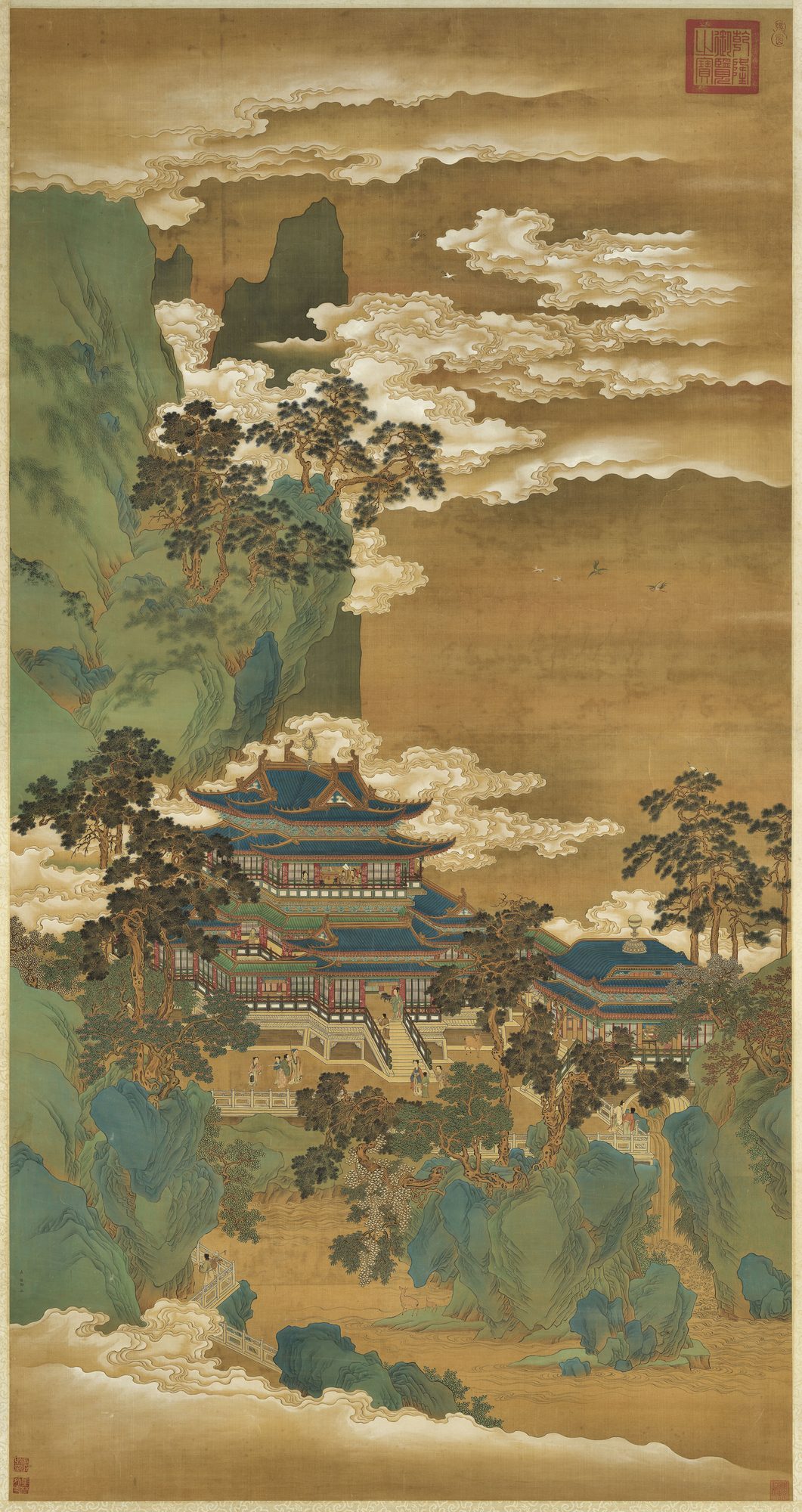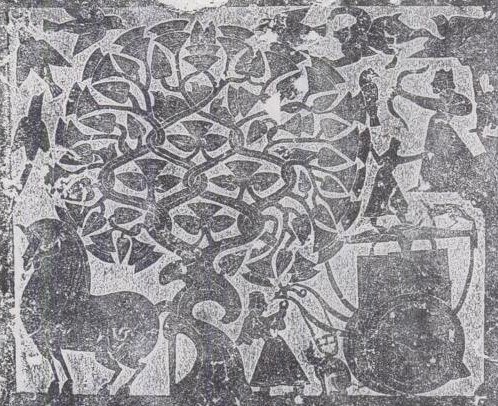
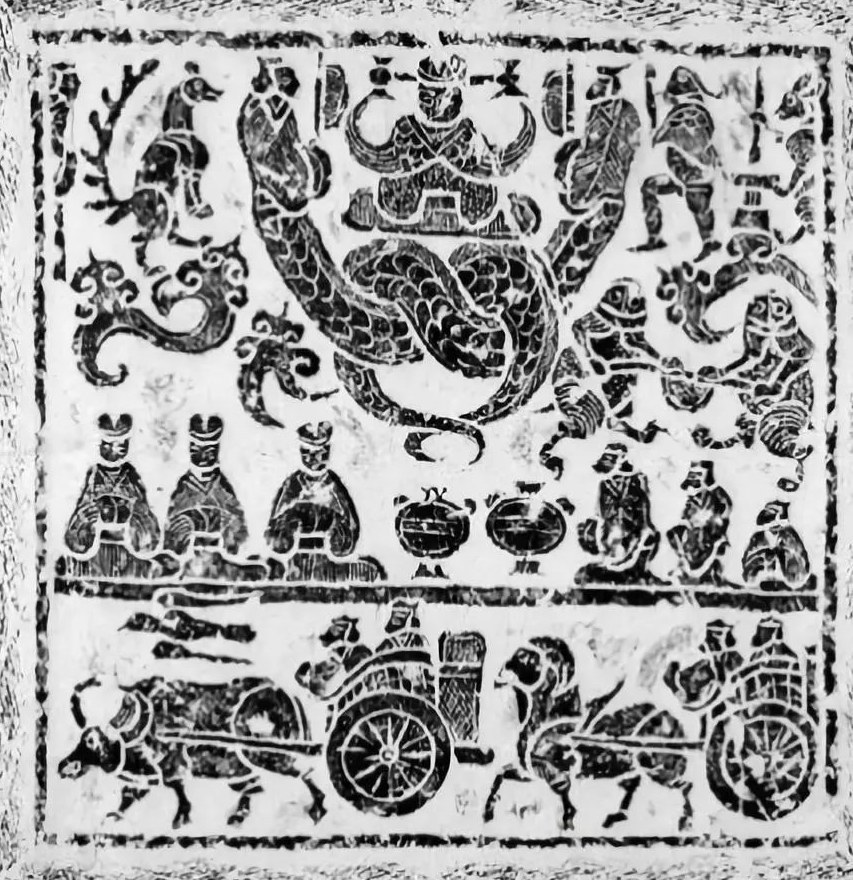
She is not what the later paintings promise. In the oldest text that names her, the Queen Mother of the West is a thing that lives in a cave on a western mountain, and the description is a catalogue of the wild: her shape is like a human’s, but she has a leopard’s tail and a tiger’s teeth, and she is good at whistling. On her tangled hair sits the sheng, a jade ornament worn like a crown, and that single touch of finery among the fangs is the only hint of the courtly goddess she will one day become. The mountain is Jade Mountain. What she presides over there is not banquets or gifts of long life but, in four flat characters, the Calamities of Heaven and the Five Destructions. She is an officer of catastrophe, a keeper of plague and ruin.
This is the Xiwangmu of the Classic of Mountains and Seas, the Shanhaijing, a compilation of the Warring States and Han that reads like a surveyor’s field-notes on a world still full of monsters. It returns to her more than once. In the chapter of the regions within the seas she is caught in a posture of unmistakable authority: she leans on a stool with the sheng on her head, and to her south wait three green birds who fetch her food.
She sits north of the Kunlun void and is waited on. In the chapter of the Great Wilderness she is starker still, a cave-dweller with the tiger-teeth and leopard-tail, set on the hill called Kunlun-qiu, which is ringed by a river called the Weak Water and by a mountain of blazing fire. To reach her, the text implies, you would have to cross water that drowns anything and flame that burns everything. She is difficult to reach.
Where death can be cheated
The mountain matters as much as the goddess. Kunlun in these pages is no ordinary peak but the lower capital of Di, the high god: a walled paradise eight hundred li square, its nine wells railed in jade, its nine gates kept by a beast called Kaiming, tiger-bodied and bearing nine human faces, who watches the approaches. And growing on it, named among the marvels, is the deathless tree. Kunlun is where death can be cheated. East of the gate-warden stand six shamans, Wu Peng and Wu Di and four others, and every one of them holds the drug of no-death aloft, the text says, to ward death off.
The drug she did not yet hold
Here is the crucial thing, and the sources are emphatic on it: in the Shanhaijing itself, Xiwangmu does not hold that drug. The shamans hold it. She overlooks the paradise where it grows; she does not yet dispense it. The link that made her the mistress of immortality, the whole later tradition in a single sentence, is forged in a different book.
It is the Huainanzi, assembled around 139 BCE, that first puts the drug in her keeping, and it does so almost in passing, inside another myth entirely: the archer Yi requested the drug of no-death from Xiwangmu, and his wife Heng’e stole it and fled with it to the moon. That is the seed. From this one line grows the Queen Mother who grants long life to emperors, and the woman in the moon whom later ages would call Chang’e.
A drug, not a peach
Notice what the immortality substance is in every early source: a drug, a herb, the no-death substance. It is never a peach. The famous peaches of immortality, the flat-peaches ripening only after long ages that the Queen Mother is later said to serve at her banquet, belong to a much later world, to Han apocrypha and finally to the Ming novel Journey to the West, where the stolen fruit became a heavenly scandal in the retelling. They are a real and beloved part of her legend. They are simply not in the ancient record, and the honest retelling keeps that seam visible rather than grafting the fruit back onto the Shanhaijing beast.
A goddess, or a place
Even her name resists a single reading. The Han commentators on the Songs of Chu did not always take Xiwangmu for a person at all. Quoting the old glossary Erya, they list her among the Four Wildernesses, the four frontier-lands at the edges of the world, so that Xiwangmu
names a western region as much as a western queen.
The great Chuci poems circle her territory without quite touching her: the Li sao climbs Kunlun to the Hanging Garden at dusk, and the Tian wen poses its haunting riddle about the moon that dies and is reborn each month, the very cycle the archer’s stolen drug set in motion. In none of these verses is she named. She stands just off the edge of the page, a goddess, or a place, or the far western limit where the deathless things are kept.
Caught mid-transformation
What survives, then, is not one Queen Mother but a figure caught mid-transformation. The tiger-toothed arbiter of plague and the gracious dispenser of immortality are the same name at different depths of time, and the pleasure of the earliest sources is watching her before she was tamed: whistling in her cave, the jade sheng headdress in her wild hair, three green birds bringing her food on a mountain past the burning river.
The moonlight — by what virtue does it die and yet be reborn? (Chuci, “Tian wen”; author’s rendering from the Chinese)
- Shanhaijing (山海經, Classic of Mountains and Seas), Xishan jing (西山經, Western Mountains), Jade Mountain (玉山) entry: Xiwangmu’s form — human-like but with a leopard’s tail and tiger’s teeth, good at whistling, the sheng headdress on tangled hair, and her office
presiding over the Calamities of Heaven and the Five Destructions
(司天之厲及五殘); and the Mountain of the Three Perils (三危之山), where the three green birds dwell (Guo Pu’s commentary glosses that they fetch food for Xiwangmu). Chinese read verbatim (zh.wikisource.org). EnglishAnne Birrell, The Classic of Mountains and Seas (Penguin, 1999). - **Shanhaijing, Hainei xijing (海內西經, Within the SeasWest):** Kunlun as the lower capital of Di (帝之下都), its dimensions, nine jade-railed wells and nine gates, the Kaiming beast (開明獸), the deathless tree (不死樹), and the six shamans holding the drug of no-death (不死之藥) to ward off death; and the line
Xiwangmu leans on a stool and wears the sheng; to her south are the three green birds that fetch her food; she is north of the Kunlun void
(西王母梯几而戴勝…). Note: the Shanhaijing does not give the drug to Xiwangmu; that link is later. - **Shanhaijing, Dahuang xijing (大荒西經, Great WildernessWest):** the archaic capsule — a cave-dwelling being with the sheng, tiger’s teeth and a leopard’s tail, named Xiwangmu, on Kunlun-qiu (崑崙之丘), ringed by the Weak Water (弱水) and the mountain of blazing fire (炎火之山).
- Huainanzi (淮南子), Lanming xun (覽冥訓), c. 139 BCE: the earliest text to make Xiwangmu the keeper of the immortality drug —
Yi requested the drug of no-death from Xiwangmu; Heng’e stole it and fled with it to the moon
(羿請不死之藥於西王母,姮娥竊以奔月). The seed of the entire laterQueen Mother = mistress of immortality
tradition. (Heng’e/姮娥 is the older spelling; Chang’e/嫦娥 is a later taboo-avoidance rewriting.) - Chuci (楚辭, Songs of Chu), Li sao (離騷): the Kunlun / Hanging Garden ascent (夕余至乎縣圃, Xuanpu atop Kunlun per Wang Yi’s commentary). The verse does not name Xiwangmu; she enters only via the Wang Yi / Hong Xingzu commentary, which quotes the Erya gloss listing 西王母 among the
Four Wildernesses
(四荒) — a western frontier-land, not a goddess. - Chuci, Tian wen (天問): the moon’s death-and-rebirth riddle (夜光何德,死則又育) and Yi shooting the suns (羿焉彃日) — the immortality / lunar mythos the Huainanzi ties to Xiwangmu. The verse does not name her directly.