Begin with the name, because the name is a ruin. Chenghuang is a compound of two things you can walk up to: cheng, the rammed-earth wall that rings a Chinese city, and huang, the dry ditch dug outside it, a moat with no water in it. Long before there was a god, there was a wall and its empty trench, and the deepest layer of the word is not a divine biography but a broken defensive work.
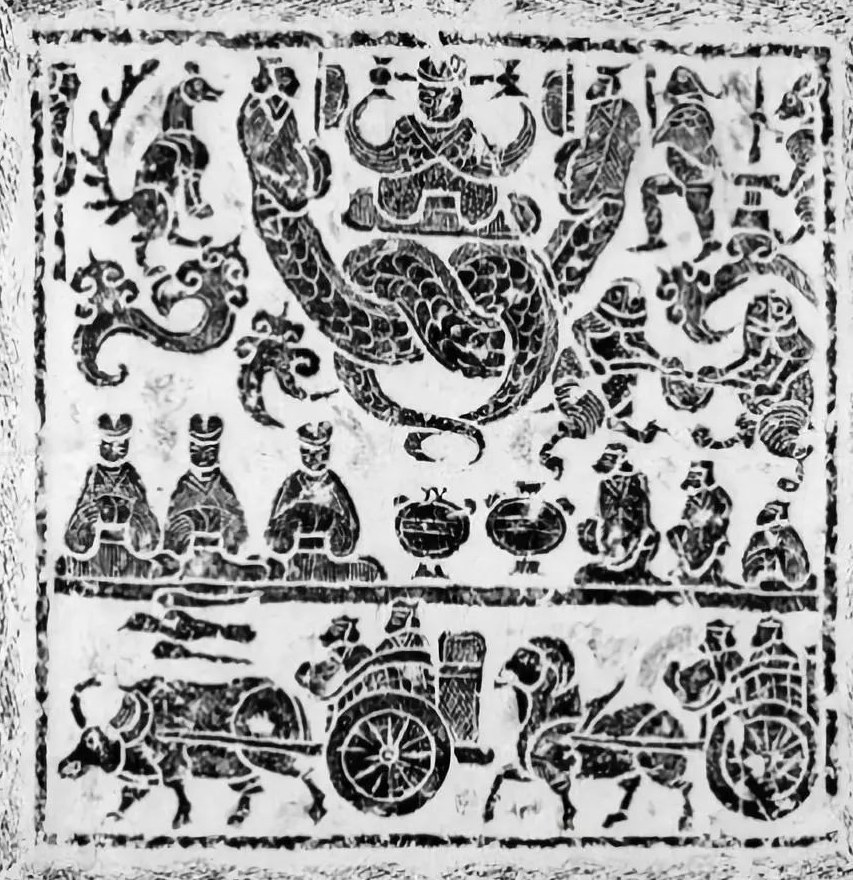
The oldest place the two graphs stand together is a line in the Yijing, in the hexagram called Peace, and it is a line about collapse: the wall falls back into the moat, rampart crumbling into its own dry ditch. That image is roughly two and a half thousand years old, and it names no deity. It is only the linguistic ancestor of one. When the Ming shi comes to write up the state cult it concedes as much at the very top: the sacrifice to the City God, none can detail its beginning.
A wall, a ditch, no water
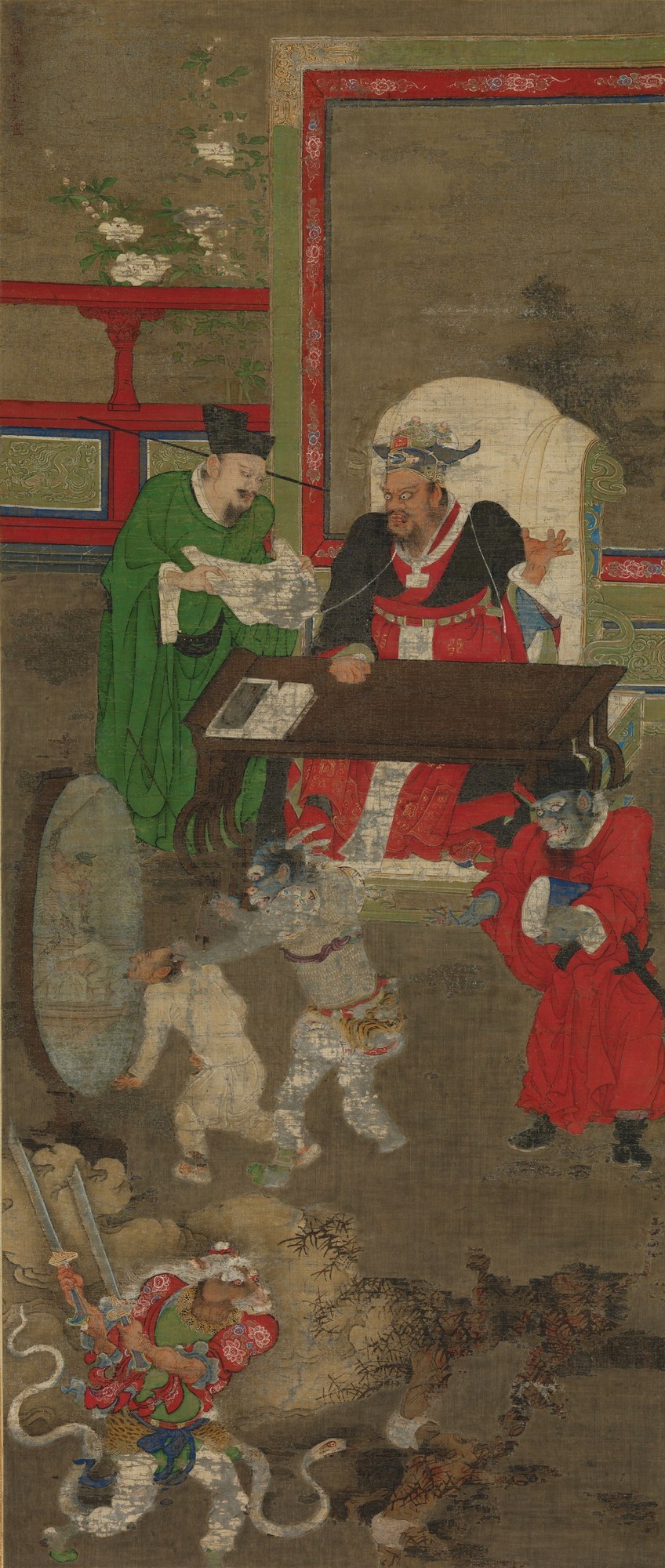
What grew out of that ruin was not a nature-spirit but an office. The Chenghuang is the tutelary god of one specific walled town, best understood as its shadow-magistrate: a supernatural counterpart to the human official in the yamenThe walled office-and-residence of a Chinese local magistrate, where he heard cases and governed his district; the City God's unseen court mirrors it., running an unseen bureaucracy laid exactly over the visible one. He guards the living above him and governs the souls of the recently dead below.
This is the move that makes the Chinese heaven unlike a council of Olympians. The City God is not a personified force of the sea or the harvest. He is a post, an appointment, a rank in a celestial civil service, and in the commonest conception the man who fills it is a deceased local worthy installed, for a term, as the god of the town where he served.
That office has real duties, and they are administrative to the point of grimness. The god takes a census of the dead in his jurisdiction and sees to their care. By the nineteenth century, in the account of the sociologist C. K. Yang, this ran to three yearly processions in which the City God went out among the ghosts: one to release them from their winter quarters, one to count them and see them fed, and the largest to gather them in, clothe them for the cold and house them. The dead of a city were, in this picture, a population on his books, to be registered and provisioned like any other subjects of a competent administration.
Whipped for a dry sky
The office cut both ways. A god who governs is a god who can fail, and the Chinese City God was held to account with a directness that has no real parallel among sovereign deities elsewhere. If he failed a proper request, above all if he failed to bring rain in a drought, his image could be dragged out and left to bake in the sun, or bodily whipped, at the order of the very governor or magistrate who was his earthly opposite number.
Yang records the practice as late as the nineteenth century. This was not worship in the abstract but something closer to a performance review conducted with a lash: a city fed its City God incense and expected results, and when the sky stayed shut the results were extracted from him.
Prince, Duke, Marquis, Earl
The most revealing single episode in the god’s history is a pair of imperial edicts issued one year apart, which must not be flattened into a single stable system. In the second year of HongwuThe reign-era name of the Ming founder Zhu Yuanzhang, who ruled from 1368 to 1398, counted from his accession so that Hongwu 2 is the year 1369., 1369, the Ming founder enfeoffed every City God in the realm with noble rank, graded to each city’s administrative level with the exactness of a pay-scale.
The City God of the capital became a Prince; every prefecture’s god a Duke of the second official grade, every department’s a Marquis of the third, every county’s an Earl of the fourth, with ceremonial robes and tasselled mortarboard crowns graded to match. At a stroke the whole unseen bureaucracy was tier-matched to the mortal one, god for magistrate, all the way down.
Then, in the third year of Hongwu, 1370, the same emperor undid it. An edict stripped the noble titles away; each god was henceforth to be called simply the City God of such-and-such a prefecture or department or county. The same reform ordered other deities removed from the temples and fixed the building itself with a startling literalism: the temple was to match the height and breadth of the government office’s main hall, the god housed as the city’s exact architectural shadow.
The clay images were smashed and floated off downstream on the water, their mud re-used to plaster the temple walls, which were then painted with clouds and mountains, and worship was redirected to a bare wooden spirit-tablet. One year had turned a court of ennobled celestial dukes into a rank of plainly-named officials seated before blank tablets in halls built to municipal spec.
A man sits an examination for the post
If the Ming shi shows the office from the throne’s side, the tradition’s most famous portrait shows it from the candidate’s, and it comes four centuries later, from fiction rather than ritual.
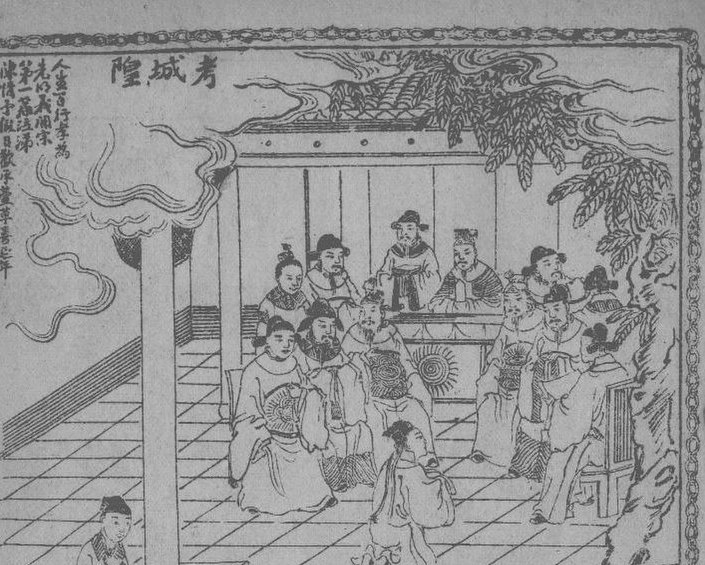
Pu Songling opened his Liaozhai zhiyiPu Songling's late-seventeenth-century collection of strange tales, first printed in 1766, which opens with a man's examination for a City-God post. with the tale of Sung Tao, a stipendiary graduate led away on a white-foreheaded horse to sit an examination in a city like a prince’s capital. On the bench sit ten-odd officials, all strangers but one: Lord Guan, the deified Guan Yu, presiding among the examiners. Sung’s essay wins the room with a line on the weighing of intention, that those who do good by design deserve no reward and those who do wrong unwittingly deserve no punishment, and the judges appoint him on the spot to a vacant post: a City God is wanted in Henan.
What follows turns the celestial civil service human. Sung begs a delay because his mother is in her seventies with no one to keep her; an attendant checks the register of lifespans, finds she has nine years left, and he is granted a nine-year furlough for his filial piety while a substitute holds the office. He wakes in his coffin three days dead, learns a graduate died elsewhere that same day, and nine years later, his mother buried, lies down and dies in earnest to take up the post at last.
Herbert Giles, translating the tale in 1880, called the god a Guardian Angel,
a Victorian softening he glossed in his own footnote as the tutelary deity of every Chinese city. The archaic dressing should not mislead: the thing Sung Tao is examined for is a magistracy of the dead, an angel only in Giles’ Victorian costume.
The distance between the witnesses
These are, deliberately, three witnesses standing far apart, and the distances are part of the truth. The Yijing line that gives the name is a political omen of the mid-first-millennium BCE, and it is the god’s etymology, not his portrait. The Ming shi record of the state cult was compiled in 1739, more than three centuries after the Hongwu edicts it summarises, so it is a retrospective official account and not a document of the founder’s own desk.
And Kaocheng huang is a work of imagination printed in 1766, some four hundred years downstream of those same reforms, a fiction reflecting popular belief rather than a rule of ritual. Even the earliest temple the Ming shi can name, at Wuhu, it dates to 239 CE on its own authority, a claim of the Qing compilers rather than a verified fact. What holds these strata together across two millennia is not one continuous cult but one persistent idea: that the unseen world is governed exactly as a city is, by an appointed magistrate with a wall at his back, a ditch at his feet, and the dead on his books.
“A Guardian Angel is wanted in Honan. Go you and take up the appointment.” Sung, seeing that resistance would be of no avail, complied. (Liaozhai zhiyi, “Kaocheng huang”; Herbert Giles, trans., 1880)
- 《周易》泰卦 上六 — Zhouyi / Yijing, Tài (Peace) hexagram, top line: the linguistic ancestor of the god’s name, not a reference to the god. The line 「城復于隍,勿用師,自邑告命,貞吝」 (
the wall falls back into the moat; use not the army; from one’s own town announce the command; steadfastness brings regret
) is the earliest datable pairing of 城 (wall) and 隍 (the waterless ditch). Core text traditionally Western Zhou (c. 1000 BCE); line-statements stabilised by the Warring States (mid-1st millennium BCE). Chinese read verbatim (zh.wikisource 周易/泰). - 《明史》卷四十九·禮志三·〈城隍〉 — Ming shi (History of the Ming), juan 49, Rites Monograph 3, City-God section: the state-cult record. Compiled 1739 (Qing), describing Ming ritual from 1368. The obscurity of origins (「城隍之祀,莫詳其始」); the Wuhu temple named as built in Wu Chiwu 2 (吳赤烏二年, = 239 CE — the Ming compilers’ own attribution, presented here as
the earliest temple the text names,
not an independently verified date); the Hongwu-2 (1369) enfeoffment grading every City God Prince/Duke/Marquis/Earl (王/公/侯/伯) with matching ranks (秩正二品/三品/四品) and graded regalia (袞章冕旒); the Hongwu-3 (1370) abolition of the titles (「詔去封號」), removal of other deities (「屏去他神」), the temple-form rule (高廣視官署廳堂), the image-destruction (毀塑像舁置水中…繪以雲山) and the wooden tablet (木主); the god’s birthday on the 5th month, 11th day (五月十一日); the rule that the resident magistrate presides in prefectures, departments and counties (「在各府州縣者守令主之」). Chinese read verbatim (zh.wikisource 明史/卷49). - 蒲松齡《聊齋志異》卷一〈考城隍〉 — Pu Songling, Liaozhai zhiyi, juan 1, story 1,
Kaocheng huang
: the canonical literary portrait. Tales written c. 1670s–1700s; first printed 1766. Sung Tao (宋燾), the white-foreheaded summons-horse (白顛馬), the celestial yamenlike a prince’s capital,
Lord Guan (關羽) among the examiners, the essay line 「有心為善,雖善不賞;無心為惡,雖惡不罰」, the Henan vacancy (「河南缺一城隍」), the mother in her seventies (老母七旬), the register of lifespans and the nine-year furlough (陽算九年) with the graduate Chang (張生) as substitute, the waking three days dead. Chinese read verbatim (zh.wikisource 聊齋志異/第01卷). - Herbert A. Giles, trans.,
Examination for the Post of Guardian Angel,
in Strange Stories from a Chinese Studio (London, 1880), story No. 1: the public-domain English of the tale above, read verbatim. Giles renders 城隍 by his Victorian domesticationGuardian Angel,
glossed in his own footnote asthe tutelar deity of every Chinese city
; the archaic term is flagged here, not adopted. Project Gutenberg ebook 43629. - C. K. Yang, Religion in Chinese Society (Univ. of California Press, 1961; 1967 printing), pp. 156–157, 177 — MODERN scholarship, cited as interpretation, not primary text: the office-versus-person conception; the god as census-taker and guardian of the recent dead; the three annual ghost-processions (spring release, midsummer census-and-feeding, tenth-month clothing-and-housing); and the whipping or sun-exposure of a god who fails to bring rain. The exact procession dates and page numbers reach this piece through a secondary relay of Yang and are attributed to him rather than independently verified against the book.