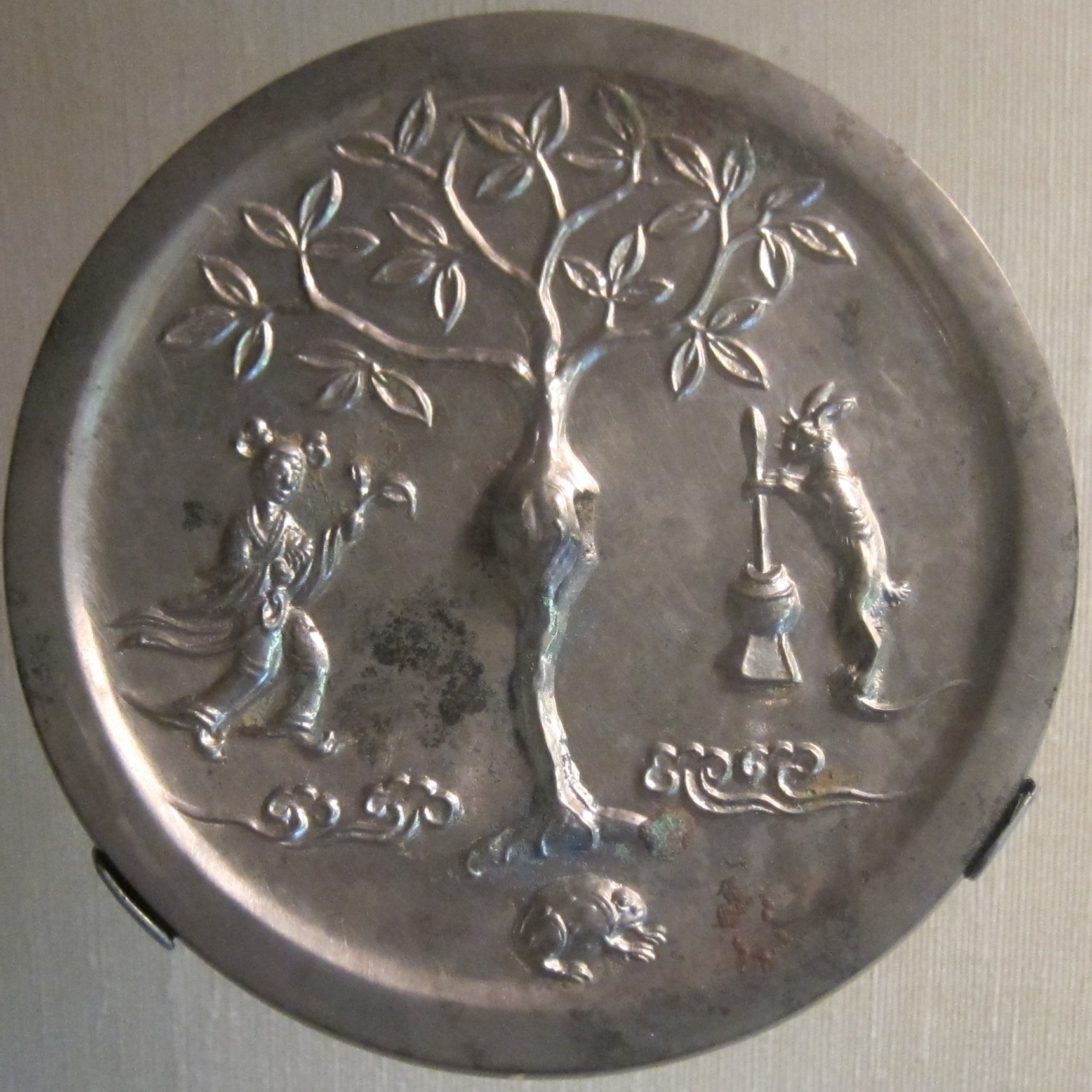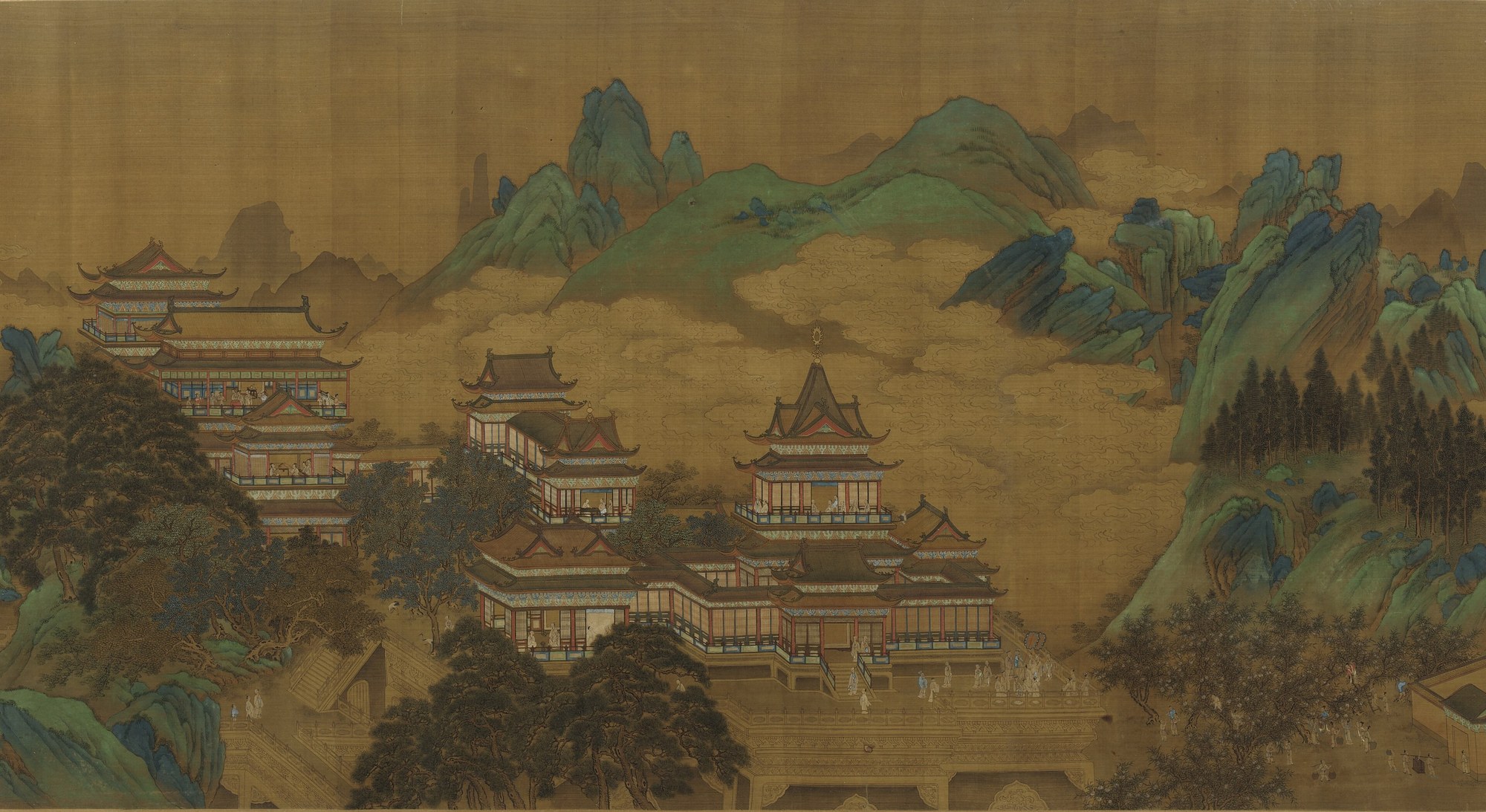
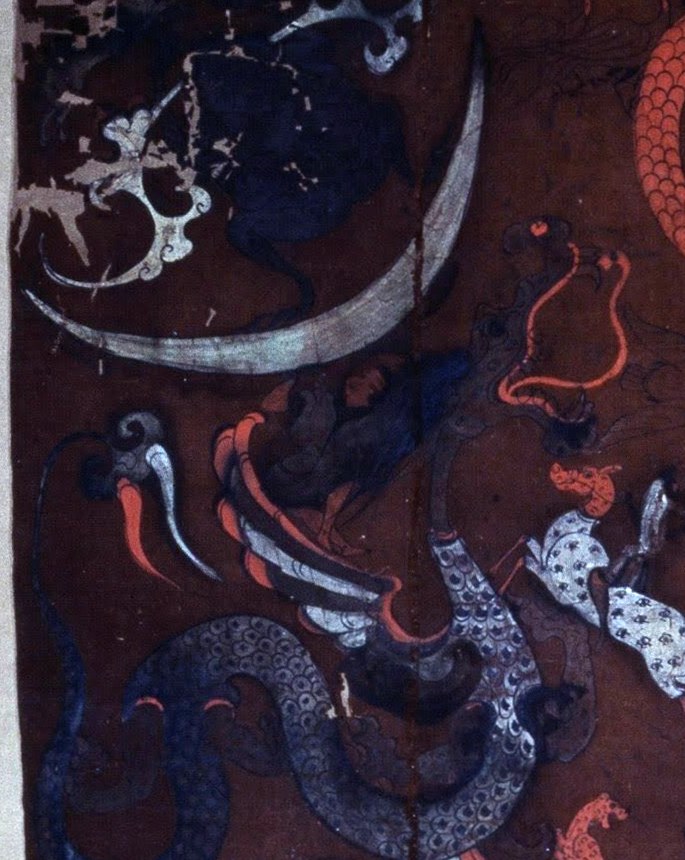
Look up at the full moon and the tradition tells you a graceful lady lives there, exiled in a jade palace, robes trailing, a white rabbit and a fragrant tree for company. Now go back to the oldest layer of the story, the writing closest to where she came from, and the palace is empty. There is no lady. There is a hare in the shadows of the disc, and there is a toad. And the toad, in the fullest early account we have, is the woman herself.
The figure the world calls Chang’e was assembled over roughly fifteen hundred years, and almost nothing the modern eye recognises about her was there at the start. To meet her as the earliest sources actually drew her is to watch a punished, transformed creature slowly soften, across the centuries, into the elegant exile of the festival. Her name changed. Her shape changed. Even the question of whether she was married changed. What did not change was the single act that fixed her to the sky: she took the one drug that defeats death, and she went where it could not be taken back.
The name that had to move
Start with the name, because it is the most important figure-level fact about her, and it is not stable. In the Han texts she is not Chang’e at all. She is Heng’e, written 姮娥, and that is how the two oldest witnesses spell her. The now-familiar Chang’e, 常娥 or 嫦娥, is a later form, and the standard explanation for the shift is a small, telling piece of imperial machinery. The graph héng, 恒 or 姮, collided with the personal name of Emperor Wen of Han, Liu Heng, who reigned in the second century BCE, and personal names of emperors were words the living were obliged to avoid. So héng gave way to cháng, and Heng’e became Chang’e.
That account is scholarship, not scripture. The primary texts do not explain the change; they only demonstrate it, showing the older spelling in the HuainanziA compendium of essays presented to the Han throne around 139 BCE under Liu An; it carries the earliest surviving reference to the moon-flight. and the newer one in the later quotations. The taboo mechanism is the received reading of why, and it should be held as interpretation rather than as something the sources state. But the plain fact underneath it is solid and strange: the woman in the moon has been renamed, and her most familiar name is a workaround for a dead emperor’s.
A theft, and a silence where the reasons should be
The story she anchors first appears not as a story but as a comparison. The Huainanzi, the compendium assembled under Liu An around 139 BCE, reaches for her only to make a point about not knowing where things come from. In a single sentence it says that Yi requested the drug of no-death from the Queen Mother of the WestXiwangmu (西王母), the western mountain deity who keeps the drug of no-death and is its source in every version of the story., and Heng’e stole it and fled with it to the moon; and the man was left bereft and forlorn, with no way to replace it.
Read what that sentence withholds. It does not call Heng’e a wife. It gives her no reason for taking the drug. It says nothing of a cold moon, a lonely exile, a jade palace, or a devoted husband robbed by a villain. The whole weight of feeling in the line sits not on the woman who flew but on the man who stayed: it is Yi who is bereft, Yi who suffers the loss, Yi who cannot begin again.
The oldest telling gives her the act and gives him the grief, and it declines to tell us anything about her heart at all. The absence of a motive is itself a finding. Everything the later tradition supplies to fill that silence, the loyalty, the self-sacrifice, the romance, is later.
The wife who arrives eight centuries late
If the Huainanzi does not marry her to Yi, where does the marriage come from? From a note in the margin. The Wen xuan, the great literary anthology of the sixth century, carries a commentary on a poem about the moon, and in that commentary the Huainanzi line is quoted and then annotated with four small words: the commentary says, Chang’e was Yi’s wife. That is the earliest surviving statement that she is his wife, and it is not narrative. It is a gloss on a narrative, appended by commentators, the layer of it we can read attributed to the Tang scholar Li Shan in the seventh century.
Set the two witnesses side by side and mind the gap between them. The Huainanzi is around 139 BCE. The commentarial gloss that makes her a wife comes, through Li Shan, roughly eight hundred years later. When a modern retelling opens on the loving couple, it is building the entire relationship on a footnote written the better part of a millennium after the woman first appeared in writing, and reading it back into a sentence that never claimed it. The marriage that feels like the bedrock of the story is one of its youngest parts.
What she became, told two ways
The transformation is where the figure turns genuinely dark, and where the sources split. Zhang Heng, the astronomer, set the fullest early version into his treatise on the heavens around 120 CE, some two and a half centuries after the Huainanzi. In it Heng’e does not simply run.
Before she goes she has her fortune divined by a diviner named You Huang, who reads out an eerie little oracle, the sign of the Returning Maiden: auspicious; fluttering, the Returning Maiden journeys west alone; she will meet the sky’s darkness and gloom; let her not be startled, let her not fear, for afterward she shall greatly flourish. And then the flourishing comes, and it is grotesque. She lodged her body in the moon, Zhang Heng writes, and became the toad.
The toad is the point. In this ancient layer the moon-woman is not enthroned; she is changed into an animal, the squat three-legged creature the old astronomers saw crouched in the lunar shadows. It reads less like an apotheosis than a sentence passed on a thief. But that is not the only ancient ending. The Guizang, a lost divination classic surviving only in fragments quoted by later books, gives a different close: in one recension she swallows the drug, flees to the moon, and becomes the moon’s very essence, its pure substance.
One tradition debases her into a toad; the other dissolves her into the light itself. Both are old, and they pull in opposite directions, and no later smoothing can reconcile them. The graceful lady of the jade palace is neither. She is a still later compromise, softer than the toad and vaguer than the essence, and she belongs to centuries the Han sources never saw.
The cold moon was cold before she came
The last thing to understand about her is the place she went, because the coldness people feel in her story is real and ancient, but it was not put there by her loneliness. It was already in the moon. Zhang Heng’s same treatise lays out a cosmology in which the moon is the ancestor of the yin essence, the pole of everything dark, watery, even-numbered and female, set against the sun as the fountain of yang. The sun is like fire and the moon is like water, he writes; fire shines its light outward, but water holds its light within. The moon is not a lamp but a cold mirror, a body of borrowed, contained, watery light.
That is the abode Heng’e enters, and it explains her chill without any need for pathos. She does not make the moon cold by weeping there. She goes to a place that is, in the physics of the age, coldness itself, the gathered essence of yin. And she does not go to an empty one.
The moon in Zhang Heng’s account already holds a hare in its shadows before she ever arrives, and she herself becomes the toad; hare and toad, the two classic moon-animals, are the ancient company of that sky. The white rabbit pounding elixir, the cassia tree, the woodcutter forever chopping it, all the furniture the modern moon is crowded with, came later and from elsewhere. The oldest moon holds two animals and a fugitive who became the second of them.
Auspicious. Fluttering, the Returning Maiden journeys west alone; she will meet the sky’s darkness and gloom. Let her not be startled, let her not fear; hereafter she shall greatly flourish. (Zhang Heng, Ling Xian, the You Huang oracle; author’s rendering from the Chinese)
- Huainanzi (淮南子), Lanming xun (覽冥訓,
Surveying Obscurities
), c. 139 BCE: the earliest surviving reference, a one-line simile used to illustrate not knowing whence a thing comes —Yi (羿) requested the drug of no-death (不死之藥) from the Queen Mother of the West (西王母), and Heng’e (姮娥) stole it and fled with it to the moon (竊以奔月); bereft and forlorn, he had no way to replace it
(譬若羿請不死之藥於西王母,姮娥竊以奔月,悵然有喪,無以續之). It names Heng’e, the theft and the flight, and nothing moreno marriage, no motive, no cold moon; the grief belongs to Yi. Chinese read verbatim (zh.wikisource). - Zhang Heng (張衡, 78–139 CE), Ling Xian (靈憲), c. 120 CE: preserved in the commentary to the Xu Han shu / Hou Han shu, Tianwen zhi (續漢書·天文志). The fullest early figure-accountthe diviner You Huang (有黃), the Returning-Maiden (歸妹) oracle, and the transformation —
Heng’e thereupon lodged her body in the moon, and became the toad
(姮娥遂託身于月,是爲蟾蠩). Also the moon-cosmology drawn on above:The moon is the ancestor of the yin essence
(月者,陰精之宗), the lunar hare (象兔), andthe sun is like fire, the moon like water; fire shines outward, water holds its light within
(火則外光,水則含景). Chinese read verbatim (zh.wikisource). - Guizang (歸藏, fragments): a lost divination classic surviving only as quotation, collected in the Qing collations (輯校). It gives the neutral wording in which she
took the drug of no-death and fled to the moon
(以不死之藥奔月) without the verbsteal
, and a recension in which she becomesthe moon’s essence
(爲月精), an apotheosis pulling against Zhang Heng’s toad. Source-tagged to Wen xuan juan 13 and Taiping yulan juan 984. Nominally pre-Han, but the readable text is a Han-and-later reconstruction, so no firm pre-Han date is claimed for the Chang’e line; the Taiping yulan phrase is tag-sourced through the collators, not fetched directly. Fragment 12 read verbatim (zh.wikisource). - Wen xuan (文選) juan 13, Li Shan (李善, fl. 658) commentary to Xie Zhuang’s
Moon Rhapsody
(謝莊〈月賦〉): anthology c. 520–530 CE, commentary Tang. It quotes the Huainanzi, then supplies the gloss on which the marriage rests — “the commentary saysChang’e was Yi’s wife” (注曰:常娥,羿妻也) — and quotes the Guizang. This commentarial layer stands roughly eight centuries after the Huainanzi, so thewife
is attested by commentary, not by the earliest narrative. Chinese read verbatim (zh.wikisource).