The oldest exact statement of how these two gods stand to one another is not a marriage vow but a work order. In chapter five of Journey to the West, the Jade Emperor, supreme sovereign of Heaven, looks at the newly arrived stone monkey idling in his court and hands him a job: you seem to have nothing to do, so you shall provisionally manage the Peach Garden. It is a small administrative moment, easy to read past, and it contains the whole strange relationship in one line. The peaches in that garden are not the Jade Emperor’s. They belong to the Queen Mother of the West. She planted them herself. Yet it is his officer who now guards her orchard, on his warrant, inside his heaven. Her fruit, his ground, his guard. The paired sovereigns of the late-imperial celestial court meet first as a matter of jurisdiction.
Her trees in his garden
The garden itself is the clearest picture we have of the two authorities interlocking. Three thousand six hundred trees stand there, sorted into three grades of ripening, a ladder of longevity climbing toward the divine. The front twelve hundred ripen once in three thousand years, and eating one makes you an immortal, light and strong. The middle twelve hundred ripen once in six thousand years, and eating one lets you soar up in the sunset-clouds, ageless. The rear twelve hundred ripen once in nine thousand years, and eating one gives you years equal to Heaven and Earth.
And the closing couplet of the garden’s description makes the ownership unmistakable: these are no common seedlings of the Mystic Metropolis, for the Queen Mother of the Turquoise PondThe Queen Mother's banquet-seat, the Yaochi (瑤池); it first appears as her throne in the Mu Tianzi Zhuan, centuries before the peach-feast reuses it. planted them herself. So the fruit that confers immortality is hers, cultivated by her own hand, and the guard set over it answers to him. Neither god owns the arrangement outright. The relationship is the seam between two powers, and the novel keeps returning to that seam rather than dissolving it.
A banquet by her own command
When the peaches ripen, it is the Queen Mother who acts, not the Jade Emperor. She sets her Grand Peach Banquet at the Turquoise Pond and sends out seven fairy maidens, in robes of red, green, white, black, purple, yellow and a second green, each carrying a flower-basket, to gather the fruit. They come by her own decree; the novel says so in as many words. But at the garden gate the arrangement folds back on itself.
This year, the gate-keepers tell them, is not like former years, because the Jade Emperor has appointed a superintendent here, and they will not open until he is informed. Her command reaches to the orchard wall and there meets his appointment. The picture is not of a queen ruling beside a king. It is of a great goddess who hosts the feast that matters most in Heaven, staged inside a domain whose officers are not hers to command.
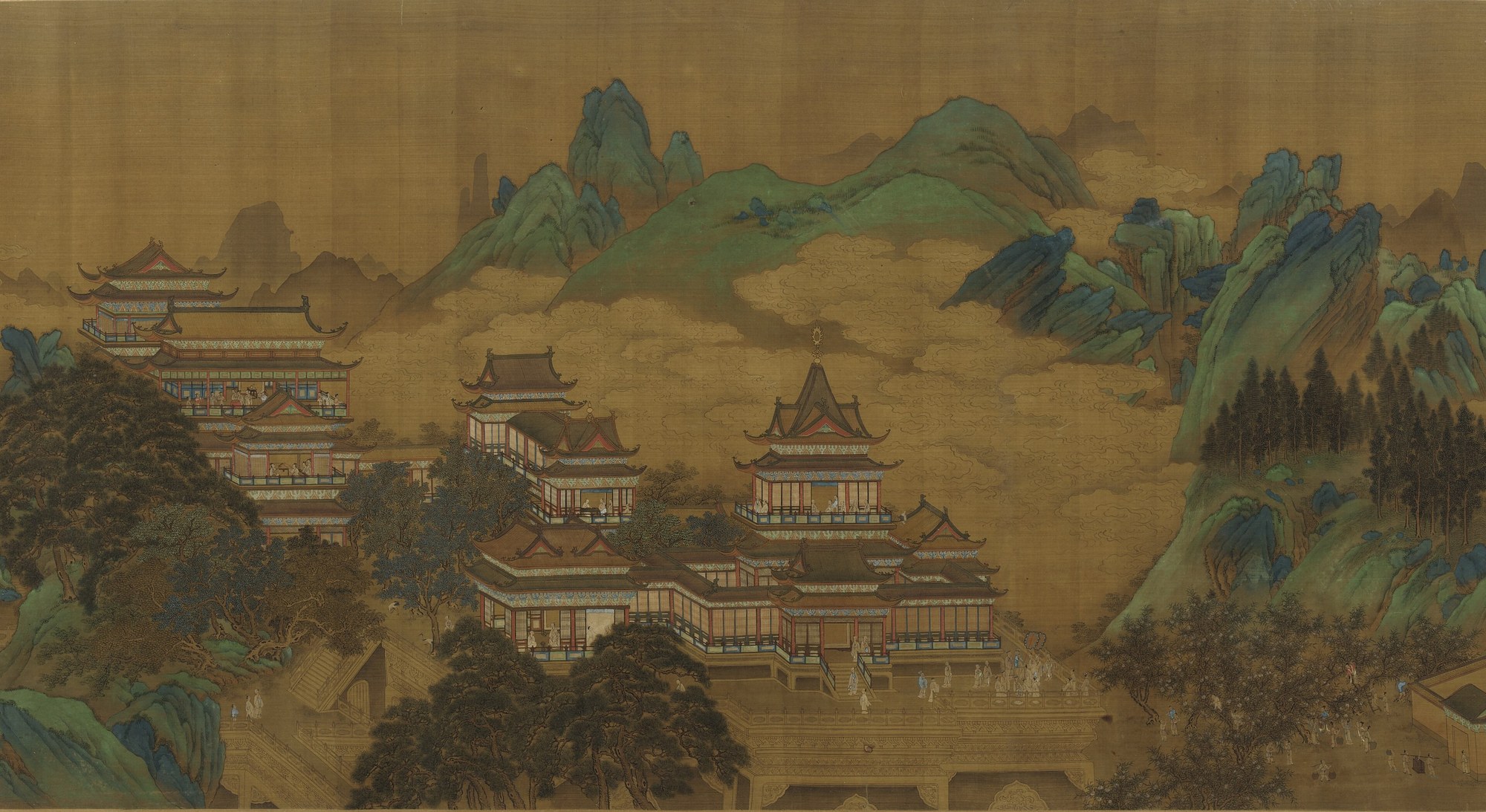
The hall she sets it in is the tradition’s densest image of a heaven-feast: fragrant mist and auspicious cloud, nine-phoenix screens and eight-jewel purple-rainbow stools, gold-painted tables and jade basins; on the dishes, dragon-liver and phoenix-marrow, bear’s paw and ape’s lip; and jars of jade-fluid and jasper-nectar wine along the gallery. It is the whole vocabulary of celestial luxury poured into one room, and it is her room, her feast, her invitations to send out.
The whole pantheon at one table
Who comes to that table is the reason this pairing matters beyond the two gods themselves. The guest-list in chapter five is a roll-call of an entire fused religion. To the Queen Mother’s Daoist feast come the Buddhas and bodhisattvas, arhats and holy monks of the Western Heaven; Guanyin; the Five Elders of the Five Regions; the Three Pure Ones and the Four Emperors of the upper caverns; the Jade Emperor himself among the middle-cavern deities; and the teachers of the underworld below.
Buddhist and Daoist high powers sit at one board, hosted by a Daoist goddess, inside a Daoist emperor’s sky. The pairing of the Jade Emperor and the Queen Mother is really the hinge of a much larger act of syncretism: the late-imperial imagination gathering every deity it had inherited into a single heaven and giving that heaven a court, a sovereign, and a hostess.
And when the banquet is wrecked, the relation shows its direction with complete clarity. After the disruption, the Queen Mother does not act on her own authority to punish or repair. She goes at once to see the Jade Emperor and lays the whole matter before him, and it is he who then dispatches the hundred thousand troops of Heaven. She reports; he commands the host. This is the single sentence that fixes the pairing as courtly rather than conjugal.
She is a sovereign in her own right, owner of the peaches, host of the feast, mistress of the Turquoise Pond, and she answers to his throne. Not one of the primary novels calls her his wife or his consort. The Heavenly Grandfather and Heavenly Grandmother,
the husband-and-wife reading beloved of folk cult and modern retelling, is a later popular gloss laid over a text that describes only a relation of court.
The queen who bowed to a mortal king
That the Queen Mother could be an enthroned sovereign long before the Jade Emperor existed to pair with is the point most easily lost. Centuries before Journey to the West, she is already a throne, and the king who sits with her is a man. The Mu Tianzi Zhuan, whose received text is a Western-Jin recension of about the late third century CE, tells of King Mu of Zhou, the Son of Heaven, received as a guest by the Queen Mother of the West.
He presents her a white jade tablet and a dark jade disc, and the Queen Mother bows twice and receives them, sovereign to sovereign. Then the king feasts her at the Turquoise Pond, the waters the Ming novel would later reuse for the peach feast, and she sings: the white clouds are in the sky, the hills rise of themselves; the road is long, mountains and rivers between us; may you not die, that you might come again. He answers that once his realm is ordered he will return within three years. She sings again, and names herself the Daughter of God.
There is no Jade Emperor anywhere in this. Her counterpart is a mortal Zhou monarch, and her divine father is an unnamed high god of the old kind, not the Yuhuang who did not yet exist as a figure. Guo Pu’s commentary on the same text even preserves her archaic body underneath the enthroned queen: like a human, with tiger’s teeth, tangled hair bearing the shengA headdress or hair ornament (勝) worn by the Queen Mother, the one courtly touch on her otherwise beast-like archaic form., and good at whistling. The banqueting sovereign of the third century CE and the fierce mountain-numen of the Classic of Mountains and Seas are layered in the very same manuscript. The Turquoise Pond is hers by right of long precedent. The Jade Emperor arrives to share it only much later.
The distance is worth stating plainly, because it is the heart of the matter. The Queen Mother’s enthroned, song-exchanging form in the Mu Tianzi Zhuan and her peach-banquet co-sovereignty with the Jade Emperor in Journey to the West stand about thirteen hundred years apart as written texts. Both are separated from her archaic tiger-toothed shape by a further thousand years and more before that.
The Jade Emperor himself, as a named supreme sovereign, is a construct of the Song dynasty and later. No single ancient heaven ever held these two gods side by side. The pairing is a thing assembled in stages across roughly two and a half thousand years and only fully joined in Ming vernacular fiction and the folk cult that grew alongside it.
A staffed sky under a different sovereign
There is an instructive counter-case in the other great Ming novel of the celestial bureaucracy, and it sharpens the point by leaving one of the pair out entirely. Investiture of the Gods is the book most often invoked for the idea of a staffed heaven, a civil service of gods, and it delivers that idea in full: because Haotian ShangdiThe August-Heaven Supreme Sovereign, the heaven-ruler of Investiture of the Gods; folk religion later equated him with the Jade Emperor, but the two novels keep different titles. commanded that the twelve chief immortals submit as his subjects, the Three Teachings compiled three hundred and sixty-five gods, divided into eight departments of thunder and fire and plague and stars.
Here is the bureaucratic heaven in its clearest form. But the sovereign who demands it is Haotian Shangdi, not the Jade Emperor, whose title does not appear in these chapters at all; and the investiture is carried out not by any heaven-emperor but by the sage Yuanshi Tianzun, whose decree Jiang Ziya reads out over each god in turn. The Queen Mother surfaces in this novel exactly once, and only as the keeper of a magic banner.
The lesson of that absence is a caution against smoothing the tradition into one shape. Folk religion did later equate Haotian Shangdi with the Jade Emperor, and it did make the Queen Mother his wife, and both equations are real parts of the living cult. But they are not in these texts, and two Ming novelists writing at the same moment did not share one sky.
Even the Queen Mother’s older divine partner is someone else: the cosmological symmetry of the earlier tradition paired her with the King of the East, the yin to her yang among the immortals, and the Jade Emperor is the newer arrangement laid over that. That paired heaven is genuine, beloved, and late. Its honesty lies in keeping the seams visible: her fruit in his garden, her command meeting his appointment at the orchard wall, and a marriage that the folk supplied but the texts never wrote.
This year is not like former years. The Jade Emperor has appointed the Great Sage to superintend here. (Xiyouji, ch. 5; author’s rendering from the Chinese)
- Wu Cheng’en 吳承恩 (attrib.), Journey to the West (西遊記), chapter 5: the graded celestial court under the Jade Emperor (玉帝); his personal appointment of a Peach-Garden superintendent (「你且權管那蟠桃園」); the 3,600 self-planted trees in three grades (3,000 / 6,000 / 9,000-year ripening) and the couplet 「瑤池王母自栽培」; the Grand Peach Banquet (蟠桃勝會) at the Turquoise Pond (瑤池) with its seven robe-coloured fairy maidens sent by the Queen Mother’s own command (王母懿旨); the interlock at the garden gate (「玉帝點差齊天大聖在此督理」); the syncretic Buddhist-and-Daoist guest-list; and the Queen Mother reporting the theft to the Jade Emperor (「王母聞言,即去見玉帝,備陳前事」). Novel first published 1592 (Ming, Wanli era); the
Wu Cheng’en
attribution is traditional and disputed. Chinese read verbatim (zh.wikisource). No reliable public-domain English exists; the wording above is the author’s own literal rendering. For a citable English quotation, cite a named modern translation (Anthony C. Yu, Chicago, rev. 2012; W. J. F. Jenner, FLP) and re-verify. - Mu Tianzi Zhuan 穆天子傳 (Tale of King Mu, Son of Heaven), juan 3, with Guo Pu’s (郭璞) commentary: the Queen Mother received as sovereign by King Mu of Zhou (「天子賓于西王母」); the jade-tablet audience,
she bowed twice and received them
(「西王母再拜受之」); the Turquoise-Pond feast (「天子觴西王母于瑤池之上」); her song (「白雲在天…將子無死,尚能複來」) and her self-titleDaughter of God
(「我惟帝女」, glossed 「帝,天帝也」); and the commentary’s archaic-form gloss (「西王母如人,虎齒,蓬髮戴勝,善嘯」). Records a legendary 10th-c.-BCE King Mu; the received text is a Western-Jin (late-3rd-c. CE) recension of the Jizhong tomb finds (unearthed 279 CE), Guo Pu’s commentary early-4th-c. CE. No Jade Emperor appears; her counterpart is a mortal king. Chinese read verbatim (zh.wikisource); English is the author’s labelled gloss. - Xu / Chen Zhonglin 陳仲琳 (attrib.), Investiture of the Gods (封神演義), chapters 15, 65, 99: the decree of Haotian Shangdi (昊天上帝) that the twelve chief immortals submit as subjects, and the 365 gods enrolled in eight departments (「共編成三百六十五位成神,又分八部」); the investiture executed by Yuanshi Tianzun (元始天尊) through Jiang Ziya (姜子牙) reading the 封神榜 (「今奉太上元始敕命」; 「開讀玉虛宮元始天尊誥敕」); and the single incidental mention of the Queen Mother as owner of the Gathering-Immortals Banner (聚仙旗). Composed later 16th c. Ming, roughly contemporary with Journey to the West; authorship disputed. The term 玉皇/玉帝 does not appear in the sampled chapters (verified by search); the hierarchy of this novel is Haotian Shangdi’s, not the Jade Emperor’s, and folk religion’s later equation of the two is a cultic gloss, not a same-name usage in the text. Chinese read verbatim (zh.wikisource); English is the author’s labelled gloss.