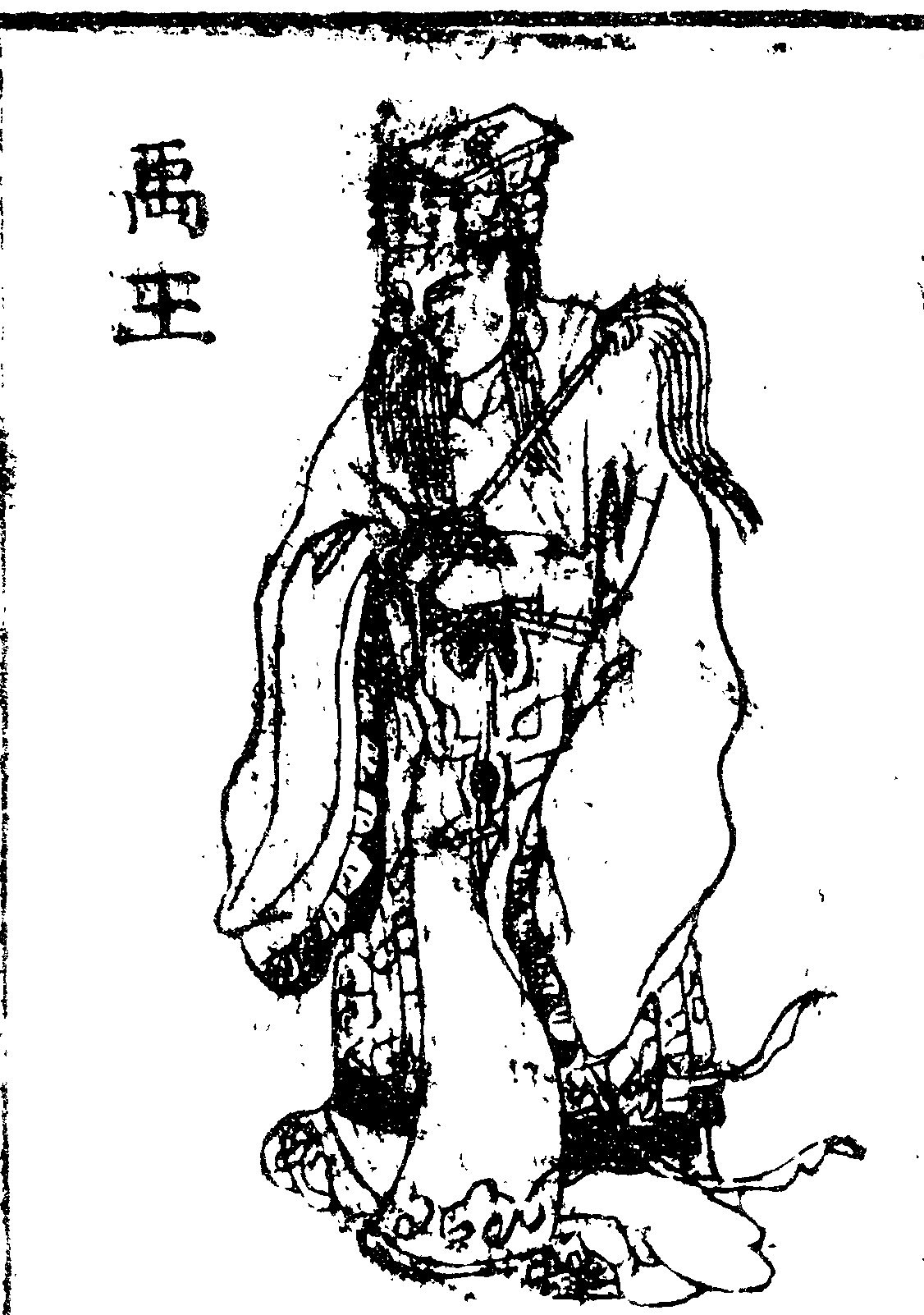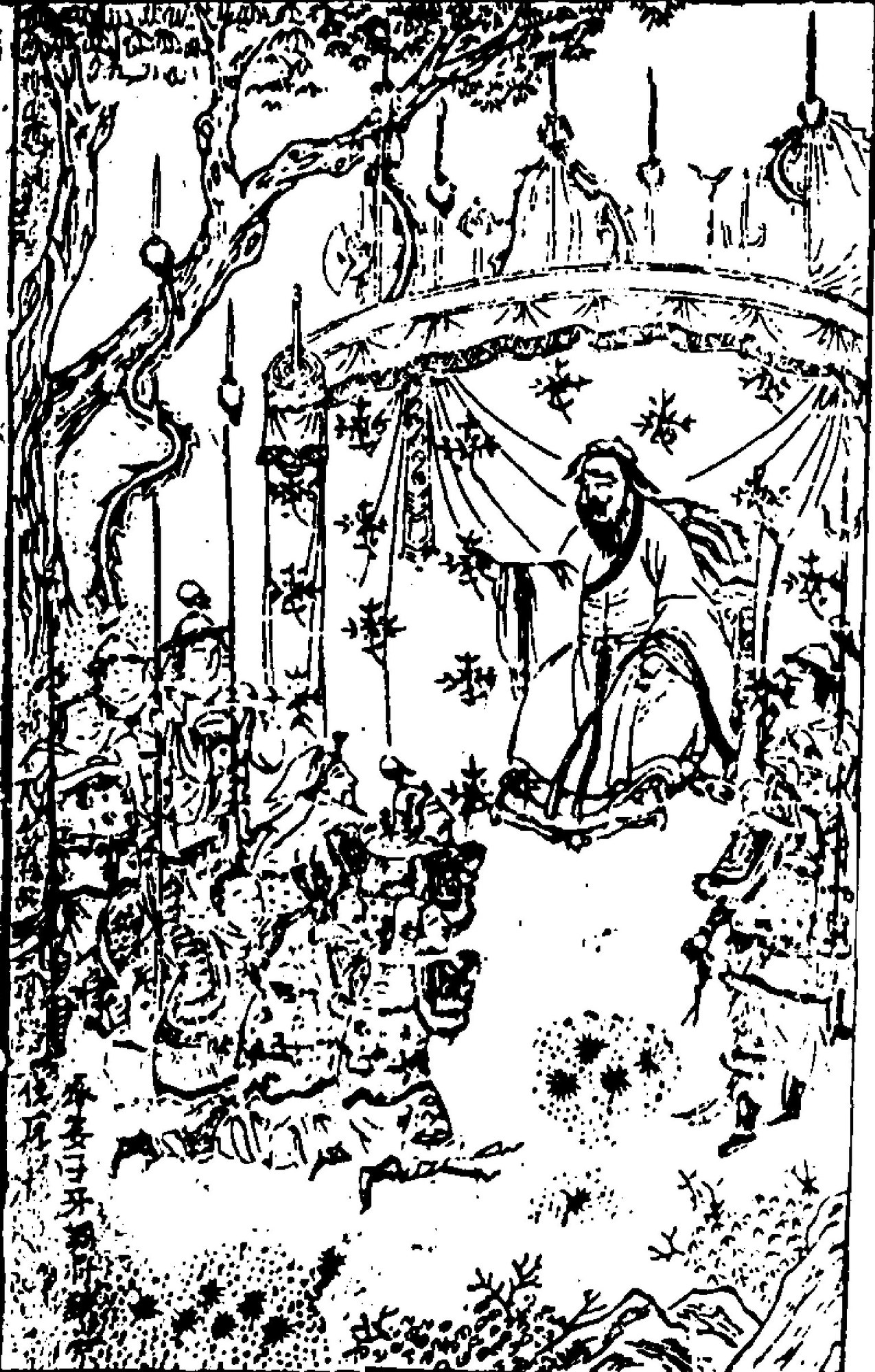
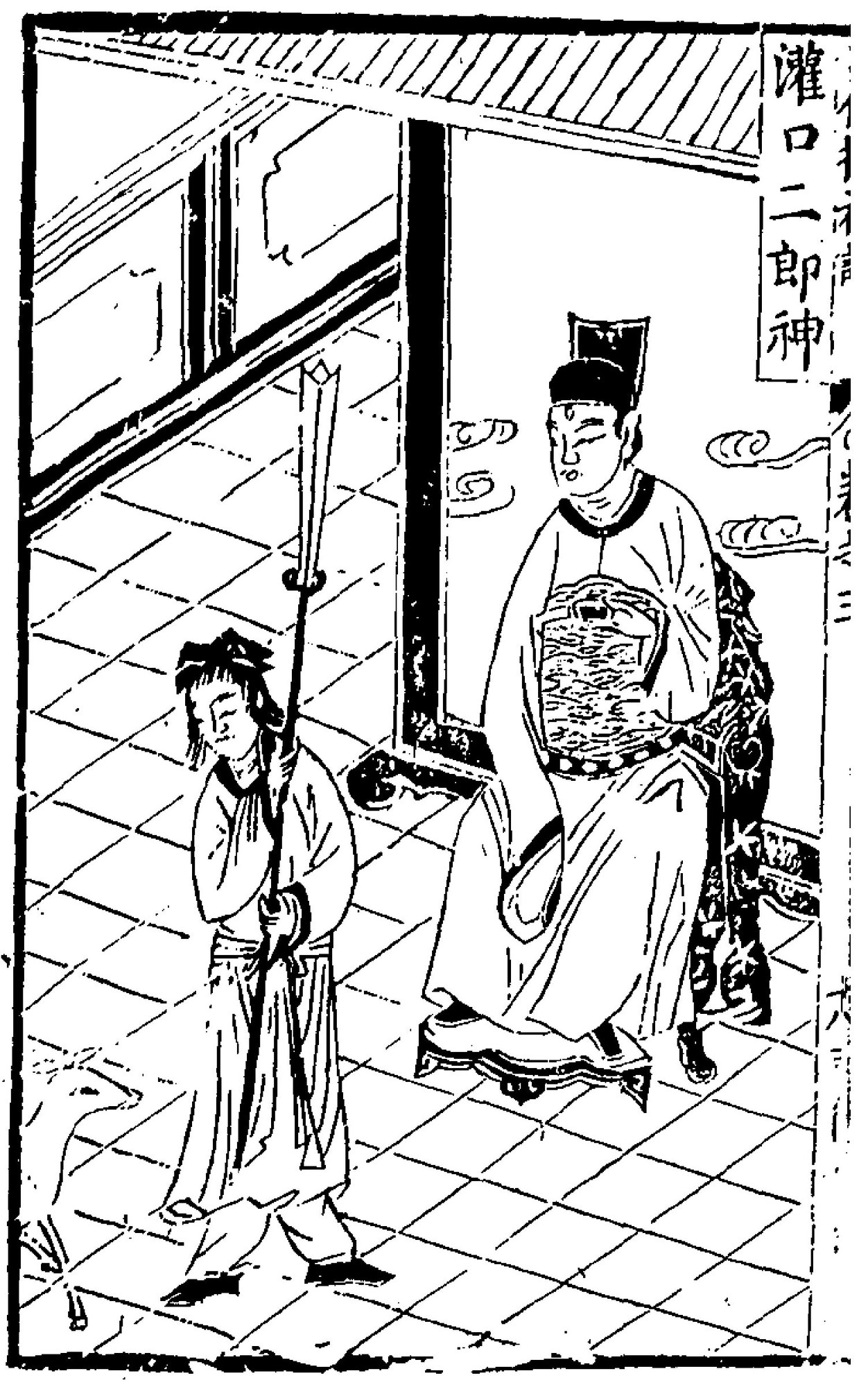
Picture the god the way the temples and the opera stage have fixed him: a young warrior in bright armour, a slender hound tensed at his heel, a three-pointed double-edged spear in his fist, and set upright in the middle of his forehead a third eye that no disguise can fool. That is the Erlang Shen of the New Year print and the animated film, and it is how almost everyone now meets him. It is worth saying at the outset that the two great novels which carry his most famous exploit do not describe him this way. In their pages he wins by ordinary sharp sight, a lucky tell, and a mirror held up by somebody else. The eye in the forehead is real, but it lives in the picture, not in the text.
He is, in the stories, the nephew of the Jade Emperor, a semi-independent warrior-god whose incense comes up from a temple at the mouth of the Guan River in Sichuan. When the bodhisattvaIn Chinese Buddhism, an enlightened being who postpones final nirvana to aid others; here Guanyin, who recommends Erlang to the Jade Emperor. Guanyin recommends him to the celestial court, she puts the relationship precisely: he obeys the summons to battle, not the summons to audience. The throne may request him. It cannot command him. He is the kind of god an empire keeps at arm’s length and calls in when its own hundred thousand troops have failed.
Three hundred bouts and a chase through shapes
The exploit everyone knows is his fight with the rebel monkey Sun Wukong in the sixth chapter of Journey to the West. When the heavenly army cannot take the Great Sage, Guanyin names the Jade Emperor’s own nephew, who once slew a brood of monsters and commands the Meishan brothers and twelve hundred grass-headed spirits. Erlang rides out with his six sworn brothers, the seven of them driving falcons and hounds, drawing crossbows and bows, and he and Wukong fight to a standstill over three hundred bouts before either resorts to sorcery.
Then comes the set-piece the whole tradition remembers, and it is a chase through shapes. Wukong turns sparrow; Erlang becomes a hawk. Wukong drops to the water as a cormorant; Erlang stoops as a crane. Fish, water-snake, and each time Erlang counters with the creature that eats the last. When the monkey finally perches on a bank as a bustard, Erlang will not stoop to so base a bird. He resumes his own form and knocks it flat with a single clay pellet from his crescent bow.
And when Wukong at last disguises himself as a roadside shrine, mouth for a door, teeth for the door-leaves, eyes for the lattice windows, it is not any magic eye that catches him. It is that the monkey could not tuck his tail away and stood it up behind as a flagpole. Erlang laughs that he has seen shrines aplenty but never one with a flagpole round the back. Sharp eyes and an absurd detail, not a mystic organ of sight.
Who actually brings the monkey down
The most quietly honest thing about the chapter is that Erlang cannot finish the job himself. The duel is settled from off-stage. Laozi, watching from heaven, drops his steel Diamond Snare and cracks it down on Wukong’s skull, tripping him. Then Erlang’s hound rushes in and bites the monkey on the calf, and the monkey, sprawling, curses the dog for troubling him instead of its own master.
The seven brothers pile on and run a hooked blade through his collar-bone so he can shape-shift no more. The god everyone paints as the lone perfect hunter takes his prize by a thrown ring and a dog’s teeth, with the demon-revealing mirror of the Heavenly King Li tracking the quarry overhead the whole while.
That mirror deserves a moment, because it is the clue to the missing eye. In Journey to the West the seeing-through of disguise is done by a bronze mirror, not by anything in Erlang’s face. His portrait in that chapter runs through his phoenix hat, his goose-yellow robe, his jade belt, his crescent bow and his spear, and gives him eyes full of light and, later, phoenix eyes. It never once gives him a third.
A second novel, a second name
Cross to the other great Ming novel and the god changes his name. In Investiture of the Gods, written within a decade or so of the first, he is Yang Jian, a hero on the Zhou side and the disciple of an immortal on Jade-Spring Mountain, master of the seventy-two transformations, who at the end of the book achieves sainthood in the flesh and is enfeoffed as the True Lord of the Marvelous Way of the Pure Source.
That last title is the same one the older Erlang cult already held, which is the novel’s way of telling you the two are one god under two names. Here at last the hound is named outright, the Howling Celestial Dog, and it flies up to seize a demon in its jaws.
Two nearly contemporary novels, then, and they disagree on the plain facts. One calls him Erlang and leaves his dog unnamed; the other calls him Yang Jian and names the dog. And the third eye is absent from both battle-sequences: when Yang Jian needs to see through the shape-shifting of the Seven Monsters of Meishan, he too snatches up a demon-mirror and shines it. The only three-featured warrior in those chapters is a different god entirely, the boy Nezha with his three heads and eight arms. The eye did not migrate from the text into the picture. It began in the picture.
Four men wearing one god
Behind both novels lies an older and stranger fact: nobody agrees who Erlang was. Peel the cult back and you find at least four men laid over one another across roughly eighteen centuries. Scholars point to the Qin engineer Li Bing, who tamed the Sichuan floods around the third century before the common era, and to a second son of his deified beside him at GuankouThe mouth of the Guan River in Sichuan, seat of Erlang's temple and hero-cult, from which he takes one of his oldest titles..
A separate strand makes him Zhao Yu, a governor of Jiazhou of Sui or Tang legend who waded into a river sword in hand, beheaded a flood-dragon, and rose to heaven on a white horse in broad daylight. That Zhao-Yu figure is the one who speaks in the Yuan zajuA form of Yuan-dynasty musical drama, the earliest stratum in which Erlang's whole legend appears fused into a single self-introduction., some two centuries before either novel, and his self-introduction already contains the whole complex: the dragon-slaying, the seven sages, the Guankou temple, the Pure-Source title. And then the novels add the fourth man, Yang Jian, the Jade Emperor’s nephew, who is now the most popular of all.
These are not one biography with variants. They are four genealogies stacked on a single hero-cult, separated from its supposed historical seed by something on the order of eighteen hundred years, and from the earliest full-narrative version, the Yuan play, by a further two centuries before the novels fixed him in print. The reader should not imagine an ancient god slowly clarified. The picture ran the other way, accreting names and eyes as it went.
The eye and the axe
So where does the third eye come from, if not the texts? From everything around them. From the temple statues and the Ming demon-hunt scrolls, from the Sichuan and Beijing opera stages, and now from film, which needed a single striking sign for a god assembled out of four men and two novels. The forehead eye that pierces all disguise is genuine iconography and worth honouring as such. It is simply not the device by which he caught the monkey in 1592.
One more legend the pictures carry runs the same way. The son who takes an axe and splits open a mountain to free his imprisoned mother is beloved across Chinese opera, and Journey to the West nods to it in a single line of Erlang’s portrait. But the full rescue belongs to the later precious-scroll and Lotus Lantern tradition, not to the novels that made his name. Like the eye, it is true of the god the culture has built, and absent from the books that built him. Erlang is best read as exactly that kind of figure: a warrior whose most famous features were painted on after the stories were told.
He obeys the summons to battle, but not the summons to court. (Journey to the West, ch. 6; author’s rendering from the Chinese)
- Wu Cheng’en (attrib.), Journey to the West (西遊記), ch. 6:
Guanyin Attends the Feast and Asks the Cause; the Little Sage Displays His Power and Subdues the Great Sage.
Novel c. 1592 (Shidetang edition). Erlang’s introduction and semi-independent status (只是聽調不聽宣), his Meishan brothers, the three-hundred-bout duel and the transformation-chase (sparrow, cormorant, fish, water-snake, bustard, and the shrine with the tell-tale flagpole), the pellet-bow, and the capture by Laozi’s Diamond Snare (金鋼琢) and the unnamed hound (細犬), with the Heavenly King Li’s demon-mirror (照妖鏡) tracking overhead. His portrait verse gives himeyes full of light
andphoenix eyes
and no third eye. Chinese read verbatim (zh.wikisource 西遊記/第006回). - 封神演義 (Fengshen Yanyi / Investiture of the Gods), juan 40, 91, 92: attributed to Xu Zhonglin / Lu Xixing, c. 1605. Erlang under the name Yang Jian (楊戩), disciple of Yuding Zhenren on Jade-Spring Mountain, master of the seventy-two transformations, enfeoffed as True Lord of the Marvelous Way of the Pure Source (清源妙道真君); the named Howling Celestial Dog (哮天犬); and the demon-mirror (照妖鑑) — not an eye — turned on the Seven Monsters of Meishan. The three-head, eight-arm form in these chapters belongs to Nezha, not Yang Jian. Chinese read verbatim (zh.wikisource 封神演義/卷040, /卷091, /卷092).
- Anonymous, Erlang Shen Drunkenly Shoots the Demon-Binding Mirror (《二郎神醉射鎖魔鏡》): Yuan-dynasty zaju drama, 13th–14th c., the earliest full-narrative stratum. Erlang’s self-introduction as Zhao Yu (趙昱), Governor of Jiazhou, who beheads the flood-dragon and ascends on a white horse; already fused with the Seven Sages of Meishan, the Guankou temple, and the Pure-Source title some two centuries before the novels. Chinese read verbatim (zh.wikisource).
- Carmelita Hinton,
In Search of Erlang,
East Asian History no. 21 (June 2001), ISSN 1839-9010: the modern scholarly survey of the cult’s history and competing origins, including the Song-dynasty imperial title-grants. Secondary; bibliographic data confirmed, article body not consulted this session, so no specific attributed claim is printed as fact. - Cheng Manchao, The Origin of Chinese Deities (Foreign Languages Press, Beijing, 1995, ISBN 7-119-00030-6), pp. 170–180: secondary; the roster of origin identifications (Li Bing and his second son at Dujiangyan / Guankou; Zhao Yu). Cited, not read verbatim.
- 寶蓮燈 / 沉香劈山救母 (Baojuan and Lotus Lantern tradition): the late-imperial precious-scroll and operatic
split the mountain to free the mother
cycle, alluded to in a single line of the Journey to the West portrait but told in full only here. A distinct later tradition; cited, not read verbatim.