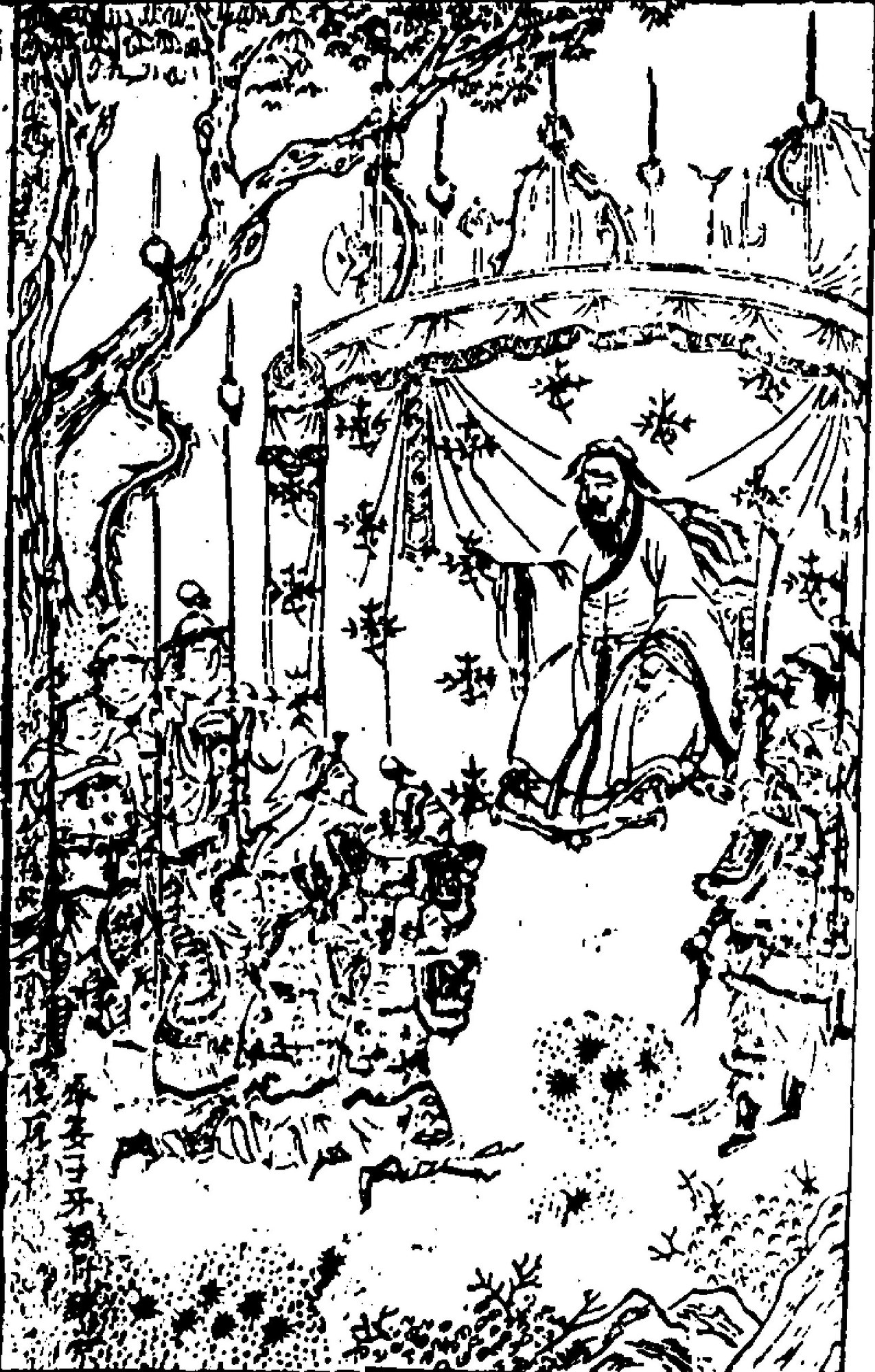
The old man in full armour stands at the centre of the terrace with a banner in one hand and a whip in the other, and calls the dead up by name. Below him hangs a long scroll. On it are three hundred and sixty-five names, and every one of them belongs to a man or woman who died in the war just ended, on one side of it or the other. He is not raising a monument. He is filling posts. The scroll is a roster, the terrace is a hall of appointment, and the ghosts filing up the earthen steps in strict order are about to be told, one after another, what office they will hold in Heaven for the rest of time.
This is the closing image of a novel, not the sequel to a battle. It matters to say so at the outset, because the ceremony wears the costume of history so convincingly that readers have taken it for a real event. It is the last great scene of the Fengshen yanyi, the Investiture of the Gods, a vast supernatural romance printed around the year 1600, in the Wanli reign of the late Ming.
The war it crowns, the Zhou conquest of the Shang, was real and ancient, fought around 1046 BCE by modern reckoning. Between the fighting and the writing lie some two thousand six hundred years. The gap is the whole point, and we will come to it. First the terrace.
The decree fetched down from Heaven
The man on the terrace is Jiang Ziya, and the first thing the novel is careful to establish is that the authority he wields is not his own. Before any name is read, he travels by earth-escape magic to the Yuxu Palace and kneels before Yuanshi TianzunThe Primordial Heavenly Lord, highest master of the novel's Chan order, whose sealed decree, not the Jade Emperor's, authorises the whole ceremony., enthroned at the Jasper-Roaming Couch.
He has a petition. The loyal ministers and filial sons cut down in the war, and the immortals fated to fall in the great tribulation, are drifting as souls with nothing to cling to. He begs a jade talisman and a sealed decree to enrol them in rank, so that they will not be left as wandering ghosts. The Primordial Lord tells him he knows already, and that the decree will come to the terrace.
It is worth being exact about who is speaking here, because popular retellings almost always get it wrong. The power behind the roster is Yuanshi Tianzun, the highest master of the novel’s own Chan order. The Jade Emperor, whom later folklore installs as sovereign of this whole celestial bureaucracy, does not appear in the chapter at all; the decree is not his, and the court being staffed is not shown as his. What the terrace enacts is the founding charter of the machine, the drafting of its first officers, and that charter is signed higher up than the throne most readers imagine at the top.
Water poured, flowers scattered, three times round
The decree descends in a procession of pipes and incense, banners and feather-canopies. Spirit attendants — the Yellow-Turban Strongmen and the White-Crane Lad — carry the golden talisman down to the minister’s residence, and Jiang Ziya takes it by earth-escape to the Fengshen TerraceThe raised altar before Mount Qi from which the roster of gods is read; in Chinese, the "god-investing terrace" (封神臺)., the god-investing altar raised before Mount Qi. There the Pure-Blessing God, Bai Jian, is waiting to meet him.
Then the novel slows down and does something it rarely bothers with, which is to walk through a rite step by step. Ziya sets the talisman on the central altar. He has two of his officers raise eight-trigram paper banners to pin the directions and the signs of the calendar. He arrays three thousand troops across the five quarters.
And then, alone, he prepares himself: he bathes, changes his robes, offers incense at the golden tripod, pours out wine, scatters flowers, and walks three times around the terrace. Only after all of it does he take up the decree. The sequence is the richest thing in the chapter, because it tells you what kind of event this is meant to be. Not a triumph over a beaten enemy. A liturgy for the dead.
In armour, the whip in his right hand
Now he reads. First comes the proclamation of Yuanshi Tianzun, and its opening is a lament, not a fanfare. Alas, it begins, the roads of immortal and mortal wind apart, the paths of god and ghost divide.
It speaks of those who in a mortal frame gave everything in loyalty to their country, and of those who through their own wrath brought calamity down on themselves, and it pities them all without much sorting the deserving from the rest: their bodies met the blade, day by day they sank in a sea of suffering, their hearts were loyal and yet they drift with nothing to hold to. For this reason, the decree commands, enrol them as the Eight Divisions of Proper Gods, to patrol the good and evil of humankind.
Then Jiang Ziya stands forth to run the appointments himself, and the novel freezes him in the pose that is the whole story in a single frame. He is in full battle armour. In his left hand is the apricot-yellow flag; in his right, the god-flogging whip. He stands at the centre and gives the order: hang the Roster of Investiture below the terrace, and let all the gods come forward in order, none pushing forward out of turn. It is a general’s command, issued to the dead. The man who a chapter earlier was directing armies is now directing souls into a filing system, and he does it in the same armour, with the same hard voice.
The general who would not kneel
The roll-call that follows is where the ceremony earns its strange power, because it does not flinch from the mixture it is sorting. The very first name on the scroll is Bai Jian himself, the usher, once a marshal of the Yellow Emperor slain fighting the war-god Chi You, now made head of the Three Realms and the presiding Pure-Blessing Proper God.
After him the dead come up one by one, each led to the foot of the terrace by a soul-guiding banner, to kneel and hear the office read aloud, and the recurring note struck over almost every one of them is not glory but grief: the case is truly grievous, their wrong is pitiable. This is a mass consolation, and it consoles both armies. It files Zhou heroes and Shang loyalists into the same heaven.
One soul refuses the choreography. Wen Zhong, the fierce Grand Preceptor of the fallen Shang, storms up unwilling to yield to anyone, and will not kneel. It takes Ziya raising the god-flogging whip and shouting him down before the great general submits and accepts his post as lord of the Thunder Division. Even drafted into Heaven, even dead, the enemy’s best man bows last and least willingly; the bureaucracy absorbs him anyway. That is its nature.
It has a slot for a hero who defied it to the end, and near the very close, once the loyal and the pitiable are all placed, it even reaches for the villains, hauling up two Shang flatterers, beheaded for treachery in the chapter that follows, to make them baleful gods of dissolution: the lowest posting on the roster, but a posting all the same. When the last of the three hundred and sixty-five is placed, the mournful winds around the terrace fall still and the red sun stands at noon.
The war that happened and the heaven that did not
Now the gap. There was a real Jiang Ziya, and we can watch him from much closer to his own century in Sima Qian’s Shiji, the great history finished around 94 BCE, itself already some nine hundred years after the events it preserves. There he is Lü Shang, also called Taigong Wang, an old and poor man of the eastern seacoast who won an audience with the Zhou chief by fishing on the bank of the Wei, and was welcomed with a line that became his name: my late lord long hoped for you. He is a soldier and a statesman, the chief architect of Zhou’s rise.
Before the decisive battle at MuyeThe plain where the Zhou host broke the Shang army in a single day, around 1046 BCE by modern reckoning, the historical battle the novel builds its heaven upon. the tortoise-shell divination came out inauspicious and a storm broke, and all the dukes were afraid; only Taigong forced the king onward, and the Shang were shattered in a day. His reward for winning the empire was an earthly one. King Wu made him lord of the state of Qi, and there history leaves him.
Sima Qian is honest in a way the novel cannot be, and the honesty is itself instructive. He gives three separate stories of how Lü Shang first came to Zhou, flags each with a plain some say, and refuses to choose between them: the fisherman at the Wei, the disillusioned servant who fled the Shang tyrant, the seacoast recluse recruited to help ransom a captive king. The point is what he does not report. In the whole biography there is no terrace, no roster, no god, not a word of it.
The celestial civil service, the drafting of the slain into rank, the three hundred and sixty-five offices, all of it belongs to the novel and to the imagination of a late-Ming writer whose own name we cannot even fix, working across a distance from the battle that dwarfs the one between the Shiji and the war it records. The investiture is not what happened after Muye. It is what a storyteller, two and a half millennia later, wished had happened: a Heaven merciful enough to find every dead soldier a post, and to grieve, name by name, for the ones who never came home.
Bai Jian, hang the Roster of Investiture below the terrace. Let all the gods come forward in order, and none may jump the queue. (Fengshen yanyi, ch. 99; author’s rendering from the Chinese)
- 《封神演義》 Fengshen yanyi (Investiture of the Gods), chapter 99, 「姜子牙歸國封神」 (
Jiang Ziya Returns to His State and Invests the Gods
): the source for the entire investiture ceremony. Jiang Ziya fetches the sealed jade decree from Yuanshi Tianzun at the Yuxu Palace; the talisman is borne down by the Yellow-Turban Strongmen and the White-Crane Lad; Bai Jian meets him at the Fengshen Terrace before Mount Qi; the ritual sequence (talisman on the central altar, eight-trigram paper banners, three thousand troops in the five quarters, then bathing, changing robes, incense, wine, scattered flowers, three circuits of the terrace); the proclamation of Yuanshi Tianzun; Jiang Ziya in full armour with the apricot-yellow flag and the god-flogging whip ordering the roster hung and the gods to come up in order; the roll-call of the 365 Proper Gods in the Eight Divisions, opening with Bai Jian and including Wen Zhong’s refusal to kneel. The count 三百六十五 is stated twice in the chapter. Ming novel, c. 1600 (Wanli era). Chinese text read verbatimChinese Wikisource, 封神演義/卷099. - 《封神演義》 Fengshen yanyi, chapter 100, 「武王封列國諸侯」: the roster’s tail, in which the Shang flatterers Feilian and Elai are beheaded and then enrolled as baleful
Melting-and-Dissolution
gods, before the novel turns to King Wu’s earthly enfeoffment of the feudal lords. Chinese text read verbatimChinese Wikisource, 封神演義/卷100. - Sima Qian 司馬遷, Shiji 史記, juan 32,
Hereditary House of Qi Taigong
(齊太公世家): c. 94 BCE, the authoritative historical account of Lü Shang / Taigong Wang. His origins on the eastern seacoast; the Wei-river meeting with King Wen and the naming asthe Hope of Taigong
; the three variant origin-traditions Sima Qian records against himself with his own some say; his generalship at Mengjin and Muye (the inauspicious divination and the storm, with Taigong alone urging the king on); his enfeoffment at Qi. Contains no investiture of gods. Chinese text read verbatimChinese Wikisource, 史記/卷032. - Authorship and date of the novel: disputed. Traditionally attributed to Xu Zhonglin 許仲琳; Chinese Wikisource gives Chen Zhonglin 陳仲琳; Lu Xixing 陸西星 has also been proposed. The c. 1600 (late Ming, Wanli) date is secure; the author is not. The c. 1046 BCE date for the conquest is a modern scholarly reconstruction (the Xia-Shang-Zhou Chronology Project), not a figure the Shiji gives.