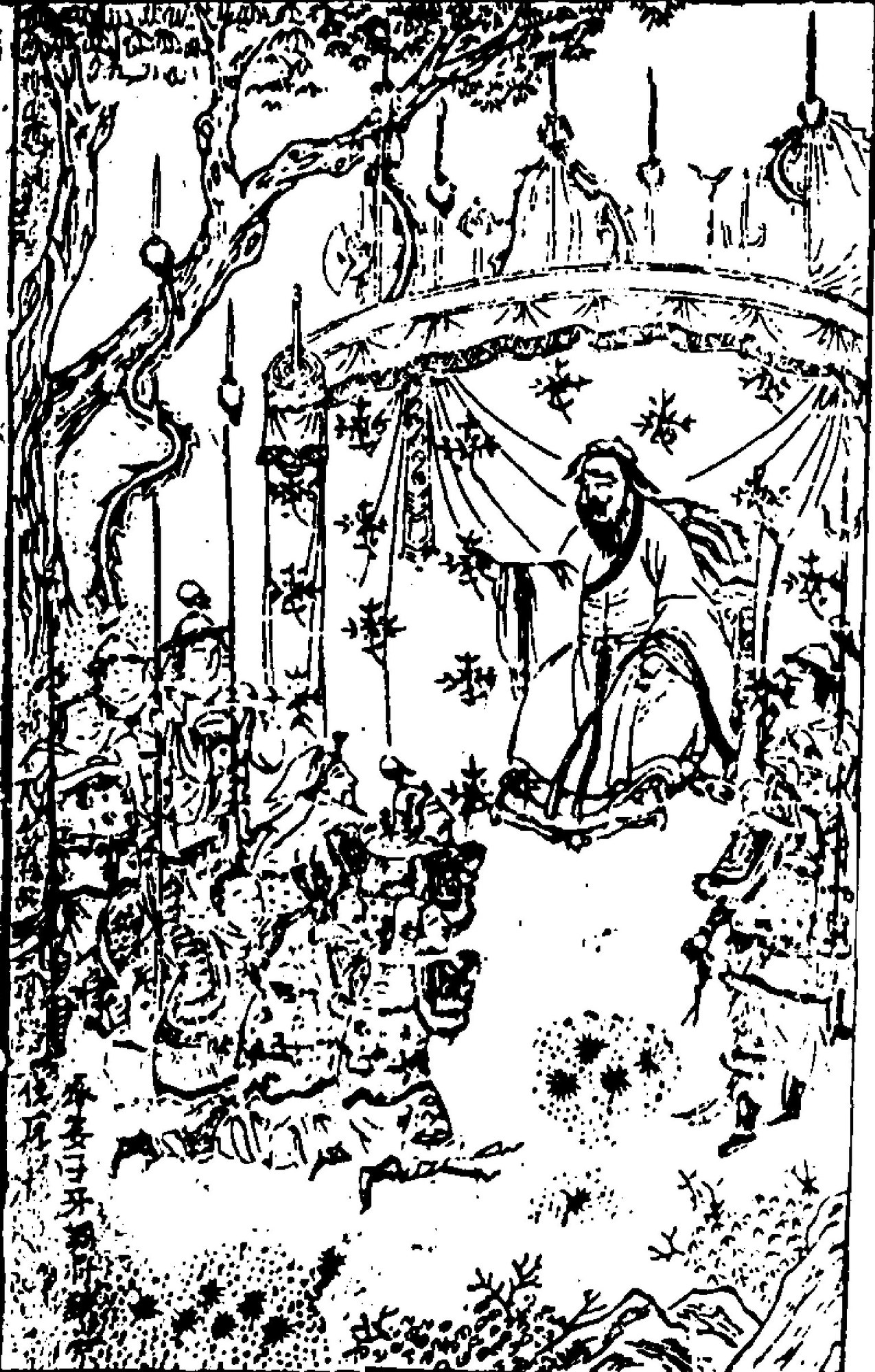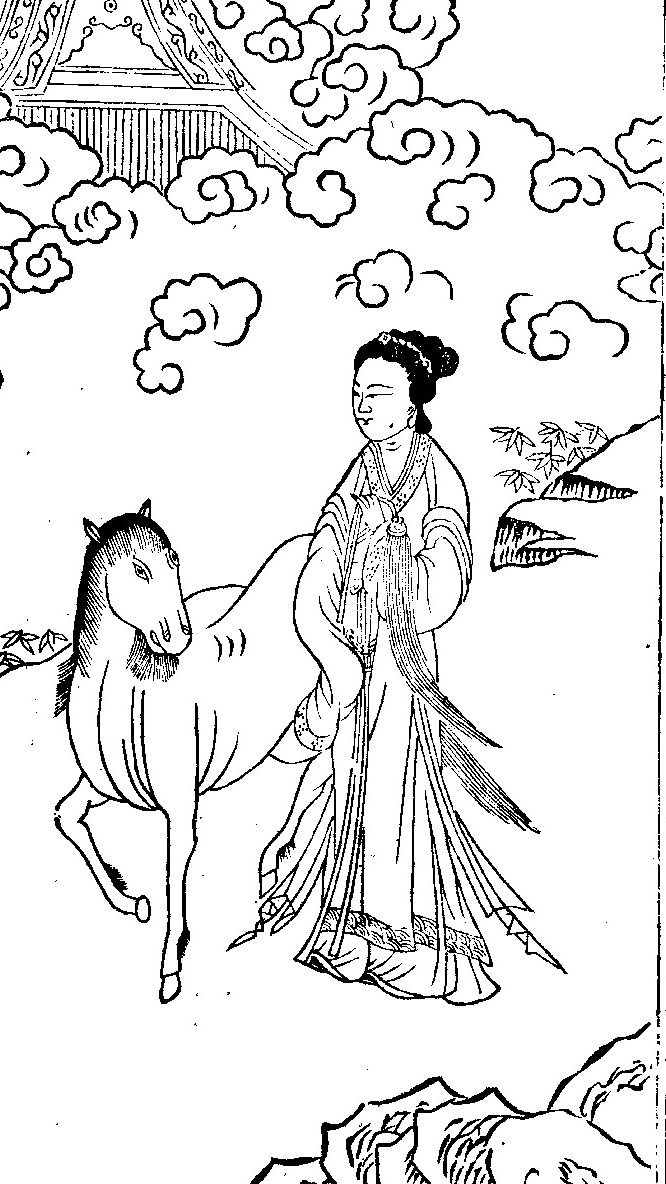
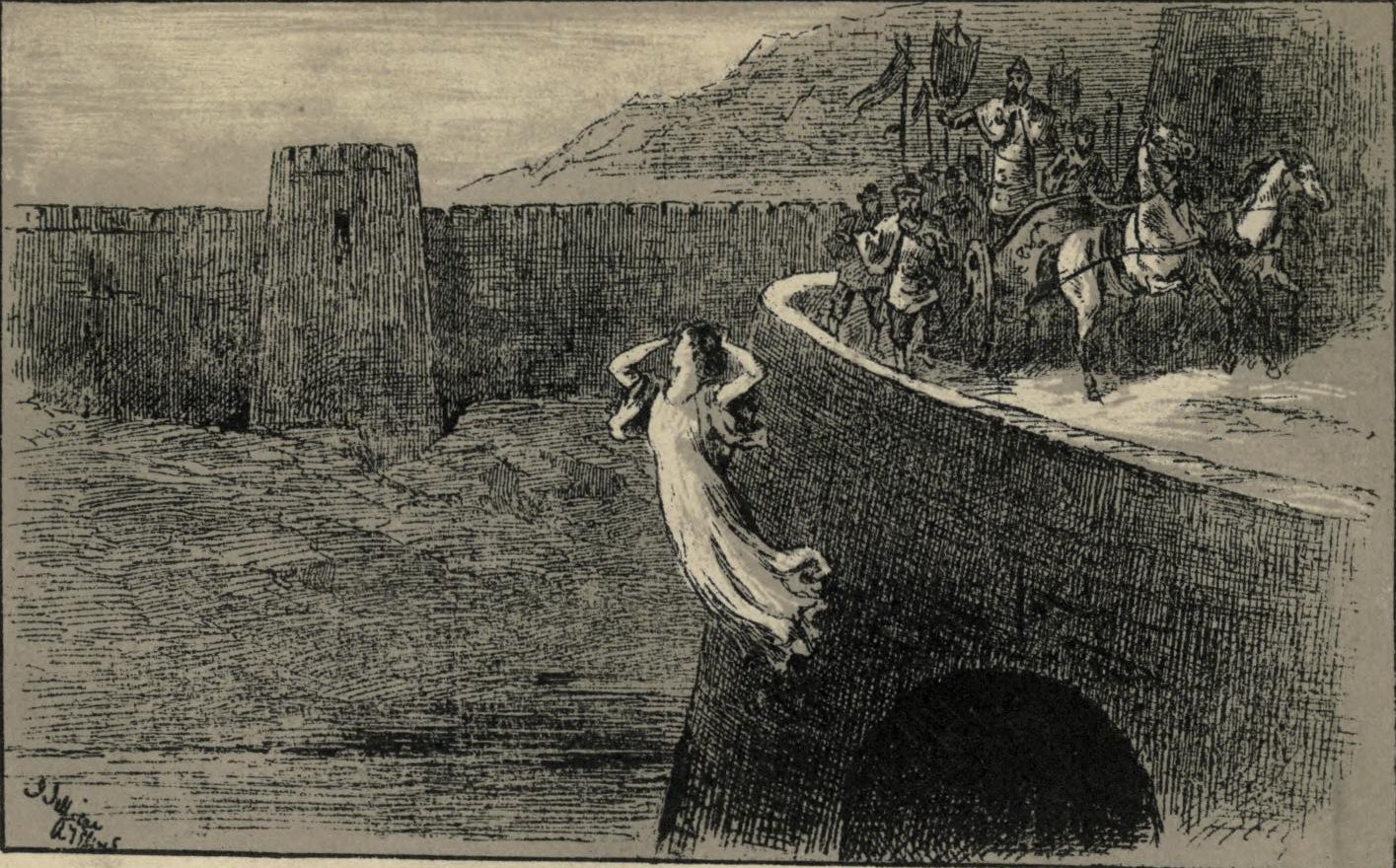
Everyone knows how the story ends. A woman travels the length of the empire with a bundle of winter clothes for her conscript husband, reaches the Great Wall, and learns he is already dead, his body rammed into the packed earth with the ten thousand other men who died building it. She sits at the foot of the wall and weeps, and her grief is so terrible that a whole stretch of the wall cracks apart and falls, spilling out the bones of the dead. Then, cursing the First Emperor who sent her husband to die, she drowns herself in the sea. It is China’s most famous story of grief against tyranny, and almost none of it is old. The wall, the emperor, the conscript, the name Meng Jiangnü, the leap into the sea: each entered the tale at a different, later date, and the earliest source knows a completely different woman who does none of these things.
A widow who would not weep in the road
Peel back the whole tradition and you reach a bare four lines in the Zuozhuan, the great chronicle of the Spring and Autumn period, recording an event of 550 BCE. Duke Zhuang of the state of Qi has made a surprise raid on the neighbouring state of Ju, and in the fighting an officer named Qi Liang is killed. The Duke, riding home, happens on Qi Liang’s widow out in the suburbs and sends a messenger to offer his condolences on the spot.
She refuses. If her husband was guilty of a crime, she answers, there is no need for the ruler’s words; and if he was not, then the humble cottage of his forebears still stands, and a lowly wife cannot receive condolence out on the open road. Rebuked, the Duke goes to her house and condoles with her properly there.
That is the entire seed. There is no wailing, no city wall, no Great Wall, no emperor, no dead husband built into anything. The story is about one thing only: lǐ, ritual propriety. A widow, in the sharpest grief, still knows that a condolence has its correct place, and she will not let even a duke offer it in the wrong one. She is an exemplar of decorum, not a figure of protest, and she does not so much as cry.
When weeping began to move the world
The tears came later, and in stages. The ritual compendium Liji, compiled under the Han from older material, retells the same scene but now has her meet the coffin on the road and weep over it with grief before she speaks her lines about propriety.
Around the same period, in the late fourth century BCE, the philosopher Mengzi lets slip the first hint that her weeping had a public power: the wives of Hua Zhou and Qi Liang, he writes, wept so well for their husbands that they changed the customs of the state. It is a passing remark about the force of sincere feeling. There is still no wall and nothing collapses. But the idea has been planted that a woman’s lament could reshape the world around her, and once planted it grew.
The distance here is worth stopping on. The Zuozhuan records an event of 550 BCE; the fully formed legend of Meng Jiangnü and the Great Wall is a thing of the Ming dynasty, more than two thousand years later. That is a longer gap than the one between the Iliad and the printing press. What the modern story treats as a single ancient legend is in truth a slow accretion, one motif at a time, and the fascination of it lies precisely in watching each piece arrive.
The first wall to fall, and it was not the Great Wall
The collapse enters the record around 18 BCE, in the Western Han, when Liu Xiang gathered his Biographies of Exemplary Women and placed the wife of Qi Liang among the chaste and obedient. She is still nameless. She goes to her husband’s corpse at the foot of the city wall and weeps, and the sincerity of her grief is such that after ten days the wall collapses for her. Then, her father dead, her husband dead, and no son to turn to, she declares there is nothing left to do but die, and drowns herself in the Zi River.
Everything here matters for what the story is not. The wall that falls is the city wall of Qi, an ordinary rampart around a Warring States town. There is no Qin First Emperor, no forced labour on a northern frontier, no Great Wall at all, because in Liu Xiang’s day the story has nothing to do with any of them. The wife dies by drowning in a river, not by leaping into the sea.
Three centuries on, the scholar Cui Bao records the same episode attached to a yuefuMusic Bureau songs: a class of Chinese ballad and its later literary imitations, through which the wife of Qi Liang passed from anecdote into sung lament., one of the Music Bureau songs. He adds the threefold cry the later tradition would keep: above I have no father, in the middle no husband, below no son, the bitterness of life is complete. In his telling too it is the capital wall of Qi that is moved by her voice and topples, and she throws herself into the water. Still a city wall. Still no emperor.
The Tang welds on the tyrant
The Great Wall and the First Emperor arrive together, and late. Under the Tang, the stock poetic theme of conscripts suffering and dying on the northern frontier, and the revived memory of the wall the First Emperor of Qin had driven men to build, were welded onto the old story of Qi Liang’s wife. The join is visible in a single poem.
The monk-poet Guanxiu, who died in 912, wrote his own Qi Liang’s Wife
in which the Spring and Autumn officer has quietly become a victim of Qin. Qin was without the Way, he sings, and the four seas withered; it built the Long Wall to fence off the northern barbarians, ramming men and earth for ten thousand li. Then the chaste wife wails, and at her first cry the wall collapses in the bitter cold, and at her second cry Qi Liang’s bones come up out of the earth.
In four hundred years the story has been transformed. The ten patient days of the Han version are gone, replaced by two cries and an instant ruin. The city wall of Qi has become the Long Wall of the tyrant. And the husband, a soldier killed raiding a neighbouring state in 550 BCE, has been carried forward some three centuries and buried in the wall of an emperor who would not be born for generations after his death.
The soul in the wall and the drop of blood
The oldest full story we can actually read as a story is not in any classic but in a ballad. Among the manuscripts sealed for a thousand years in a cave-library at Dunhuang and recovered only in the last century are transformation texts, the sung-and-spoken bianwenTransformation texts: illustrated prose-and-verse ballads for popular recitation, recovered from the sealed cave-library at Dunhuang, that carry the earliest full Meng Jiangnü story. that ordinary people listened to. One of them tells the Meng Jiangnü tale at length, and it is here that the tale acquires its most harrowing images.
Qi Liang’s body has been built into the fabric of the wall itself. His soul wanders among the thorns and speaks to his wife across the barrier of death, telling her that a poor soldier under the earth will never forget her. When the wall breaks open it reveals not one skeleton but a mass of them, the anonymous dead of the whole works heaped together, and she cannot tell which bones are her husband’s.
So she bites her finger and lets the blood fall, praying it will sink into his bones and no others. The dead among the yellow sands call out to her to carry word to their own wives, still waiting in their rooms, and to keep up the offerings for their souls.
None of this is in the ancient strata. The blood that knows its own, the soul that speaks from inside the wall, the field of nameless bones: all of it is Tang, the invention of performers turning a scholar’s exemplum into something a grieving audience could feel in the body. This is the layer where the legend stops being about propriety and becomes about the human cost of the wall.
Even her name is a fossil of the story’s origins. In every source before the Tang she is simply the wife of Qi Liang, with no name of her own. When a name finally attaches, it is Meng Jiang, and it is not a personal name at all.
Jiang was the surname of the ruling house of Qi, and Meng marked an eldest daughter; Meng Jiang meant no more than the eldest Jiang girl, a stock designation for a noblewoman of that state. The very name that seems to make her an individual is in fact a relic pointing straight back to Qi, the Spring and Autumn kingdom where the whole thing began, long before anyone dreamed of the First Emperor.
The rest is Ming and later. Only then is the Great Wall explicitly named as the wall of the tale, only then does the husband gain names of his own such as Wan Xiliang or Fan Qiliang, and only then does the ending in which she throws herself into the sea appear, complete in 1594 with a temple to Lady Meng Jiang built near the eastern end of the wall at Qinhuangdao. The winter-clothes journey, the curse on the emperor, the marriage trap: all of it is late popular elaboration, evocative and beloved and no older than the last few centuries.
What Gu Yanwu already knew
The most remarkable thing is that a Chinese scholar took the whole story apart more than three hundred years ago, and did it better than most. In 1670 the philologist Gu Yanwu devoted an entry of his Record of Daily Knowledge to the wife of Qi Liang. He quotes the Zuozhuan and observes flatly that the ancient text amounts to no more than this: no weeping, no wall. Weeping, he notes, begins with two later books; the collapsing wall begins with two later books still. He even doubts the collapse ever happened.
And then he lays down the sentence that is the whole point of the tale’s history. What collapsed, he writes, was merely a city wall; it does not say Great Wall. The Long Wall of Qi was built in the time of King Wei, over a hundred years after Duke Zhuang, and the Long Wall of Qi is in any case not the Long Wall built by the First Emperor of Qin. Later people, he goes on, passed down the tale that Qin built the Long Wall and that there was a Meng Jiang, wife of one Fan Lang; but this is no longer the affair of Qi Liang’s wife at all.
He was right, and he had read it right in 1670. The story that everyone knows, the wall and the emperor and the wailing that topples stone, is a magnificent thing built over a thousand years and more on a foundation of four dry lines about a widow who would not receive condolence on the road. Its power is not diminished by knowing this. If anything the accretion is the deepest thing about it, the record of how a whole people, generation after generation, kept returning to a woman’s grief and pressing into it everything they could not otherwise say about the men their rulers sent away to die.
At her first cry the wall collapses in the bitter cold; at her second cry Qi Liang’s bones emerge from the earth. (Guanxiu, “Qi Liang’s Wife,” in Yuefu Shiji 73; author’s rendering from the Chinese)
- Zuozhuan (左傳), Duke Xiang year 23 (襄公二十三年) — c. 4th c. BCE, of an event of 550 BCE: the seed anecdote and the foundation for reading all the rest, because here there is no weeping and no wall of any kind. Qi Liang is killed in Duke Zhuang of Qi’s raid on Ju; his widow refuses roadside condolence on grounds of propriety (「下妾不得與郊弔」), and the Duke condoles with her properly at her house. Chinese read verbatim (zh.wikisource).
- Mengzi (孟子),
Gaozi II
(告子下) — c. late 4th c. BCE: the first hint that her lament had public force, 「華周、杞梁之妻,善哭其夫,而變國俗」,the wives of Hua Zhou and Qi Liang wept well for their husbands and thereby changed the customs of the state.
No wall, nothing collapses. Chinese read verbatim (zh.wikisource). - Liji (禮記),
Tan Gong II
(檀弓下) — compiled Han from Warring-States material: adds the weeping the Zuozhuan lacks — she meets the coffin on the road and weeps over it with grief (迎其柩於路而哭之哀) before the propriety speech. Still no wall. Chinese read verbatim (zh.wikisource). - Liu Xiang (劉向), Lienü Zhuan (列女傳),
Chaste and Obedient
juan,Wife of Qi Liang of Qi
(齊杞梁妻) — c. 18 BCE (Western Han): the first wall-collapse, and decisively a CITY wall, not the Great Wall. Still unnamed, she weeps at the foot of the wall, it falls after ten days (十日而城為之崩), and after the burial she drowns in the Zi River (淄水). No Qin, no conscription, no Great Wall; the death is by drowning, not by leaping into the sea. Read verbatim as quoted in Yuefu Shiji j.73 and Gu Yanwu’s Rizhi Lu j.25; theten days later the wall toppled down
rendering is Waldron 1990 p.201. - Cui Bao (崔豹), Gujin Zhu (古今注) — c. 300 CE (Western Jin): on the Music Bureau song
Qi Liang’s Wife
; supplies the threefold lament (「上則無父,中則無夫,下則無子,人生之苦至矣」) that later tellings keep, has the capital city wall of Qi topple at her voice (杞都城感之而頹), and again ends in drowning. Still a city wall, still no Qin. Read verbatim as quoted in Yuefu Shiji j.73 and Rizhi Lu j.25. - Yuefu Shiji (樂府詩集), juan 73 (雜曲歌辭), comp. Guo Maoqian (郭茂倩), Northern Song (c. 1080s): the anthology that preserves Cui Bao’s and Liu Xiang’s notes verbatim and Guanxiu’s Tang poem (「秦之無道兮四海枯,築長城兮遮北胡…一號城崩寒色苦,再號杞梁骨出土」), in which Qin tyranny, the Long Wall, the cry that topples it, and the exposed bones are fused for the first time. Chinese read verbatim.
- Dunhuang bianwen (敦煌變文)
Meng Jiangnü
ballad, manuscripts 9th–10th c.; tr. Arthur Waley, Ballads and Stories from Tun-huang (1960), pp. 145–149: the earliest full narrative telling as popular performance literature — the husband’s body built into the wall, his soul speaking to her (a poor soldier under the earth will not ever forget you
), the mass of indistinguishable bones, the blood-recognition in which she bites her finger so her blood will sink into his bones alone, and the dead among the yellow sands begging her to carry word to their wives. Quotations transmitted second-hand via Waley; verify against Waley 1960 or Idema 2008 before printing as direct quotation. - Gu Yanwu (顧炎武), Rizhi Lu (日知錄), juan 25,
Qi Liang’s Wife
(杞梁妻) — 1670 (Qing): the source-critical witness who dissected the stratigraphy and ruled that the collapsing wall is a Qi city wall — 「且其崩者城耳,未云長城。長城築於威王之時,去莊公百有餘年,而齊之長城又非秦始皇所築之長城也」,what collapsed was merely a city wall, it does not say Great Wall; the Long Wall of Qi was built in the time of King Wei, over a hundred years after Duke Zhuang, and is not the Long Wall built by Qin Shi Huang
— and identified the Meng Jiang / Fan Lang layer as a later transposition. Chinese read verbatim (zh.wikisource).