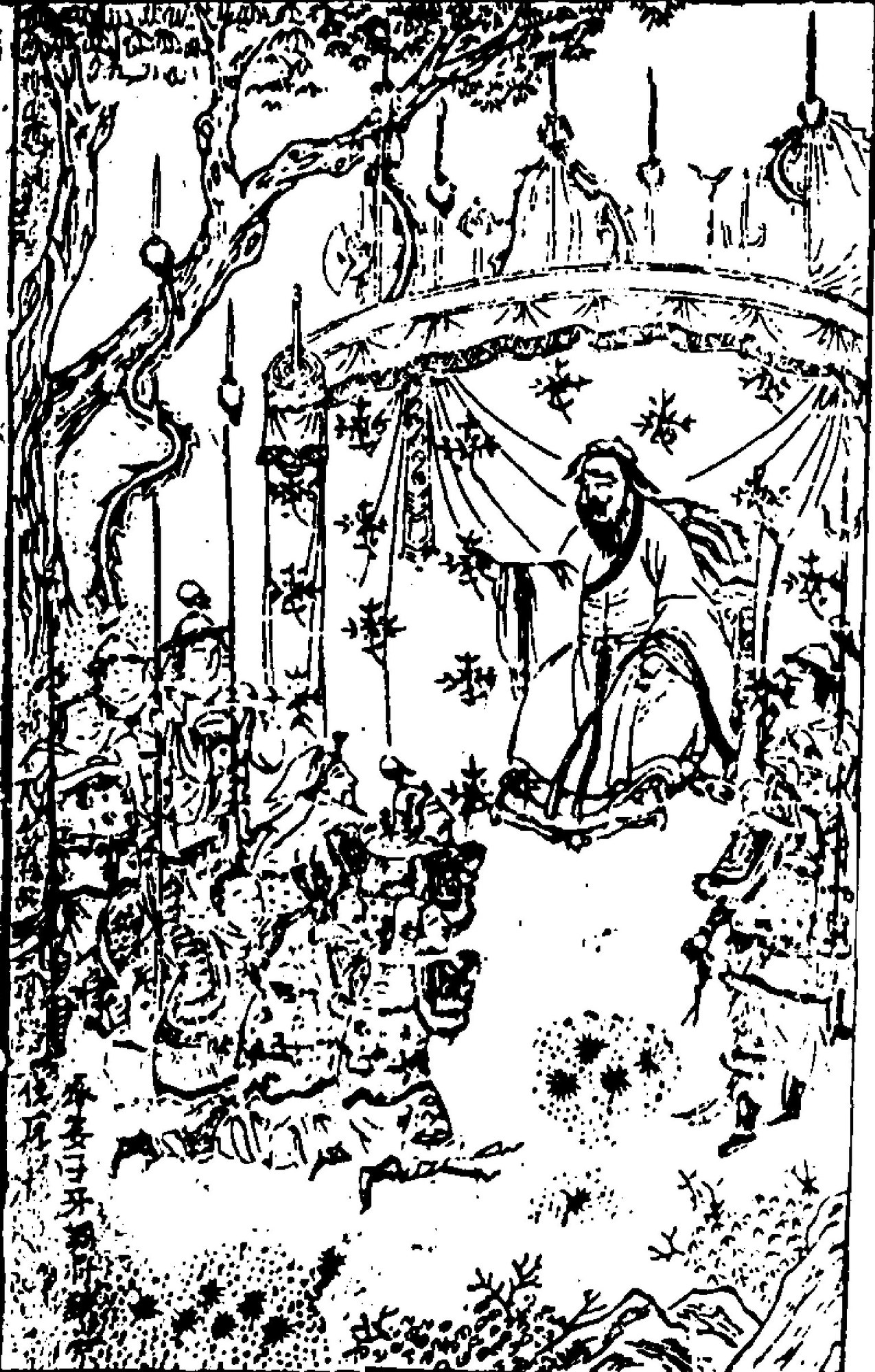
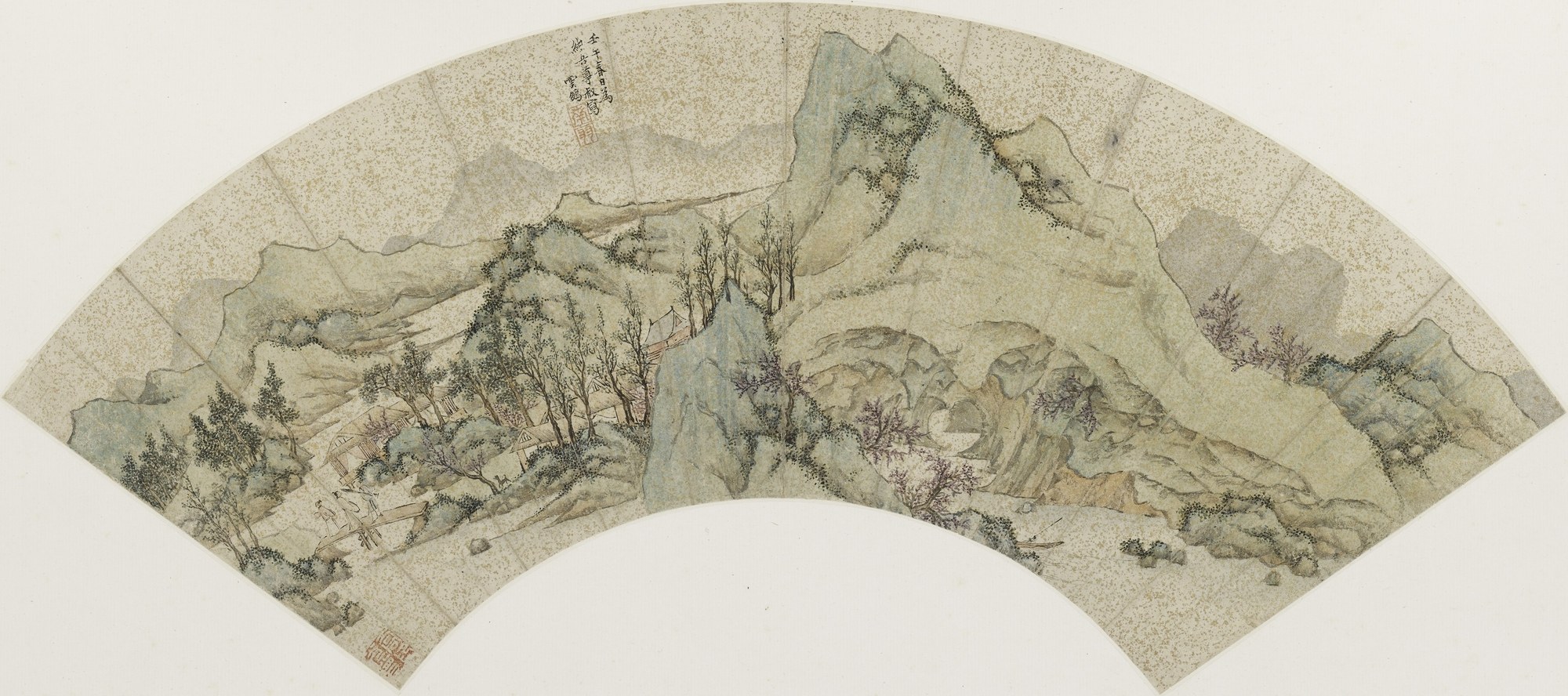
The fisherman had lost track of how far he had rowed. Somewhere in the reign the histories call Taiyuan, near the close of the fourth century, a man of WulingA commandery of Jin in what is now north-western Hunan; the fisherman's home district and the edge of the settled world at the story's start. who made his living on the water was following a stream up into the hills and had stopped counting the bends behind him, when both banks ahead of him turned to blossom. Peach trees, and nothing else among them, ran on for several hundred paces, a pure corridor of pink over grass that was startlingly fresh and sweet, the petals coming down in drifts on the current around his boat. He had never seen such a grove, and he went on to find where it ended.
Barely wide enough for a person
It ended at the head of the stream, against a hill, and in the hill there was a small opening with what looked like light leaking out of it. He tied up his boat and squeezed in. For the first few dozen paces the passage was so narrow it barely admitted a man, and then, all at once, it opened out bright and wide.
What lay on the other side was not a fairyland. That is the first surprise of the story and the one most often lost in the retelling: there are no immortals here, no spirits, no peaches of deathlessness. There is a farming valley. The land ran flat and broad; the houses stood in neat rows; there were good fields and handsome ponds, mulberry and bamboo, footpaths crossing between the plots, and, carrying from one holding to the next, the sound of cocks crowing and dogs barking at one another.
People were out working the land in clothes cut exactly like the clothes of anyone outside. The white-haired old and the small children with their hair hanging loose all looked thoroughly, placidly content. The wonder of the place is precisely its ordinariness.
What dynasty is it now
They were astonished to see him. Nobody came here. They asked where on earth he had come from, and when he had told them, they took him home, warmed wine, killed a chicken and fed him. Then they told him who they were.
Their ancestors, they said, had fled the disorders of the QinThe short-lived first empire to unify China (221 to 206 BCE) and a byword for harsh rule; the disorder of its fall is what the villagers' ancestors fled.. They had brought their wives and children and their neighbours to this cut-off place and had never gone out again, and so, over the generations, they had drifted clean out of the world.
Then came the question that gives the tale its ache. They asked him what dynasty it was now, out there. They did not know there had been a Han, and had never heard of Wei or of Jin. Six centuries of history had washed past the mouth of their valley and not a drop of it had reached them; the empire that broke their grandfathers’ grandfathers had itself long since been dust. He told them everything he knew, the whole long catalogue of rise and ruin, and they sighed over all of it.
He stayed several days. Every household in turn had him in and set out food and wine. When at last he made to leave, someone said a thing that reads, in hindsight, like a door quietly closing: it is not worth telling the people outside about this.
Marking the road home
He did not take the advice. Back at his boat he found the way he had come and made marks along it, at this bend and that, all the way down. When he reached Wuling he went straight to the Grand WardenThe Chinese office (太守) of a commandery's chief administrator, the local authority to whom the fisherman reports his discovery. and reported what he had seen, and the Warden sent men off with him to find the place again by his marks.
They never found it. The marks led them astray, the road tangled, and the way was simply gone. It is the plainest and cruellest turn in the story: not that the valley was hidden by any magic, but that a marked, remembered, deliberately blazed route can still, in the retelling, refuse to be there a second time. A high-minded gentleman of Nanyang named Liu Ziji, a real recluse of the age whom Tao names to keep the fable within living memory, heard the account and gladly made his own plans to go. He fell ill and died before he could set out. After that, the record says, no one else went looking for the ford.
A cousin at Wu Creek
Tao Yuanming, the Eastern Jin poet who wrote this down around 421, gave his piece a double title, a Record and a Poem, and the verse he attached carries something the prose withholds. It puts a name to the tyranny: the House of Ying, the Qin ruling line, that threw the order of Heaven into chaos,
so that the worthy of the age withdrew and hid.
Inside the valley, the poem adds, the harvest bears no royal tax because there is no crown to pay; the vessels follow the old rites and the clothing keeps no new fashion; and though the people mark no calendar, the four seasons make a year of their own accord. The realm had lain concealed, the poet reckons, for five hundred years before it opened for a single morning and closed again. Those English phrasings are a working gloss of the Chinese, not a published translation; Giles, who put the prose into English in 1884, left the poem alone.
There is a near-twin of this story, and the honest thing is to set it beside Tao’s and give the reader the dates. Only a few years after Tao wrote — the parallel is set in the early Yuanjia era, around 424, and Tao died in 427 — a collector named Liu Jingshu recorded, in his Garden of Marvels, a hidden world at Wu Creek.
There a tribesman shooting a deer chases it into a stone cave just wide enough to enter, climbs a ladder he finds inside, and comes out into a bright, wide place lush with mulberry and fruit-trees where people stroll and pay him no mind. He cuts marks on the trees along the way, and afterwards can find no trace of it. The shared bones are unmistakable: a stranger blunders through a narrow gap into a fertile secret, marks his path, and loses it forever.
But the two are not one story wearing two coats, and neither can be read as the parent of the other, because they are all but contemporaries — a handful of years apart, not the centuries that usually separate a myth from its variant. Liu Jingshu’s hunter is no fisherman; his lure is a deer and not a drift of blossom; his door is a cave with a ladder, not a glowing cleft past a corridor of peach.
And crucially his hidden people carry no history at all: no flight from the Qin, no ignorance of the dynasties, no soft warning not to tell. That absence is the measure of what Tao actually made. The other man wrote down a marvel. Tao wrote down a grief with a marvel around it, a whole vanished generation of ordinary people who had done nothing but run from a cruelty and quietly keep house on the far side of it, and a world that lets an outsider in exactly once and never again.
They asked what dynasty it was now; they did not know there had been a Han, still less Wei or Jin. (Taohuayuan ji; author’s rendering from the Chinese)
- Tao Yuanming (陶淵明, a.k.a. Tao Qian 陶潛, 365–427 CE), Taohuayuan ji bing shi (桃花源記并詩,
Record of the Peach Blossom Spring, with Poem
), Eastern Jin, composed c. 421 CE: the foundational and only canonical source. The prose Record supplies the entire narrative — the Wuling fisherman whoforgot how far he had gone
(忘路之遠近); the grove of peach with no other tree among it (中無雜樹) and the blossom drifting in profusion (落英繽紛); the hillside opening faintly lit (山有小口,髣髴若有光), so narrow itbarely admitted a person
(纔通人) before opening outbright and wide
(豁然開朗); the level land, good fields, ponds, mulberry and bamboo and the answering cocks and dogs (良田美池桑竹之屬…鷄犬相聞); the elders and fringe-haired children content (黃髮垂髫,怡然自樂); the wine and the killed chicken (設酒殺鷄作食); the flight of the ancestors fromthe disorders of Qin
(先世避秦時亂) and their not knowingthere had been a Han, let alone Wei or Jin
(乃不知有漢,無論魏晉); the parting linenot worth telling the people outside
(不足爲外人道也); the marked road that dissolves (尋向所誌,遂迷,不復得路); and the coda of Liu Ziji of Nanyang (南陽劉子驥), thehigh-minded gentleman
who planned to go and died first (欣然規往…未果,尋病終). The accompanying 43-line poem supplies what the prose omitsthe House of Ying thatthrew the order of Heaven into chaos
(嬴氏亂天紀), the harvest thatbears no royal tax
(秋熟靡王稅), the old rites and unchanging dress (俎豆猶古法,衣裳無新製), the un-kept calendar under whichthe four seasons of themselves make a year
(雖無紀曆誌,四時自成歲), and the realmhidden five hundred years
(奇蹤隱五百). Original Chinese read verbatim (Sibu Congkan 四部叢刊 text of the Jian zhu Tao Yuanming ji 箋註陶淵明集, juan 5, via zh.wikisource); English renderings of the poem are the author’s own working gloss. - Herbert A. Giles (tr.),
The Peach-Blossom Fountain,
in Gems of Chinese Literature, 1st ed. 1884 (public domain): the standard early English prose translation of the Record only (Giles did not translate the poem), attributing the piece toT’ao Yuan-ming, 365–427 A.D.
Read verbatim from the archive.org scan (cu31924023366564, pp. 107–108). Used for public-domain English wording of the prose; note the abridgements (Liu Ziji becomesa famous adventurer
; the parting line is paraphrased) and that Giles’ own footnote allegorising the tale as a return tothe peach-blossom days of youth
is Giles’ reading, not the text’s. - Liu Jingshu (劉敬叔), Yiyuan (異苑,
Garden of Marvels
), juan 1, entry 武溪石穴 (The Stone Cave of Wuxi
), Liu-Song dynasty, story-dated to the early Yuanjia era (元嘉初, c. 424 CE): the near-contemporary parallel — a Man (蠻) tribesman of Wuxi (武溪,Wu Creek,
not Tao’s Wuling 武陵) shooting a deer chases it into a stone cavejust wide enough for a person,
climbs a ladder inside, and finds itopen out bright and wide
(豁然開朗, the identical phrase to Tao’s) amid mulberries and fruit-trees growing lush (桑果蔚然), with people strolling who take no notice of him; hecuts marks on the trees
to remember the way (斫樹為記) but afterwards can findno trace
of it (無復彷彿). Original read verbatim (zh.wikisource). A cousin, not a sourceit carries no Qin-refugee backstory, no dynasty-ignorance dialogue, nodon’t tell outsiders
line, no governor and no Liu Ziji, and makes no reference to Tao. Its early-Yuanjia dating (c. 424) is a few years after the Record and after Tao’s likely composition, so neither text can be assumed to derive from the other. - Textual-apparatus witnesses to the early transmission (cited via the Sibu Congkan critical notes): Yiwen Leiju (藝文類聚, comp. Ouyang Xun, 624 CE) and Taiping Yulan (太平御覽, 983 CE) each preserve a shorter, variant Record that lacks the entire Liu Ziji coda — evidence that the ending, though canonical in the received text, is textually later-attested. Cited as evidence of the text’s early instability, not as independent stories.