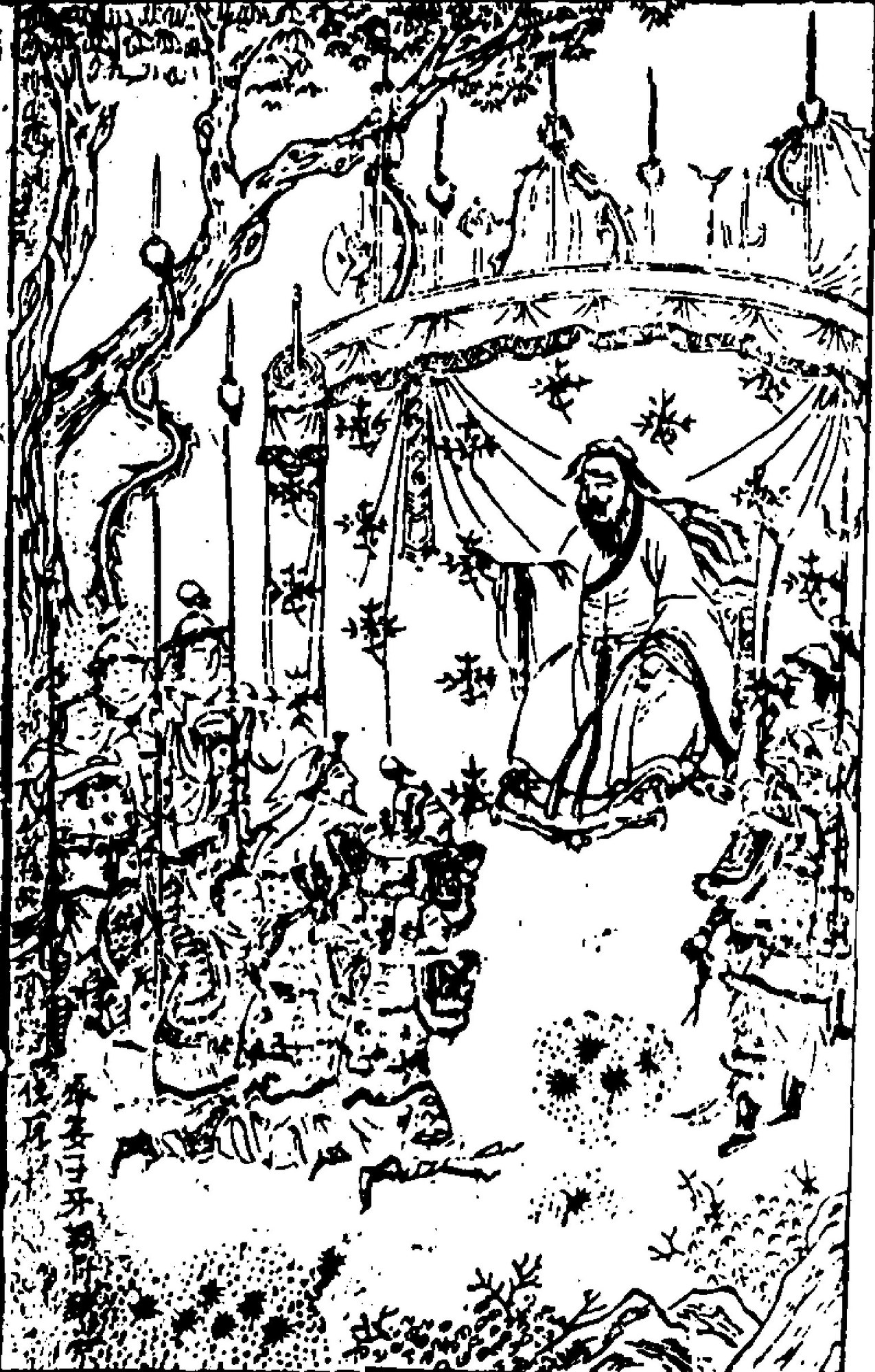
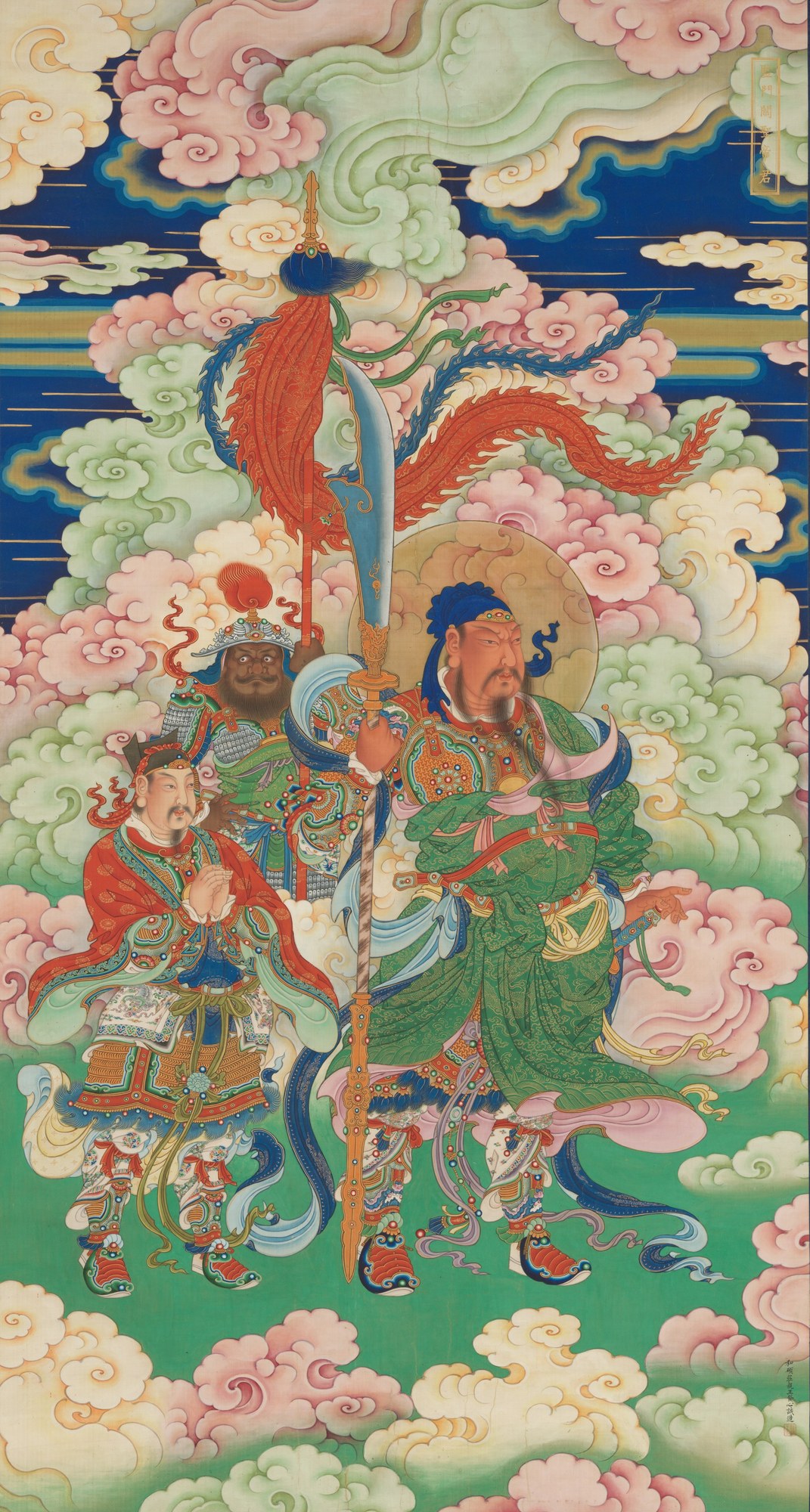
Walk into a shop in Guangzhou or a police post in Hong Kong or a triad’s back room, and the same figure may be watching from a shrine in the corner: red-faced, heavy-bearded, in a green robe, one hand on the long curved blade across his knees. He is prayed to for wealth by merchants, for protection by policemen and by the criminals they chase, for victory, for straight dealing between sworn partners. He is one of the most worshipped gods in the Chinese world. He was also, once, an actual man who lost his last war and had his head cut off, and whose own biographer thought his pride had killed him.
A fugitive who became a brother
The man is Guan Yu, a native of Xie in Hedong, in what is now southern Shanxi. His courtesy nameA second personal name (字, zi) an educated man took at capping, used by peers in place of his given name; Guan Yu's was Yunchang. was Yunchang. The earliest account of him, the one that matters, is the biography Chen Shou set down in the Records of the Three Kingdoms around 280 to 290 of the common era, sixty or seventy years after Guan Yu’s death, near enough to living memory to be trusted and far enough to have already lost most of the detail a legend later supplies.
Chen Shou’s Guan Yu enters as a man on the run. He had cancelled his local registration and fled to Zhuo commandery, and there, when the warlord Liu Bei raised a militia, Guan Yu and Zhang Fei became his protectors. The bond that grew between the three is the seed of everything the cult would later make of loyalty, and it is worth quoting exactly what the history says and does not say.
Liu Bei, it records, shared the same bed with the two men when they slept, and their affection was as of brothers. That is all. There is no oath, no peach garden, no ceremony of sworn brotherhood. The famous scene that opens the novel, three men swearing to die on the same day beneath the blossom, is a fiction laid over one sentence about men who were close as kin.
The head taken amid ten thousand
The single feat that made his name is set at the siege of Baima in the year 200. Guan Yu was serving Cao Cao at the time, having been captured and, the history says, treated very generously. Sent against the enemy general Yan Liang, he sighted the man’s command-parasol across the field, spurred his horse, and rode into the middle of ten thousand men to stab Yan Liang dead and carry off his head, and none of the opposing generals could stand against him. For this Cao Cao had him enfeoffedGranted a title and a fief by a ruler; the standard reward by which the Chinese court raised a man into its ranks of nobility. Marquis of Hanshou Village.
The verb the history uses is stab, a thrust of spear or lance. It gives him no named weapon at all. The Green Dragon Crescent Blade, the eighty-two-catty (about 48 kg by Ming measure) guandaoA Chinese pole-glaive with a heavy curved blade on a long shaft, a weapon type of the later Song dynasty and so anachronistic to a third-century general. that every statue and opera costume shows him holding, appears nowhere in the biography. It is the novel’s invention, and doubly out of place, because the guandao as a weapon type belongs to the Song dynasty, eight centuries after the battle it is swung in. The red horse called Red Hare is a gift the novel gives him. The history mentions no horse.
What the history does dwell on is the loyalty. Guan Yu would not stay with Cao Cao, generous as the man had been. I well know Lord Cao has treated me handsomely, he is recorded as saying, but I received deep kindness from General Liu and swore to die with him; I will render a service to repay Lord Cao, then leave. He killed Yan Liang as that service.
Then he sealed up every gift Cao Cao had given him, left a farewell letter, and went. Cao Cao forbade any pursuit: each man serves his own lord. This scene, a debt of kindness weighed against a prior debt of loyalty and both paid in full, is the real historical root of the god the merchants would one day trust to keep a bargain honest.
Blood in the dish, and a name that shook the land
Two images from the biography carry the whole flavour of the man. In the first, an old arrow-wound in his arm aches when the weather turns, and a physician cuts it open to scrape the bone and draw out the poison. Guan Yu stretches out the arm and lets him cut. The blood flows until it fills the dish beneath, and all the while he goes on carving roast meat and drinking wine, talking and laughing as though nothing were the matter. The history does not name the surgeon; the celebrated physician Hua Tuo who performs the operation in the novel is another later gift.
The second image is the height of his career and the beginning of its end. In the autumn of 219, besieging the enemy at Fan, he was helped by the weather. Heavy prolonged rain made the Han River overflow, and the seven armies sent to relieve the siege were all submerged; their commander surrendered, and Guan Yu had the general who refused to surrender beheaded. His awe, the history says in four characters that later worshippers would take almost literally, shook all China. The novel improves the flood into strategy, having Guan Yu dam the river and loose it deliberately. Chen Shou credits only the rain.
Then it collapsed. Guan Yu had refused a marriage alliance with the warlord Sun Quan and insulted his envoy; Sun Quan, secretly allied with Cao Cao, seized the territory behind him, and his army melted away. Sun Quan’s men ambushed and beheaded Guan Yu together with his son Guan Ping. His head was sent to Cao Cao, who buried the remains with the rites of a feudal lord. The only posthumous title of his own era came forty years later from Liu Bei’s son: Marquis Zhuangmou.
Even that may not be praise. By one old rule of naming, the character mou marked a man whose name and reality were at odds, who had failed to live up to his repute; other readers take it as a scribe’s slip for a character meaning the opposite. And Chen Shou’s own final verdict was plain. Guan Yu was a match for ten thousand men and a tiger among the courtiers of his age, but he was hard and full of himself, and by these faults he met his defeat.
From marquis to emperor, one dynasty at a time
None of that stopped him. The historical Guan Yu was a great, flawed, defeated general; the god Guandi was assembled slowly on top of him, over more than a thousand years, by two forces working in parallel. One was the storytellers, whose oral cycles hardened into the novel and gave the world the sworn brothers, the great blade, the horse and all the rest. The other was the state, which promoted him by imperial decree the way it promoted living officials, one rank at a time.
The escalation is worth watching as a ladder, because each rung is centuries above the last. Under the Song he was made a duke, then a prince, some nine hundred years after his death. A Daoist legend of the period sets his spirit to battle the demon Chi You over a failing salt lake and win back its yield, which is where his powers as exorcist and rain-bringer begin. The Yuan retitled him.
Then, in 1614, the Wanli Emperor of the Ming took the decisive step and made him an emperor, di, in a great god-name about subduing demons in the three worlds. That is the leap from marquis to emperor, and it is the di that turns Guan Yu into Guan-di. The Qing raised him again, until his title ran to twenty-four characters, and paired him as the Sage of War against Confucius, the Sage of Culture, a fitting honour for a general the history says could recite a Confucian classic almost by heart.
The one thing he did not start as is a god of money. That role, for all that it now fills the shops, is the youngest and thinnest layer of the cult: the scholar Barend ter Haar finds the earliest references to Guan Yu as a wealth deity only in the eighteenth century, long after his martial and exorcist functions and absent from the older temple traditions. The merchant’s Guandi is younger than the United States. The reader who lights incense to him for good business is praying to the last thing he became, not the first.
Guan Yu was reckoned a match for ten thousand men, a tiger-minister of his age; yet he was hard and full of himself, and by these faults he met defeat. (Sanguozhi 36, Chen Shou’s verdict; author’s rendering from the Chinese)
- Chen Shou 陳壽, Sanguozhi 三國志, vol. 36, biography of Guan Yu (compiled c. 280–290 CE): the sole near-contemporary account, written sixty to seventy years after the man died. Source of every historical fact used herethe flight to Zhuo and the bond with Liu Bei that was only ever
as of brothers
(恩若兄弟), with no oath and no peach garden; the killing of Yan Liang at Baima by a spear-thrust (刺) into the middle of ten thousand men (於萬眾之中), with no named weapon and no horse; the sealed gifts (盡封其所賜) and the departure from Cao Cao; the bone-scraping with the blood filling the dish (盈於盤器) while he ate and dranktalking and laughing as usual
(言笑自若); the fine beard (羽美鬚髯); the natural flood that drowned the seven armies (七軍皆沒) and the phrasehis awe shook all China
(威震華夏); the fall and beheading at Linju with his son Guan Ping; and Chen Shou’s own verdict that he was hard and self-conceited and so met defeat. Chinese read verbatim (zh.wikisource 三國志/卷36). - Pei Songzhi 裴松之, annotations to the Sanguozhi (c. 429 CE): roughly a century and a half after Chen Shou. Source of the note that Cao Cao buried Guan Yu’s remains with a feudal lord’s rites (Wu Li), the note that he could recite the Zuo zhuan almost by heart (Jiang Biao Zhuan), and the
urge Liu Bei to kill Cao Cao on the hunt
story (Shu ji) which Pei himself rejects as improbable. - Liu Shan’s posthumous edict, 260 CE: the grant of Marquis Zhuangmou 壯繆侯, the only posthumous title of Guan Yu’s own era, some forty years after his death. Recorded in Sanguozhi 36 and 33; the sense of 繆 is disputed, read as
name and reality at odds
by the Yizhoushu 逸周書 6.54 and as a variant of 穆upholder of virtue
by others, so the title is not unambiguously an honour. - Sanguo yanyi 三國演義 (Romance of the Three Kingdoms), attrib. Luo Guanzhong 羅貫中 (14th c.; first printed 1522; Mao recension 1660s): written twelve to fourteen centuries after the man and the source of every legendary prop referred to here as absent from the historythe Peach Garden Oath (桃園結義), the Green Dragon Crescent Blade (青龍偃月刀), the horse Red Hare (赤兔), Hua Tuo as the arm-surgeon, and the deliberate damming of the Han. The Qing critic Zhang Xuecheng judged it
seven parts fact and three parts fiction
. Cited here for its role as the legend’s carrier, not read verbatim for this post. - Imperial canonisation titles (Song 1102/1187 → Yuan → Ming 1614 → Qing 1644 → mid-19th c.): the staged state edicts that built the cult, from duke and prince under the Song, through the Yuan retitling, to the Wanli Emperor’s elevation to Emperor (帝) in 1614 (the watershed that makes him Guan-di), and on to the late-Qing twenty-four-character title, shortened to 武聖 Wu Sheng,
Sage of War
, paired against Confucius as 文聖Sage of Culture
. Documented via the imperial-title apparatus (Roberts 1991 p. 970); the exact page is taken from that apparatus and not independently verified. - **Barend J. ter Haar, Guan YuThe Religious Afterlife of a Failed Hero (Oxford University Press, 2017):** modern scholarly monograph (secondary). Cited for the meaning of 亡命 as a cancelled household registration rather than a crime, and for the finding that Guan Yu’s role as a god of wealth and commerce is an eighteenth-century innovation, the youngest layer of the cult and absent from the older temple-stele traditions. Used for the cult’s chronology, not for any third-century fact.