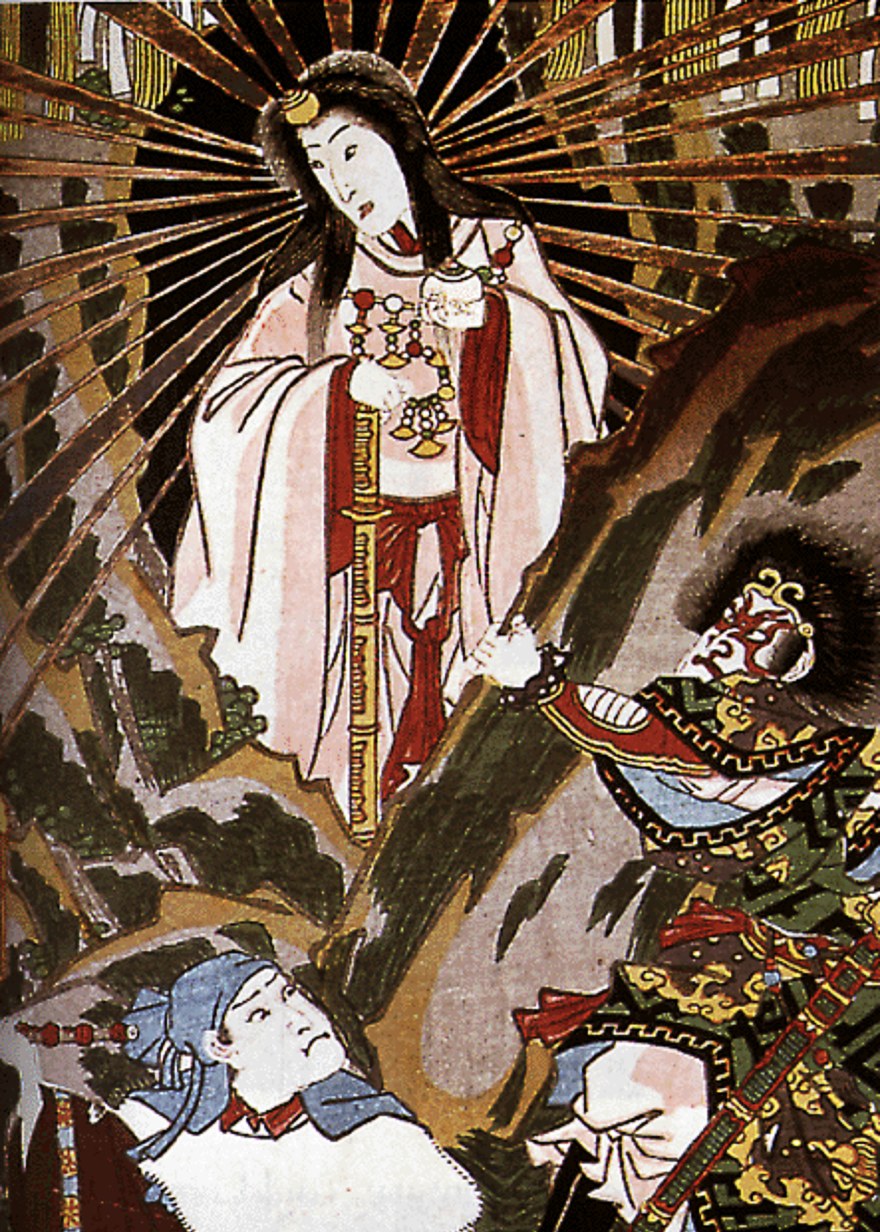
The trouble started with a slammed door. The sun-goddess Amaterasu, sickened by her brother’s violence, had shut herself inside the Heavenly Rock-Dwelling and bolted the stone behind her, and with her gone the whole Plain of High Heaven went dark and eternal night prevailed. The gods needed her back, and they were not going to break the door down. Instead they made two objects. A smith-goddess, Ishikoridome, was set to forge a mirror; a second god, the Jewel-Ancestor, was set to string curved jewels eight feet long, five hundred of them threaded into a single glittering rope. These are the first two of the three things a Japanese emperor would one day have to hold in order to be an emperor at all, and they were made not as crowns or sceptres but as bait.
The gods dug up a five-hundred-branched Sakaki tree whole from the Heavenly Mount Kagu and dressed it like an offering-stand. The jewel-string went on the high branches; the mirror, in the Kojiki eight feet long
and in the Nihon Shoki an eight-hand mirror
, went on the branches at the middle; streamers of white and blue cloth hung below.
Then, when the dance of the Dread Female had drawn the whole assembly into a roar of laughter and Amaterasu cracked the door to see what she was missing, two gods pushed the mirror forward and held it up to the gap. She saw a face blazing back at her and, not knowing it for her own, leaned out to look. That was the whole trick: a sun-goddess shown her own light and mistaking it for a rival. She was hauled into the open, and the light returned.
So two of the three treasures were born in a con. The mirror and the jewels are, at bottom, stage-properties from the most famous rescue in Japanese myth, forged to lure a reluctant sun back into the sky. Only much later would they be spoken of as regalia.
The sword in the serpent
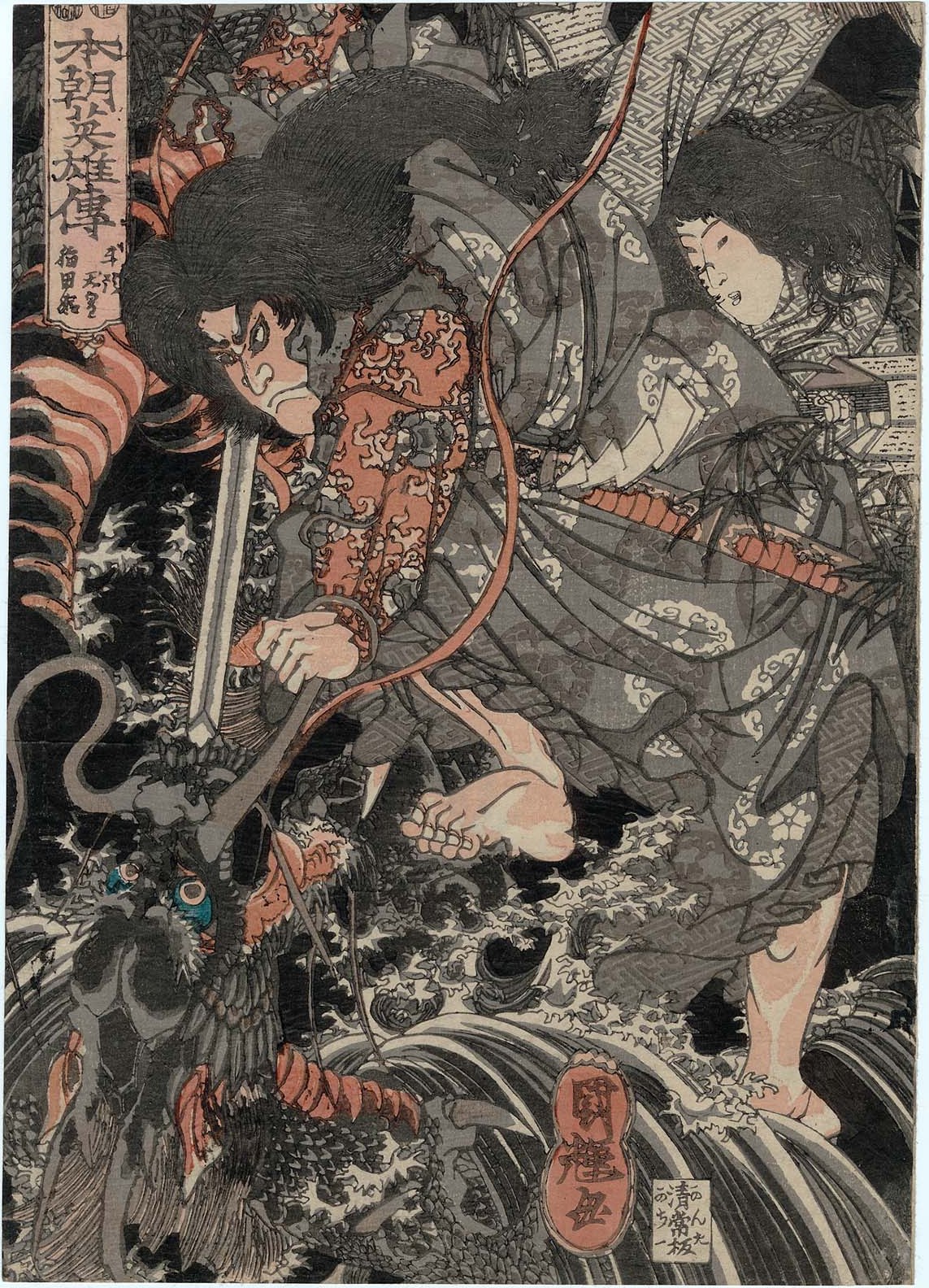
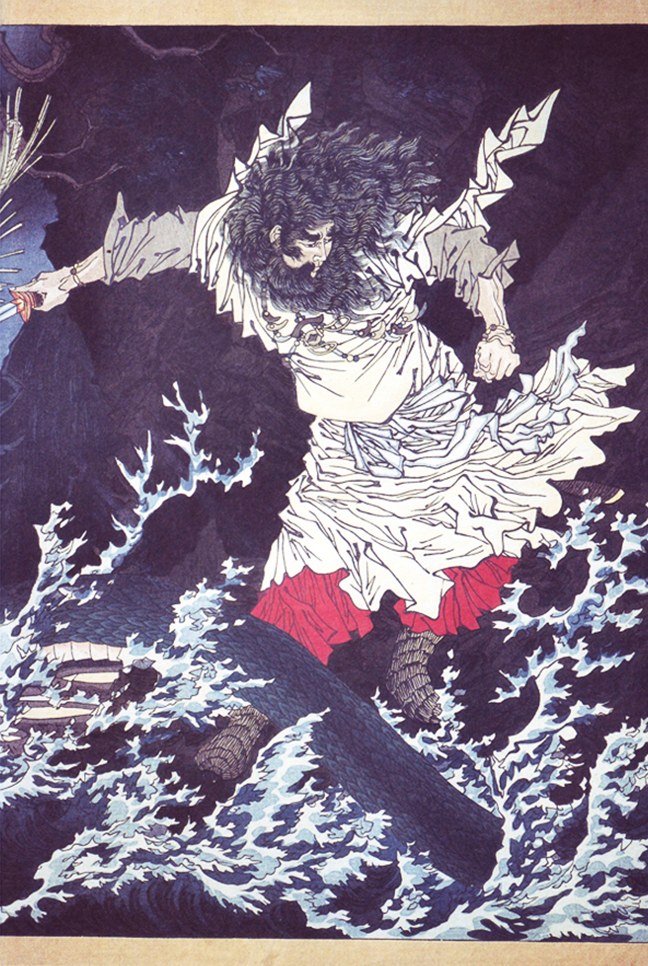
The third came from the opposite kind of scene, not a trick but a slaughter. Susanoo, the storm-god whose outrages had driven his sister into the cave, was expelled from Heaven and came down to the head-waters of the River Hi in Izumo. There he found an old couple weeping over their last daughter, promised to a monster. The serpent Yamata-no-Orochi was a horror of scale: one body with eight heads and eight tails, eyes red as the winter-cherry, moss and cypress and cryptomeria growing on its back, its length spanning eight valleys and eight hills, its belly always bloody and inflamed.
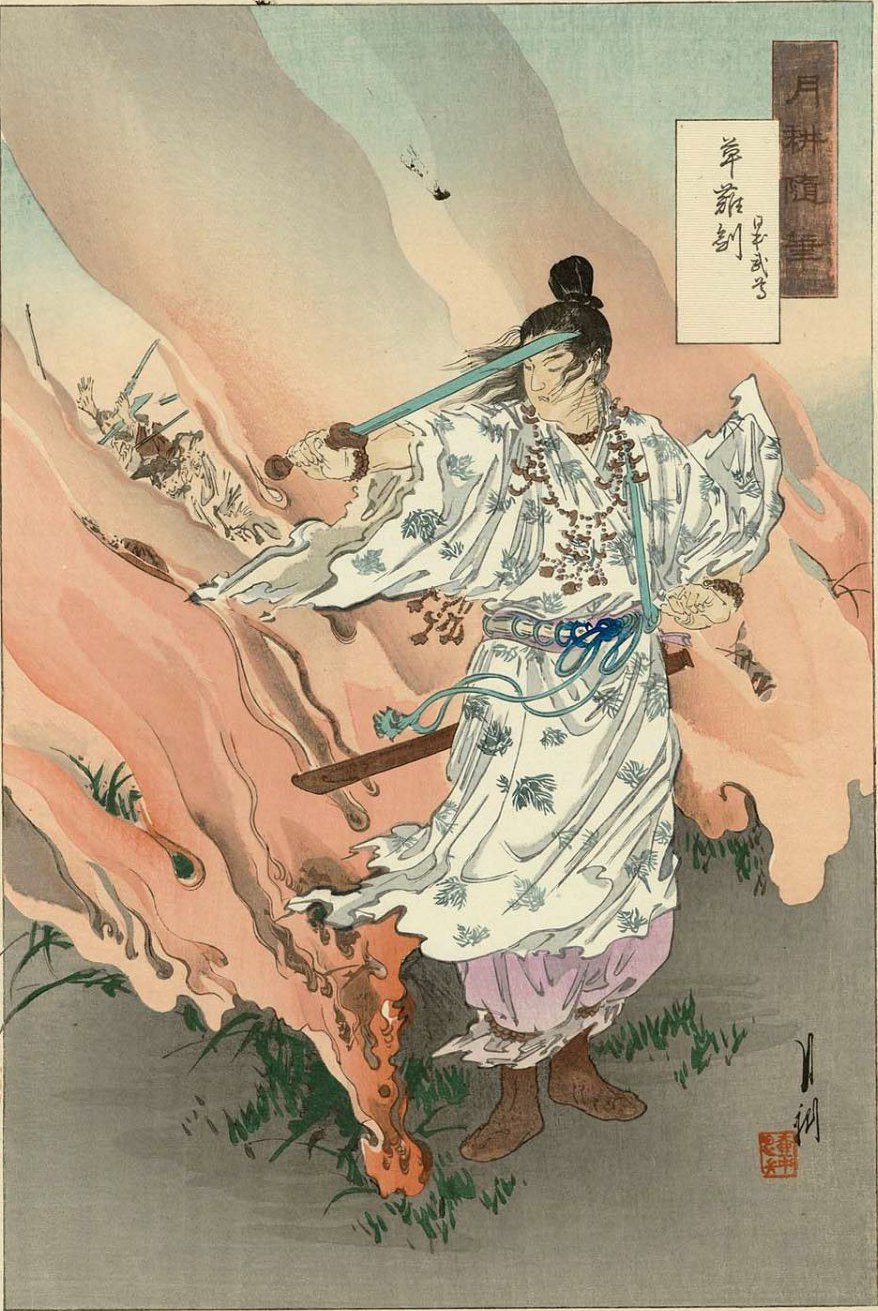
Susanoo did not fight it so much as engineer it. He had eight vats of eight-fold refined liquor set out behind a fence of eight gates, one draught for each head, and when the serpent had drunk itself insensible he hacked it apart. Cutting through the middle tail, the edge of his own august sword broke against something hidden in the flesh. He split the tail open and drew out a great sharp blade: the Herb-Quelling Great Sword, Kusanagi. He did not keep it.
The Kojiki says only that he found the sword and reported it up to Amaterasu; the popular gloss that he offered it to his sister as an apology is a later tidy-up, not the chronicle’s own wording. In the Nihon Shoki the same sword is tracked forward to a real place, now in the village of Ayuchi, in the province of Ohari, in the charge of the Hafuri
, the priests of what became Atsuta shrine near Nagoya, where the sword’s tradition still lives.
So the three objects come from three unrelated stories. The jewel is passed between gods in an oath, the mirror is forged as a lure, the sword is dug out of a monster. Nothing in these episodes announces them as a set, and one of them, the jewel, never gets a dramatic making or finding at all: the curved magatama are simply named, exchanged and worn, comma-shaped stones of the kind still seen in museums in Japan. That asymmetry is worth noticing rather than smoothing over. Two of the treasures have origin-scenes; the third only has a name.
The gift that made a dynasty
What binds them into a set is a single act of transmission. When Amaterasu resolves to send her grandson Ninigi down from Heaven to rule the Central Land of Reed-Plains, she equips him for it. In the Kojiki she joins to him the curved jewels and mirror that had allured her from the Rock-Dwelling, and also the Herb-Quelling Sword that Susanoo had drawn from the serpent’s tail: the three old heirlooms, each trailing its own myth, handed down together.
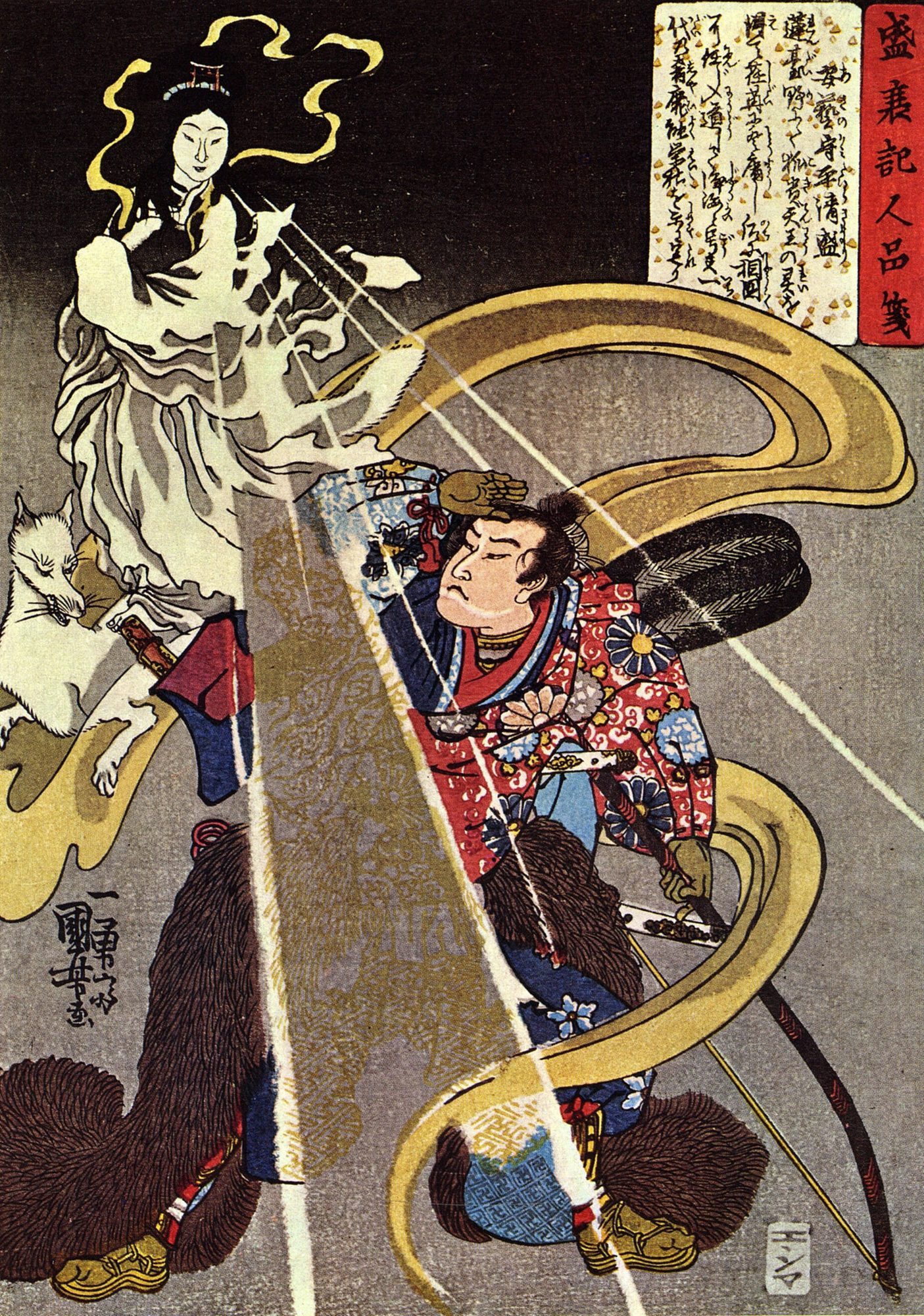
And over one of them she lays a charge that is the mythic root of an entire imperial cult. Regard this mirror, she tells him, exactly as if it were our august spirit, and reverence it as if reverencing us. She does not send an image of herself to earth. She sends the surface that gives back a face and tells her grandson to treat what it holds as herself.
Here the two chronicles part company in a way that matters. The Kojiki never uses a three treasures
formula; it lists the jewels, the mirror and the sword as separate gifts. It is the Nihon Shoki that packages them, stating outright that Amaterasu gave to Ninigi the three treasures, viz. the curved jewel of Yasaka gem, the eight-hand mirror, and the sword Kusanagi
, and sent him off with a blessing on his house: may prosperity attend thy dynasty, and may it, like Heaven and Earth, endure for ever. Aston, translating in the 1890s, added a plain editorial note at the passage: the regalia, or mirror, sword and jewel, are doubtless meant.
The familiar title itself, The Three Sacred Treasures
, the fixed sealed set of imperial regalia, is a later technical and liturgical label. It is not a phrase the gods of the eighth-century chronicles use. What those texts give is subtler and, in a way, more interesting: three objects with wholly separate origins, gathered into one grandmother’s hands and passed down with a command to treat the mirror as her living presence. The doctrine of a single triad came afterward, laid over old and mismatched things. The legitimacy it confers, though, was there from the first gift. To hold these objects is to hold the sun-goddess’s own charge, and to descend from the grandson she charged.
Why they live at shrines
If the treasures authorise the emperor, one might expect them to live with him. They do not, and the reason the chronicles give is startling. Under Emperor Sujin, Amaterasu, present in her mirror, had been worshipped inside the emperor’s own great hall. But Sujin, the Nihon Shoki records, dreaded the power of these gods and did not feel secure in their dwelling together with him. He could not bear to share a roof with the very thing that made him a sovereign. So he entrusted the goddess’s worship to a princess and moved her out.
The search for the mirror’s permanent home carries into the next reign. Under Suinin, the princess Yamato-hime leads the goddess from place to place until, arriving in Ise, Amaterasu speaks her own preference plainly: in this land I wish to dwell. A shrine is built by the Isuzu river, and that is the origin the chronicle gives for the enshrinement of the sacred mirror at Ise, where the mirror-tradition remains, as the sword’s remains at Atsuta. The human ruler, in the myth’s own telling, cannot cohabit with the treasure that legitimises him. The proof of his right to rule is too holy, and too heavy, to keep in the house.
His Augustness Heavenly-Beckoning-Ancestor-Lord and His Augustness Grand-Jewel pushed forward the mirror and respectfully showed it to the Heaven-Shining-Great-August-Deity, whereupon the Heaven-Shining-Great-August-Deity, more and more astonished, gradually came forth from the door and gazed upon it. (Kojiki, trans. Chamberlain, Sect. XVI)
- Kojiki (Records of Ancient Matters, 712 CE), Sect. XVI,
The Door of the Heavenly Rock-Dwelling
, trans. Basil Hall Chamberlain (1882)read verbatim for the forging of the regalia. Ishikoridome charged to make the mirror and the Jewel-Ancestor to makean augustly complete string of curved jewels eight feet long, of five hundred jewels
; the five-hundred-branched Sakaki of Mount Kagu hung with the curved-jewel string on the upper branches andthe mirror eight feet long
on the middle branches; and the scene in which Ame-no-Koyane and Futodamapushed forward the mirror and respectfully showed it
to the sun-goddess. Read at en.wikisource.org, Kojiki (Chamberlain, 1882) Sect. 16. - Kojiki, Sect. XVIII–XIX,
The Eight-Forked Serpent
, trans. Chamberlainread verbatim for the sword. Susanoo’s eight vats ofeight-fold refined liquor
and the slaying of Yamata-no-Orochi at the head-waters of the River Hi; the breaking of his own sword’s edge on the middle tail; and the finding within the flesh ofa sharp great sword … this is the Herb-Quelling Great Sword
(Kusanagi), which he found and reported up to Amaterasu (theapology
framing is a later gloss, not the text). Read at en.wikisource.org, Kojiki (Chamberlain, 1882) Sect. 18–19. - Kojiki, Sect. XXXIV,
The August Reign in Himuka
, trans. Chamberlainread verbatim for the bestowal. Amaterasu joining to Ninigithe eight-feet-long curved jewels and mirror that had allured her from the Rock-Dwelling, and also the Herb-Quelling-Great-Sword
, given as separate heirlooms rather than a named triad, with the injunctionRegard this mirror exactly as if it were our august spirit, and reverence it as if reverencing us.
Read at en.wikisource.org, Kojiki (Chamberlain, 1882) Sect. 34. - Nihon Shoki (Nihongi, Chronicles of Japan, 720 CE), Book I–II,
The Age of the Gods
, trans. W. G. Aston (1896)read verbatim for the parallel chronicle and the named triad. Book I: Susanoo’sbeautiful curved jewels of Yasaka-gem
and the oath-exchange with Amaterasu;an eight-hand mirror
on the middle branches of the Sakaki; and the sword within the serpent’s tail,Kusa-nagi no tsurugi … now in the village of Ayuchi, in the province of Ohari … in the charge of the Hafuri of Atsuta
. Book II: Amaterasugave to Ama-tsu-hiko-hiko-ho-no-ninigi no Mikoto the three treasures, viz. the curved jewel of Yasaka gem, the eight-hand mirror, and the sword Kusanagi
, with the dynastic blessingmay prosperity attend thy dynasty, and may it, like Heaven and Earth, endure for ever
, and Aston’s note thatthe regalia, or mirror, sword and jewel are doubtless meant
. archive.org idnihongi1asto. - Nihon Shoki, Book V (Sujin) and Book VI (Suinin), trans. Aston (1896)read verbatim for the separation from the palace and the Ise enshrinement. Sujin, who
dreaded the power of these Gods, and did not feel secure in their dwelling together
, entrusting Amaterasu’s worship to the princess Toyo-suki-iri-hime; and Suinin’s princess Yamato-hime finding the goddess a permanent home, where she declaresIn this land I wish to dwell
, the origin of the Ise enshrinement of the sacred mirror. archive.org idnihongi1asto.