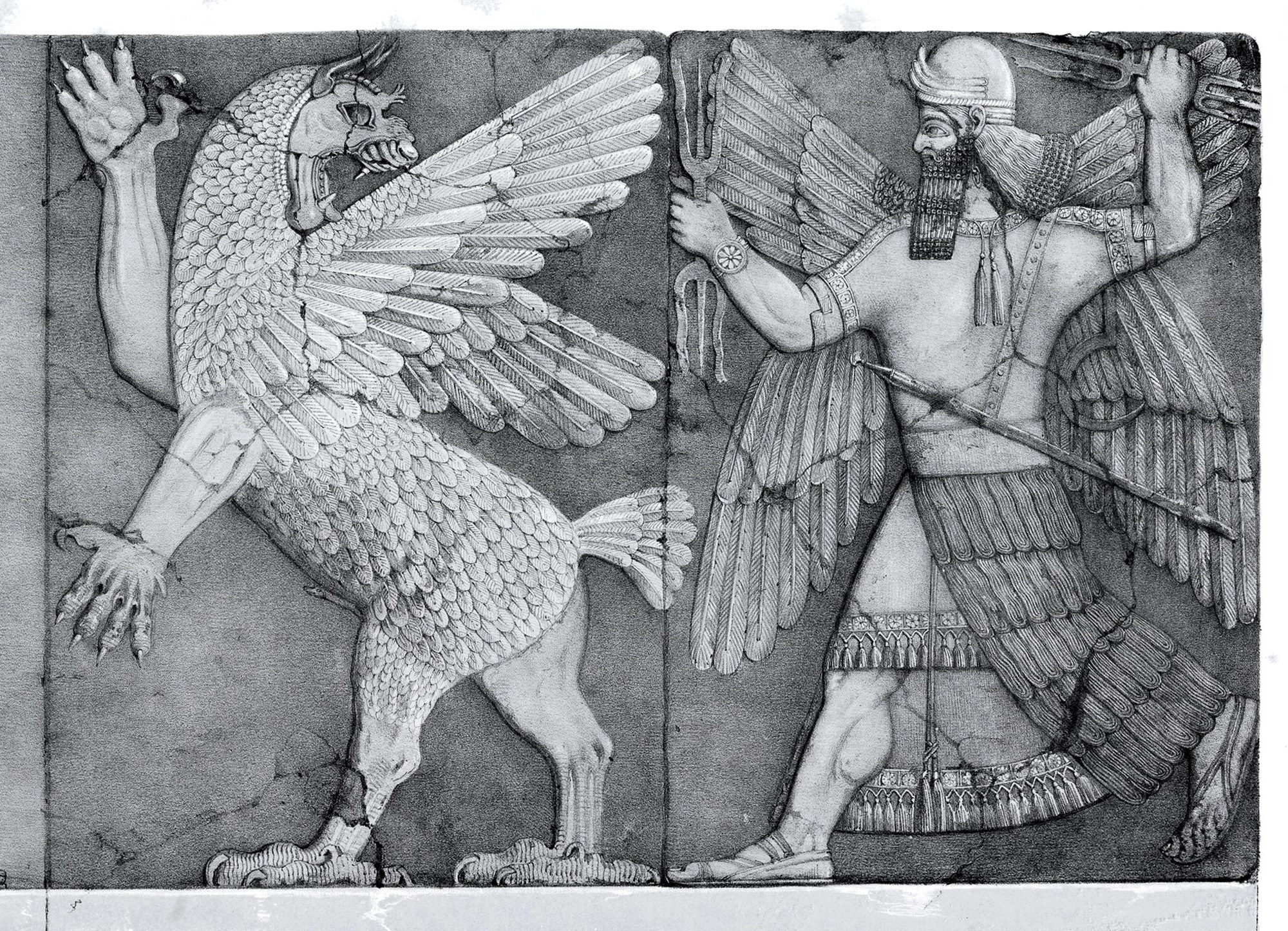
The word that fixed every fate was in the wrong hands, and the world had gone quiet. The storm-bird Anzu, born from the mountain rocks and set as doorkeeper on the threshold of Enlil’s innermost chamber, had watched his lord lay aside the lordly crown to bathe, seized the Tablet of Destinies from where it lay, and flown off to his mountain with the whole authority of heaven clutched to his chest. Rites were abandoned. Radiance faded.
The machinery that assigned to every thing its portion had stopped, because the one object that ran it was gone. Now Anzu had only to command, and whoever he cursed turned to clay. At his utterance the gods themselves were made to tremble. This is the part of the story the sky god Anu set out to fix, and it is a harder thing than a theft. A theft can be answered by a stronger arm. Anzu had made his own voice into the law of the universe, and there is no arm stronger than that.
No god will go to the mountain
Anu put the matter to the assembly as a prize. Whichever god killed Anzu, he proclaimed, would have his name made great across every settled land; he would take cult-centres in the four quarters and stand without a rival among his brothers. Then he named his champions, one after another, and one after another they said no.
He called first on Adad, the storm and canal god, Anu’s own son. Adad heard the offer, weighed the mountain against it, and turned away. He called on Gerra, the fire-god, son of Anunitu. Gerra gave the same answer. He called on Shara, son of Ishtar, and Shara refused as the others had.
The refusals are almost identical, and the sameness is the point: each god asks the same helpless question, who could rush off to the inaccessible mountain, and each gives the same reason. Anzu holds the Tablet. His word is now fate. Whoever he curses turns to clay, so to march against him is to march against a foe who can unmake you with a sentence before your weapon is raised. The cosmos, offered the greatest honour in its gift, produced not one volunteer.
The plan out of the Apsu
When the assembly fell silent and despaired of any advice, the answer came from the deep. EaThe Mesopotamian god of wisdom (Sumerian Enki), who dwells in the freshwater Apsu and here devises the stratagem rather than fighting., the lord of intelligence who dwells in the freshwater Apsu, did not offer to fight; wisdom rarely does. He offered a plan. There was a fighter the assembly had not yet thought to summon, and the way to reach him ran through his mother.
So Ea had the gods honour the mother-goddess Belet-iliThe Mesopotamian mother-goddess (also Mami, Ninmah), honoured by Ea as "Mistress of all Gods" and mother of the champion Ninurta., and renamed her Mistress of all Gods, and asked her to give up her son. Give Ninurta, he said, your superb beloved, broad of chest, the one who forms the battle array. She consented with a single word, yes, and made the commission her own. She had helped create the gods’ assembly, she declared; she had assigned the Enlil-power that Anzu had now disrupted; and so it fell to her son to set it right.
She sent him to war with instructions as precise as a smith’s. Muster your devastating force. Set the arrow to the string and coat it with poison. Change your shape, cloak yourself in fog, and seize the bird by the throat. Let the winds carry his feathers home to EkurThe Mountain House at Nippur, Enlil's temple and the seat from which fates were decreed for the ordered world., the Mountain House, as the news of victory, and let kingship enter it again.
Seven winds go up the mountain
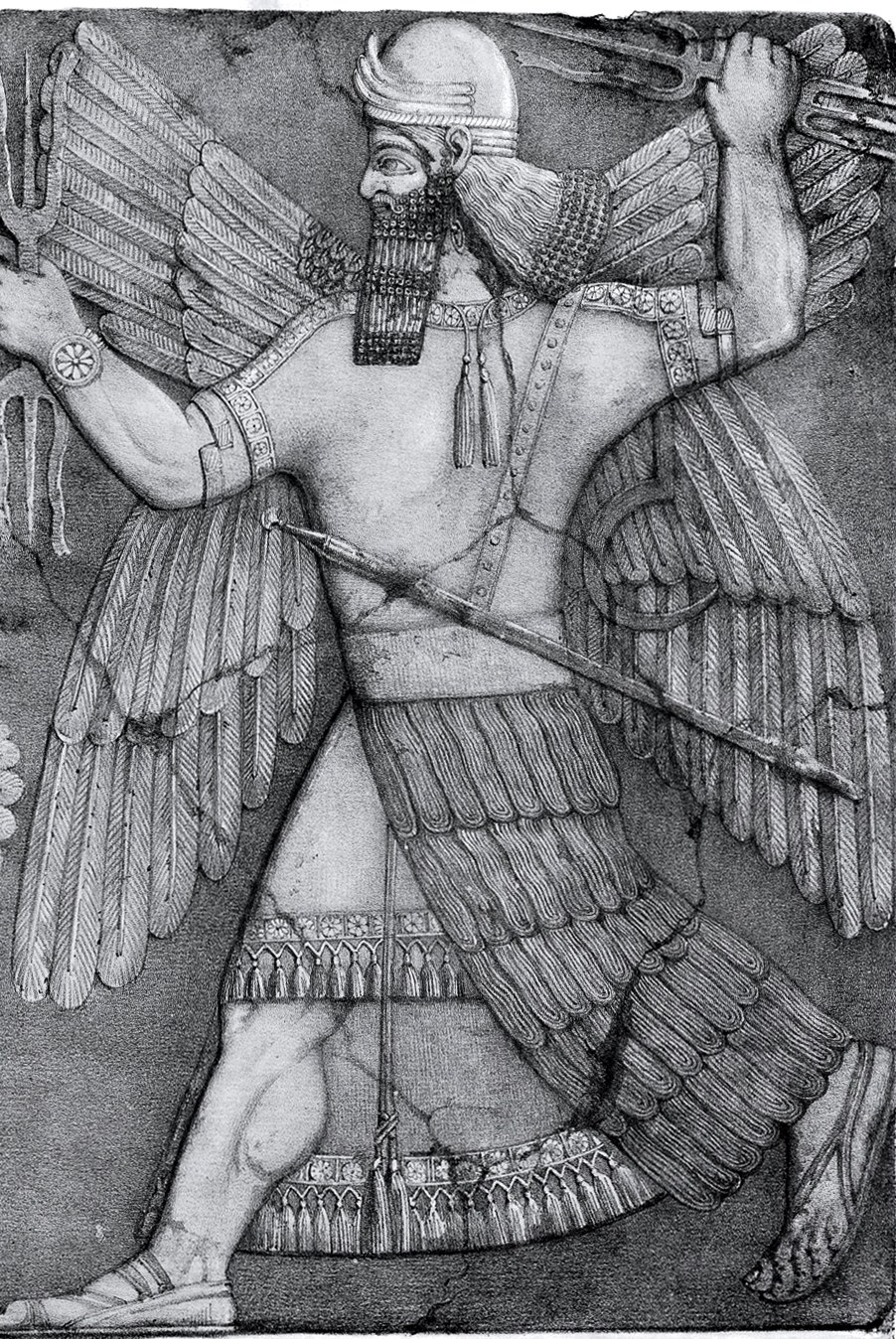
Ninurta went up armed with weather. He marshalled the Seven of Battle, the seven evil winds that dance in the dust, the seven whirlwinds, and drove them ahead of him against the mountain. On the mountainside the two met, and Anzu shook with rage, baring his teeth like a lion, and demanded to know who had come to fight him.
Ninurta answered that he was the avenger of the god of the Bond of Heaven and Earth, which is to say of Enlil. The bird shouted, and his shout put out the daylight: even Shamash, the light of the gods, was overcast with darkness. Adad roared in the murk, the battle-lines crashed together, clouds of death rained down, and an arrow flashed like lightning between them.
The arrow that came back apart
Then the story turns on the thing that made it worth telling. Ninurta drew and loosed, a clean shot from the curve of the bow, and it did not reach Anzu. The shaft turned back in the air. For the Tablet of Destinies does more than assign fates; it lets the one who holds it wind a thing back to what it was made from, and Anzu now used it as a weapon.
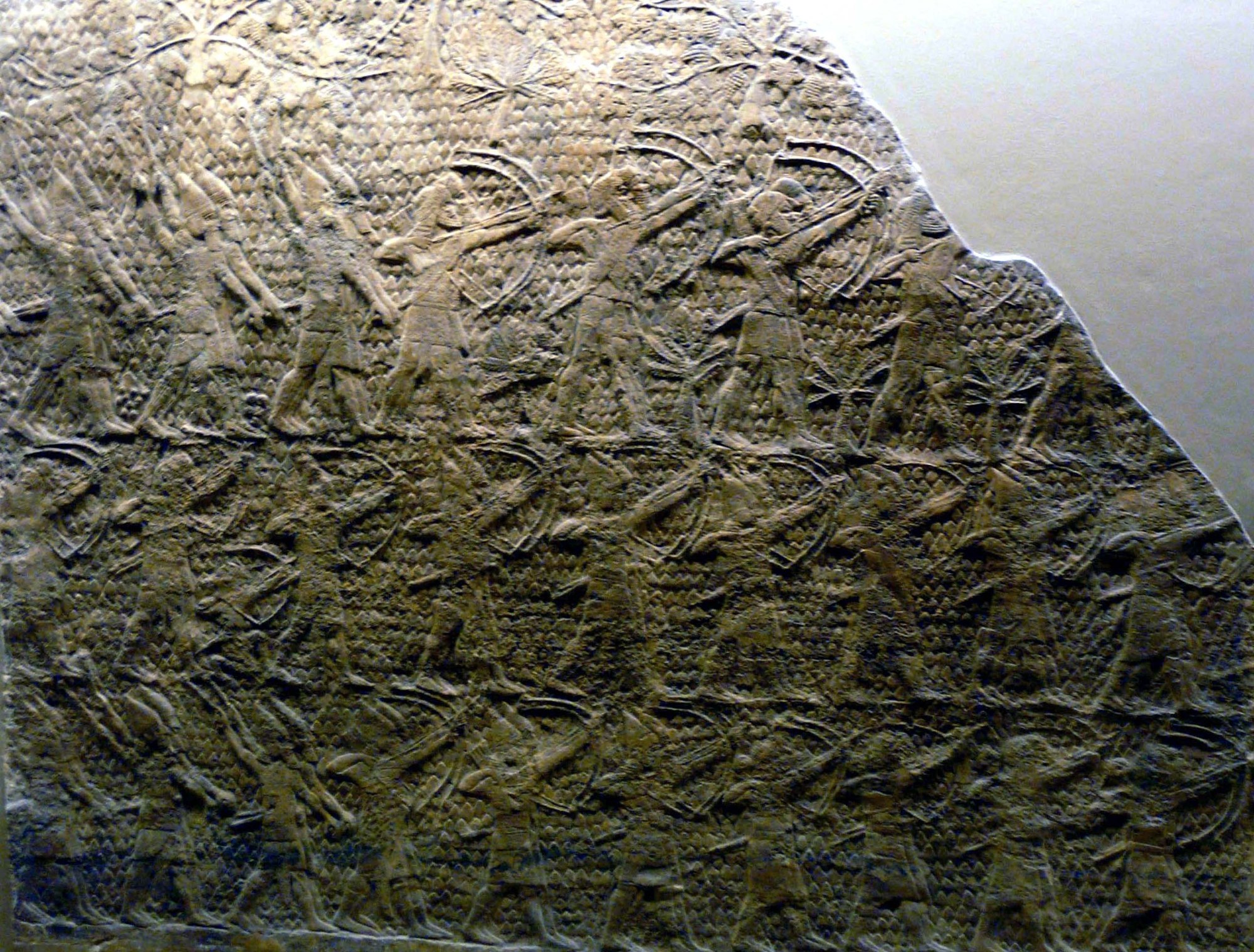
He shouted the arrow apart into its origins. Shaft, he cried, return to your reed thicket. Bow-frame, back to your copse. Bow-string, back to the ram’s gut. Feathers, return to the birds. And the arrow obeyed. It came undone in flight into reed and wood and gut and feather, and nothing touched the bird. Weapons stopped. A deadly silence settled over the battle, and the mountain kept its thief.
Stalemated, Ninurta turned to the one thing on the field that could carry a message. His weapon SharurNinurta's talking weapon, a mace or mace-head that speaks, bows and carries messages between the battlefield and the gods., the mace that speaks, took the dispatch and bore it back down to Ea: the shaft had failed, the bird had unspoken it, and the war would not be won by shooting.
Butterflies of shorn feather
Ea’s answer, carried back up the mountain by the same weapon, is the cleverest move in the poem, and it works precisely because it accepts that the Tablet cannot be beaten head-on. Do not let the battle slacken, he said. Do not answer the bird’s magic with more arrows for it to unravel. Wear him out in the storm until the whirlwinds make him shed his own pinions in the clash. Then take a throw-stick, follow it after your arrows, and shear off both wings, right and left. When he sees them gone and cries his spell, do not panic: draw the bow taut and let the shorn feathers dance away like butterflies. Then seize him by the throat.
The trick is that it disarms the counter-spell rather than defying it. Anzu’s command is Feathers, return to the birds. It restores a fired arrow to its parts, but it cannot re-fix wings already ripped from his own body once the winds have torn them loose.
So Ninurta pressed the storm home, and in it the bird grew weary and shed his pinions, and the throw-stick came after the arrows and cut the wings away, both right and left. As Anzu shouted the old cry, wing to wing, a shaft came up at him with nothing left to unmake it. It passed through his very heart, through heart and lungs, and the warrior took the Tablet of Destinies back into his own hand.
A feather for good news
Victory was announced not by a herald but by the wind. As a sign of good news it carried Anzu’s feathers down from the mountain, and the god Dagan saw them fall, understood, and rejoiced, and told the assembled gods that the strong one had indeed slain Anzu on his mountain. With the Tablet recovered, kingship could enter Ekur again and the abandoned rites resume. Enlil sent his vizier Nusku, and then the messenger Birdu, to summon the victor and have him place the Tablet of Destinies back in its rightful lap.
Here the standard text frays: the close of the poem is broken, and it is not certain the champion gives it up without a pause. Some read the fragments to mean that Ninurta, having held the writ of all fate in his own hand, hesitates before returning it. The tablet does not survive well enough to say. What the poem does end on is a flood of names poured over the champion to seal the restored order. He is hymned as Ningirsu, as Nin-Azu, as Pabilsag and Ishtaran and Zababa and Lugalbanda and Tishpak; even in Elam he is named, as Hurabtil and as Shushinak in Susa. Order is made safe by making its recoverer into everyone’s god.
That litany hides a real seam in the tradition. The version told here, with Ninurta as the champion, comes from the Standard Babylonian recension copied at Nineveh in the seventh century BCE. But the older Anzu poem, whose principal witness was found at Susa and which is conventionally dated to the early second millennium, roughly eight hundred to a thousand years earlier, gives the same victory to a different god: Ningirsu, the lord of Girsu.
The later text folds him in as one of Ninurta’s many names, which is how a tradition absorbs its own older self. The two gods are near enough to be sung as one hero, but the centuries between the poems are longer than the reach of any single teller.
Shaft that came, return to your reed thicket. Bow-frame, back to your copse. Bow-string, back to the ram’s gut. Feathers, return to the birds.
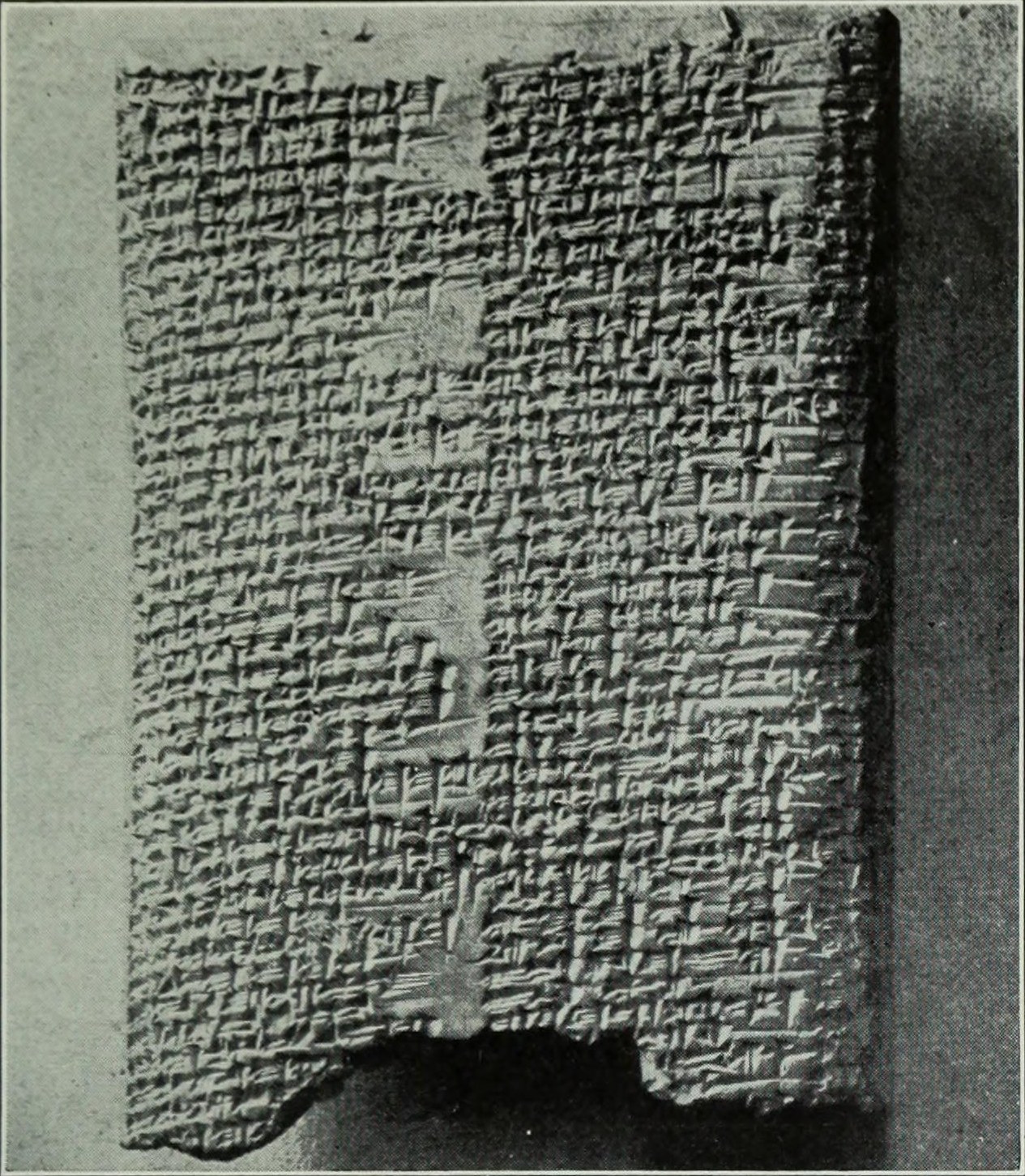
- The Standard Babylonian Myth of Anzu / Epic of Anzû (1st-millennium BCE Late Assyrian recension; from the library of Ashurbanipal at Nineveh, 7th century BCE)Anu’s call for a champion and the three refusals of Adad, Gerra and Shara; Ea’s plan and the commissioning of Ninurta by the mother-goddess Belet-ili; the marshalling of the seven winds; the confrontation; the arrow unmade in mid-flight by the Tablet’s power; Sharur carrying the dispatches to and from Ea; Ea’s throw-stick counsel; the shedding of the wings and the killing dart through heart and lungs; the recovery of the Tablet; the feather-sign, Dagan’s announcement, and the restoration to Ekur. Read via S. Dalley, Myths from Mesopotamia: Creation, the Flood, Gilgamesh, and Others, Oxford UP, 1989; rev. 2000, pp. 203–227 (in copyright: the narrative is paraphrased and only short phrases quoted). Standard critical edition: Amar Annus, The Standard Babylonian Epic of Anzu, SAACT 3, Helsinki, 2001; also B. R. Foster, Before the Muses: An Anthology of Akkadian Literature, 3rd ed., 2005.
- The Old Babylonian Anzu (early 2nd millennium BCE, conventionally c. 1800–1600 BCE; principal witness from Susa)the shorter, earlier recension in which the hero is Ningirsu, not Ninurta. Edited in M. E. Vogelzang, Bin šar dadmē: Edition and Analysis of the Akkadian Anzu Poem, Groningen, 1988; translated and discussed by Dalley, pp. 222ff.
- Ninurta and the Turtle, ETCSL 1.6.3 (Sumerian; tablet UET 6/1 2)the variant in which the Tablet belongs to Enki, who then humbles the over-ambitious Ninurta with a giant turtle. Cited here via the Ninurta and Tablet of Destinies reference articles (ETCSL 1.6.3; Penglase 1994; Black & Green 1992), not read verbatim this session.
- Enūma Eliš (the Babylonian creation epic)cited for the Tablet’s other career (worn by Kingu, then passing to Marduk) and for the strand in which Marduk, not Ninurta, is the storm-bird’s slayer. Standard editions: W. G. Lambert, Babylonian Creation Myths, 2013; Dalley, Myths from Mesopotamia. Used for the variant point only; tablet lines not read verbatim this session.
- A. R. George,
Sennacherib and the Tablet of Destinies,
Iraq 48 (1986) 133–146on what the Tablet is — a sealed legal writ conferring supreme authority — and, with Eleanor Robson,Ninurta,
Oracc (2015); Charles Penglase, Greek Myths and Mesopotamia (1994); and Black & Green, Gods, Demons and Symbols of Ancient Mesopotamia (1992), for the dating of the recensions, the scholarly reading of the Tablet’s power as reverting things to their original state, and the summary variant in which Ninurta calls the south wind to tear the wings away rather than shearing them with a throw-stick.