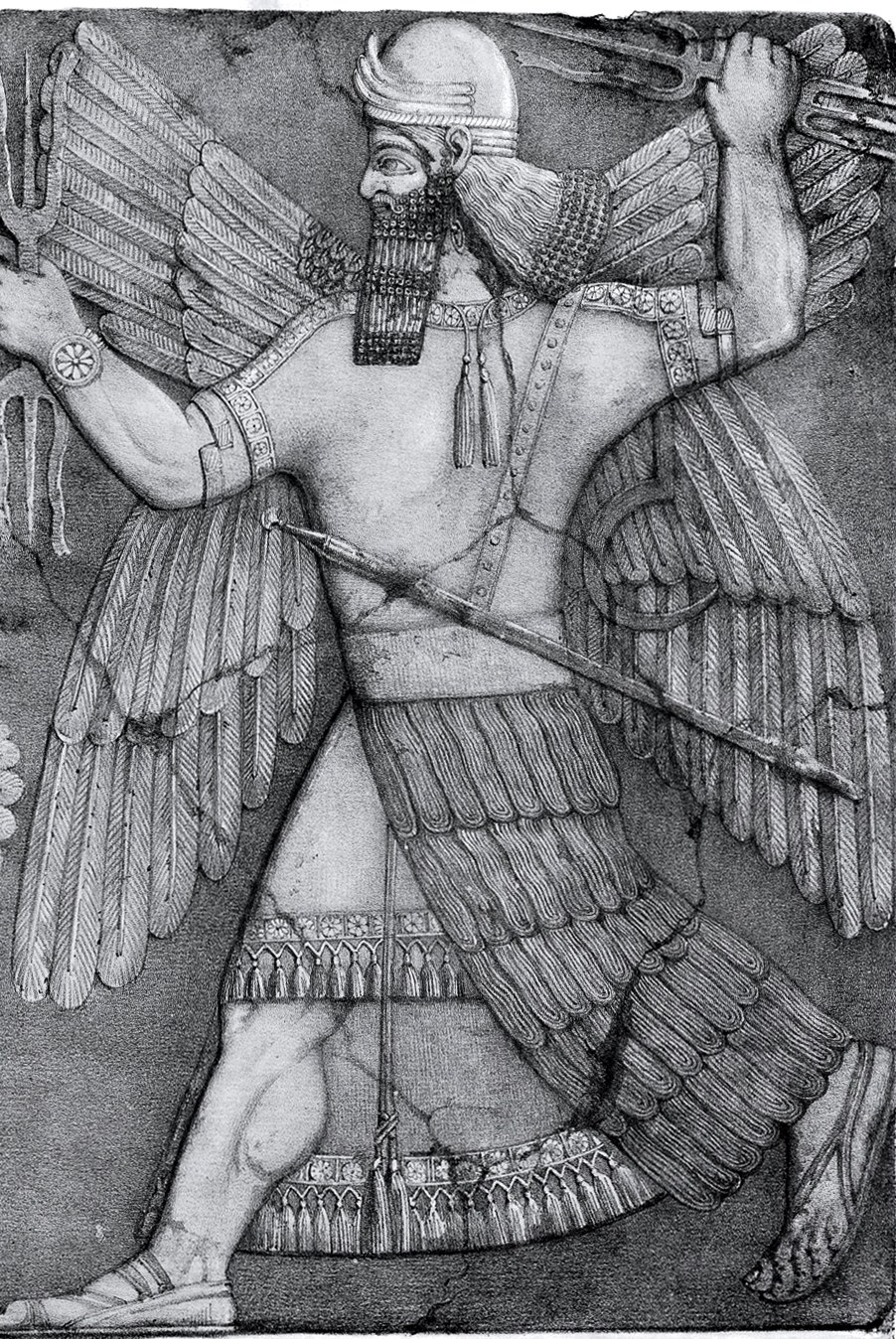
She has no shore. In the Babylonian Enūma Eliš, this page follows Tiamat as a being — the primeval sea, mother, maker and source of monsters — rather than treating her as only the backdrop to Marduk’s victory. Before any field was formed or any marsh could be seen, before a single god had been called into being or a destiny ordained, she was already there: the salt water, spread out with nothing to hold her in. The Babylonians called her Tiamat, and the name is simply their word for the sea, tâmtuThe ordinary Akkadian word for the sea or ocean; Tiamat's name is simply this word made into a person, so that she is the salt water itself rather than a deity who rules it., the ocean itself made into a person. She is not a goddess who rules the sea from somewhere dry. She is the water. Everything that has a name in the world got its name later than she did, and one of the last things to be made from her was the sky.
The word for the ocean
Her nature is written into her name, and it is worth being exact about it, because the exactness is the whole point. Tâmtu means sea, and Tiamat is that sea in its salt form, set against her consort the sweet or fresh water of the deep. The oldest lines of the poem do not stage the two of them as a contrast of chemistries; they say only that the waters mingled. The salt-and-sweet reading is drawn from who the two of them are rather than declared outright, but it is old and steady, and it makes Tiamat the ocean proper: the wide brine, not a river or a spring.
The scribes could split even the single sea in two when they needed to. In a note preserved with the epic she is set out as Tiāmat elītu, the Upper Ocean, against Tiāmat saplītu, the Lower Ocean, the waters above the sky held apart from the waters below it. That division will matter at the end of her story, when half of her is bolted up over the heavens and half left beneath, but it is already latent here in the way her name could be doubled. She is not a small thing given a large title. She is the largest thing there is, and the language strains to hold all of her at once.
Where the gods came from
Her first office is not war but motherhood. The epic calls her the mother of them both, meaning she and the fresh water together are the source of the divine line, and from the mingling of the two came the gods in generations: first Lahmu and Lahamu, then Anshar and Kishar, then Anu the sky, then Anu’s son Ea.
This is her oldest face and the one the later, more famous scenes tend to erase. She begins as the origin, the maternal water out of which everything divine is drawn. She is not born a monster. She becomes one only after grief, and only after a long stretch in which her whole meaning is that she is where the gods come from.
That maternal-creative power carries a title the poem keeps for her: Ummu-ḪuburTiamat's epithet in the epic, 'who formed all things': a title of a maker-mother, used at the very moment she turns from bearing gods to breeding monsters., who formed all things. It is a maker’s name, the name of the one who shapes and produces, and the terrible turn in her story is that the poet reaches for it at the exact moment she stops shaping gods and starts shaping horrors. The hand that formed the first family of heaven is the same hand that forms the army sent to destroy it. The title does not change. What she makes with it does.
What she filled with poison
When she turns, she turns as a mother still, breeding rather than fighting. She does not raise a sword; she spawns. The poem watches her make a brood, and it is precise and physical about the making. She bore monster-serpents, sharp of tooth and merciless of fang, and where a living thing should carry blood she filled their bodies with poison instead.
She clothed the vipers with terror, gave them a lofty and dreadful stature, so that whoever beheld them was overcome by fear before a blow was struck. These are not soldiers she recruits. They are creatures she produces out of herself, the way she once produced the gods, and the horror the poem wants is the horror of a womb turned to this use.
Popular retellings like to fix a number to the brood and get it wrong. The text names eleven, but it names eleven kinds, and several of the kinds are plural or collective, so the count of actual creatures runs well past eleven.
The list is a bestiary in miniature: monster-serpents, vipers, dragons, and the monster Lahamu; then hurricanes, raging hounds, scorpion-men, mighty tempests, fish-men, and rams, all of them bearing cruel weapons and without fear of the fight. To read that as eleven individuals is to shrink a teeming sea into a squad. The point of the passage is abundance. She is the ocean, and she brings up out of herself as many terrors as the ocean has ever been imagined to hold.
A tablet fastened to a captain’s breast
She needs a hand to lead what she has bred, and she chooses one and raises him high. The god is KinguThe god Tiamat raises as her war-captain and, in the tradition, her new consort, and to whose breast she fastens the Tablet of Destinies that lets its holder decree fate., and she exalts him in the midst of the host, sets him to march before the forces and give the battle-signal and lead the advance. In the tradition she takes him as her second consort as well, the new spouse standing in the place war has emptied. Then she gives him the one thing that turns a captain into a king. She hangs the Tablet of Destinies on his breast, the writ that makes a spoken command binding on the whole ordered world, so that Kingu, thus exalted and holding the power that had been Anu’s, could decree the fate of the gods as though he sat in the highest seat.
It is the act of a sovereign, and it is hers to perform. Whatever the poem will make of her later, at this moment she has the authority to hand out the government of the cosmos, and she hands it to her general and her spouse. That the tablet will be torn from Kingu’s breast and pressed against the victor’s chest is another story, told elsewhere; here what counts is that she was the one with the power to give it away.
The body that became the sky
The killing itself belongs to the champion’s story, and this is not that story. What belongs to Tiamat, what she is finally for, is what her killer does with what is left. So take the duel in a single breath: a younger storm-god was made king to face her, walked out to the sea that had turned every other god around, caught her in a net, drove a wind into her open mouth so she could not close it, and put a spear through her belly.
He stood on her, smashed her skull with his mace, cut the channels of her blood, and set the north wind to bear it away into secret places. That is the end of Tiamat the combatant. It is also the beginning of Tiamat the world.
Because he did not bury her. He built with her. He split her up like a flat fish into two halves, and one half of her he raised and fixed as a covering for heaven. Then he did the thing that makes her body an act of architecture rather than a corpse: he set a bolt across it and stationed a watchman, and charged the watchman not to let her waters come forth.
The salt sea that had no shore is now held above the sky as its ceiling, penned behind a bar so that the upper ocean cannot pour back down onto the world. Over against the fresh-water deep he set the dwelling of Ea and founded the heaven called E-šara for the great gods. The two waters that mingled at the start of everything are pulled apart at last, and one of them is nailed up overhead as the roof of the sky.
And then he keeps building. In the next tablet the sky-half of her body becomes the frame on which the heavens are hung: he fixes the stations of the great gods among the stars, sets the constellations, marks out the year and the months, and lays down the paths that the Moon and the Sun will walk. The celestial architecture is her carcass, dressed and ordered.
When a Babylonian looked up at the fixed courses of the year, the doctrine of the poem was that he was looking at the inside of a dead sea. There is a later and richer recension, not preserved in the oldest public translation and standard only in the modern editions, that carries the image further still and makes the Tigris and the Euphrates flow from her two eyes. If that reading is right, then even the rivers of the Babylonian world are her, weeping out across the land she used to be.
The woman who ruled the monsters
She survived into Greek, and the portrait that reaches us there is worth setting beside the cuneiform one, so long as the reader keeps the distance in view. Around 281 BCE a Babylonian priest named Berossus wrote his people’s traditions up in Greek, some eight or nine hundred years after the epic was composed, and his account comes to us only at third hand, through a Greek epitomist and then a Christian chronicler. In that late, foreign telling she is Omoroca, glossed as Thalatth, the Sea, and she is drawn as a woman who rules a whole court of hybrid monsters: men with two faces or with wings, horse-footed and bull-headed things, creatures with the tails of fish.
Belos, the later slayer, cleaves her in two and makes the earth from one half and the heavens from the other. The menagerie is more lurid than anything in the epic, and the split is doubled so that both halves go to cosmic use. It is a vivid outsider’s picture of her, and it agrees with the cuneiform on the essentials: she is the Sea, she governs the monstrous, and her body becomes the frame of the world. But the agreement runs across a gulf of nearly a thousand years and through two hands of retelling, and that is corroboration of a particular, cautious kind, not a second witness standing beside the first.
One more distance is worth naming, because it is easy to collapse. Tiamat is not the oldest sea-mother the region imagined. The Sumerians had told of Nammu, a primeval sea who mothered heaven and earth and was no one’s enemy, and Tiamat is the later Babylonian reworking of that idea, roughly a thousand years downstream, who takes the benevolent creatrix and turns her into the thing a young god must conquer to be king.
Whether she was ever pictured as the many-headed dragon of modern imagination the poem never quite says; it calls her the Sea, and describes her fought and split like a vast beast, and leaves the exact shape of her to the reader. The dragon is a later accretion. What the oldest text insists on is stranger and larger than a dragon. She is the water without a shore, the mother of the gods, the maker who bred an army out of her own body, and the body that a younger god unrolled across the dark to make the sky you stand under.
After this fashion, huge of stature, she made eleven (monsters). … She exalted Kingu; in their midst she raised him to power. To march before the forces, to lead the host, to give the battle-signal, to advance to the attack. (Enūma Eliš I 146, 147–150, tr. King)
- Enūma Eliš, Tablets I, IV and V (the Babylonian Epic of Creation), with Tablet VI for Kingu’s blood — read verbatim in L. W. King, The Seven Tablets of Creation, vol. I (LondonLuzac, 1902), public domain (archive.org id
the-seven-tablets-of-creation.-vol.-1): the naming of the two primeval waters and the birth of the gods in generations (I 1–20); Tiamat asthe mother of them both
(I 4) andUmmu-Ḫubur, who formed all things
(I 133); the monster-serpentssharp of tooth, and merciless of fang; with poison instead of blood she filled their bodies
and the eleven kinds of monster (I 133–146); the exaltation of Kingu and the Tablet of Destinies fastened on his breast (I 147–158); the killing — net, evil wind driven into her open mouth, spear bursting the belly, skull smashed with the mace, blood borne off by the north wind (IV 95–132); and the splittinglike a flat fish into two halves
, one half raised as a covering for heaven with a bolt fixed and a watchman set (IV 137–146), the sky-half framing the constellations, the year and the months, and the paths of Moon and Sun (V 1 ff.). Composed in the later 2nd millennium BCE (commonly placed under Nebuchadnezzar I, c. 1125–1104 BCE); the surviving manuscripts are Neo-Assyrian and Neo-Babylonian copies (7th c. BCE onward), so even the native text reaches us centuries younger than its own composition. - Enūma Eliš, Tablet V (the fuller Neo-Assyrian recension, lines c. 53–58) for the Tigris and Euphrates flowing from Tiamat’s two eyesNOT preserved in King 1902, where that stretch was still fragmentary. Standard only in the later editions — A. Heidel, The Babylonian Genesis, 2nd ed. (Chicago, 1951), and W. G. Lambert, Babylonian Creation Myths (Winona Lake: Eisenbrauns, 2013). Cited to those editions and flagged here as a later-recovered fragment, not read from King.
- Berossus, Babyloniaca (c. 281 BCE), the Creation fragment — epitomised by Alexander Polyhistor and preserved in Eusebius, Chronicon (ed. Schoene coll. 14 f.) and SyncellusOmoroca, glossed Chaldean
Thalatth
(the Sea), as a woman ruling a court of hybrid monsters, and Belos cleaving her into earth and heaven. Read via King’s verbatim Greek quotation and translation, Introduction pp. xlv–xlix. A native but Hellenistic and Greek-language witness, written some 800–900 years after the epic was composed and reaching us only at third hand; any agreement with the cuneiform is corroboration across roughly a millennium, and is treated as such.