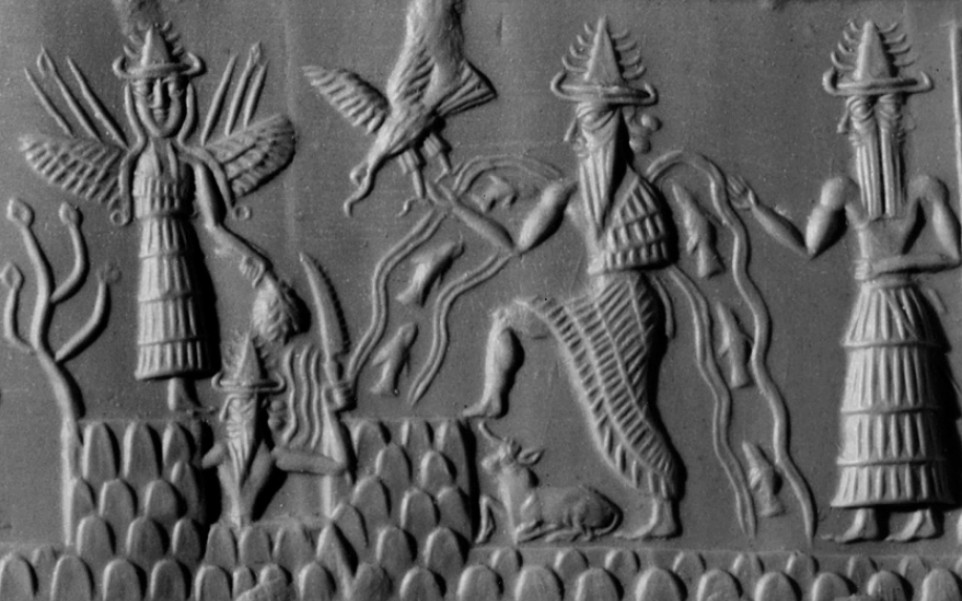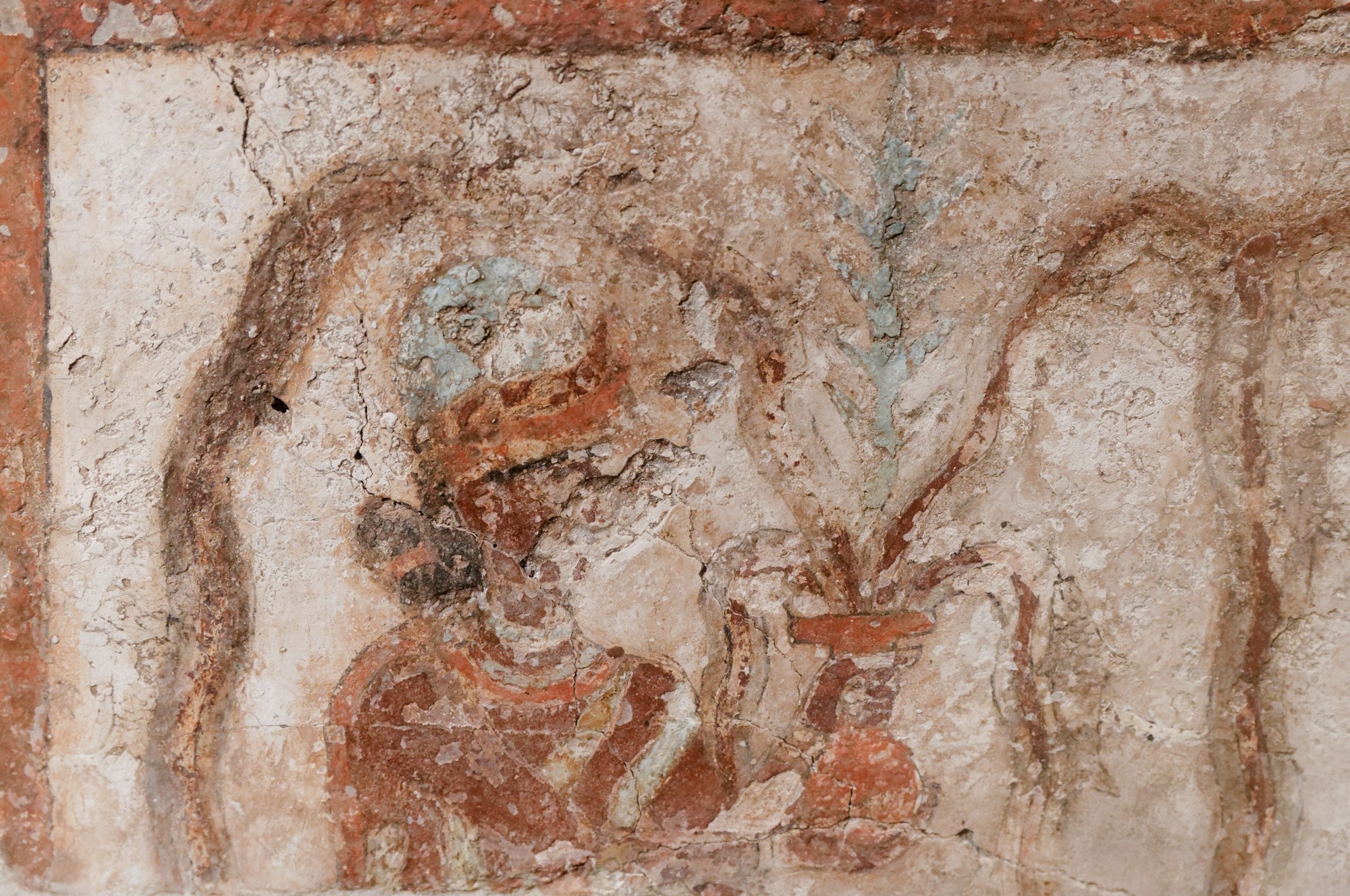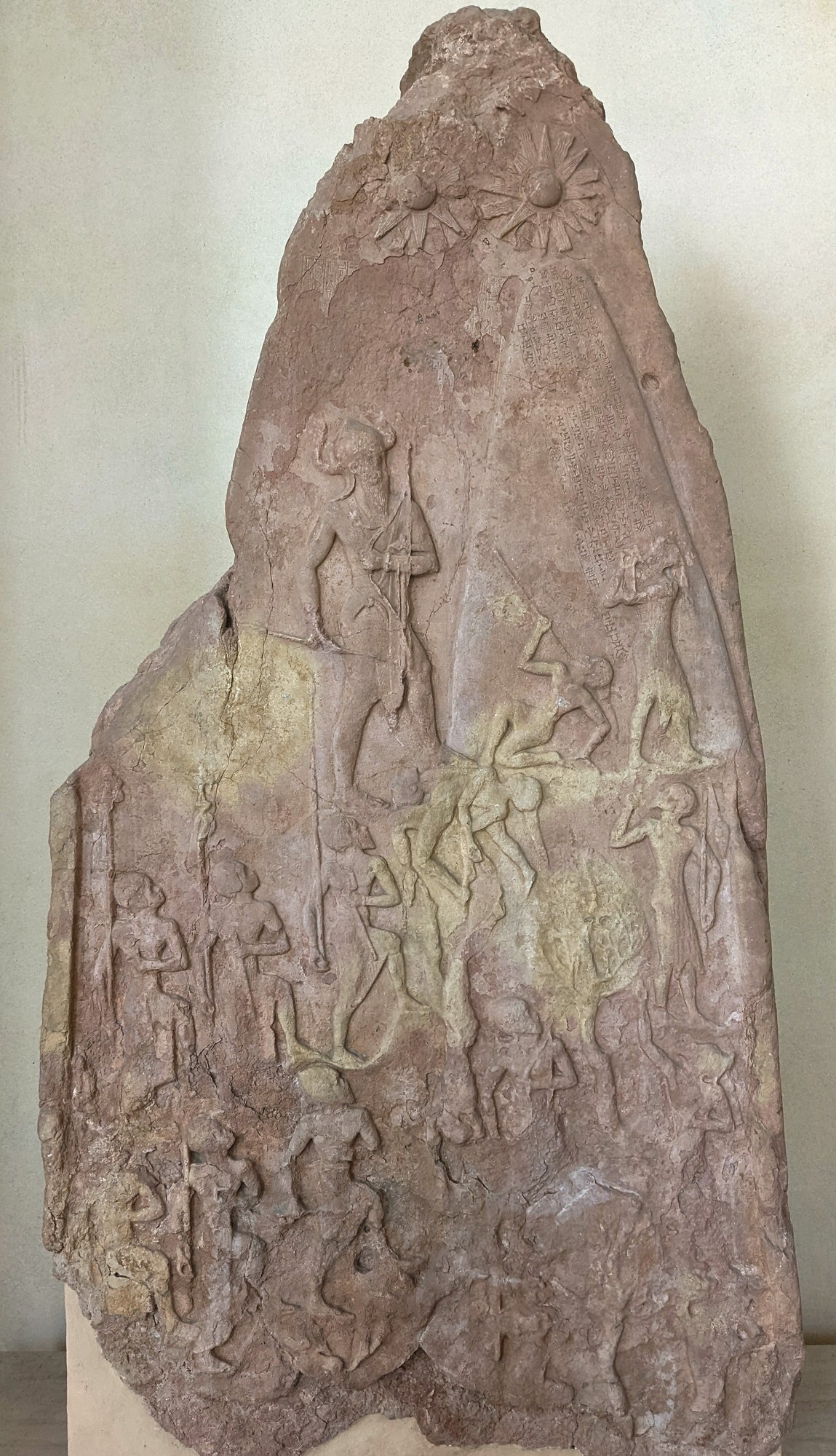
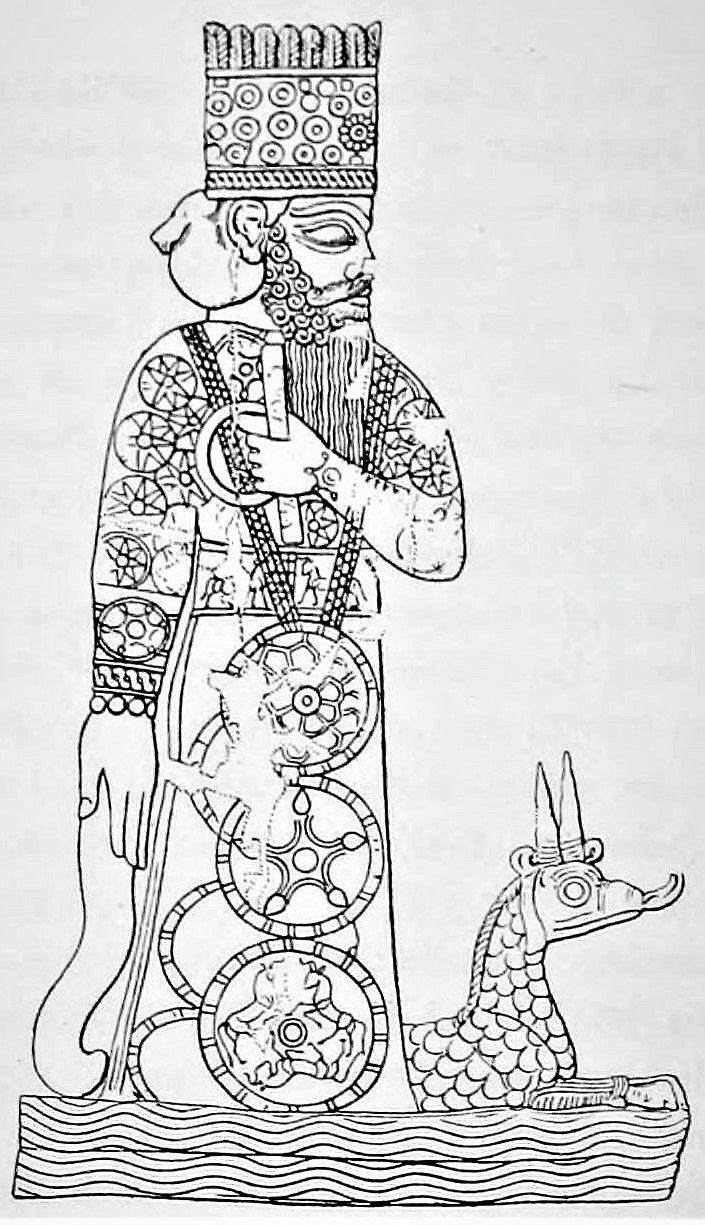
Before there was a name for anything, there were two waters. The fresh water and the salt water lay mingled together in the dark, and there was no field yet, no marsh, no reed-bed, nothing that had been called into being and set apart. Out of that undivided deep the gods were born in their generations, and the gods, being young and loud, disturbed the ancient quiet. This is where every catastrophe in the poem begins: with life stirring in the belly of a chaos that would rather have stayed asleep. The salt water was Tiamat, the mother of them all, and when the younger gods killed her consort Apsû she rose to avenge him, and there was no one among the great gods with the nerve to meet her. The one who would was not yet born when the trouble started. His name was Marduk.
Tiamat did not come to the fight unarmed. Roused to war, she spawned a brood of eleven monsters and raised up the god Kingu to be her captain and her new consort, and into his hands she gave the Tablet of Destinies, the writ that makes a command binding on the whole ordered world, so that his word would be law. Against that the elder god Anshar sent out his champions one by one. He sent Anu, and Anu turned back. He sent Ea, the wise, and Ea turned back too. Neither could look the salt-water chaos in the face. Only then did the assembly turn to Marduk, the son of Ea, a storm-god still young enough to say yes.
He said yes, but not for nothing. This is the political heart of the epic and it should not be softened into simple heroism. Marduk agreed to fight on one condition: that the gods convene, fix his destiny above all their own, and let him decree fates in their place.
With my word in place of you will I decree fate. May whatsoever I do remain unaltered, may the word of my lips never be changed nor made of no avail. He was not asking for a reward after victory. He was asking to become, in advance, the god whose speech is reality. The bargain was kingship for a battle, and the gods, with the dragon at the gate, took it.
They tested him first. At the banquet where they decreed his destiny, the gods set a garment in their midst and told him to make it vanish by a word and then, by a word, to bring it back. He spoke, and the garment was gone; he spoke, and it returned. That was the proof they needed, that his command was the thing commanded, and they cried out that Marduk was king and laid on him the sceptre, the throne and the ring.
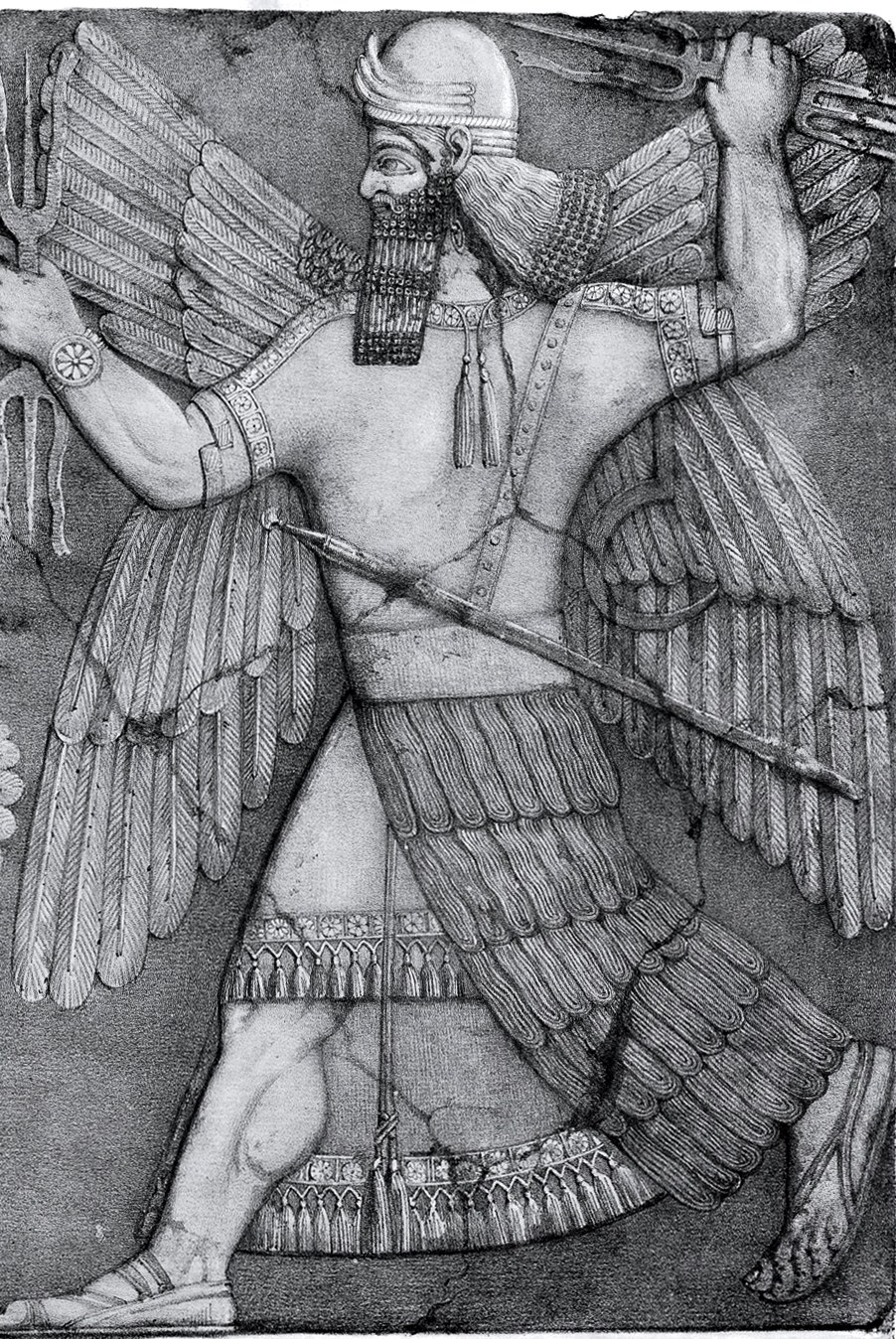
Then he armed. He took a bow and a quiver, a club, and lightning set before him; his body filled with burning flame. Anu had given him a great net to trap the enemy so that nothing of her might escape. And he mustered the winds, seven of them, the four quarters of the sky and the evil wind and the tempest and the whirlwind besides, and rode out with the storm itself for a chariot.
The kill is one of the most physical things in ancient literature, and the poem does not look away from it. Marduk spread his net and caught her, and as Tiamat opened her mouth to its full extent to swallow him, he loosed the evil wind into her face. It rushed in before she could close her jaws; the terrible winds filled her belly so that she could not shut her mouth, and her body was stretched taut and open.
Then he drove the spear through, burst her belly, severed her inward parts and pierced her heart. He overcame her and cut off her life. With her dead he turned on Kingu, stripped the Tablet of Destinies from him, sealed it with a seal and laid it in his own breast. The authority that had been the dragon’s now sat inside the storm-god’s chest.
What he did next was to make the world out of the corpse. He smashed her skull with a merciless club and set the North Wind to carry her blood away to secret places, and then he split her, the poem says, like a flat fish into two halves. One half he raised as a roof over the sky, and he fixed a bolt across it and posted a watchman there with a single order: do not let her waters come forth.
The salt-water chaos that had wanted to unmake the gods became the firmament that keeps the upper waters from drowning the world. He set the stars in their stations, fixed the year and its twelve months, and appointed the Moon to measure out the month.
Then came the making of us. So that the gods might be freed from their toil, a god was to be slaughtered and humankind mixed from his blood, and in the received version of the story it is Kingu, the guilty rebel who had led the war, whom Ea puts to death, so that mankind is founded on the blood of the defeated enemy. (An older reading, preserved in King’s 1902 text before the relevant tablet was recovered, and matching the Greek account of Berossus, had Marduk make man from his own blood instead; the standard text names Kingu.)
Man was made to carry the labour and to serve the gods, and in gratitude the gods took up the brick-mould and worked a full year to build him a city and a temple, Babylon and the Esagila, raised to a great height. Construct Babylon, Marduk commanded, let its brickwork be fashioned; you shall name it The Sanctuary. The epic ends not with the battle but with a litany: the gods proclaim the fifty names of Marduk, title upon title, the whole liturgy of a god who had been born the son of Ea and had made himself king of everything by keeping a single promise the salt water could not.
The lord spread out his net and caught her, and the evil wind that was behind him he let loose in her face. As Tiamat opened her mouth to its full extent, he drove in the evil wind, while as yet she had not shut her lips. (Enūma Eliš IV.95–98, tr. L. W. King)
- Enūma Eliš (Babylonian Epic of Creation), Seven Tablets — the primary text, read verbatim in L. W. King, The Seven Tablets of Creation, Vol. I (LondonLuzac, 1902), public-domain full text: Tablet I (the mingled fresh and salt waters, the birth of the gods, the fall of Apsû); Tablet II (Marduk’s terms,
with my word in place of you will I decree fate
); Tablet IV (the garment-test enthronement andMarduk is king!
, the sceptre/throne/ring, the arming and the net and the seven winds, the single combat and slaying of Tiamat, the splitting of her bodylike a flat fish
and the roofing of the sky); Tablet V (the ordering of the heavens, the stations of the stars, the year and the months); Tablet VI (the making of man from a slain god’s blood, the building of Babylon and Esagila); Tablet VII (the fifty names). - Enūma Eliš, Tablet VI.57–58 (the building-of-Babylon command,
you shall name it The Sanctuary
) — as translated in J. B. Pritchard (ed.), Ancient Near Eastern Texts Relating to the Old Testament (ANET), 3rd ed. (Princeton, 1969), p. 68. Quoted from the modern edition because King’s Tablet VI is broken at this point. - Berossus, Babyloniaca (frr., 3rd c. BCE), via Alexander Polyhistor and Eusebius; text in I. P. Cory, Ancient Fragments (1876), pp. 57–60a later Greek witness to the same cosmogony (the chaos-goddess cut in half to form heaven and earth; mankind made from a slain god’s blood). A secondary, later witness, not a primary tablet.
- W. G. Lambert, Babylonian Creation Myths (Eisenbrauns, 2013) — the current critical edition and standard scholarly reference (cited, not read verbatim here); with P. Talon, The Standard Babylonian Creation Myth Enūma Eliš (SAACT 4, 2005) and B. Foster, Before the Muses.
- A. Heidel, The Babylonian Genesis, 2nd ed. (1951), and D. D. Luckenbill (1921) — for the text-recovery history and the correction from Marduk’s own blood (King’s 1902 reading) to Kingu’s blood in the standard post-1929 text (scholarship, not primary narrative).