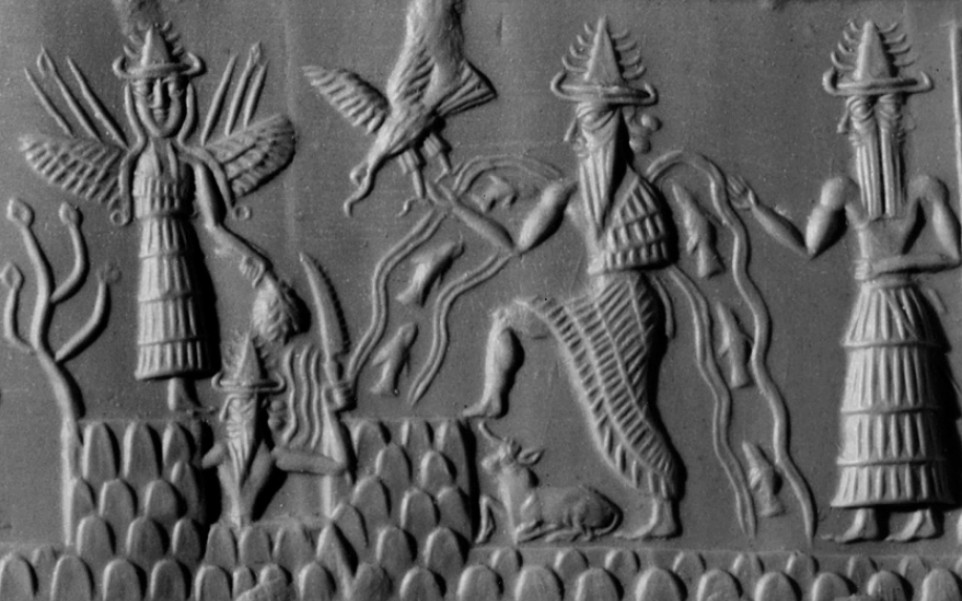
Before heaven was named and before the earth beneath it bore a name, there were two beings and nothing else. One was Apsu, called the begetter; the other was Tiamat, named in the poem as the mother of them both
. No field had been formed, no marsh could be seen, no god had been called into being, and no destiny had been ordained. There was only the pair, and the single act the poem gives them at the start of everything is quiet and physical: their waters were mingled together. Out of that commingling came the gods, out of the gods a quarrel, and out of the quarrel a war that ended with one of the two bodies split open to make the sky. But the beginning is not violence. It is two waters flowing into one another in the dark.
Their waters were mingled together
The couple are defined by water, and the poem opens on the moment the two meet. The scholarly reading, the one the brief takes as its frame, calls Apsu the sweet or fresh water, the underground deep the Sumerians named the abzu, and Tiamat the salt sea, from the Akkadian tâmtu, the ocean. It is a clean and old identification and almost certainly right. Worth saying plainly, though, that the opening lines do not draw the fresh-against-salt contrast in so many words. They say only that the waters mingled. The sweet-and-salt reading is inferred from who the two deities are, not spelled out at line one.
From that union the gods were begotten, and they came in pairs, generation after generation, with long intervals between: first Lahmu and Lahamu, after an interval Anshar and Kishar, then Anu the sky, and then his son Nudimmud, who is Ea, abounding in all wisdom, exceeding strong, without a rival. The rhythm of the theogony is a rhythm of couples: the first family of the cosmos reproduces the shape of its founders, one pair begetting the next.
A quarrel over sleep
The rupture, when it comes, is not grand. It is domestic, and it is about noise. The young gods are restless. Their new way, their busy activity, the order they are bringing where there had been only the still commingled waters, robs the old father of his rest. This is the detail the poem is precise about and later retellings lose: the trigger is not a cosmic principle but a grievance a tired householder would recognise. By day Apsu cannot rest; by night he cannot lie down in peace. He wants the silence back.
So Apsu summons MummuApsu's minister or vizier in the epic; a sixth-century Greek source instead makes him the couple's only-begotten child and glosses his name as "the intelligible world"., his minister, and the two of them go to Tiamat, and before her they lie down to take counsel against the gods, their own children. Apsu says it outright: I will destroy their way, that quiet may be restored and we may lie down again in peace.
Here the poem does the thing every loose retelling of this story gets backwards. It is Apsu, not Tiamat, who first plots to destroy the gods. And Tiamat refuses. When she hears what her consort intends for the children the two of them made, she rages and cries aloud; she utters a curse; she asks what then shall we do, and answers with restraint rather than slaughter. Let their way be made difficult, she says, and let us lie down again in peace. She wants only to slow them. She will not have them killed. The mother of them all is, at the first crisis of the world, the one who argues for mercy.
Ea beholds the muttering
It is Mummu who tips the balance. The minister urges his master on, and at the counsel Apsu’s face brightens with a hard joy, and he resolves to act. But the plot does not stay secret. Ea, who knows all that is, beholds their muttering, and answers the scheme with a word rather than a weapon: his pure incantation.
Here the oldest readable text fails us, and it is worth telling the reader why. In King’s 1902 edition, built from the fragments then recovered, the lines describing Apsu’s death are simply broken away; King could say only that Apsu and Mummu were overthrown and Ea was their conqueror.
The vivid scene most modern readers know, in which Ea pours sleep over Apsu, strips away his tiara and his aura, kills him, binds Mummu, and builds his own dwelling upon the dead father’s body, comes from the fuller text recovered later at Ashur and Kish. It is real, but it is not in the century-old public translation, and the honest thing is to attribute the sleeping-and-slaying to the modern complete editions rather than pretend the old fragments carried it.
What matters for the couple is the sequence, which is often reversed in the telling. Apsu is killed first. Only after her consort is dead does Tiamat turn to war, and she turns to it to avenge him, not as the original aggressor. The monster-host she raises, and the champion Kingu she takes as her second spouse for his support, belong to that later grief, not to the beginning. The famous ending, in which Marduk slays her and splits her body into halves to roof the heavens with one, lies far downstream of this couple’s rupture. The rupture itself was a husband’s plot against his children and a wife’s refusal to allow it.
The Sea under a Greek name
The couple survived into Greek, twice, and both times across a gulf of centuries the reader should keep in view. Around 290 to 278 BCE, a Babylonian priest named Berossus wrote up his people’s traditions in Greek, some nine hundred to a thousand years after the epic was likely composed, and his account survives at further removes still, quoted by Alexander Polyhistor and then by the Christian chronicler Eusebius in the early fourth century CE. In that transmission Apsu appears as Apason and Tiamat as a woman ruling the monstrous brood of the primeval deep, named Omorka, which the text glosses as Thalatth in Chaldean and Thalassa, the Sea, in Greek.
Bel, the later slayer, cleaves her in two, making the earth from one half and the heavens from the other. The equation holds, but it reaches us through a Greek priest writing a millennium late and a Greek-reading bishop later still.
The other Greek witness is later and stranger. Damascius, a Neoplatonist writing in the sixth century CE, some seventeen or eighteen hundred years after the epic, preserves the same couple and the same pair-by-pair genealogy under Greek names: Tauthe and Apason begetting Moymis, then Lache and Lachos, Kissare and Assoros, Anos and Illinos and Aos, recognisable through the Greek as Tiamat and Apsu and Mummu, Lahmu and Lahamu, Kishar and Anshar, Anu and Enlil and Ea.
But Damascius reads Moymis as the intelligible world, a philosopher’s abstraction laid over a Babylonian vizier, and this is reception rather than religion. Set beside the cuneiform epic, these Greek accounts are not the same story at a later date; they are the tradition seen through Greek eyes across a gap that runs, for Damascius, to nearly two thousand years.
A pair-shape older than the poem
The primeval couple is not only the epic’s invention. The great Babylonian god-list known as An = AnumThe great Babylonian god-list, which opens the cosmos as a long file of ancestral couples begetting one another, pair by pair. opens with a long file of ancestral pairs, the lords and mothers of Anu, set out two by two: Duri and Dari, Lahma and Lahama, Alala and Belili, and more. The editor of the modern reconstruction equates that Lahma and Lahama directly with the Lahmu and Lahamu of the epic, and identifies the list’s Anshar with the Anshar who looms so large in the poem. The names are not identical to the epic’s roster, but the shape is: creation told as a genealogy of couples, one pair begetting the next.
This parallel is worth more than the Greek ones. The god-list was most likely composed in the Kassite period, roughly between 1300 and 1100 BCE, which makes it very nearly a contemporary of the epic rather than a distant echo. Where Berossus and Damascius stand a thousand and nearly two thousand years downstream and filtered through Greek, An = Anum stands beside Enūma ElišThe Babylonian creation epic, named from its opening words "When on high", which tells of the primeval waters, the birth of the gods and the making of the world. as a genuine near-parallel witness: two Babylonian texts of roughly one age agreeing that the world began as a series of paired begettings. When sources are close in time that is worth saying, exactly as it is worth flagging when they are far apart. Here they are close, and the agreement is the stronger for it.
So the sweet water and the salt sea are older and steadier than any one poem. Two waters mingle in the dark; from them the gods come in pairs; a quarrel over rest turns a father against his children and a mother against the father; and long after, the salt sea’s torn body becomes the sky. What the earliest text insists on, and the later retellings blur, is this: the mother did not begin it. She rose to war for a husband already dead, having asked, at the very first, only that the children be allowed to live.
When on high the heaven had not been named, and the earth beneath did not yet bear a name, and the primeval Apsu, who begat them, and chaos, Tiamat, the mother of them both, their waters were mingled together. (Enūma Eliš I 1–5, tr. King)
- Enūma Eliš, Tablet I 1–52 and I 60 ff. (Babylonian Epic of Creation; standard 1st-millennium BCE text, likely composed in the later 2nd millennium, c. 1200–1100 BCE)the opening theogony (no heaven or earth yet named, no field, no marsh, no destiny ordained), the mingling of the two waters, the birth of the gods in pairs (Lahmu and Lahamu, Anshar and Kishar, Anu, Nudimmud/Ea), Apsu’s grievance over lost rest and his plot with Mummu against the gods, Tiamat’s opposition to destroying her children, Mummu’s counsel and Apsu’s brightening face, and Ea beholding the muttering and answering with his pure incantation. Read verbatim in L. W. King, The Seven Tablets of Creation, vol. I, Luzac, 1902, pp. 3–13 (public domain; archive.org id
the-seven-tablets-of-creation.-vol.-1). King’s fragments break off exactly at Apsu’s death (I 68–82 wanting). - Enūma Eliš, modern complete editionW. G. Lambert, Babylonian Creation Myths, 2013, and B. R. Foster, Before the Muses: An Anthology of Akkadian Literature, 3rd ed., 2005. In copyright; cited as the source of the completed Apsu-slaying passage absent from King (Ea pours sleep over Apsu, strips his tiara and aura, kills him, binds Mummu, and raises his own abode
the Apsu
over the corpse, where Marduk is later begotten). Paraphrased, not quoted verbatim. - Berossus, Babyloniaka (c. 290–278 BCE), epitomised by Alexander Polyhistor and quoted by Eusebius, Chronicon (Chronicorum liber prior), ed. Schoene coll. 14–16the Greek transmission giving Apason for Apsu and Omorka/Thalatth (the Sea) for Tiamat, and Bel cleaving her in two to form earth from one half and heaven from the other. Read via King’s verbatim Greek quotation, Introduction pp. xlv, xlix. A native but late (Hellenistic) and Greek-language witness, reaching us at two removes through Eusebius (early 4th c. CE).
- Damascius, De principiis cap. 125 (ed. Kopp p. 384; Neoplatonist, c. 6th c. CE)the Greek pair-genealogy Tauthe/Apason begetting Moymis (glossed
the intelligible world
), then Lache/Lachos, Kissare/Assoros, and Anos/Illinos/Aos (Anu, Enlil, Ea). Read via King’s verbatim quotation, Introduction p. xxxiii n.1. Treated as Neoplatonic reception, not primary Babylonian theology. - An = Anum (the Great God List), Tablet I 1–24 (god-list; probable composition c. 1300–1100 BCE, Kassite period; preserved in 1st-millennium copies)the twenty-one ancestral pairs of Anu set out two by two (Duri/Dari, Lahma/Lahama, Alala/Belili and others), with Lahma/Lahama equated with the epic’s Lahmu/Lahamu and Anshar identified with the epic’s Anshar. Ed. R. L. Litke, A Reconstruction of the Assyro-Babylonian God-Lists (Texts from the Yale Babylonian Collection 3, 1998), Tablet I and notes, pp. 22–23. Roughly contemporary with the epic, and so a genuine near-parallel witness to the pair-genealogy motif.