The first being in the world does nothing. Before heaven or earth is named, before any field or marsh has been formed, the Babylonian creation poem Enūma ElišThe Babylonian creation epic, named from its opening words "When on high"; it tells of the primeval waters, the birth of the gods, and the making of the world. reaches back to a single figure standing at the head of everything, and calls him the primeval Apsu, who begat them. He is not a king enthroned or a warrior armed. He is water. He is the sweet, fresh water of the deep, and at the beginning of all things his one attribute is stillness. He is the sleep of the world before the world.
That is the whole of him at the start, and it is worth pausing on how strange a first god this is. He acts by not acting. The generations that come after are defined by what they do; Apsu is defined by rest, by an undisturbed expanse that lies there and begets without effort. The poem gives him no body we can picture.
Later art loads the primeval deep with dragon-scales and coils, but those belong to his consort, not to him; King, the 1902 editor, could only remark that the first beings were conceived as monsters and not endowed with human forms,
which is a scholar’s shrug, not a description. Apsu has no face. He has a quality, and the quality is quiet.
What noise did to the first god
The undoing of the first god is not grand. It is insomnia. The younger gods, begotten and multiplying, bring a new way into the still deep: activity, order, restlessness where there had been only calm. And the old water cannot sleep. The complaint the poem puts in his mouth is not the language of cosmic principle but of an exhausted householder: by day I cannot rest, by night I cannot lie down in peace. He wants the silence back, and he decides he will have it at any price.
The price is his children. Apsu resolves to destroy them, to wipe away their disturbing way so that quiet may be restored and he may lie down again. This is the hinge of his whole existence, and it must be stated plainly because loose retellings reverse it: the first aggressor of the epic is not the salt-sea mother but Apsu himself, the sweet water, the passive one. The god of stillness commits the first violence in creation, and he does it for the pettiest and most human of reasons. A cosmic murder, planned to win back a quiet night.
Killed off the page
Then comes the most remarkable thing about Apsu, and it is a thing the poem does rather than says. His grandson EaThe Babylonian god of wisdom and fresh water (Sumerian Enki), grandson of Apsu, who detects the plot and kills him; afterwards he dwells in the Apsu and fathers Marduk., who knows all that is, perceives the design and answers it with a word rather than a weapon: a pure incantation. The plot is discovered. The counter-move is set. And at the exact moment the killing should happen, the oldest readable text goes dark.
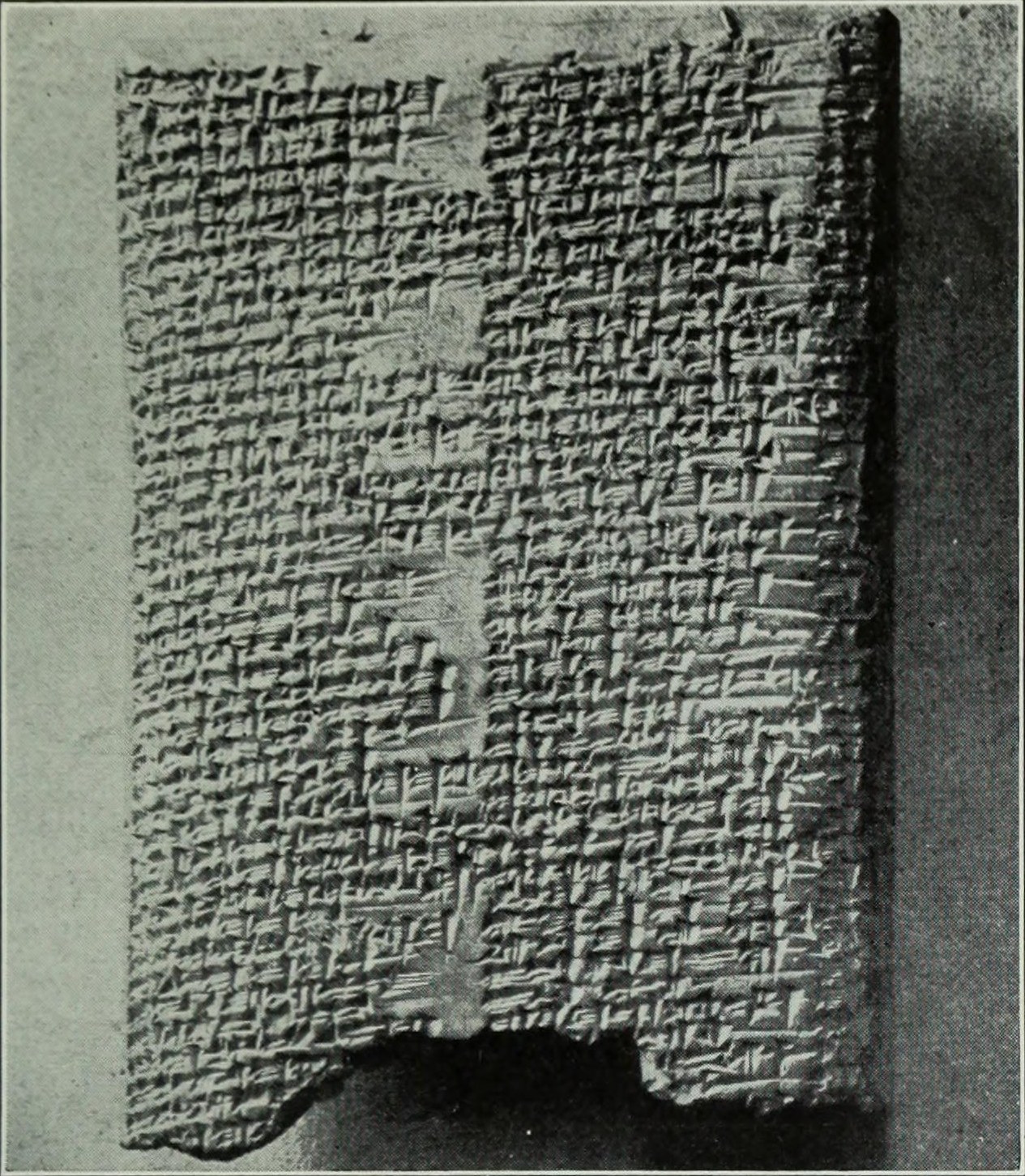
In both public-domain editions of the epic, the century-old translations a curious reader can actually open, the lines that describe Apsu’s death are simply gone. The editors mark them wanting.
Fifteen lines are missing, and they are precisely the fifteen that show the first god being killed. What survives on either side of the gap is only aftermath, the death reported as a thing already done, glimpsed in passing: Mummu and Apsu thou hast cast down, one god says to Ea later; Apsu is laid waste, murmurs another broken line. The first murder in the world reaches us as hearsay.
The vivid scene most modern readers know, in which Ea pours sleep over Apsu, strips away his crown and his radiance, slays him, binds his vizier Mummu, and raises his own house upon the dead god’s body, is real. It was recovered from duplicate tablets found later at Ashur and Kish, and it lives now in the modern complete editions. But it is not in the old translations, and the honest thing is to say so, and to keep the older reader’s experience intact: in the text a general audience can look up, the poem draws a veil across the death of its first character. The camera cuts away at the murder.
The grave becomes a house
What happens next is the strangest turn in Apsu’s story, and it is the reason he is never truly gone. The slain god does not vanish. He becomes a place. After the killing, the Apsu
is no longer a person but a location, the fresh-water deep where Ea takes up residence and works. It is there, later in the epic, that humankind itself is fashioned: Ea in the Apsu pinched off clay, the poem says, and shaped the first people out of it.
The god who was murdered for wanting silence is turned into the quiet workshop where the gods do their making. His body becomes real estate. His grave becomes a house, and in the completed text, recovered from the same later tablets that fill the gap over his death, Marduk, the hero of the whole epic, is engendered inside it.
He outlived his own language, too. Nearly two thousand years after the epic took shape, a Greek-writing Neoplatonist named Damascius still had the name. In his account of the Babylonian cosmogony the first couple survive under Greek masks, and ApasonThe Greek form of Apsu's name in Damascius, a sixth-century Neoplatonist who preserved the Babylonian couple under Greek names. is the husband of Tauthe, their only child a certain Moymis. Apason is Apsu; Tauthe is Tiamat; Moymis is the vizier Mummu, glossed by the philosopher as the intelligible world.
The gap between that page and the cuneiform is enormous, some seventeen or eighteen centuries and a change of religion and tongue, and it should be kept in view rather than smoothed over. But the fact stands: the fresh-water god who was killed in the first hundred lines of his own poem, and whose death the poem would not even show, was still being named in Greek two millennia later.
That is the shape of Apsu’s life. He is the first being, water and rest; he is the first killer, undone by noise; he is the first casualty, dispatched behind a curtain the text refuses to draw back; and then, uniquely among the slain gods, he does not stay dead so much as change state, from a person into the deep that bears his name.
And the primeval Apsu, who begat them, their waters were mingled together. (Enūma Eliš I 3–5, tr. King)
- Enūma Eliš, Tablet I (Babylonian Epic of Creation; standard 1st-millennium BCE text, likely composed in the later 2nd millennium, c. 1200–1100 BCE)Apsu as the first-named begetter (I 3), water as his defining substance (I 5), his grievance over lost sleep and his resolve to destroy the gods to restore quiet (I 25–40), Ea perceiving the plot and answering with a pure incantation (I 60–62), and the lacuna at I 68–82 where the killing itself is lost. Read verbatim in L. W. King, The Seven Tablets of Creation, vol. I, Luzac, 1902, pp. 3–13 (public domain; archive.org id
the-seven-tablets-of-creation.-vol.-1), and in R. W. Rogers, Cuneiform Parallels to the Old Testament, Eaton & Mains, 1912, pp. 3–7 (archive.org idcu31924026822175). Both editions mark I 68–82wanting
; only the retrospectiveMummu and Apsu thou hast cast down
and the fragmentaryApsu is laid waste
preserve the death, as back-references. - Enūma Eliš, modern complete editionsW. G. Lambert, Babylonian Creation Myths, Eisenbrauns, 2013, and B. R. Foster, Before the Muses: An Anthology of Akkadian Literature, 3rd ed., 2005. In copyright; cited as the source of the reconstructed killing absent from King and Rogers (Ea pours sleep over Apsu, strips his tiara and aura, slays him, binds Mummu, and raises his own dwelling
the Apsu
over the corpse, where Marduk is later begotten). Paraphrased, not quoted from the older tablets. - Enūma Eliš, Tablet VIApsu as place, Ea dwelling and fashioning humankind
in the Apsu
(Akkadian Ea ina apsi ikrusa ṭiṭṭam,Ea in the Apsu pinched off clay
). Read verbatim in Rogers 1912, p. 45 (English) and p. 46 (transliteration). - Damascius, De principiis §125 (Neoplatonist, c. 6th century CE)the Greek theogony in which Apason is the husband of Tauthe and their only child is Moymis (= Mummu, glossed
the intelligible world
). Read verbatim in Rogers 1912, p. 44. Neoplatonic reception across nearly two millennia and a change of language, not primary Babylonian theology.