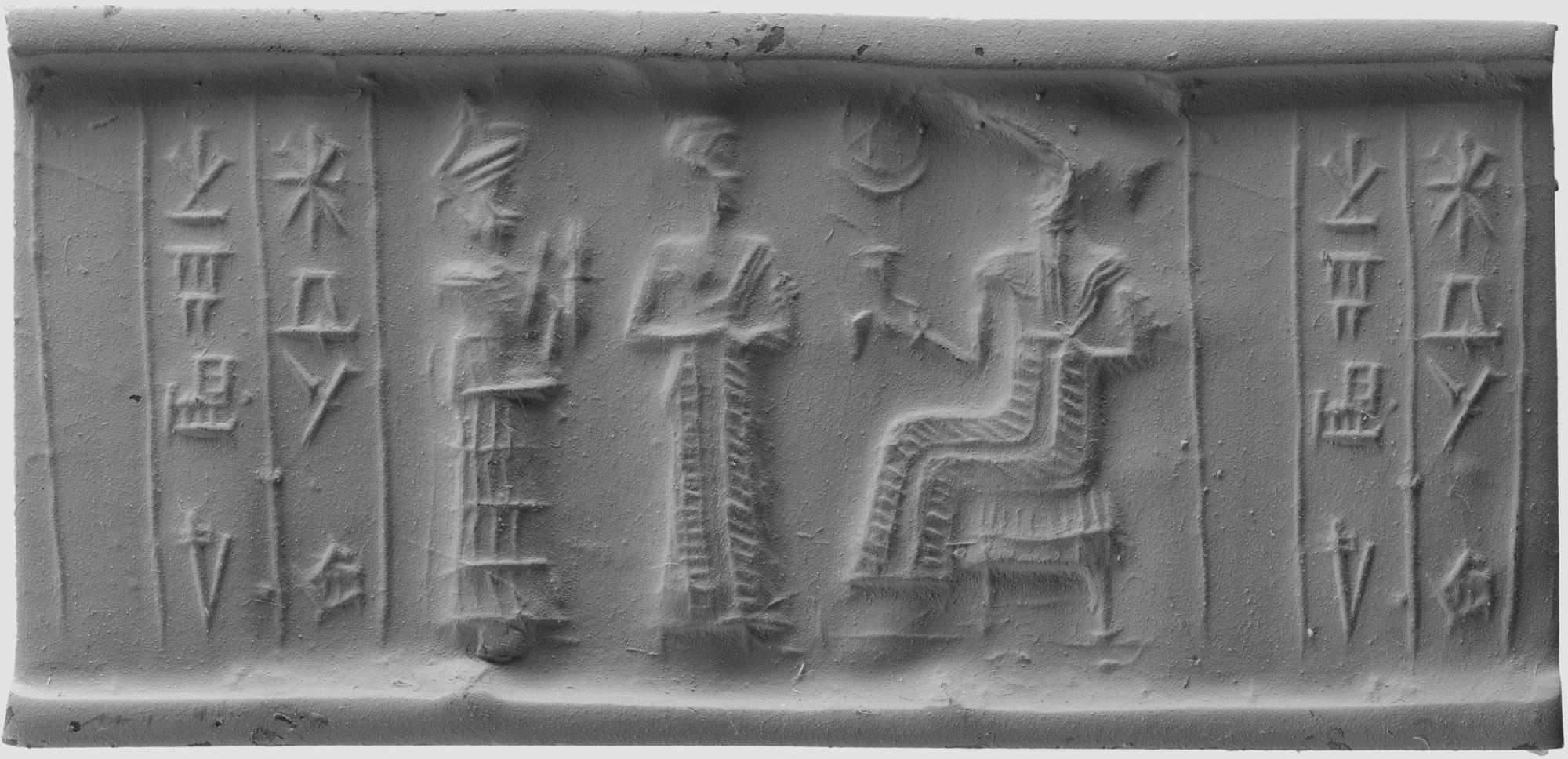
In those days, in those distant days, in those nights, in those remote nights, in those years, in those distant years: this is how a Sumerian poet reaches back to the beginning of the world. Not with an argument about how things came to be, but with a formula, a run of temporal clauses that keep pushing the frame further back until there is nowhere further to go. And it is inside that frame, almost in passing, that the oldest cosmic event of all is set down. Bread had been tasted for the first time in the shrines of the Land. The ovens of the Land had been made to work. And heaven had been separated from the earth. The strangest thing about the great sundering of the Sumerian cosmos is that no one ever sat down to tell it as a story. It survives only as this: the date-stamp on the front of other stories, the when
before the then
.
Before bread, before cloth
To feel the weight of the separation you have to first stand in the world it ends. Another poem, a debate between the goddess of grain and the goddess of the flocks, opens on exactly that world, and it is a picture of lack. There is no grain yet, of thirty or forty or fifty days’ ripening. There is no cloth, no loom, no turban. And there are people, but they are barely people. They do not know about eating bread. They go about with their limbs naked.
Like sheep they eat grass with their mouths, and they drink water from the ditches. That same poem locates the very first act higher up, on what it calls the hill of heaven and earth, and there it places the sky-god An, begetting the great gods, the AnunaThe Anuna (Akkadian Anunnaki), the "great gods" of the Sumerian pantheon; in the debate poems An begets them upon the hill of heaven and earth., in a heaven and an earth that are not yet two things but one joined mass. The world starts fused, undifferentiated, mouth-to-the-grass poor. Everything the Sumerians counted as civilisation is on the far side of a cut that has not yet been made.
Heaven prised off the ground
The cut itself is recorded in the fullest of the three witnesses, the long poem catalogued as Gilgameš, Enkidu and the Nether World, which spends its first dozen lines dating itself to the dawn of everything before it gets anywhere near Gilgameš. When the heavens had been separated from the earth, it says, when the earth had been delimited from the heavens.
The doubling is deliberate, the same event turned over and stated from both sides, heaven-from-earth and then earth-from-heaven, which is a habit of Sumerian cosmic verse rather than two separate partings. What is worth noticing is the physical force in the words. The verb for the first line means to prise open, to push away, to move a thing bodily off another. The verb for the second means to mark off, to delimit, to draw the boundary. Something is levered apart, and then a line is scored between the halves so they stay apart.
There is a human note folded into the same run of clauses, easy to miss. In the very breath in which heaven is pushed off earth, the poem also dates the moment when the fame of mankind was established. The severing of the cosmos and the beginning of human renown are set down together, as though the world could not have a name-worthy humanity in it until the sky and the ground were two separate things. The order of creation and the possibility of glory arrive in the same instant.
Notice, too, who does the severing. In this poem, nobody. The separation is stated flat, with no hand on the lever and no name attached to the act. The text tells you that heaven and earth came apart; it does not tell you who pulled them. The named gods enter only at the next stage, when there are two halves lying there to be claimed.
Three shares, not two
Then the division. When An had taken the heavens for himself, the poem goes on, when Enlil had taken the earth for himself. The verb is the plain one for carrying, bearing a thing off, so the working title of this piece renders it fairly: An carried off heaven, Enlil carried off earth. Each great god shoulders his half of the broken cosmos and bears it away as his own portion. That is the neat, two-part summary everyone remembers: An gets the sky, Enlil gets the ground.
Except the poem does not stop at two. The very next line adds a third share, and it is the one the tidy version quietly drops. When the nether world had been given to EreškigalaQueen of the kur, the Sumerian nether world; at the primeval division the underworld is bestowed on her as a gift. as a gift. The verb here is different again, the one used for bestowing something as a present, and the recipient is the queen of the land of the dead. So the primeval division is not a partition of a cosmos into an upper and a lower half between two brothers. It is a threefold settlement: sky to An, earth to Enlil, the world below to Ereškigala. Any retelling that gives you only the first two has left the underworld out of the will.
The god with the golden hoe
The second witness tells it another way, and the difference matters enough that the two should not be blended into one account. The Song of the Hoe does name an agent, and it is not An but Enlil. Here Enlil hastens to separate heaven from earth, and hastens to separate earth from heaven, the same chiastic doubling as before, and he does it for a reason: so that humankind can grow up out of the ground. He fixes the pivot of the divided world at Dur-an-ki"The bond of heaven and earth": not a person but the cosmic pivot where Enlil is said to fix the axis of the world, the cult-name of Nippur., the bond of heaven and earth, the place that is also the cult-name of the city of Nippur, the tether that keeps the torn halves from drifting free of each other.
And he does it with a tool. The poem is in love with this hoe, which it describes as wrought in gold, its top inlaid with lapis lazuli, its point a plough of lapis, its blade like a battering ram. With that gold-and-lapis implement Enlil breaks the ground open, and daylight breaks forth from the gash.
Then, at the place the poem calls Where Flesh Came Forth (a handful of manuscripts prefer Where Flesh Grew), he sets the first humans in a brick mould, and the Land starts to break through the soil towards him. Humanity does not walk onto the earth; it germinates out of it, like a crop pushing up through the mud, at the exact seam where heaven was levered off the ground.
The versions we have, and the one we made up
A word about time, because it is easy to hear Sumerian
and imagine these lines being chiselled at the very dawn of writing. They were not. All three of these witnesses survive as Old Babylonian school copies, tablets written out in scribal classrooms between roughly 1900 and 1600 BCE, at a point when Sumerian was already dying as a spoken language.
That the three agree with one another is meaningful precisely because they are near-contemporaries as physical documents, all from within the same three-century window; the compositions behind them may be several centuries older, but the oldest Sumerian writing of all is a good thousand years older still. These are not the world’s first creation account written at the world’s first dawn. They are late copies of an old idea.
And one strand of the popular picture is younger even than that. The often-repeated formula in which Enlil cleaves heaven and earth and An carries off the sky while the earth-goddess Ki takes the ground alongside Enlil is a modern reconstruction, assembled by the Sumerologist Samuel Noah Kramer in the twentieth century out of these same scattered prologues. In the ancient lines themselves the one who takes the earth is Enlil, and Ki is simply not named.
Nor should any of this be confused with the more famous Babylonian scene, later and quite separate, in which the god Marduk splits the body of the slain sea-dragon Tiamat to make the sky and the ground. There is no combat here, no monster, no corpse. The Sumerian heaven and earth are not butchered. They are prised apart and shared out, quietly, in the clause before the story starts.
When the heavens had been separated from the earth, when the earth had been delimited from the heavens… when An had taken the heavens for himself, when Enlil had taken the earth for himself, when the nether world had been given to Ereškigala as a gift. (Gilgameš, Enkidu and the Nether World A 8–13, ETCSL t.1.8.1.4; author’s rendering from the ETCSL composite translation)
- Gilgameš, Enkidu and the Nether World, Version A, lines 1–13 (ETCSL c.1.8.1.4, translation t.1.8.1.4): the fullest statement of the primeval division — heaven separated from earth (
prised open
) and earth delimited from heaven, the fame of mankind established, then An taking the heavens and Enlil the earthfor himself
, and the nether world given to Ereškigala as a gift. A Sumerian literary composition surviving in Old Babylonian school copies (c. 1900–1600 BCE) from Nibru (Nippur), Urim (Ur) and elsewhere; the composition itself likely late 3rd / early 2nd millennium. This is the passage the title quotes. Quotations here are the author’s renderings of the ETCSL composite English translation (J. A. Black, G. Cunningham, E. Robson & G. Zólyomi), Oxford. - The Song of the Hoe, lines 1–27 (ETCSL c.5.5.4, translation t.5.5.4): Enlil as the explicit, active separator, hastening to divide heaven from earth and earth from heaven
so that humans could grow
; the cosmic axis fixed at Dur-an-ki (Nippur); the gold-and-lapis hoe with which he breaks the ground and lets daylight forth; and the sprouting of the first humans atWhere Flesh Came Forth
(variantWhere Flesh Grew
). Old Babylonian manuscripts, c. 1900–1600 BCE. ETCSL translation, Oxford. - The Debate between Grain and Sheep (Sheep and Grain), lines 1–36 (ETCSL c.5.3.2, translation t.5.3.2): the pre-differentiated cosmos — An spawning the Anuna gods upon the hill of heaven and earth, and the
not-yet
litany of a world before order, its people naked and grazinglike sheep
. Old Babylonian manuscripts, c. 1900–1600 BCE. ETCSL translation, Oxford. All three ETCSL translations were also published in J. Black et al., The Literature of Ancient Sumer (Oxford, 2004).