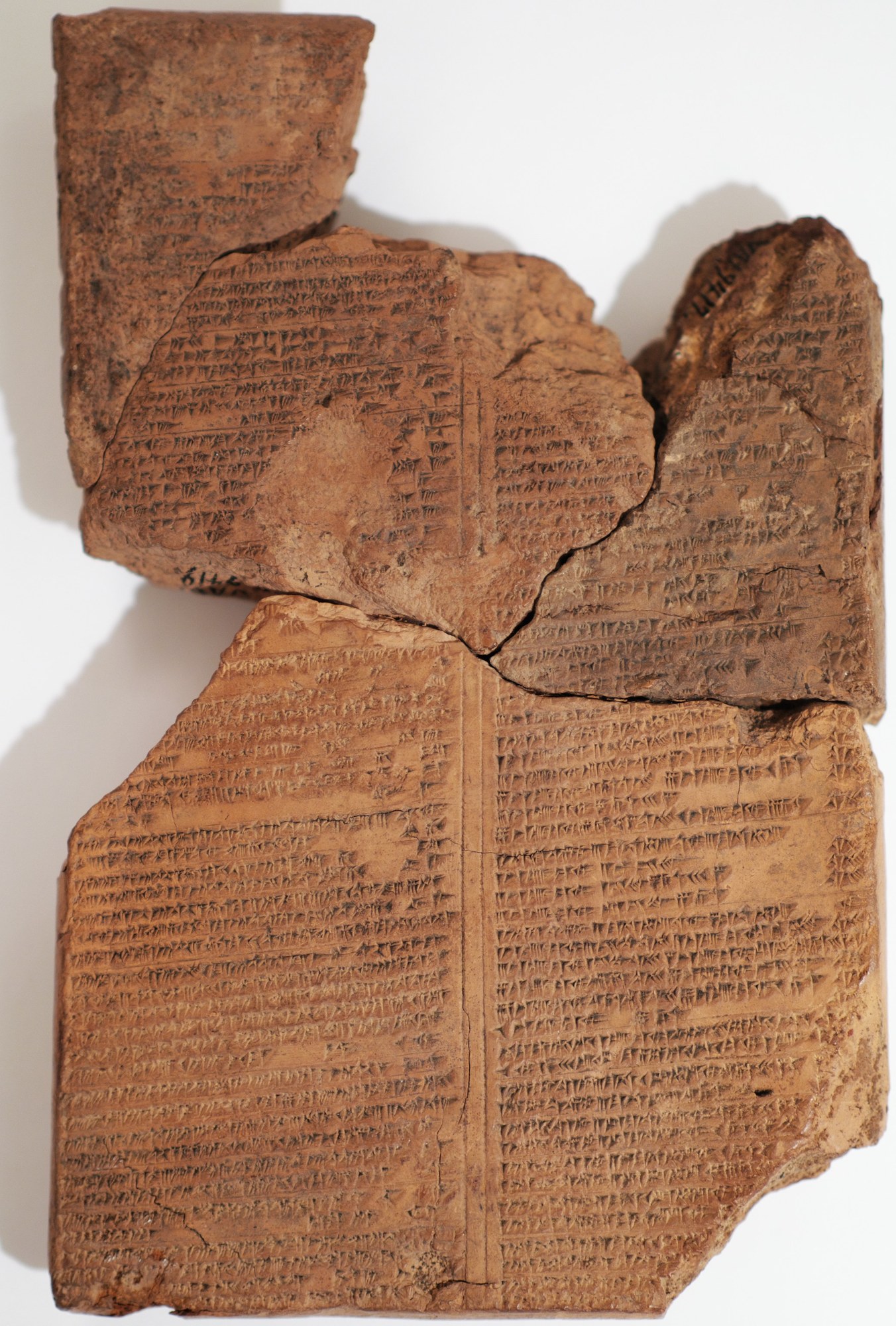
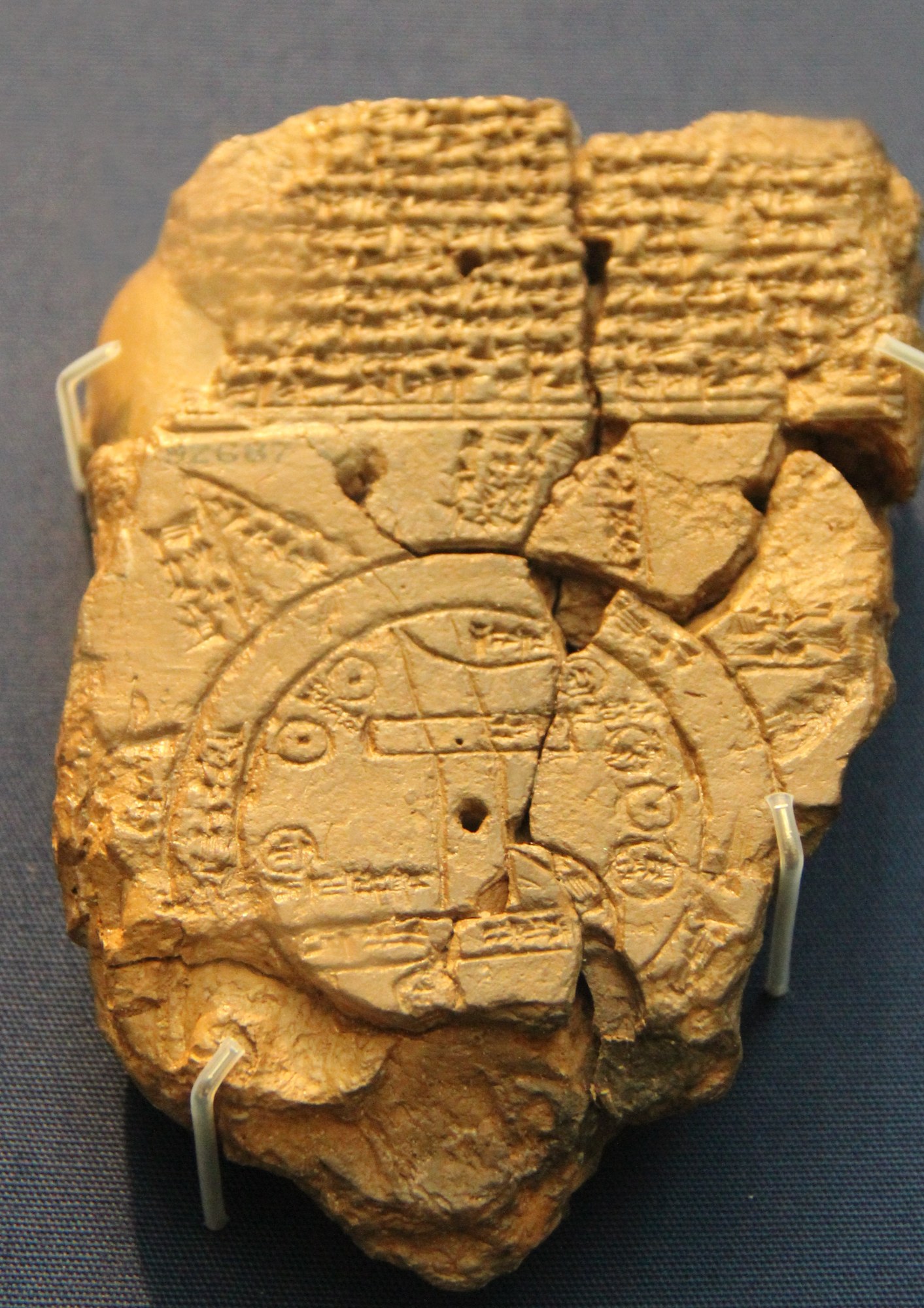
A single tablet from the Assyrian city of Assur carries a map of the whole universe, and it was never meant for your eyes. Its scribe drew the cosmos as six floors of coloured stone stacked one above another in open air: three heavens overhead, three earths underfoot, each slab a ceiling for the world below it and a floor for the world above. Then, in the colophonThe scribe''s closing note on a tablet, giving such things as its title, source and, here, a warning about who may read it. at the foot of the tablet, he wrote a warning. This is a secret of the great gods; let the knowing show it only to the knowing, and never let the ignorant look. The Babylonian picture of the layered universe survives most fully in a text that classed itself as forbidden knowledge, a piece of restricted temple lore rather than anything a worshipper in the street would have been told.
Six floors and a warning
The tablet is catalogued as KAR 307, and it is not a story. There is no plot in it, no gods at war, no beginning or end. It is a diagram in words, a scholar’s inventory of what the universe is made of and who lives on each level, embedded in the kind of dense explanatory compilation that Assyrian temple scholars kept for themselves. What it lists, from the top down, is three heavens and three earths, always in descending order, beginning with the highest heaven and ending in the pit.
That descending order matters, because it tells you the scribe was thinking architecturally, floor by floor, the way you would read a building from roof to cellar. And the building is made of stone. Each of the three heavens is a different stone slab, and the beings of each level dwell not in empty sky but on the hard ground, the bedrock, of their own floor, with open air between one floor and the next. The visible daytime sky, in this scheme, is simply the underside of one of those stone floors seen from below.
Three coloured stones for a roof
Read the heavens downward, as the tablet does. The Upper Heavens are made of a stone called luludānītu, a mottled, reddish rock, and they belong to Anu, the king of heaven, whose level this identifies with the long-attested Heaven of Anu. Below them the Middle Heavens are saggilmud-stone, which is blue. This is the level the tablet lingers on. Here a god sits enthroned on a high dais, in a sanctuary of lapis lazuli, and has made a lamp of electrum, that pale alloy of gold and silver, shine inside. A blue chapel lit by a metal lamp, hidden from the earth and glimpsed only as the blue of the sky, which is the underside of this very floor.
Lowest of the three come the Lower Heavens, made of jasper, and they belong to the stars. On them the arranging god drew the constellations of the gods. This is the sharpest image the tablet gives. The night sky is not a void full of scattered fires but an engraved stone slab, and the constellations are line-drawings scored into its underside, figures cut into the lowest floor of heaven and read from beneath by anyone who looks up. The stars are not lights. They are engravings.
The god who never gives his name
Who does the arranging? The tablet keeps saying he
without ever quite saying who, but the scholarship is confident, and so was the scribe’s audience. The enthroned figure in the blue chapel is Bel"The Lord": in first-millennium Babylonian texts like this one the title means Marduk, not the older god Enlil who once bore it too., and in Babylonian texts of this period the Lord is Marduk. He is the one who settles the gods in the upper heaven, who sits in the lapis sanctuary of the middle heaven, who scores the constellations into the jasper of the lowest, and who will go on, in the next breath, to furnish the three earths as well.
The affinity with the great creation epic is close enough to name: in both Enūma Eliš and this tablet, the same god settles Ea in the deep, mankind on the surface, and groups of gods in heaven and in earth. This is not the myth of how the cosmos was split apart. It is a picture of the finished, furnished house, with the furniture already in place and the maker’s hand still resting on it.
The tablet argues with itself
Here the neat picture cracks, and the honest thing is to let it. KAR 307 is not one seamless vision. Its lines on the heavens are a splice of two older sources, joined at the seam, and the two disagree. One source hands the Middle Heavens to the IgigiThe great gods of heaven as a group; KAR 307 counts three hundred of them and cannot decide which heaven they occupy., the great gods of heaven, and seats Bel among them.
The other instead puts three hundred of those same Igigi up in the highest heaven, alongside Anu, and reserves the middle for Bel. So the one short passage manages to place the great gods of heaven in two different heavens almost in the same breath, in adjacent lines, without noticing or caring. The only point on which both underlying sources agree is the bottom: the Lower Heavens belong to the stars.
A reader wants this tidied, and it cannot honestly be. The tablet is a compilation, and its compiler set two rival diagrams side by side and let the join show. Any retelling that gives you one clean roster of who sits where has quietly deleted half of what the tablet actually says. The Babylonian universe, on its fullest single witness, could not keep its own gods on one floor.
The earths below, half in shadow
Then the tablet turns downward, and here the text is broken and the reading grows harder. Three earths follow the three heavens, named in the scholars’ Akkadian as the upper, the middle and the lower earth. On the Upper Earth the god lays down the spirits of mankind. On the Middle Earth he settles Ea, called here his father. Into the Lowest Earth he shuts six hundred of the AnunnakiFrom Kassite times onward, the gods of the underworld; the tablet shuts six hundred of them inside its lowest earth., the underworld gods, locked inside and unable to escape, a number a hymn to the underworld king confirms when it praises him as supervisor of the six hundred. Three hundred gods of light settled above; six hundred gods of the dead shut in below.
But what these three earths are is where interpretation takes over from text. The tablet does not spell it out. That the Upper Earth is the earth’s surface, the Middle Earth the freshwater deep of the Apsu, and the Lowest Earth the underworld is the reading of the modern editor Wayne Horowitz, argued from good parallels rather than stated on the stone.
The clue for the middle is Ea: this is the god of the freshwater deep, so the earth in which he is settled is taken to be that deep, his own cosmic region. It is a strong argument. It is not a caption the Babylonian scribe wrote. And even Horowitz flags a later text in which the Middle Earth is guarded by other gods and is not obviously the Apsu at all, so the equation is his best reading of this tablet, not a fixed law of Mesopotamian thought.
Two smaller uncertainties sit in the same lines and should not be smoothed away. One broken line speaks of a rebellion that the god either did not let be forgotten or did not identify; the verb can be read both ways, no rebellion of Ea against Marduk is known from anywhere else, and so the line is simply obscure, no place to build a lost drama upon. And the tablet’s phrase for the spirits of mankind on the Upper Earth uses a word that normally means ghosts of the dead, which sits awkwardly with the reading that these are the living on the surface of the world. The map has smudges. An honest tracing keeps them.
The ladder we drew, and the tablet’s real age
It is tempting to line all six levels up as a single clean ladder, Heaven of Anu and Middle Heavens and starry sky above, then surface and Apsu and underworld below, and to say the Babylonians believed this. They may have, in some learned circle. But no single ancient tablet lays out all six levels together as one diagram. The six-tier ladder repeated in modern handbooks is Horowitz’s synthesis, assembled from many texts, and the elegant column of it belongs to the twentieth century as much as to Babylon.
Time is the last honesty the map demands. The two witnesses to this scheme are both first-millennium tablets, KAR 307 in Neo-Assyrian script from Assur and its partial parallel, AO 8196, in Late-Babylonian. Yet the list they carry may be older, perhaps as old as the Kassite period around 1595 to 1155 BCE, because it already assumes the split between heaven-gods and underworld-gods that is not found before Kassite times, and the tradition of three heavens and three earths could reach back further still.
That opens a gap of up to a thousand years between the scheme’s likely origin and the tablets we actually hold, a distance greater than the span from Homer to the Roman guidebooks that retold his world. This is not a timeless statement of what the Babylonians always believed. It is a late, learned, esoteric distillation, and older Sumerian texts described a simpler cosmos, heaven and surface and underworld, without the three stacked heavens and three stacked earths at all. The stone ladder was drawn late, and drawn in secret.
The Upper Heavens are luludānītu-stone. They belong to Anu… The Middle Heavens are saggilmud-stone… Bel sat on the high dais inside, in the lapis lazuli sanctuary… The Lower Heavens are jasper. They belong to the stars. He drew the constellations of the gods on them. (KAR 307 obv. 30–33, in W. Horowitz’s translation, Mesopotamian Cosmic Geography, 1998, p. 4)
- KAR 307 obv. 30–38 (tablet VAT 8917; Keilschrifttexte aus Assur religiösen Inhalts no. 307)the core text, a list of three stone heavens (luludānītu / Anu, blue saggilmud with Bel enthroned in the lapis sanctuary, jasper for the stars) and three earths (upper, middle, lower), all arranged by the god named Bel, closing with a colophon that brands the tablet a
secret of the great gods
. A Neo-Assyrian mystical-explanatory compilation from Assur, first millennium BCE; the list in its present form may descend from the Kassite period (c. 1595–1155 BCE), and the passage is itself a splice of two disagreeing sources. Edition and translation used: Horowitz 1998 (below), pp. 3–5; also in A. Livingstone, Court Poetry and Literary Miscellanea (SAA 3, 1989) no. 39, and Livingstone, Mystical and Mythological Explanatory Works (1986). - AO 8196 iv 20–22a Late-Babylonian astronomical-astrological tablet (ed. E. Weidner, AfO 19, 1959–60), first millennium BCE; the partial parallel giving the three heavens with their stones but neither the three earths nor Bel’s throne, and agreeing that the Lower Heavens belong to the stars. Read via Horowitz 1998, pp. 4–5, 7–8.
- Wayne Horowitz, Mesopotamian Cosmic Geography (Mesopotamian Civilizations 8; Winona Lake, INEisenbrauns, 1998), chs. 1–2 (pp. 3–19), summary p. 243, earth-names pp. 267–269: the authoritative modern edition, translation and analysis of both tablets and the standard treatment of the six-level universe. The clean six-tier ladder, and the identification of the three earths as the earth’s surface, the Apsu and the underworld, are Horowitz’s reconstruction argued from parallels, not statements on the tablet; he himself flags a later text (BE 39099) where the Middle Earth is not clearly the Apsu.
- Enūma Eliš (Babylonian Epic of Creation), Tablets IV–Vcited by Horowitz for the parallel in which Marduk settles Ea in the deep, mankind on the surface, and groups of gods in heaven and earth, and draws the constellations (Ee V 1–8). Read here only through Horowitz’s discussion (pp. 6, 8), not re-checked against a full Enūma Eliš edition.