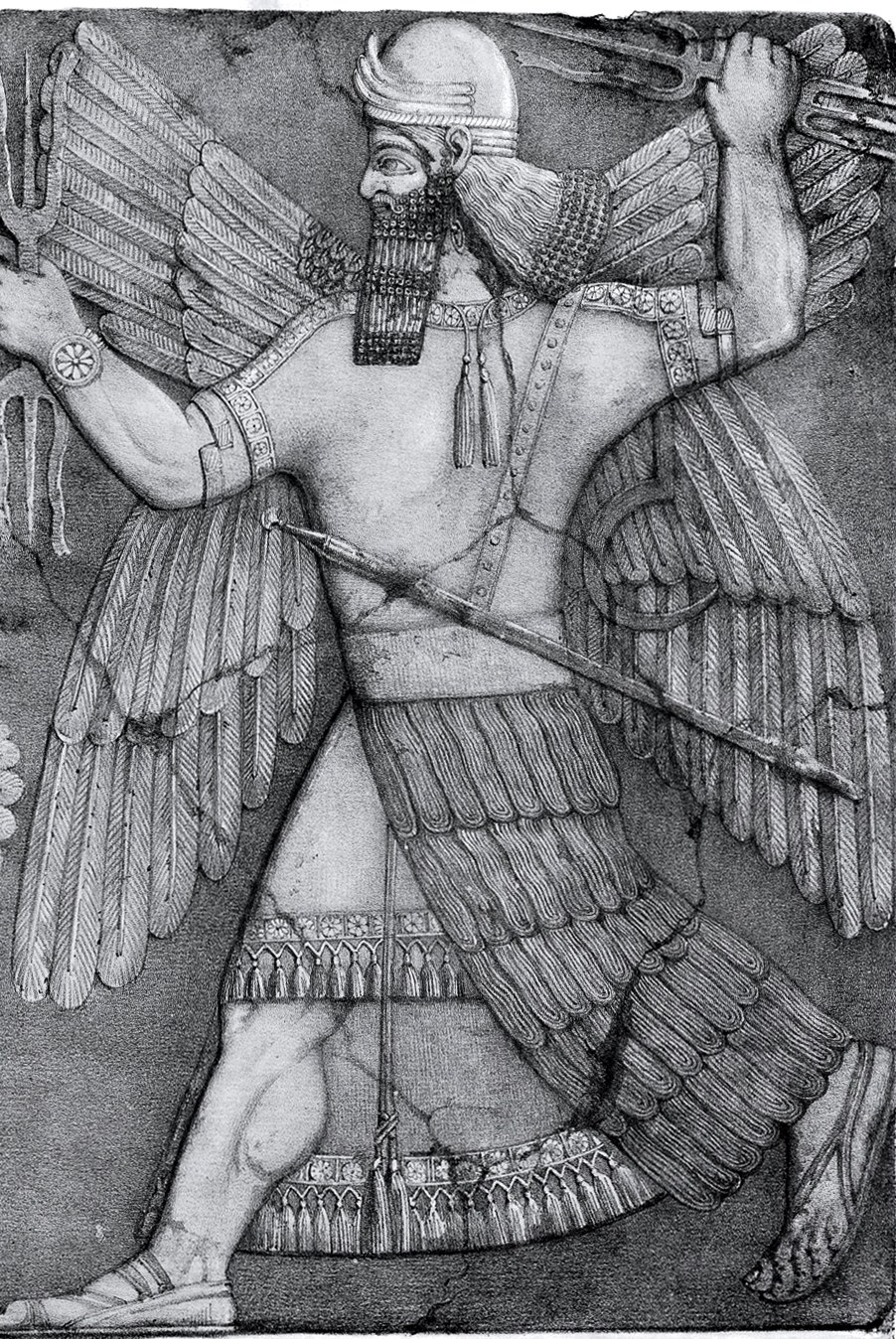
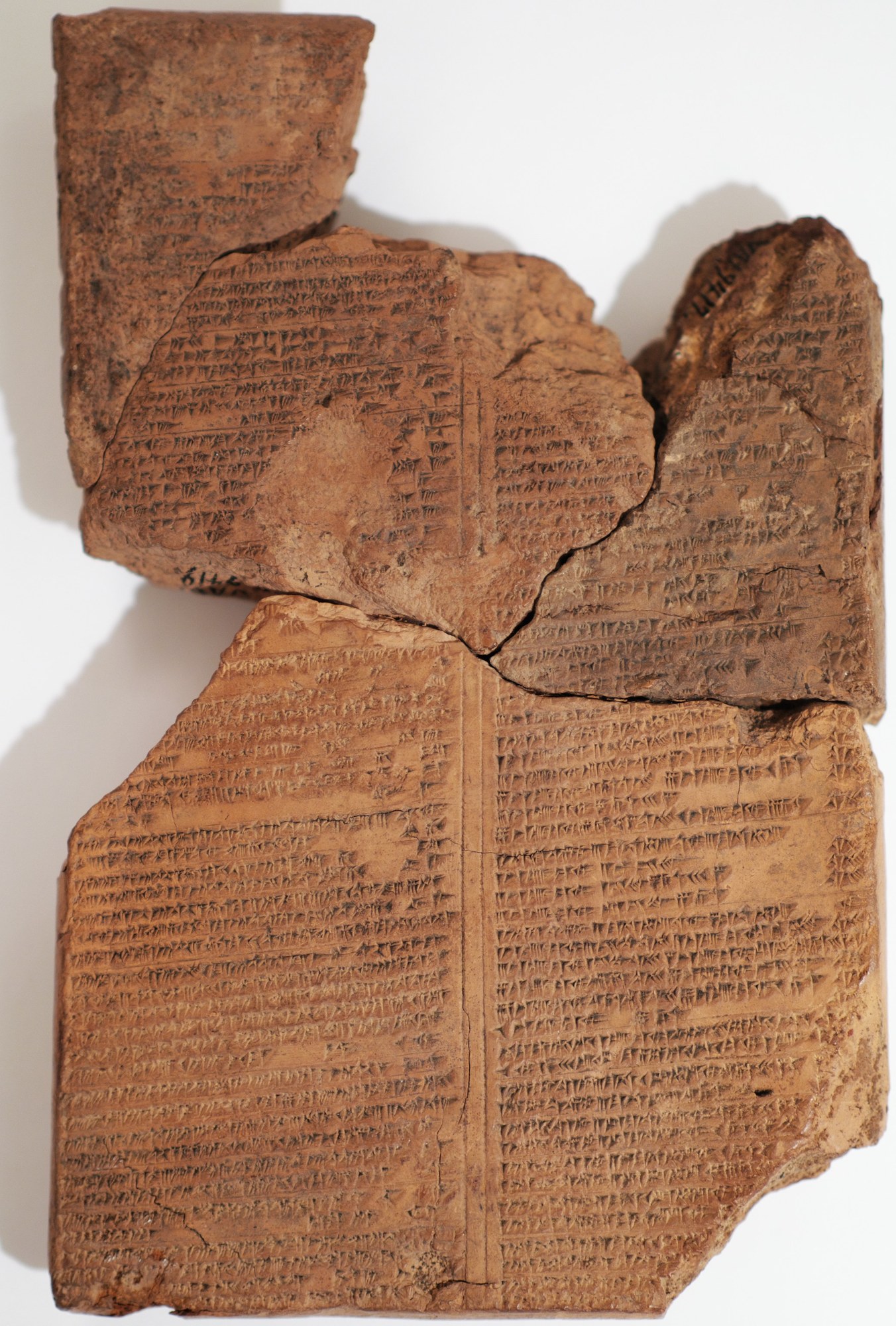
The sea lay dead beneath his foot, and the harder work began. Killing Tiamat had taken an afternoon and a trapped mouthful of wind; ordering what he had made would take founding a system meant to run without him, forever. So the champion turned from the corpse to the empty sky and started to build time. The kind he built was measured time, the sort a watcher on the ground could count: units that repeat, stations that can be named, a year cut into equal pieces and a moon that keeps a schedule. The Babylonian creation epic gives this its own tablet, and it is the most broken tablet of the seven, so much of what follows survives only in scraps. But the spine of it is legible, and it is a strange, bureaucratic kind of grandeur. The god organises the heavens the way a clerk rules a ledger, drawing the lines that make the sky readable.
Stations for the great gods
The first act is administrative. Marduk sets up stations for the great gods and fixes the constellations, the stars, their images, as the stars of the Zodiac.
Then he ordains the year and divides it into sections, and for the twelve months he fixes three stars each. That single line carries the whole calendar, and it is worth being careful about what the poem is actually claiming.
The neat scheme of twelve months with three stars apiece, thirty-six stars in all, is a real Babylonian system, but the epic only gestures at it in one verse. The full apparatus lives elsewhere, in the astronomical tablets, and the two must not be read as one document. The poem asserts that a god decreed the pattern once, at creation. The tablets show the pattern being worked out and corrected over centuries.
He founds one station above the rest as an anchor. NēbiruThe fixed sky-station Marduk founds so the stars keep their bounds; King and standard scholarship read it as the planet Jupiter, though the word carries other technical senses elsewhere., which King and the standard reading take for the planet Jupiter, is set to determine their bounds, that none might err or go astray,
and beside it he posts two more stars as guides: a Bēl near the pole of the sky and an Ea far to the south. The word Bēl here means a star, not the god Marduk who elsewhere wears that title, and a variant tablet reads Anu in place of Ea, which would suit the astronomy just as well.
The heaven he is raising is architecture, a built space with walls. He opens great gates on both sides of the sky, shoots strong bolts on the left and the right, and fixes the zenith in the midst. It is a bolted chamber with a single fixed apex, and Jupiter is the peg that keeps everything else from wandering off its road.
A being of the night
Then comes the part the whole passage has been building toward. Marduk causes the Moon-god to shine forth and entrusts the night to him, appointing him a being of the night, to determine the days.
The Sumerians called this god Nanna and the Akkadians Sîn; the epic simply calls him the luminary and hands him the dark the way a king hands a governor a province. His office is timekeeping.
The sun rules the day and needs no instruction to do it, but the moon is the pointer on the dial, the body whose changing shape lets a person on the ground count where they are in the month. And every month without ceasing,
the poem says, Marduk crowns him. The crescent is a recurring coronation, a fresh horn of light set on the god’s head at the start of each cycle.
The moon’s monthly work-order
What follows is the heart of it, and it reads less like a hymn than like a foreman’s instructions. Marduk speaks aloud, and gives the moon a schedule to keep. At the beginning of the month, when you shine upon the land, grow the horns to mark off six days. On the seventh day, halve the crown: the disc split down the middle, the first-quarter half-light.
On the fourteenth day stand opposite, full-faced across the whole width of the sky from the sun. From there the lines fray into breakage, but the surviving fragments keep the moon in relation to the sun’s path, drawing near it and standing away from it, so that between the two of them the month can be read off the sky by anyone who looks up.
This is the passage this retelling exists for, and it is worth pausing on how odd and how modern it is. The phases of the moon arrive here as decree rather than description: a divine timetable with numbered days, six, then seven, then fourteen, handed down as a command. The waxing crescent becomes an act of obedience, the moon following orders. Measured time in this cosmos is legislated: numbered, decreed, and enforced.
Men on a temple roof
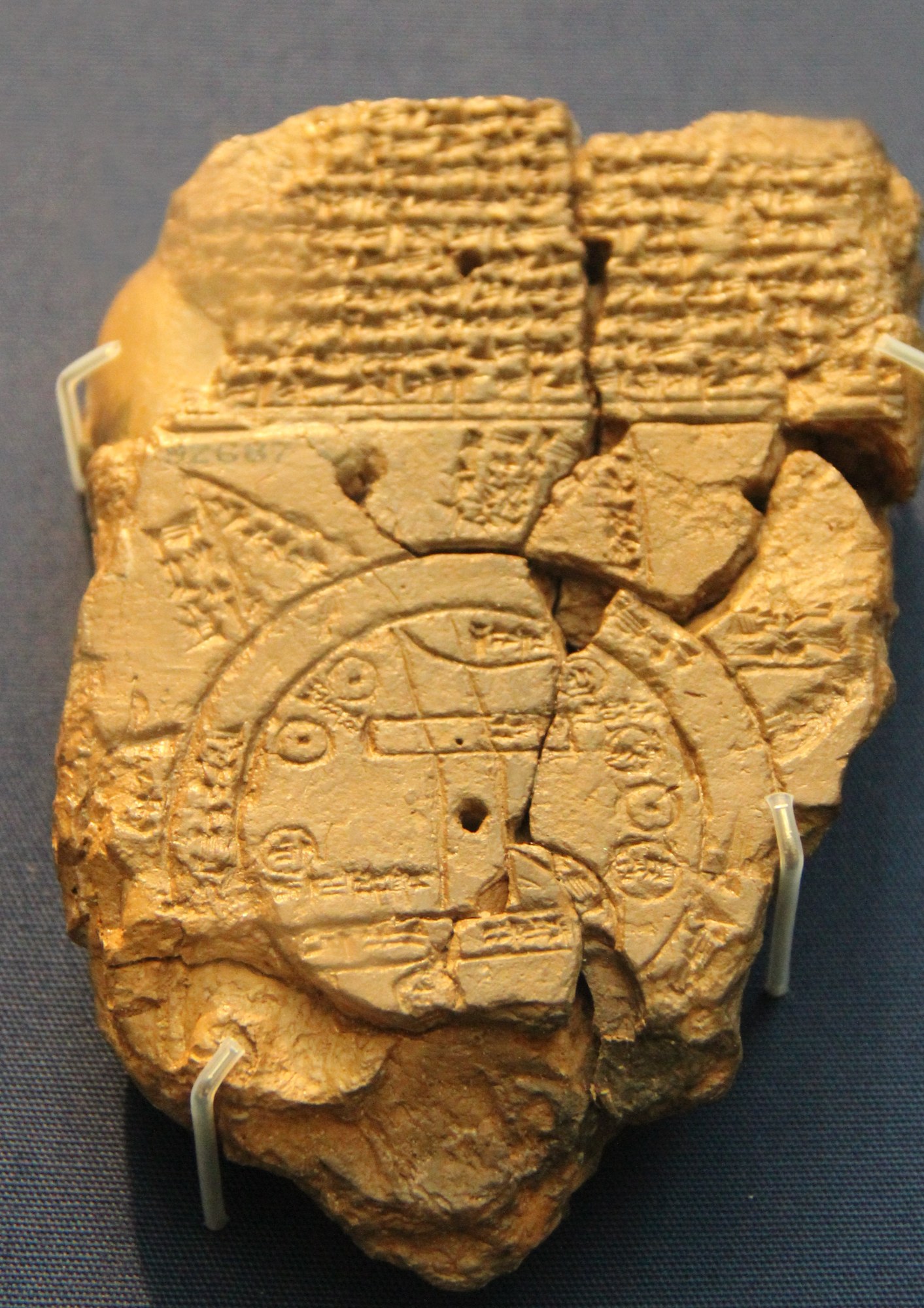
Here the honest dating has to be spoken aloud, because behind the single god issuing a single command stand three separate documents that are not contemporaries, and to let them blur together would be to make a poem pretend it was a science manual. The epic itself was most likely composed around 1125 BCE, though the tablets we read it from are centuries younger, copied down to the Seleucid age.
The three stars each
scheme it alludes to is spelled out in full on Astrolabe B, an actual clay star-calendar written at Assur around 1100 BCE, roughly when the poem was being composed far to the south; that tablet assigns three stars to each month across the three great roads of the sky, the northern way of Enlil, the middle way of Anu, the southern way of Ea, and pairs each month with its stars and rites in a menologyA month-by-month text pairing each month of the year with its stars, its gods and its seasonal rites, turning a star-list into a working calendar.. The mature system arrives later still, in MUL.APIN, compiled about 1000 BCE and copied for the next seven hundred years. So the picture matured across roughly a thousand years between the poem’s composition and its latest copies, and the god who fixed the year
in a single verse stands in for scribes and watchers who kept refining the scheme long after.
It had to be refined because a real year will not obey a poem. MUL.APIN assumes an ideal year of twelve thirty-day months, a tidy 360 days, but the lived Babylonian calendar was luni-solar and drifted, and had to be dragged back into step. The method was to watch for the heliacal risingThe first dawn on which a star reappears just before sunrise after a season of invisibility, the event Babylonian priests watched to keep the calendar true. of a handful of stars, the first dawn each year on which a star climbs back into view just ahead of the sun.
When the Pleiades, or Sirius the Arrow, or Arcturus came up too early or too late against the moon, the priests slipped an extra month into the year to correct it. Tablet II of MUL.APIN lays out the rules for exactly this: intercalationThe insertion of an extra leap-month to stop the lunar year drifting out of step with the sun and stars. keyed to a star’s first reappearance at daybreak. Which means the abstract grandeur of Marduk fixing the stations of heaven came down, on the ground, to men standing on a temple roof in the last dark before sunrise, counting whether Sirius had come up on schedule, and reaching for a leap-month when it had not.
What the god actually made
Strip the astronomy back to the myth and what remains is a claim about order itself. The poem’s Marduk does not make time pass; time was passing before him, in the formless churn of the waters he defeated. What he makes is time that can be counted. He does not create the moon’s light so much as put it on a rota, and in doing so he turns the sky from a spectacle into an instrument.
Everything the later tablets add, the three roads, the leap-months, the watched risings, is machinery bolted onto that first idea: that the heavens were meant to be legible, that a person should be able to look up and know the day. The dead sea underfoot made him king. Dividing the year into months a farmer could plant by, and teaching the moon to keep the count, is what made him a god worth keeping.
He ordained the year and into sections he divided it; for the twelve months he fixed three stars. (Enūma Eliš V.3–4, trans. L. W. King)
- Enūma Eliš, Tablet V 1–26 (Babylonian Epic of Creation) — the founding of measured time, read verbatim in L. W. King, The Seven Tablets of Creation, Vol. I (LondonLuzac & Co., 1902): the stations of the great gods and the constellations fixed
as the stars of the Zodiac
(V 1–2); the year ordained and divided,for the twelve months he fixed three stars
(V 3–4); the founding of Nēbiruto determine their bounds, that none might err or go astray,
with Bēl and Ea (a variant reads Anu) as guides (V 6–8); the great gates, the bolts on left and right, and the zenith fixed in the midst (V 9–11); the Moon-god caused to shine and the night entrusted to him,a being of the night, to determine the days,
crownedevery month without ceasing
(V 12–14); and the spoken charge governing the phases, to grow the horns for six days, halve the crown on the seventh, and stand full and opposite the sun on the fourteenth (V 15–19), fragmentary thereafter (V 20–26). Composed most likely under the Second Dynasty of Isin, c. 1125 BCE; the surviving tablets are Neo-Assyrian, Neo-Babylonian and later copies (7th c. BCE to the Seleucid era). Tablet V is the most broken tablet of the epic; King predates the Ashur tablets recovered 1924–29, so the later lines on night, day, weather and the rivers lie outside his text and are not quoted here. - W. G. Lambert, Babylonian Creation Myths (Winona LakeEisenbrauns, 2013), and P. Talon, The Standard Babylonian Creation Myth Enūma Eliš (SAACT 4, 2005) — the current critical editions, authoritative for the completed Tablet V (the creation of night and day, of cloud, wind, rain and cold, and the making of the Tigris and Euphrates). Cited, not read verbatim; used as summary only. H. L. J. Vanstiphout,
Enūma eliš: Tablet V Lines 15–22,
Journal of Cuneiform Studies 33 (1981) 196–98, a focused study of the moon-phase lines. - Astrolabe B = KAV 218 = VAT 9416 — a Middle Assyrian star-calendar tablet, c. 1100 BCE, from Assur, the type-specimen of the
Three Stars Each
traditionthirty-six stars, three to a month, distributed across the three paths of Enlil, Anu and Ea, with a month-by-month menology. Cuneiform copy published by O. Schroeder, Keilschrifttexte aus Assur verschiedenen Inhalts (KAV), no. 218 (1920); studies by E. Weidner, Handbuch der babylonischen Astronomie (1915) and A. Schott (1934). Object data verified at CDLI P281769. The broad Middle Assyrian date is secure; the tighter c. 1100 BCE / Tiglath-Pileser I attribution is a scholarly refinement within that window. - MUL.APIN — the standard Babylonian astronomical compendium, compiled c. 1000 BCE (earliest surviving copy 686 BCE, latest c. 300 BCE)the three paths of the sky (Enlil, Anu, Ea), the ideal 360-day year of twelve thirty-day months, the path of the moon, and, in Tablet II, the intercalation rules keyed to the heliacal risings of the Pleiades, Sirius and Arcturus. Standard edition H. Hunger & D. Pingree, MUL.APIN: An Astronomical Compendium in Cuneiform (1989); also Hunger & Steele (2020) and Watson & Horowitz, Writing Science before the Greeks (2011). Structural facts here follow the modern synthesis; not read in the primary editions.
- Berossus, Babyloniaca (3rd c. BCE), via Alexander Polyhistor and Eusebius, accessible in Cory, Ancient Fragments — a late Greek paraphrase noting that Bēl
formed the stars, and the Sun and the Moon, together with the five planets,
a Hellenistic compression of the creation-of-luminaries narrated in Tablet V, some eight centuries after the poem’s composition. Cited, not read in full.