The gods were digging, and they were weeping over it. Before there were people in the world there was still work to be done in it, and the work fell to the junior gods: they dug the canals, they piled up the silt on the banks, they dredged the clay of the watercourses, and they complained bitterly about this life. Their tears did not reach the one god who might have helped them, because he was asleep. Enki, the god of wisdom, lay in the deep beneath the earth, in the subterranean water whose depths no other god knows, and he did not wake up. So someone had to go down and fetch him. The one who could was the oldest mother of all, and the Sumerian poem that tells this calls her Namma, the primeval mother who gave birth to the senior gods. She took the tears of the gods down to her sleeping son and shook him by the shoulder.
A mother in the deep water
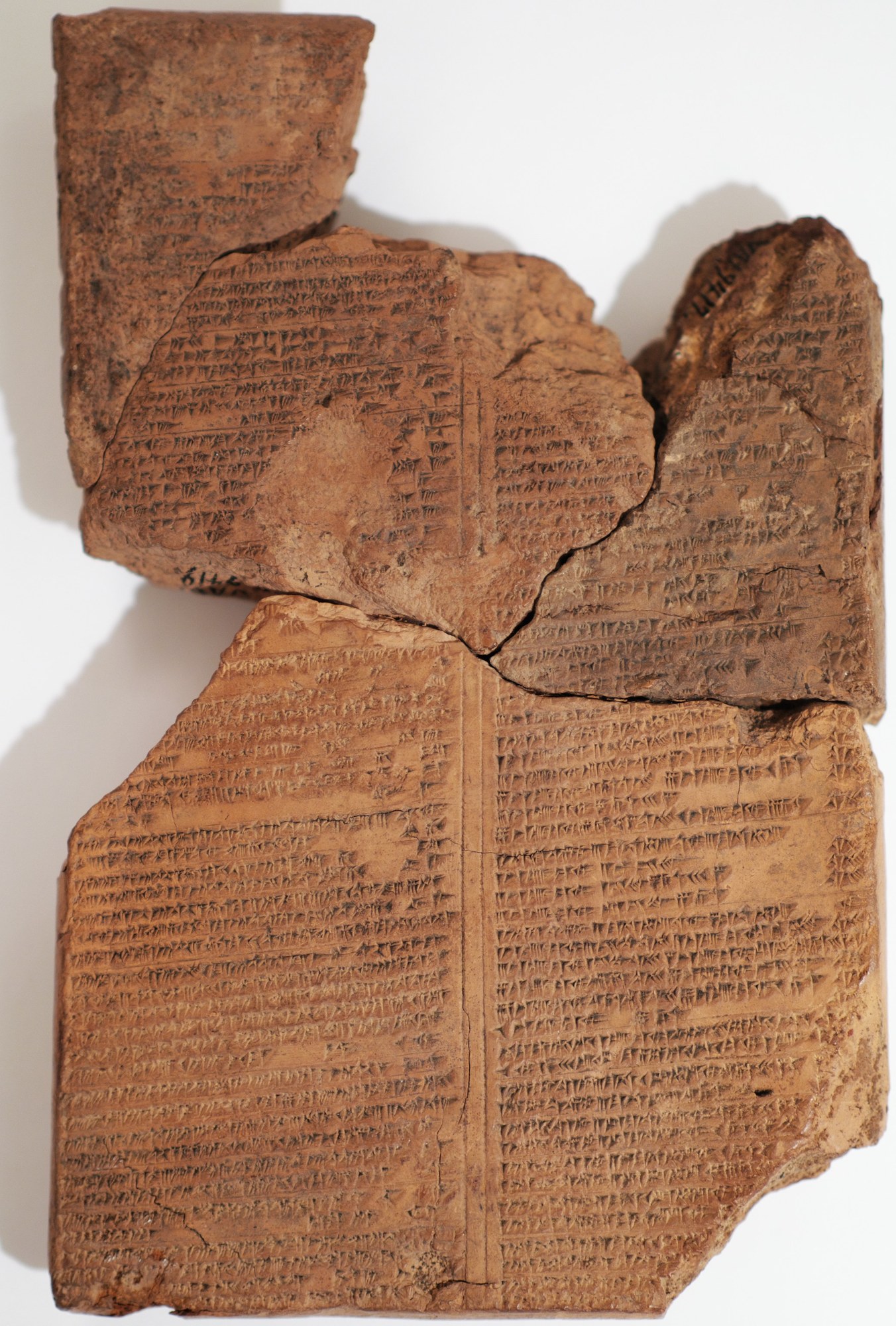
This is the fullest scene of Nammu that any single ancient text preserves, and it is worth being clear about what it does and does not say. It comes from a poem about Enki and the birth-goddess Ninmah'August Lady', a name of the Sumerian mother-goddess; here Nammu's assistant at the shaping of humankind, who afterwards contends with Enki., who quarrel in it over the making of humankind, and which is titled after them: Enki and Ninmah. Its surviving copies are Old Babylonian, written between roughly 1900 and 1600 BCE, and a bilingual Sumerian-Akkadian version was still being copied for the library of the Assyrian king Ashurbanipal in the seventh century BCE, more than a thousand years later.
In it Nammu is unambiguously two things: the mother of the wisdom-god Enki, and the maker, with her own hands, of the human race. She is not, in this poem, called the sea, and she is not shown giving birth to the sky or the earth. Hold on to that, because the title above this article promises rather more than one poem delivers, and the honest version of the story is the more interesting one.
What the poem shows is a mother waking a son. She reaches Enki where no other god can reach him, in the deep engurThe subterranean watery deep, a synonym of the abzu, where the wisdom-god Enki lies asleep and which no other god can reach; the same sign writes Nammu's own name., and her words are a mother’s words with a cosmos riding on them: wake up from your bed, apply the skill of your wisdom, and make a substitute for the gods so they can be freed from their toil. He does not rise to fight anything. He rises to think. The Sumerians imagined the beginning of humankind as a labour-relations problem solved by a clever son at his mother’s insistence, and the solution is made of mud.
Clay from the top of the deep
Enki tells his mother where to dig. She is to knead clay from the top of the abzuThe fresh-water deep beneath the earth, home of the wisdom-god Enki; the clay for the first humans is pinched from its surface., the fresh-water deep, and bring a form into being from it; a company of birth-goddesses will nip off the clay as she works, and Ninmah will stand over her to help.
Then Nammu gives birth. The first humans are pinched from riverbed clay the way a potter pinches a pot, and they are made for a reason the poem states without any softening: to carry the baskets, to bear the toil of the canals, so that the gods who had been weeping can rest. The image is precise and physical. This is not a goddess breathing life across the void. It is a goddess with her arms in the wet clay of the marsh, shaping a workforce.
There is a fine detail buried in the name of that clay. The word for the deep Nammu draws from, and for the deep where Enki sleeps, is written with the same single cuneiform sign that writes her own name. Goddess, son’s dwelling, and the engendering mud are one glyph. Yet the tradition does not simply collapse her into the water: she can be called the maker of the deep as well as its inhabitant, which means the Sumerians distinguished, grammatically at least, between the power and the water it works in. She is not quite the water. She is the thing in it that makes.
The feast, and the boast that follows
The making of humankind is not the poem’s ending. Enki holds a feast for his mother Namma and for Ninmah, and An, Enlil and Enki himself sit at it; they drink beer, their hearts grow elated, and it is here, warm with drink, that Ninmah makes the boast that turns the poem into a contest. She can decree the fate of a human body, she says, make it good or make it bad as she pleases.
What follows is a wager over deliberately defective people, a divine drinking-game with living stakes, and it belongs to Enki and Ninmah more than to Nammu. But it is worth noting where she sits in it: at the head of the table, the mother in whose honour the feast is held, the one without whom none of the guests, or the servants they are toasting, would exist. After the clay is shaped, she recedes. The Sumerian imagination gives its creatrix the first act and then lets the argument pass to the young.
The sea that the sources do not quite say
Now the harder question, the one the title raises and a single poem cannot answer. Was Nammu the primeval sea who bore heaven and earth? The phrase is a modern synthesis, assembled by scholars from scattered evidence, and its three parts come from three different places and three different centuries. Say that plainly to a reader and you have told them something true; assert it as a single ancient belief and you have flattened two thousand years of clay into one sentence.
Take the sea first. The popular handbook picture, owed largely to the mid-century Sumerologist Samuel Noah Kramer, makes Nammu the primeval saltwater ocean out of which everything came. But Thorkild Jacobsen, whose 1976 study first named this goddess for many English readers, did not call her the sea at all; he read her as the power in the riverbed to produce water, a personification of fresh subterranean flow, not the ocean.
Wilfred Lambert put it more bluntly still in 2013: no explicit references to Nammu being identical with the sea are known. More recent work leans towards groundwater, and treats even the fresh-versus-salt question as open. Nammu the sea
is a reading, a good and defensible one, but a reading, and it should be offered to the reader as such rather than smuggled in as fact.
Then the birth of heaven and earth. The epithet mother who gave birth to heaven and earth
is genuinely attested, and the tradition that made her the mother of An (Heaven) and Ki (Earth) is real. But it turns up in god-lists and lexical material, and it is dated by the specialists from the Old Babylonian period onwards, which is to say from the same later end of the timeline as the poem, not from the deepest Sumerian past. And here the dating matters more than anywhere else on this page.
The earliest substantial text that names Nammu is a royal inscription of Lugal-kisalsi, around 2400 BCE, and there she is not the mother of heaven and earth but the wife of An. The bilingual copy of her creation poem in Ashurbanipal’s library is roughly 1,750 years younger than that inscription, a gap as wide as the one between us and the fall of Rome. The cosmic mother who bore the universe
theology sits at the late end of that span. To say the ancient Sumerians believed Nammu bore the cosmos
is to attach a claim to a date it does not have.
Not the Tiamat of the Babylonians
One last correction keeps the picture honest, because the internet has a tidy version of this goddess that the tablets do not support. She is often folded into Tiamat, the saltwater chaos-mother of the Babylonian epic Enūma Eliš, slain and split to make the sky and the ground. It is an easy slide: both are watery, both are primeval, both are mothers of gods, and a single late Mesopotamian text does equate Nammu with the deep.
But Lambert judged that equation most likely borrowed from Enūma Eliš rather than an old independent tradition, and there is no evidence anywhere that Nammu was ever a monster, an enemy, or a slain thing. Her son does not kill her; he wakes to her. She is not cut in two to build the world; she kneels in the mud and shapes it. The Sumerian creatrix and the Babylonian chaos-dragon are the closest of parallels precisely because they are not the same figure, and the retelling that makes them one loses the very thing that is distinctive about the older goddess: she creates by mothering, not by dying.
Namma, the primeval mother who gave birth to the senior gods, took the tears of the gods to the one who lay sleeping, to the one who did not wake up from his bed, to her son. (Enki and Ninmah, ETCSL 1.1.2, ll. 16–20; author’s rendering from the ETCSL composite translation)
- Enki and Ninmah, prologue and the creation of humankind, ETCSL 1.1.2: the fullest surviving narrative of Nammu — named
the primeval mother who gave birth to the senior gods,
mother of Enki, who carries the weeping gods’ tears down to her sleeping son in the deep engur, rouses him, kneads humankind from the clay of the abzu at his instruction (with Ninmah and the birth-goddesses assisting) and gives birth, after which the creation closes in a drinking-feast and the boast-contest between Ninmah and Enki. Old Babylonian Sumerian composition, c. 1900–1600 BCE (possibly reflecting an Ur III tradition, c. 2100 BCE); a bilingual Sumero-Akkadian copy survives in the Library of Ashurbanipal, 7th c. BCE. Quotations here are the author’s renderings from the ETCSL composite English translation (J. A. Black, G. Cunningham, E. Robson & G. Zólyomi), Oxford. URLshttps://etcsl.orinst.ox.ac.uk/cgi-bin/etcsl.cgi?text=t.1.1.2 and https://etcsl.orinst.ox.ac.uk/section1/tr112.htm. - God-list An = Anum, Tablet I: a 1st-millennium BCE compilation with older roots, attesting Nammu as the mother of Enki and preserving her epithets. Standard editionR. L. Litke, A Reconstruction of the Assyro-Babylonian God-Lists An:dAnum and An:Anu ša amēli (1998). Cited via the reference apparatus, not collated in the cuneiform edition.
- God-list TCL XV 10: an Old Babylonian lexical list attesting the epithet
mother who gave birth to heaven and earth
(dama-tu-an-ki). Cited via Asher-Greve & Westenholz 2013 and Lisman 2013; not read in the primary edition. Kept distinct from An = Anum above. - Lugal-kisalsi royal inscription (c. 2400–2250 BCE, Early Dynastic; king of Uruk and Ur):
For Namma, the wife of An, Lugal-kisalsi built the temple of Namma.
The earliest substantial attestation, and the one text in which Nammu is An’s wife rather than his mother. Published by Lapérouse 2003; cited via the reference apparatus. - zame hymns (Early Dynastic, c. 2600–2350 BCE, from Abu Salabikh): among the earliest attestations of the goddess, assigning her a settlement whose reading is uncertain. EditionM. Krebernik,
Zame-Hymnen,
Reallexikon der Assyriologie (2016). Cited, not read. - Secondary scholarship (modern, labelled as such): T. Jacobsen, The Treasures of Darkness (Yale, 1976), ch. 3, reading Nammu as
the power in the riverbed to produce water
(fresh water, not the sea); W. G. Lambert, Babylonian Creation Myths (2013),no explicit references to Nammu being identical with the sea are known
(p. 238) and no traditional consort (p. 446); J. Lisman, Cosmogony, Theogony and Anthropogeny in Sumerian Texts (2013), dating the heaven-and-earth motherhoodfrom the Old Babylonian period onwards
; M. Ceccarelli, Altorientalische Forschungen 44/1 (2017), suggesting groundwater and denying a close Nammu–Tiamat link; F. A. M. Wiggermann,Nammu,
RlA 9 (1998); J. M. Asher-Greve & J. G. Westenholz, Goddesses in Context (2013), on the epithets and a parthenogenesis reading.