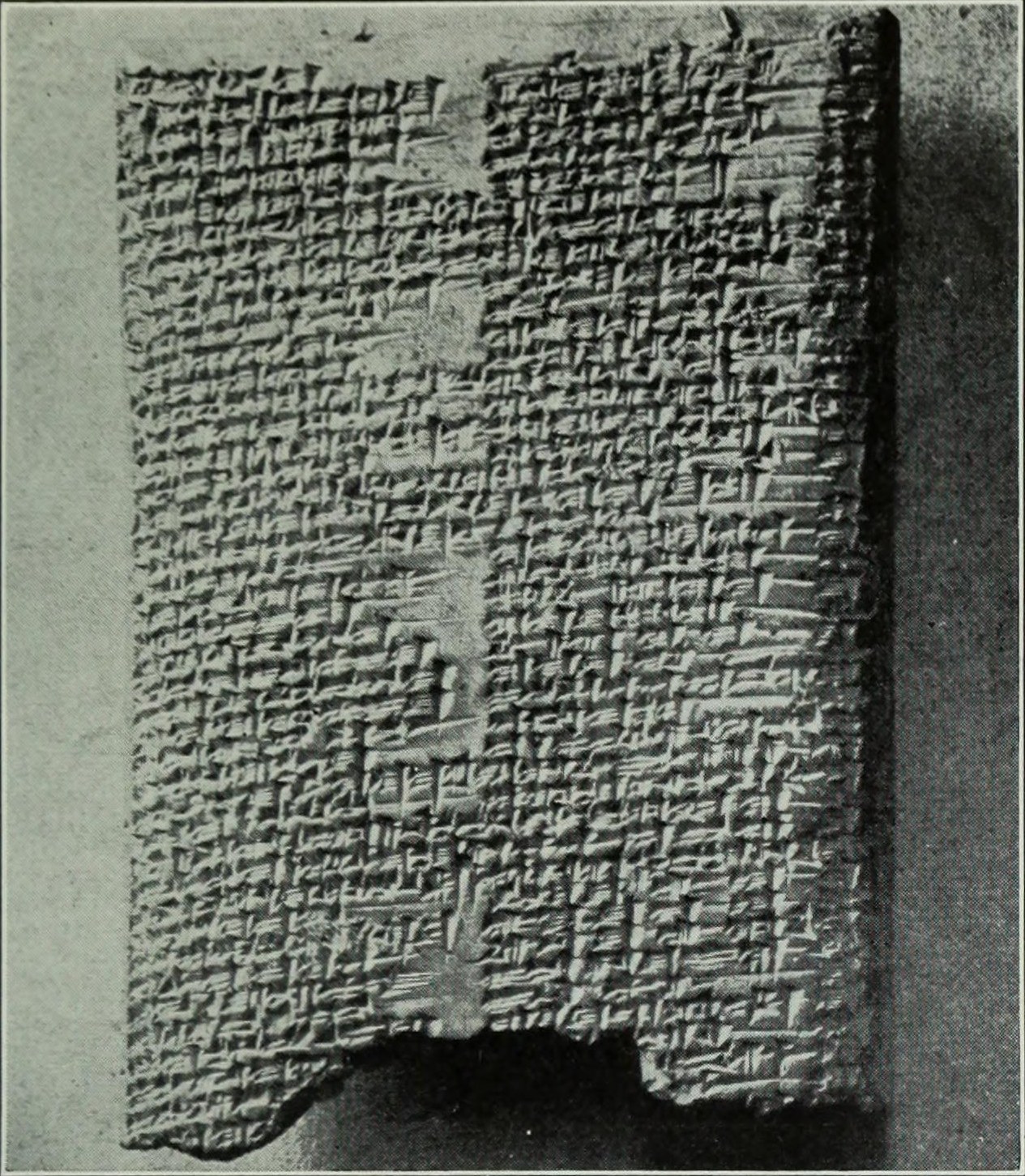
It was, of all things, a clay tablet. Not a crown, not a throne, not a weapon: a slab of river mud pressed with cuneiform wedges and rolled over with a cylinder seal, the same technology that notarised a loan of barley or the sale of a field. Yet in the myths of Mesopotamia this one document carried the entire authority of heaven. Whoever held it held the right to decree the fate of everything that existed, the office of ruling the universe itself, made portable, sealed, and small enough to lay against a chest. The gods called it the Tablet of Destinies, and the whole political drama of the tradition can be read as a single question: who has it now.
A writ you wear over the heart
What the Tablet confers is the right to fix šīmātuThe fixed destinies of Akkadian myth: the fates and portions decreed for gods, kings and things, whose ordering is the supreme act of rule., the destinies, and in Mesopotamian thought no god does anything more consequential. To decree fate is to say what shall be and have it be so. Individual gods are strong; only the holder of this object has the last word.
The texts mark the moment it changes hands with a gesture that never varies. The Tablet is not carried in a pocket or locked in a treasury. It is laid on the breast of its owner, worn over the heart like a crown one wears on the inside, and once it lies there the same guarantee follows: the holder’s command shall not be without avail, and the word of his mouth shall be established. That formula is the whole of it. The Tablet is the physical correlate of a word that cannot be unsaid.
The authority it carries even has a name of its own. In Enūma Eliš the power the Tablet transmits is called the power of Anu, the sky-god at the nominal head of the pantheon: Anūtu'Anu-ship': the sovereign authority named after the sky-god Anu, which the Tablet is said to carry to whoever holds it., Anu-ship,
being-Anu itself. When the Tablet is handed to a new owner, the text says he has received the power of Anu
and can now decree the fate for the gods.
The abstract noun for supreme rule in this world is simply the sky-god’s name turned into a condition you can be granted. To hold the Tablet is to be, for as long as you hold it, Anu.
Scholars reach for the language of the law-court, and the reach is apt. A. R. George, in the study that put the object on modern footing, reads the Tablet as a sealed legal writ, a notarised charter of title whose possession simply is the legitimate right to rule. The cylinder seals impressed on its clay are not decoration; they are the ancient equivalent of a registered signature, the mark that makes a document binding.
On a second, more dramatic reading its power is magical rather than merely constitutional: it lets the holder wind a thing back to what it was made from, to transform present circumstances back into their original state,
the interpretation summoned to explain how, in one myth, the Tablet’s holder can unmake an arrow in mid-flight. Both are modern glosses laid over texts that show the effect without defining the mechanism. What the tablets say is only what the object does: its holder speaks, and the world obeys.
The switch that keeps the lights on
The clearest proof of what the Tablet is comes from what happens when it goes missing. In the tradition of the storm-bird Anzu the Tablet belongs to Enlil, the executive god of the older Sumerian order, and embodies what those texts call his Enlil-power. When it is stolen from him the world does not merely change management; it stops. The rites of the gods are abandoned, radiance fades, silence falls over the ordered world, because the one object that runs the machinery of destiny has left the hands that ran it.
(The theft and the long hunt that recovers it belong to their own tellings, and this is not the place to walk through them.) The point that concerns the object itself is stark: without the Tablet in its rightful lap, fate is not reassigned, it is switched off. The cosmos does not hum along under new ownership. It halts and waits. The object is a portable throne, and every myth that features it is, at bottom, a myth about moving it from hand to hand.
Down a chain of three holders
Nowhere is the chain of custody laid out as deliberately as in Enūma Eliš, the Babylonian epic of creation, where the Tablet passes down three owners in three moves and the poem repeats each transfer until no reader can forget who is holding it.
It begins with the primeval sea. Tiamat, raising up her consort KinguTiamat's consort and war-leader in Enūma Eliš, raised to command and given the Tablet, then defeated and stripped of it by Marduk. as the war-leader of her host, installs him in office with the object: she gives him the Tablet, and on his breast she lays it, sealing his command so that it cannot be gainsaid. The gesture is the whole coronation. So equipped, Kingu is exalted,
and, having received the power of Anu, decreed the fate for the gods.
A creature who was nothing is now, by virtue of the writ on his chest, the sovereign of destinies. The poem is so anxious about this that it stages the same transfer three more times in retrospect, once inside an elder god’s lament and again in the summons to the war-council, drumming the fact home: the enemy holds the Tablet, and while he holds it his word is law.
Then the writ is taken by force. When the young storm-god Marduk defeats Kingu in the war that the epic is built around, his first act on the conquered field is to repossess the document. He took from him the Tablets of Destiny that were not rightly his, he sealed them with a seal, and in his own breast he laid them.
Every element of that sentence matters. He seals it, re-registering the charter under a new owner exactly as a notary re-seals a transferred deed.
He lays it on his own breast, repeating precisely the motion by which Tiamat had installed Kingu, so the object is re-authorised rather than merely seized. And the poem frames the whole war in a single relative clause: the Tablet was one that were not rightly his.
At a stroke the combat becomes not conquest but restitution, the recovery of a usurped title. A stolen writ is returned to legitimate hands, and the sealing is the proof of legitimacy.
The last move closes the circle, and it is the one place the reader must be told exactly how the tradition reaches us. In the completed epic Marduk, having ordered the heavens and set the stars in their stations, presents the Tablet to Anu, lodging supreme authority with the sky-god whose name it had borne all along. The Tablet is Anu-ship made portable, and it comes home. But this final gift is not in the public-domain text most readers meet.
The oldest full English rendering, L. W. King’s of 1902, worked from a Fifth Tablet too broken to carry the passage; his manuscript trails off around the naming of Marduk’s bow among the stars. The Marduk-to-Anu handover survives only in fragments recovered later and printed in modern critical editions. It is entirely real and standard scholarship, but it is a reconstruction, and honesty requires saying so rather than quoting a line the familiar old translation never contained.
Whose tablet, and how old
For all the neat chain in Enūma Eliš, the tradition does not agree on who owns the Tablet to begin with, and the disagreement is a reminder that these texts stand centuries and different theologies apart. In the Anzu poems and in Enūma Eliš the writ is Enlil’s, the property of the old storm-headed order. But in the Sumerian poem Ninurta and the Turtle it belongs instead to Enki, the god of wisdom and the freshwater deep, and resides with him in the Abzu. The object’s home owner
shifts with the theology of the text that holds it.
And the object is far older than any single story of it. The Sumerian name, dub nam-tar-ra, the tablet of decreeing fates,
predates the Akkadian ṭuppi šīmāti of the epics, so the idea of a fate-fixing writ was already old when the surviving narratives were composed. Those narratives are themselves strung across a long span.
Enūma Eliš was composed around 1125 BCE, in the reign of Nebuchadnezzar I, but the copies we read were made at Nineveh in the seventh century BCE, four to five hundred years later; the Anzu tradition reaches from an Old Babylonian recension of roughly 1800 to 1600 BCE down to its first-millennium form, some two thousand years of retelling. To treat the Sumerian tablet of Enki, the Enlil-power stolen by Anzu, and the writ Marduk seals into Babylonian kingship as one continuously attested object would flatten a span longer than the one separating Homer from the fall of Rome. They are versions of one idea, held by different gods in different centuries.
That the idea outlived the myths is a matter of record. The Tablet of Destinies was concrete enough to be named in a real royal inscription: a text of the Assyrian king Sennacherib, who reigned around the turn of the seventh century BCE, refers to it, on a tablet now in the British Museum.
Even a king could invoke the writ of fate as though it were a document one might actually hold, exactly as the myths had always described it. The most powerful object in the Mesopotamian cosmos was never a sword or a mountain. It was a piece of sealed clay, and its whole terrible authority lay in the fact that whatever was written on it, and whoever held it, came true.
He took from him the Tablets of Destiny that were not rightly his, he sealed them with a seal and in his own breast he laid them. (Enūma Eliš IV.121–122, tr. L. W. King)
- Enūma Eliš (Babylonian Epic of Creation) — Tablet I 137–138 (Tiamat lays the Tablet on Kingu’s breast,
Thy command shall not be without avail, and the word of thy mouth shall be established
; = modern I 155–158); II 43–46 (Kinguhaving received the power of Anu, decreed the fate for the gods
); III 47 and 105 (the transfer re-told in the assembly summons); IV 121–122 (Marduktook from him the Tablets of Destiny that were not rightly his, he sealed them with a seal and in his own breast he laid them
). Read verbatim in L. W. King, The Seven Tablets of Creation, Vol. I (LondonLuzac, 1902), public-domain full text. Composed c. 1125 BCE (Second Dynasty of Isin, reign of Nebuchadnezzar I); the manuscripts quoted are the Nineveh copies from the Library of Ashurbanipal (7th c. BCE), roughly four to five centuries later than the composition. King prints the pluralTablets of Destiny
;Tablet of Destinies
(singular) is the standard modern rendering of the single Akkadian object ṭuppi šīmāti and is used throughout above. - Enūma Eliš V 69–70 (Marduk presents the Tablet to Anu) — not present in King 1902, whose Fifth Tablet is fragmentary. Attested only in the modern reconstructed text and taken here from the in-copyright critical editions W. G. Lambert, Babylonian Creation Myths (Eisenbrauns, 2013); B. R. Foster, Before the Muses, 3rd ed. (2005); Ph. Talon, Enūma Eliš, SAACT 4 (2005). Summarised above as the settled scholarly reading, not quoted from King.
- The Myth of Anzu (Standard Babylonian recension; 1st-millennium BCE, Library of Ashurbanipal)the Tablet as Enlil’s
Enlil-power
and as the switch of ordered fate — with it gone,rites were abandoned… radiance faded, silence reigned.
Read via S. Dalley, Myths from Mesopotamia, Oxford UP, 1989; rev. 2000, pp. 203–227 (in copyright; paraphrased here, the theft-and-recovery narrative told in full in the sibling posts). Critical edition: Amar Annus, The Standard Babylonian Epic of Anzu, SAACT 3 (2001). The Old Babylonian recension (Susa witness, c. 1800–1600 BCE) names Ningirsu, not Ninurta, as the recoverer. - Ninurta and the Turtle, ETCSL 1.6.3 (Sumerian; tablet UET 6/1 2)the variant in which the Tablet (Sumerian dub nam-tar-ra,
the tablet of decreeing fates
) belongs to Enki and resides in the Abzu; the source of the object’s old Sumerian name. Cited via the reference apparatus (ETCSL 1.6.3; Black & Green 1992, p. 179), not read verbatim this session. - A. R. George,
Sennacherib and the Tablet of Destinies,
Iraq 48 (1986) 133–146the definitive study of what the Tablet is — a sealed clay legal writ conferring supreme authority, its power read as the ability totransform present circumstances back into their original state
— and of its Neo-Assyrian afterlife, named in a royal inscription of Sennacherib (r. 705–681 BCE) on tablet K 6177 + 8869 (British Museum). With Karen Sonik,The Tablet of Destinies and the transmission of power in Enūma eliš,
in Organization, Representation, and Symbols of Power in the Ancient Near East (Eisenbrauns, 2012), pp. 387–396, on the Tablet as the token whose transfer is the transfer of cosmic power; and Black & Green, Gods, Demons and Symbols of Ancient Mesopotamia (1992), p. 173. Modern scholarship, not ancient sources.