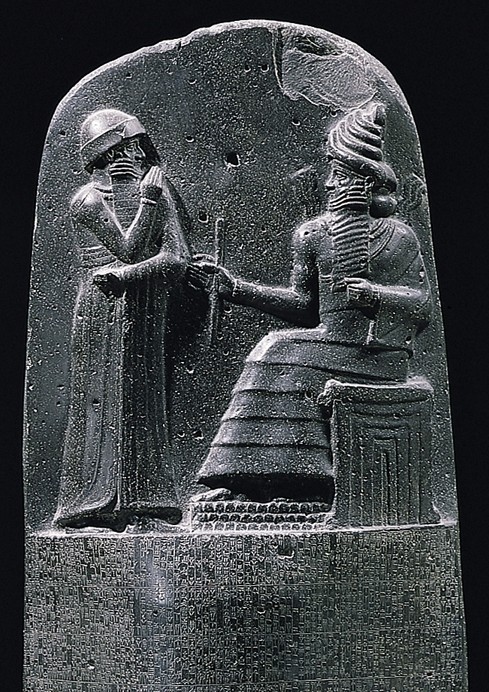
On the fourth night of the first month of spring, in a chamber of the great temple at Babylon, the high priest lifts his hand and begins to recite a poem from its first line to its last. The poem tells how the world was made, and while it is chanted two objects in the sanctuary are kept covered: the crown of the sky-god Anu and the throne of Enlil, veiled and empty for as long as the recitation lasts. What is being read aloud is an account of a council of gods who once decided whose word would run the universe. The Babylonians did not treat this as a story about the distant past. They performed it, every year, because in their theology a fate is not a thing that simply happens to you. It is a thing that is spoken, in an assembly, by whoever holds the authority to make a word stick.
When a word became as fixed as the sky
The poem is the Enūma Eliš, the Babylonian Epic of Creation, and its heart is not the famous battle that splits a sea-goddess into sky and earth. Its heart is a meeting. Before the young god Marduk will go out to fight the forces of chaos, he sets a condition: the other gods must convene, name him their champion, and grant him the power to fix destinies by speech alone.
They do. Seated in the seat of kingship, Marduk is told what his new office means. The words thou utterest become Anum,
they say, making his speech as fixed and permanent as the sky. That which goeth forth from thy mouth shall be established, against thy utterance shall be no appeal.
To prove the office is real, the assembly stages a test. A garment is laid among them, and Marduk is challenged: speak, and the cloak shall vanish; speak again, and it shall return unharmed. He speaks. The cloak disappears and comes back whole, and the gods cry out, Marduk is King,
and load him with sceptre, throne and the symbols of rule. Here is the theological core of the whole tradition in a single scene. A destiny is decreed by the council, then verified by the plain fact that the god’s word does what it says.
The tablet you can fasten to a head
That power has a physical form. The right to fix destinies is not only an attribute of the mightiest god; it is an object, and it can change hands. It is the Tablet of Destinies, and before the war the chaos-mother Tiamat had fastened it to the head of her champion Kingu with words that echo Marduk’s own commission: what goeth forth from thy mouth shall be established.
Whoever wears the tablet fixes the fates. When Marduk wins, the first thing he does is take it: he took from him the Tablet of Destinies, which should never have been his.
Fate-decreeing authority is portable, worn and seized and reclaimed exactly like a crown, passing to whoever now has the standing to speak with it.
The decreeing does not end with the war. After the cosmos is built and Babylon founded, the assembly reconvenes, and this time the fate it fixes is Marduk’s own. In EsagilaThe great temple of Marduk at Babylon, blessed at the New Year as the "image of heaven and earth" and the seat of the god before whom the king is humbled., the temple named in the poem, the gods pronounce his rank and his name one by one, every one of them
pronouncing his name in the sanctuary.
Then comes the long climax, the proclaiming of his names not once but fifty times, until his very identity has been decreed by the full council of heaven.
The epic is emphatic that this fixing is a spoken, repeatable act. Its closing lines turn the fifty names into a liturgy to be recited down the generations, and seal the whole with the tradition’s bedrock conviction, His word is true, his command altereth not.
That single line is why the Akitu exists. If a fixed fate is a word that never alters, then re-speaking the word is how you keep it in force.
The night the epic is spoken into the rite
Which brings us back to the priest with his raised hand. The link between the myth of decreed destinies and the New Year festival is written into the liturgy itself. On the fourth of Nisan, after a small evening meal, the urigalluThe high priest of Esagila, the ritual actor who recites the epic to Bēl, strips and restores the king's regalia, strikes his cheek and reads the tear-omen. recites the whole Enūma Eliš to Bēl"The Lord", the title under which Marduk is addressed in the ritual; the god to whom the whole Creation Epic is recited on the fourth night of the New Year., du commencement jusqu’à la fin
, from beginning to end.
For as long as it lasts, the face of the tiara of Anu and the throne of Enlil remain covered.
The two great elder gods are veiled while the poem plays out; only when the account of Marduk’s supremacy has been spoken through to its close is the sanctuary whole again. Just before, the priest has gone into the great court, faced north, and blessed the temple three times: Astre Ikû, Ésagil, image du ciel et de la terre
, the star of Babylon, Esagila, image of heaven and earth.
Here the honest reader needs the arithmetic, because it is tempting to feel that the myth and the rite are one seamless witness. They are not. The festival is old, descended from a Sumerian á-ki-ti kept at Ur in the twenty-first century BCE, roughly a thousand years before the epic recited at it was even composed.
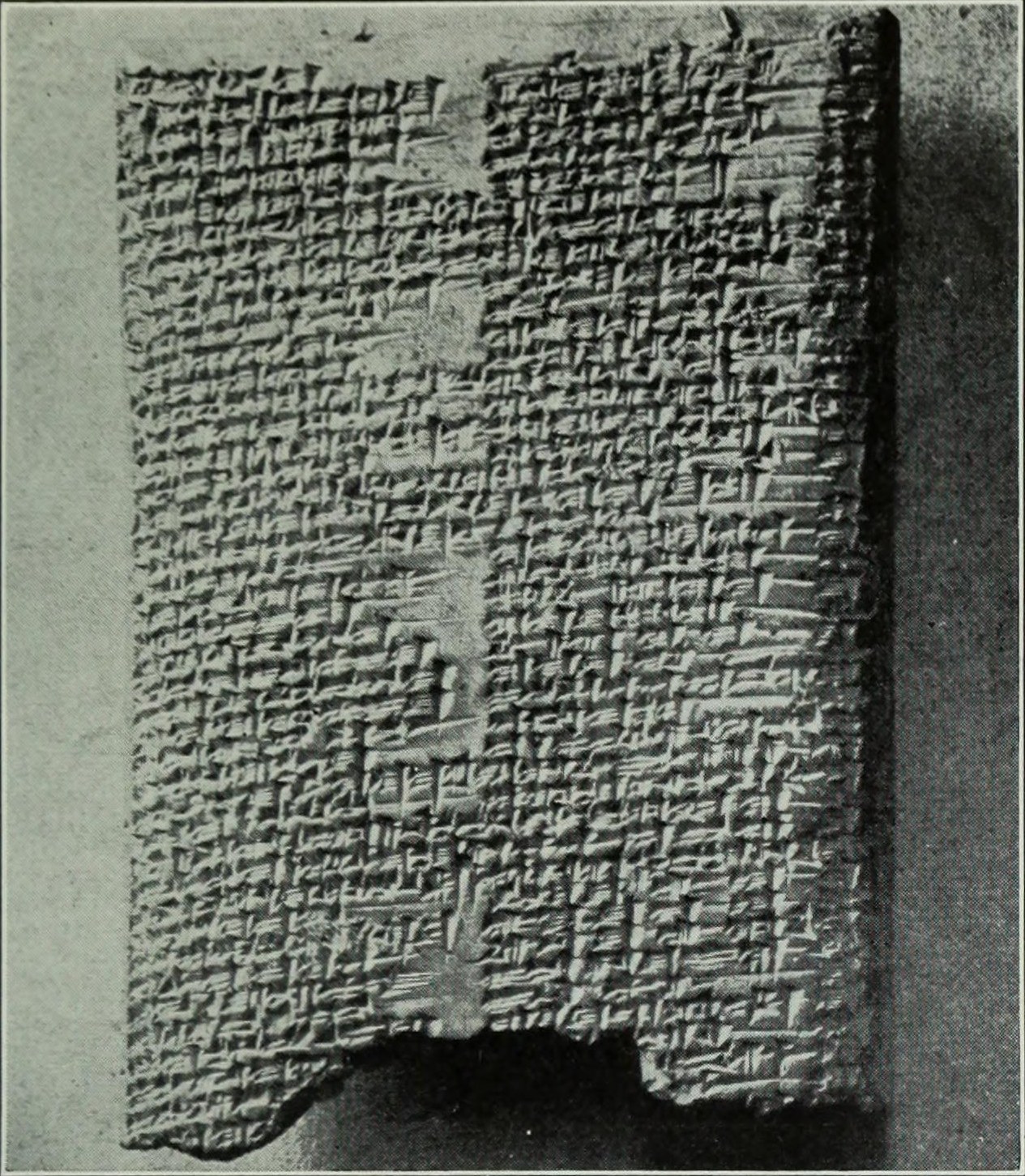
The epic itself dates to around 1200 to 1100 BCE. And the tablet that tells us how the Babylonians actually performed the New Year is a Seleucid-era copy from the third or second century BCE, whose own editor said it was fairly pointless to try to fix when the underlying text was first drafted. So the surviving ritual manuscript stands nearly two thousand years from the Sumerian root, and a thousand to fifteen hundred years younger than the poem it has the priest recite. When we say the Akitu re-enacts the Creation, we describe something documented for the late period and inferred backward into the dark.
A slap, a lie, and a tear
The rite’s most extraordinary scene is what it does to the king. The reigning monarch, the most powerful man in the land, is led into the sanctuary, and the urigallu takes from his hands le sceptre, le cercle, la harpe
and his royal tiara, and lays them on a seat before the god. Then, stripped of every mark of office, the king is struck: the priest frappera la joue du roi
, strikes the king’s cheek, pulls his ears, and forces him to his knees.
Kneeling, he must recite a confession of everything he has not done. I have not sinned, O lord of the lands… I have not destroyed Babylon… I have not struck the cheek of a subject.
The reversal is pointed: the king swears he has never struck a subject’s cheek in the very breath after his own has been struck.
The priest answers in the god’s name with a blessing, promising that Bēl will enlarge the king’s sovereignty and cast down his enemies, and the regalia are restored. But the fixing of the king’s fate comes from a second blow. The priest strikes the cheek again, and this time the ritual watches for tears: si ses larmes viennent, Bel est bien disposé; si ses larmes ne viennent pas, Bel est en colère
, if his tears come, Bēl is well disposed; if they do not, Bēl is angry, and an enemy will rise and bring about his fall.
This is the human counterpart of the whole myth. Where the poem has an assembly of gods decree a destiny by speech, the sanctuary has the king’s fate for the twelve months ahead decreed by an omen read from whether or not he weeps. The most powerful man in Babylonia has his fate settled, once a year, by a slap and a tear.
The chamber where the year is fixed
The surviving Babylon tablet breaks off before it reaches the moment the festival was named for, the actual fixing of the year’s destinies. For that we turn to the parallel ritual from Uruk, a city that kept its own New Year festival in autumn rather than spring, for the god Anu rather than Marduk.
There the description survives: in the procession the god halts dans le parahku des destins, pour y fixer les destins de l’année
, in the dais of destinies, to fix there the fates of the year, which the editor calls un élément essentiel des fêtes d’akîtu
, an essential element of the Akitu festivals. The god is enthroned in the festival court facing the rising sun, with Enlil and Ea seated to right and left and the full pantheon around him: the council of the epic, reconvened in ritual space to write the fates of the coming months.
That autumn festival corrects a common tidiness. The Akitu is not simply the spring New Year.
The destiny-fixing festival was kept in different months at different cities, spring at Babylon for Marduk, autumn at Uruk for Anu, and both at Sumerian Ur. A further honesty is owed about the popular picture of a full eleven or twelve-day programme, with its numbered processions and its meeting where the fate of all mankind is decreed on the gods’ return.
That schedule is a modern synthesis, stitched from several texts and later scholarship. The tablets themselves are fragmentary; they secure the recitation on the fourth night, the humbling of the king, and, in the Uruk parallel, the destiny-station. The rest is reconstruction, and honest reading keeps the two apart.
What the rite was for
It is tempting to read the stripped and weeping king as pure degradation, and an older strand of scholarship did exactly that, building a grand theology of ritual humiliation on these lines. But the tablet gives us actions, not a doctrine, and the modern study that anchors this festival reads it the other way round: not as degradation but as legitimation.
The king does not merely suffer the rite; he emerges from it confirmed. By kneeling before Bēl and swearing he has kept faith with the city, its temple and its gods, and receiving the blessing and the restored regalia in return, he has his sovereignty renewed for another year from the only source that can grant it. His humbling is the price of his re-authorisation.
And that closes the circle the epic opened. The Enūma Eliš imagines a council of gods that fixes destinies by declaring them, and stamps its whole theology with the line that a true word does not alter. The Akitu takes that declaration and makes it recur.
Once a year the poem is spoken into the sanctuary, the elder gods are veiled while Marduk’s supremacy is re-proclaimed, the king’s fate is read from a tear, and the gods gather in the chamber of destinies to fix the year. The fates of Babylon were never fixed once and left. They were decreed, and a decree, in a world where a word can be as fixed as the sky, has to be spoken again to stay true.
His word is true, his command altereth not. (Enūma Eliš VII.131, tr. E. A. Wallis Budge)
- Enūma Eliš (Babylonian Epic of Creation), Tablets III(end)–IV and VI–VII: the mythic prototype of the decreeing of fates — the divine assembly convening, feasting and decreeing Marduk their champion (III end); the enthronement in which his word is made
as fixed as the sky
and verified by the garment fate-test,Marduk is King
(IV 4–29); the Tablet of Destinies as the portable token of fate-decreeing power, fastened on Kingu’s head and taken by Marduk (II 47–50; IV 121); the seating of the Gods of Fate and the proclamation of his rank in council after Esagila is built (VI end, VI 140–144); and the decreeing of the Fifty Namesfifty times
, with the enduring formulaHis word is true, his command altereth not
and its charge of perpetual recitation (VII 123–131). Read verbatim in E. A. Wallis Budge, The Babylonian Legends of the Creation (British Museum, 1921; Project Gutenberg ebook 9914). Composition c. 1200–1100 BCE (est.); surviving on Neo-Assyrian and Neo-Babylonian tablets already some five to six centuries younger than composition; the 1921 English and its line-numbering differ from modern critical editions, and the VI destiny-passage survives only as Budge’s prose summary of broken lines (cross-checked against L. W. King, The Seven Tablets of Creation, vol. I, Luzac, 1902, whose Tablet VI is likewise incomplete). - The Babylon New Year (Akitu) ritual for the month of Nisan: the liturgy quoted here — the recitation of Enūma Eliš to Bēl on the fourth night
from beginning to end
while the crown of Anu and the throne of Enlil stay veiled; the blessing of Esagila asimage of heaven and earth
; the king stripped of sceptre, ring and tiara, struck on the cheek, made to kneel and to swear the negative confession (I have not sinned… I have not destroyed Babylon… I have not struck the cheek of a subject
); the priest’s answer and blessing and the restored regalia; and the tear-omen fixing the year’s fate (if his tears come, Bēl is well disposed; if they do not come, Bēl is angry
). F. Thureau-Dangin, Rituels accadiens (Leroux, Paris, 1921),Le rituel des fêtes du nouvel an à Babylone
, pp. 127–154, esp. pp. 136–137 and 144–145. FRENCHThureau-Dangin translated the Akkadian into French; the French or a clearly-labelled working gloss is quoted, never a fabricated English edition. The tablets are Seleucid-era copies, c. 3rd–2nd century BCE (Avant-propos, pp. i–ii); the rite is older than its surviving copy, but how much older is not recoverable from these tablets, and the preserved text is fragmentary (chiefly days 2–5). - The Uruk (temple of Anu) New Year ritual: the autumn (Tišrî) parallel and the clearest surviving description of the destiny-station — the god halting
in the dais of destinies, to fix there the destinies of the year
, calledan essential element of the Akitu festivals
, enthroned in the festival court facing the sunrise with Enlil and Ea to right and left and the pantheon assembled. Same volumeThureau-Dangin, Rituels accadiens (1921),Le rituel du temple d’Anu à Uruk
, pp. 86–111, esp. pp. 106–107; the Sumerian á-ki-ti at Ur and the double spring/autumn New Year are discussed at pp. 86–87. The full eleven/twelve-day festival programme is a modern synthesis from several texts, not a single ancient tablet. - **Julye Bidmead, _The Akitu FestivalReligious Continuity and Royal Legitimation in Mesopotamia_ (Gorgias Press, 2004; ISBN 1-59333-158-4):** the standard modern monograph, which reads the festival as royal legitimation rather than degradation. In copyright; cited here for interpretation and function, not quoted verbatim. (The brief’s
2002
is the dissertation; the published book is 2004.)