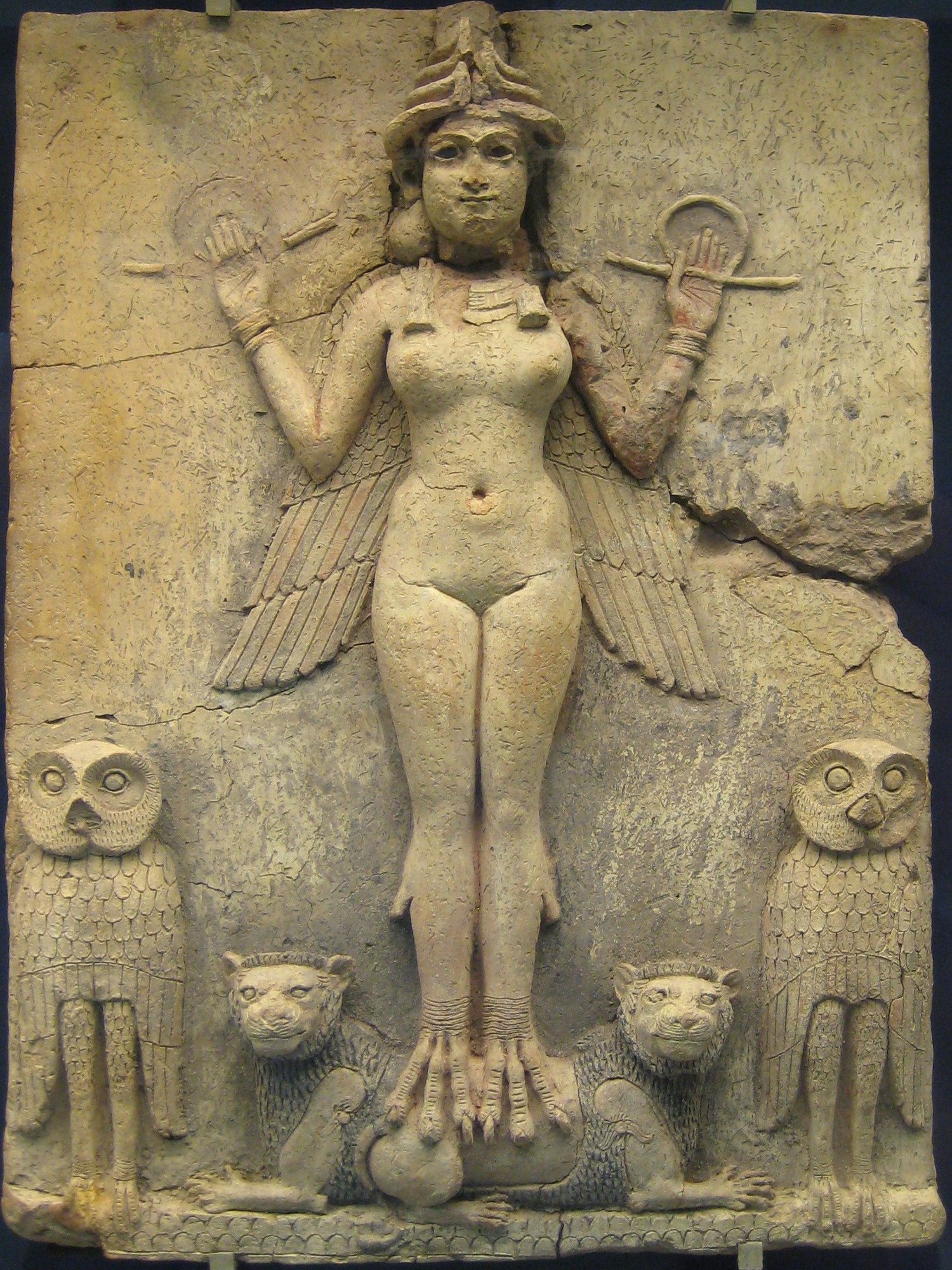
No single ancient text agrees with another about who Ereshkigal was married to, and that is the most revealing fact about her. In the oldest Sumerian poem her husband is Gugalanna, the Bull of Heaven, already a corpse before the story starts. In a separate strand of the tradition her consort is Ninazu, whom the scribes called her husband and then, later, quietly reclassified as her son. In the great Akkadian marriage-myth it is the war-god Nergal. She is the sovereign of the one place no one leaves, and yet she is the deity the sources could least leave alone, remarried and rewritten across two thousand years of cuneiform. This is a portrait of a goddess through the changes the tradition kept making to her, which is a different question from what happened in any one of her famous scenes.
A power too dangerous to petition
Start with the strangest thing the scholarship records: almost nobody prayed to her. Her name meant Queen of the Great Earth
, the polite Sumerian way of naming the land of the dead, and her chief temple stood at Kutha, a city that belonged more properly to Nergal than to her. Beyond that her cult is close to invisible.
Across the whole cuneiform record there is not one personal name built on hers, no Babylonian equivalent of the countless people called after Ishtar or Sin or Nabu. Parents named their children for gods they hoped would favour them. To carry Ereshkigal’s name into a household was to invite the last power anyone wanted to draw near, so no one did. She is that rare thing, a great deity whose greatness was measured precisely by how carefully the living kept their distance.
A near-beheading in one tablet, a romance in the other
The one story that lets us watch her up close is her marriage to Nergal, and it survives in two versions so far apart in time and temper that welding them together falsifies both. The short recensionA distinct version of a text as it survives in a particular copy or line of copies, often differing from others in wording, length or plot. comes from a tablet found at Tell el-AmarnaA site in Egypt (ancient Akhetaten) whose 14th-century-BCE archive preserved the short, violent version of the Nergal and Ereshkigal myth. in Egypt, copied in the 14th century BCE. The long one comes from SultantepeA site in southern Turkey whose 7th-century-BCE tablets preserved the longer, gentler version of the same myth. and Uruk, roughly the 7th century BCE, some seven hundred years later, a gap about as wide as the one that separates us from Dante finishing his Commedia. They tell the same courtship as opposite kinds of story.
In the Amarna version it is a conquest. The god Ea arms Nergal with fourteen demon-comrades and posts one at each of the fourteen doors of her house. Nergal storms the throne room, cuts down her vizier Namtar, seizes the queen by her hair and hauls her off her own throne, and lifts his weapon to strike her head off on the floor.
She buys her life in the only currency a queen of the dead commands, offering him not surrender but partnership: be my husband, and I will make you lord of the wide underworld, the tablets of Wisdom in thy hand … Thou shalt be lord And I shall be queen.
He lowers the blade, lifts her up, and wipes away her tears. The marriage begins as a near-beheading.
The Sultantepe version, seven centuries on, is almost a romance. Here Nergal comes down under a warning from Ea not to sit, eat, or lie with her, breaks the last taboo across a six-day affair, and flees on the seventh, leaving her stricken rather than conquered. The violence has drained out of it; what is left is closer to reluctant love. Read either poem alone and you have a coherent goddess. Read them as one and you get a monster who is beheaded and beloved in the same breath, which is precisely the error the dating forbids.
A throne received, not held by right
Even her rulership, the one thing that never changes, has been argued to be less securely hers than it looks. Modern scholarship reads the Nergal marriage not as an old organic tale but as a later attempt to reconcile two regional pictures of who governed the dead, a southern tradition that was Ereshkigal’s and a northern one built around Nergal’s entourage of war and disease.
On this reading the co-rulership is something assigned to the pair to knit two cults together. One study goes further and argues that the netherworld sovereignty comes to her as a dowry, a thing granted and settled on her rather than held in her own right from the beginning. It is a minority reading and a contested one, but it fits the pattern of everything else about her: a queen the tradition kept redefining, down to the terms on which she held her own throne.
The name that outlived its meaning
Her strangest afterlife came once her language was dead. In the late-antique Greek magical papyri of the 3rd and 4th centuries AD, long after the last scribe could read cuneiform, the name Ερεσχιγαλ, Ereschigal
, turns up bound to the Greek Hecate, goddess of crossroads and the restless dead. Sorcerers chanted it in binding-spells as a word of power.
They almost certainly had no idea it had once been the throne-name of a Sumerian queen of the dead; it survived as pure sound, a syllable of dread detached from its story. She was never really identified with Hecate in any living Mesopotamian religion. It is the last rewrite in a long series, the queen whose name outlasted every myth that gave it meaning, and outlasted even the knowledge of what it meant.
Slay me not, my brother, I would say thee a word … Thou shalt be lord And I shall be queen. (Nergal and Ereshkigal, Amarna recension, trans. S. H. Langdon, Semitic Mythology, 1931)
- Nergal and Ereshkigal, short Amarna recension (14th century BCE, Tell el-Amarna, Egypt), as translated and summarised in S. H. Langdon, Semitic Mythology (The Mythology of All Races, vol. V, 1931), pp. 163–164, read verbatimEa’s fourteen named demon-comrades and the fourteen doors, the slaying of Namtar, Nergal seizing the queen
by her hair
and casting herfrom her throne
about tosever her head on the floor
, and her life-buying offer of marriage and co-rule (the tablets of Wisdom in thy hand … Thou shalt be lord And I shall be queen
). - Nergal and Ereshkigal, long Sultantepe (and Uruk) recension (c. 7th century BCE), in S. Dalley, Myths from Mesopotamia (rev. ed. 2000), and analysed in **A. Gadotti, “Never Truly HersEreškigal’s Dowry and the Rulership of the Netherworld,” Journal of Ancient Near Eastern Religions 20 (2020) pp. 1–16**: the tenderer courtship (Ea’s taboo-list, the six-day affair, the flight and return) and the reading of the netherworld rulership as a dowry assignment rather than Ereshkigal’s own by right. Not read verbatim for the Sultantepe wording; the recension contrast and the dowry thesis are reported from Gadotti 2020 and Dalley 2000.
- Inana’s Descent to the Nether World (Sumerian), ETCSL t.1.4.1 (ed./trans. J. A. Black, G. Cunningham, E. Robson, G. Zólyomi et al., Oxford), read verbatim, cited here only for the varying consort traditions and for Namtar named as her sukkal; the full Descent narrative belongs to the sibling posts, not to this piece.
- F. Wiggermann,
Nergal A. philologisch
andNin-azu,
Reallexikon der Assyriologie 9 (2001), with G. Leick, A Dictionary of Ancient Near Eastern Mythology (1998) p. 55her limited cult (chief temple at Kutha; no personal names built on hers), the meaningQueen of the Great Earth
, and the shifting consorts (Gugalanna; Ninazuoriginally regarded as her husband but later as a son
; Nergal). - P. Taracha, Religions of Second Millennium Anatolia (2009) p. 124, with A. Archi (2013)the Hurrian Allani, the Hattian/Hittite sun-goddess of the earth Lelwani, and other Anatolian underworld deities conflated with Ereshkigal / Akkadian Allatu. Reported, not read verbatim.
- H. D. Betz,
Fragments from a Catabasis Ritual in a Greek Magical Papyrus,
History of Religions 19.4 (1980), with D. Schwemer (2019) pp. 66–67the late-antique Greek magical papyri (3rd–4th century AD) attaching the name Ερεσχιγαλ,Ereschigal,
to Hecate. Late syncretism, not an ancient Mesopotamian identification.