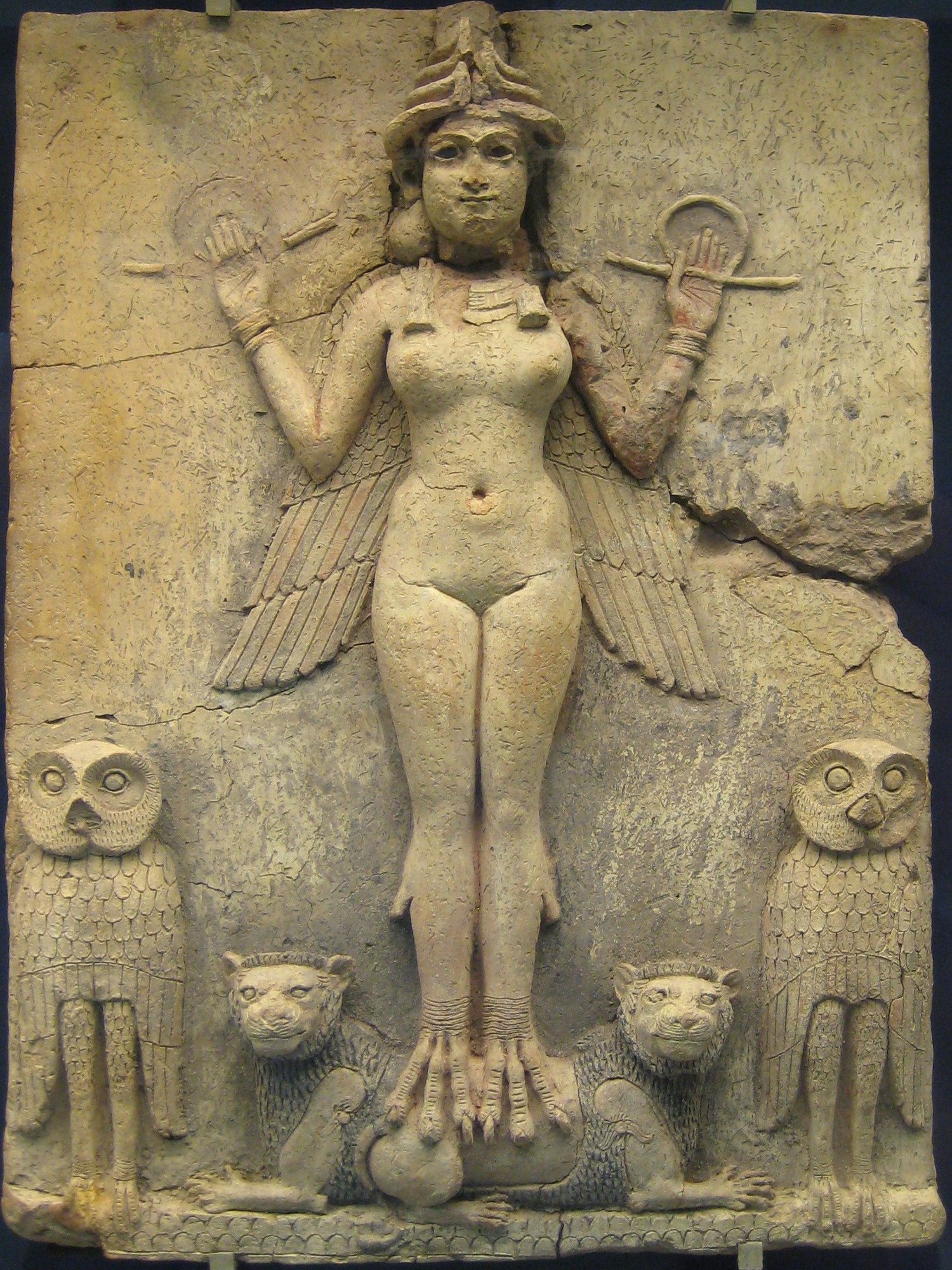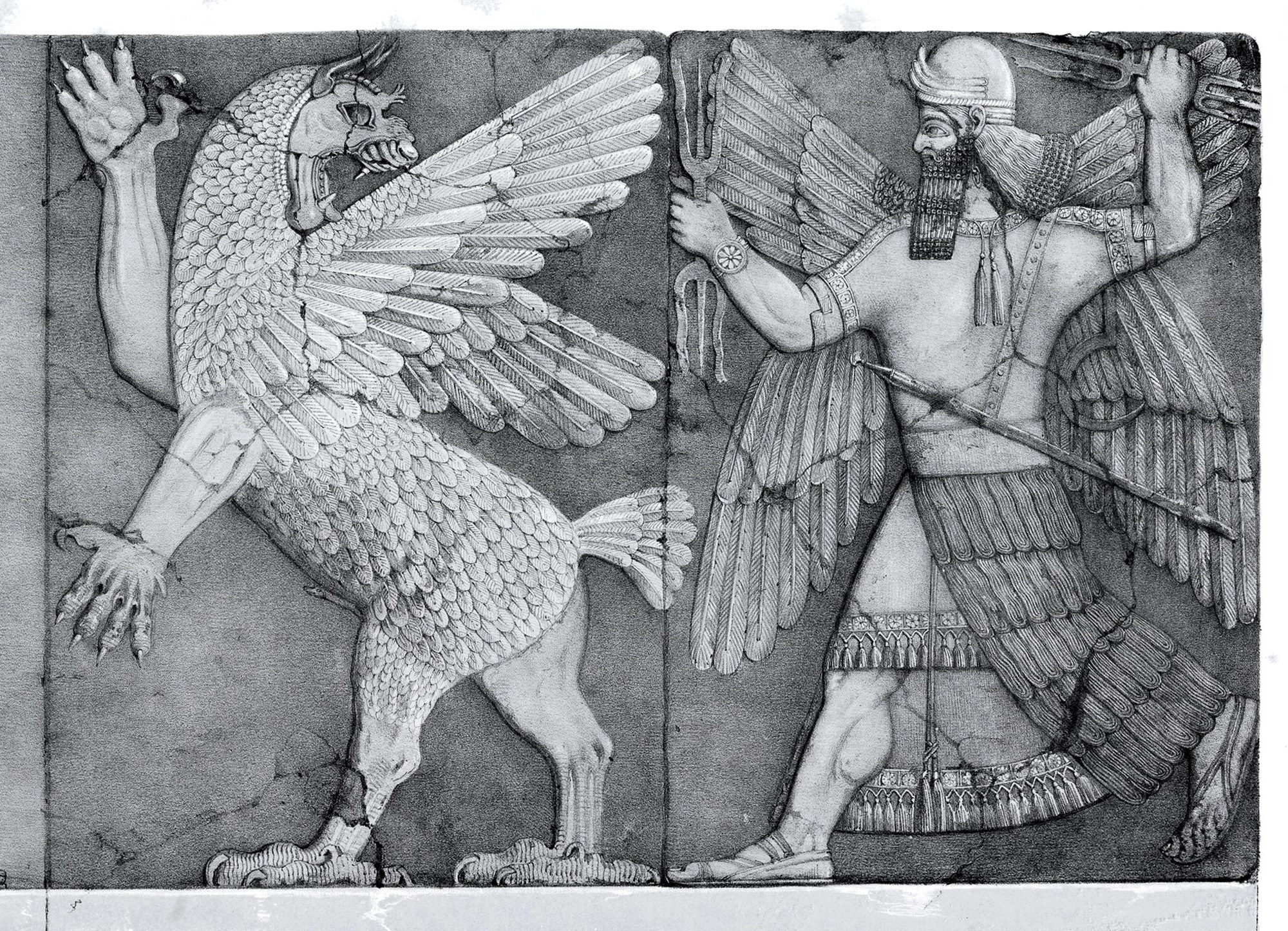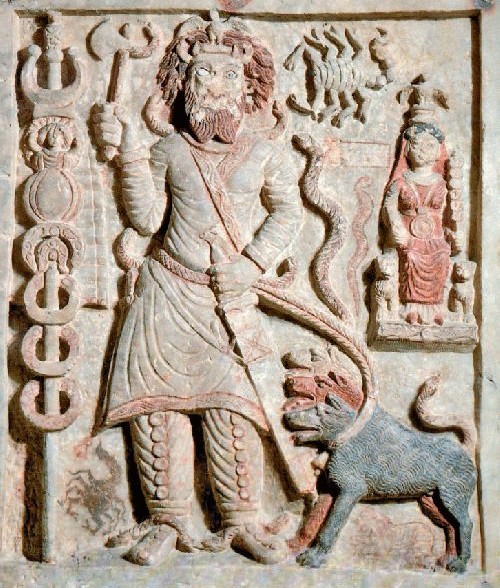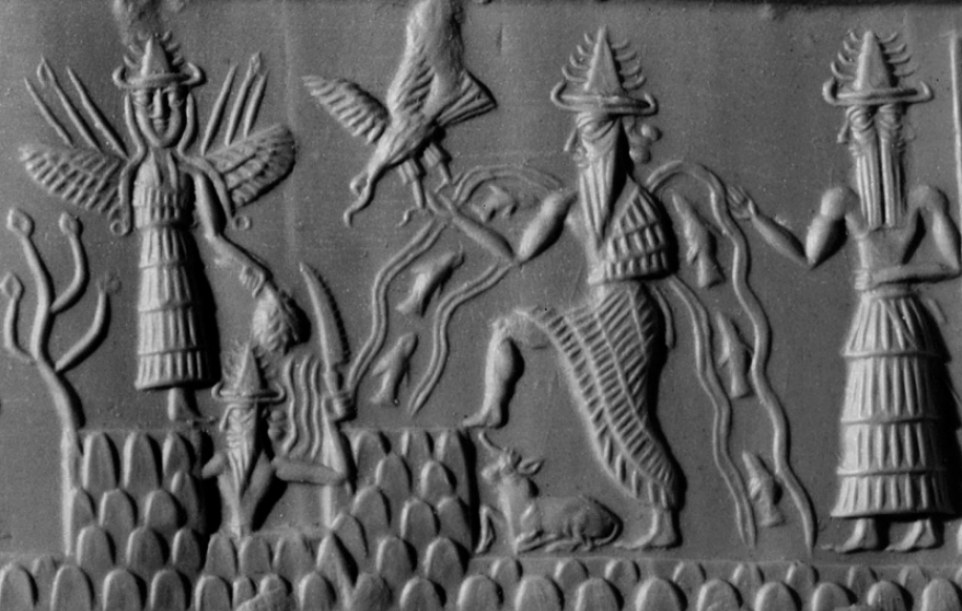
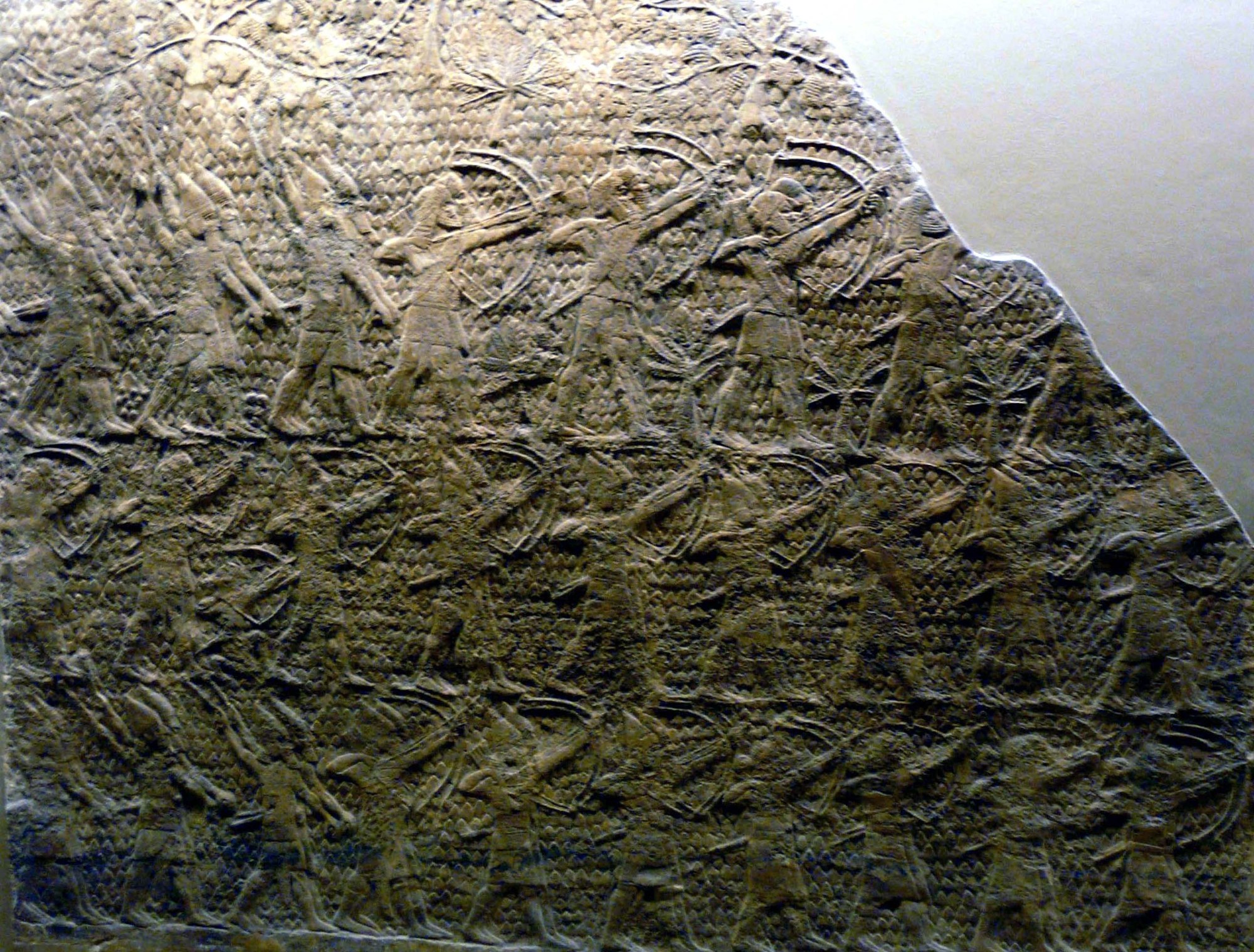
The war-god cannot decide whether to get out of bed. Erra lies beside his consort Mami with his arms hanging exhausted at his sides, like a man who has not slept, and puts the question to his own heart: should I rise, or lie here asleep? It is a strange opening for a poem about the near-extinction of the human race. The god of pestilence and mass killing, the one the tradition calls warrior and lord of plague and carnage, is too drowsy to obey his own mind. He has to be talked into the slaughter. What talks him into it, in the reading modern scholars now prefer, is not a scheming adviser but the restlessness inside his own chest, and then the loud complaint of his weapons.
A rusted dagger and a festival
Those weapons are gods in their own right. The SebittiThe Seven, peerless warrior-gods created by the sky-god Anu and each given a destructive destiny, who serve in this poem as Erra's personified weapons., the Seven, were made by the sky-god Anu and each handed a destructive destiny, and they lie idle and furious. Their gear is going to rot, they tell Erra: cobwebs are spun on the battle kit, and the dagger has gone rusty for lack of bloodshed. There are too many people in the world, they add, and too many beasts.
Then they sing him the oldest recruiting song there is. Going on campaign is like a festival. A palace on its terrace is nothing beside a bivouac in the open field, a loaf baked in the ashes, water drunk from a leather bottle. Go forth, valiant Erra, and rattle your weapons.
His minister tries to stop him. Ishum, the benevolent little fire-god who walks the streets at night as a watchman, is Erra’s sukkalThe vizier or minister of a Mesopotamian god, who carries messages, gives counsel and goes before his lord: Ishum's office at Erra's side., the one who goes before him and behind him, and in this poem he is the single bolt drawn across the door of the Seven. He asks his lord plainly why he is plotting evil against mankind. Erra gives no reason, only a paean of self-praise with one grievance underneath it: no god has brought war for so long that humans have lost their fear of heaven. They hold me in contempt, he says, a line the poem repeats like a drumbeat. He means to be feared again.
The god who was coaxed off his throne
So Erra goes to Babylon, to the temple EsangilThe great temple of Marduk in Babylon, seat of the king of the gods and the throne Erra coaxes him to leave., to call on Marduk, king of the gods. This is not the young champion who once split the chaos-sea to become king. This Marduk is old, distinctly past his prime, and Erra works on him with a craftsman’s care. Your cult-statue has decayed, he points out; its ornaments are tarnished and want refurbishing. Why not step down from your seat and see to it?
The world, of course, cannot be left ungoverned while its king is away, and Marduk knows it. He agrees to go only after Erra promises to keep order in his absence. That promise is the hinge of the whole disaster. Erra does not seize an empty throne by force; he borrows it on a vow, and then breaks the vow. When Marduk comes back, Erra takes offence at his return and swears to make the old king and all the senior gods remember him.
Now the killing begins, and the poem lets Ishum narrate most of it, which has the odd effect of making the restrainer the witness to what he could not restrain. First it is Nippur, where the great god Enlil walks out of his own house. Then it is Babylon itself, turned inward on its own people. Erra altered his divine nature and took the shape of a man to enter the city, and the governor’s own troops fell to looting it. The order given is the one line of the poem that has never needed a gloss: respect no god and fear no man, do young and old to death alike, and spare not even any babe unweaned.
Brother against brother
From there it widens until it swallows everyone. Erra vows to strike the very seat of the king of the gods so that no voice of reason will be left alive, and he sets every household in the land against itself. Nation shall not spare nation, the poem runs, nor city city, nor house house, nor man man, nor brother brother, but they shall slay each other. The peoples are named one by one as they turn on themselves, Sealander and Subartian, Assyrian and Elamite, Kassite, Sutean, Gutian and Lullubean, the whole map of Mesopotamia and its restless neighbours feeding the same fire.
The horror is domestic as much as martial: Erra promises to kill the son so the father must bury him, then kill the father with no one left to bury him at all, and to hand a man’s cherished house to a stranger. In a culture that buried its ancestors under the floor and owed them rites, that is not merely death. It is the erasure of the family line itself. By now the pollution of blood is so total that Marduk can no longer bear to stay in his temple, and the king of the gods abandons his cosmic station a second time. The universe has come fully unbalanced.
War made on a mountain
It ends because Erra, at last, lets it end. The carnage, the poem says, will only cease when a new ruler rises in Babylonia, and to clear the ground for him Erra gives Ishum leave to close the war. What Ishum does with that leave is the quiet masterstroke of the composition. He makes war not on humanity but on a mountain.
He turns his campaign against Mount Šaršar, read Ḫeḫe in the older editions, the symbolic homeland of the nomad peoples whose uprising set the whole thing off, and he fights it in purely elemental terms. He raises his hand and turns the mountain into a void; he fells the cedars of its forest until the woodland looks as though the Deluge had passed over it. Not one drop of human blood is named. A war-god’s minister ends a war by aiming all its violence at rock and timber, and the killing simply stops.
Facing the appalled assembly of gods, Erra confesses. When he is in a rage, he admits, no one can master him: where one is in a fury, another cannot counsel him. Then he praises Ishum for ending the war and sparing a remnant of mankind, so that kingship and the feeding of the gods can resume, and Ishum answers with the calm that is his whole nature. Be silent, hero, and hear me, he says. Be calm, and we shall stand at your service; for at the time of your fury, who could have withstood you? Content at last, Erra decrees a coming age of plenty under a Babylonian king.
A poem worn as an amulet
The strangest thing about the Poem of Erra is how it was used. It closes on its author, a rare thing in Babylonian writing: a man named Kabti-ilāni-Marduk, son of Dābibu, who says the god Ishum revealed the entire text to him in a dream one night, and that he set it down whole, leaving nothing out and adding not a single line.
And it ends with a promise of protection. The house that honours these words, the poem swears, will be kept safe from plague. Ancient scribes took that literally. The fifth tablet was copied onto stone and copper amulets and hung up against pestilence, so that the poem describing the plague-god’s rampage became the very charm invoked to keep him away.
The text comes down to us across some very long silences, and it is worth being honest about the gaps. The manuscripts that survive were copied at Nineveh in the mid-seventh century BCE, but the poem was probably composed earlier, anywhere from the eleventh to the eighth century, so the tablets in our hands may stand as much as four hundred years downstream of the poet. The first Englishing of it is later still and stranger.
When George Smith published his fragmentary rendering in 1875, calling Erra by the guessed name Lubara, he was working on freshly dug and badly broken tablets with a decipherment still in its infancy. A. R. George’s translation, quoted throughout here, is from 2013. When Smith and George seem to agree on the shape of the story, that is not two witnesses agreeing across the ancient world. It is a hundred and thirty-eight years of scholarship refining the same broken text.
Nation shall not spare nation, nor city city, nor house house, nor man man, nor brother brother, but they shall slay each other.
- The Poem of Erra and Ishum (Standard Babylonian Akkadian; five tablets, c. 700 of c. 800 lines surviving)the primary text. Its composition is disputed, dated anywhere from the eleventh to the eighth century BCE, while the oldest surviving manuscripts come from the library at Nineveh in the mid-seventh century BCE. Critical edition: L. Cagni, L’Epopea di Erra, Studi Semitici 34 (Rome, 1969), following the first edition by F. Gössmann, Das Erra-Epos (1955/56). Both are in copyright and were not read verbatim for this post.
- **A. R. George, “The Poem of Erra and IshumA Babylonian Poet’s View of War,”** in Warfare and Poetry in the Middle East (I.B. Tauris, 2013), ch. 2, pp. 39–72: the modern scholarly study relied on here, which prints George’s own English translation of the key passages with tablet and line numbers. Read verbatim, and the source of every quotation above: Erra sleepless and undecided (I 15–16); the rusted dagger and the war-as-festival speech (I 49–91); the order to spare no unweaned babe (IV 24–26); the fratricidal curse of nation against nation (IV 134–135); Ishum’s bloodless campaign on Mount Šaršar (IV 139–150); his calming words to Erra (V 19–21); and the closing hymn (V 59–61). It also underwrites the named author, the disputed date, and the amulet function.
- George Smith, The Chaldean Account of Genesis (London, 1875),
The Exploits of Lubara,
pp. 123–135: the earliest public-domain English attempt at the epic, made on newly excavated and heavily broken Nineveh fragments with an immature decipherment. It names ErraLubara,
IshumItak
and MardukMerodach.
Cited here only as a historical curiosity; its obsolete names and conjectures are used for no point of fact. - Oracc / AMGG,
Erra (god)
(Ancient Mesopotamian Gods and Goddesses; CC-BY-SA)the signed scholarly reference for Erra’s functions and epithets (warrior
;lord of plague and carnage
), his cult at the E-meslam temple in Kutha, his early syncretism with the underworld god Nergal, and the standing debate over whether he is at root a god of plague (Lambert) or of famine and scorched earth (Roberts). Read. - **B. R. Foster, *Before the MusesAn Anthology of Akkadian Literature*, 3rd ed. (2005), pp. 880–911;** and S. Dalley, Myths from Mesopotamia (rev. ed. 2000), pp. 282–315: the current standard English translations of the complete poem. Both are in copyright and were not read for this post; they are noted for the reader who wants the whole text.
- E. Reiner,
Plague amulets and house blessings,
Journal of Near Eastern Studies 19 (1960)on the copying of the poem’s fifth tablet onto amulets against pestilence, the concrete evidence that the epic was worn as the very object it describes.