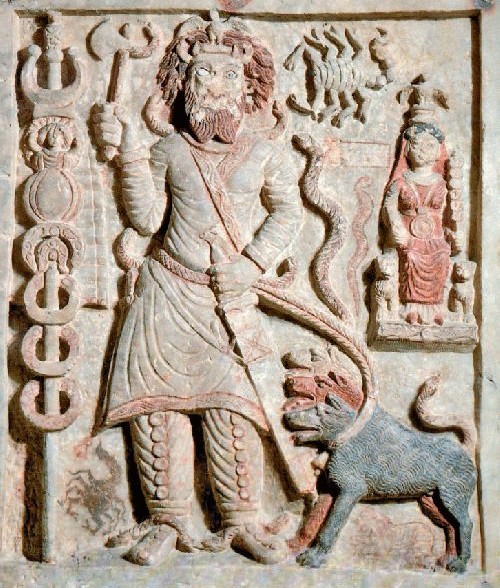
The whole assembly of heaven rose to its feet, and one god did not. A feast was in progress, and the queen of the dead, who cannot climb out of her own kingdom to attend, had sent her steward Namtar up the long stairway of heaven to collect her portion. When the netherworld’s envoy entered, every god stood to honour him. Nergal alone kept his seat. It is the smallest possible offence, a failure of courtesy that would embarrass a dinner guest, and it is the hinge on which this entire myth turns. The god of war, death and disease is undone not by a battle but by bad manners, and everything that follows, the descent, the sword, the crown, flows from the moment he did not get up.
The god who would not rise
To see why the slight matters, you have to know who Nergal was before it. He was a god of inflicted death, worshipped from the earliest dynasties down to the last centuries of cuneiform, with his chief seat at the city of Kutha and its temple Emeslam. His domain was war and plague and the fever that empties a household. He is a power of the upper world, a god who deals death to the living rather than governing the dead. He had no throne below when the tablet opened. That is the point of the story: he acquires one.
He goes by more than one name here. In the translations of this poem he sometimes wears the name ErraA war- and plague-god equated with Nergal from Old Babylonian times; in this myth the two names stand for the same figure., the plague-god that Mesopotamian scribes had long since fused with him into a single figure. It is the same god under a second title, not a rival.
Namtar carries the insult home, and Ereshkigal’s response is immediate. Namtar is her sukkalA high steward and messenger-vizier who carries a deity's word and will; Namtar is Ereshkigal's., the steward who bears her word up and down the long stairway between the worlds, and what he reports is an outrage. In the short version of the myth she wants blood. She rages and orders that the god who would not stand be delivered down to her so that she can kill him. The invitation to the underworld is a death sentence, and Nergal knows it.
Hidden in the crowd
What he does next is the most human thing in the poem, and the least godlike. When Namtar comes back to heaven to identify the culprit and count the gods one by one, Nergal hides. Langdon’s translation puts it plainly: one of them hid himself in the background.
Picture it. The god of war, the bringer of plague, the deity whose name parents would not give their children, shrinking into the crowd so that the underworld’s steward cannot pick his face out of the assembly. He is found anyway. Before he becomes terrible he is first afraid, and the poem is unembarrassed about showing us the fear.
Cornered, Nergal appeals to Ea, the clever god the myth calls his father. The genealogy is a courtesy rather than a fact. Nergal’s parents were Enlil and Ninlil, and no other tradition makes him Ea’s son; father
here is the honorific a suppliant pays to the god who can get him out of trouble. And Ea does. He arms Nergal for the road down.
An escort of fevers
The weapon Ea gives him is a war-band, and the war-band is made of diseases. He assigns Nergal fourteen demon-comrades, and Langdon’s list preserves most of their names: the Lightning-maker, the Slanderer, the Spy, Terror, Whirlwind, Plague, Fever, Prostration-by-heat, Heat, Ague. They are personified afflictions, the very things a plague-god carries in his own person, marching down into death at his back. When Nergal reaches the queen’s house he posts one of them at each of its fourteen doors, a fever set to guard every threshold, and only then does he go in. The god who came to be judged arrives instead as an invasion, his own domain deployed around him.
Inside, the short recensionA distinct edited version of a text as it survives in a particular copy or line of copies, often differing from others in wording, length or plot. resolves the confrontation with brutal speed. Nergal storms the forecourt, cuts down the steward Namtar, and in the throne room seizes Ereshkigal by the hair and hauls her off her seat. He is about to sever her head on the floor. This is the near-execution of the queen of the dead in her own hall, and it is worth being precise that only the short, older telling stages it this way. The scene exists on one tablet, and it is the tablet that came to Nergal’s kingship by conquest.
Two tablets, seven hundred years apart
Because there is no single canonical version of this story. It survives in two Akkadian recensions that stand about seven hundred years apart and tell the courtship in opposite registers, a gap wider than the one between us and the first printed books in Europe. The short version was copied in the 14th century BCE and turned up, of all places, in Egypt, among the scribal tablets of Tell el-Amarna.
The long version comes from the 7th century BCE, from the library at Sultantepe and a copy at Uruk. When exactly the myth was first composed nobody can say; scholars place it anywhere across several centuries, and every surviving copy is in Akkadian. The two witnesses are not one story told twice. They are two answers to the same question about how a war-god ended up on the throne of the dead.
In the long version there is no order to kill him on arrival. Instead Ea sends Nergal down under a set of prohibitions: refuse the chair, the bread, the meat, the beer, the washing of his feet, and above all, when the queen bathes and lets herself be seen, do not do what men and women do. Nergal keeps every rule but the last.
He gives in to desire, and the affair runs its countable course before he steals away and the poem drives toward its forced return. The violence of the short telling is gone; what replaces it is closer to a reluctant love story. The queen’s side of that longer version, her grief, her cosmic threat, her heart, is told in full elsewhere on this site and is properly hers. What both tablets share, and what belongs to Nergal, is the destination.
Moving in with death
Because both roads end at the same throne. In the short version the queen, an instant from decapitation, buys her life with the only thing a sovereign of the dead can offer, which is co-rule: be my husband, she says from the floor, and I will place the tablets of wisdom in your hand, you shall be lord and I shall be queen.
Nergal lowers the blade, lifts her up, and kisses her. In the long version the gods surrender him, he descends a second time, and the tablet resolves in union rather than murder, closing on the two of them going impetuously into the bedchamber while Anu’s messenger goes off to proclaim Nergal’s new office. The war-god does not defeat death. He marries it and stays.
And here is the fact that keeps the story honest. This marriage lives in the poem and almost nowhere else. In the dry registers of the god-lists, where Mesopotamian scribes recorded who was paired with whom, Nergal and Ereshkigal are not listed as husband and wife at all. His wife in those documents is Mammitum, or the minor medicine-goddess Laṣ, not the queen of the dead. Even his rule over the underworld had another explanation on offer, older than this romance: that he governed it on behalf of his parents Enlil and Ninlil, with no wedding required.
The marriage of the underworld
was a literary annexation, one tradition’s way of explaining a war-god’s throne among the dead by giving him the queen who already sat it. Scholars read the whole poem as an attempt to reconcile two regional pictures of who ruled below, a northern one built around Nergal and a southern one that was always Ereshkigal’s, by simply marrying the two together.
Which returns us to the god who would not stand. He begins the story as an intruder summoned to be punished for a discourtesy, hides from the reckoning, is armed with his own plagues, and comes back with a crown he did not possess when the poem opened. Whether he took the throne at swordpoint or in bed depended on which scribe, in which century, was telling it. The shape is the same in both, and it is a strange one for a god of war: he went down to death expecting to be killed, and he never came back up.
Thou shalt be my husband, and I thy wife. I will cause thee to possess Kingship in the wide underworld. I will place the tablets of Wisdom in thy hand. Thou shalt be lord And I shall be queen. (Nergal and Ereshkigal, Amarna recension, trans. S. H. Langdon, Semitic Mythology, 1931, p. 164)
- Nergal and Ereshkigal, short Amarna recension (single Middle Babylonian tablet from Tell el-Amarna, Egypt; mid-14th century BCE; composite Q002884 / P270856), as translated and summarised in S. H. Langdon, Semitic Mythology (The Mythology of All Races, vol. V, 1931) pp. 162–165, read verbatimthe banquet slight (
Nergal alone of all the gods refused to rise from his seat to greet Namtar
), Nergal hidingin the background
, Ea’s gift of fourteen named demon-comrades and the fourteen doors, the slaying of Namtar, the near-beheading (seized Ereshkigal by her hair … about to sever her head on the floor
), and the marriage offer (Thou shalt be lord And I shall be queen
). Modern editions (Izreʾel, The Amarna Scholarly Tablets, CM 9, 1997, pp. 51–61; Foster; Dalley) are in-copyright; Langdon 1931 is the public-domain quarry. - Nergal and Ereshkigal, long Sultantepe (and Uruk) recension (Neo-Assyrian copies from Sultantepe; Neo-Babylonian copy from Uruk; c. 7th century BCE). Editio princepsO. R. Gurney,
The Sultantepe Tablets (Continued): VII. The Myth of Nergal and Ereshkigal,
Anatolian Studies 10 (1960) pp. 105–131. Standard modern English: S. Dalley, Myths from Mesopotamia (rev. ed. 2000), and B. R. Foster, Before the Muses (1996 printing, pp. 410–428): Ea’s taboo-list, the six-day affair, the flight, the forced return, theimpetuously entered the bedchamber
ending, and Kakka as Anu’s messenger opening and closing the poem. In-copyright; the plot beats are securely attributed, but the exact Sultantepe wording is reported from Gadotti 2020 and the sibling posts’ reading of Dalley 2000, not re-read verbatim here. - **A. Gadotti, “Never Truly HersEreškigal’s Dowry and the Rulership of the Netherworld,” Journal of Ancient Near Eastern Religions 20.1 (2020) pp. 1–16 (Brill)**: the two recensions and their roughly seven-hundred-year gap, the Amarna kill-motive present only in the short version, the uncertain composition date, and the reading of the myth as a reconciliation of two regional underworld traditions.
- F. A. M. Wiggermann,
Nergal A. Philologisch
andNergal B. Archäologisch,
Reallexikon der Assyriologie 9 (1998/2001) pp. 215–226Nergal as god of war, death and disease; his cult city Kutha (temple Emeslam); his parents Enlil and Ninlil; the Nergal–Erra equation; his default consorts Mammitum or Laṣ; the god-list fact that he and Ereshkigal are not paired as husband and wife; the two routes to his underworld kingship; and Ea as Nergal’sfather
only as an honorific.