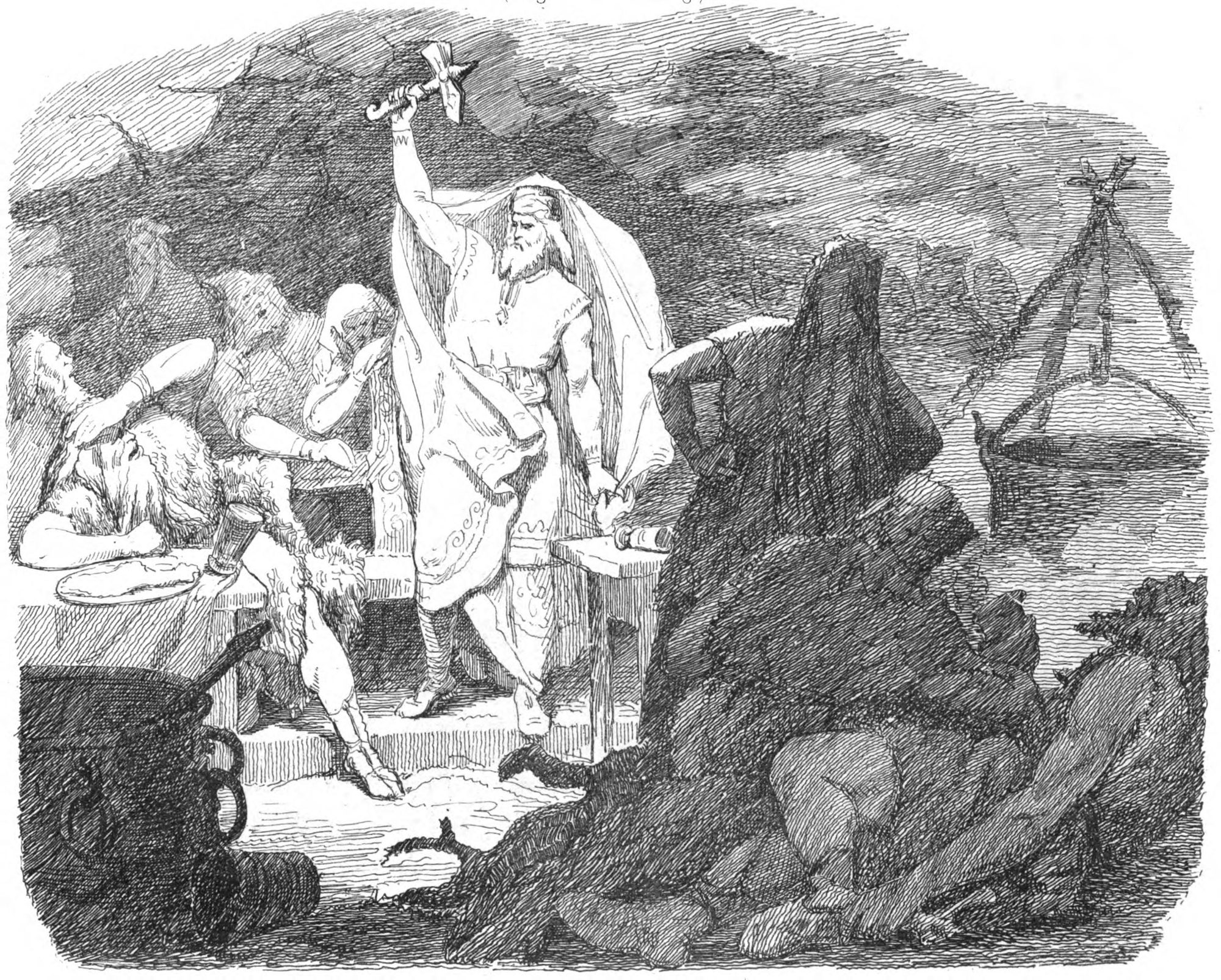
Wild is the thunder-god when he wakes and finds his hand closing on nothing. He gropes through his beard for it, and about the bed, and the hammer is not there. His hair bristles; he shakes his beard; and the strongest of all the gods feels a cold that no frost-giant ever put in him, because Mjöllnir has been lifted out of the world while its owner slept. He goes straight to Loki with the worst news in Asgard. The hammer is stolen, and no one on earth or in heaven knows where it lies.
Thrym plaiting leashes of gold
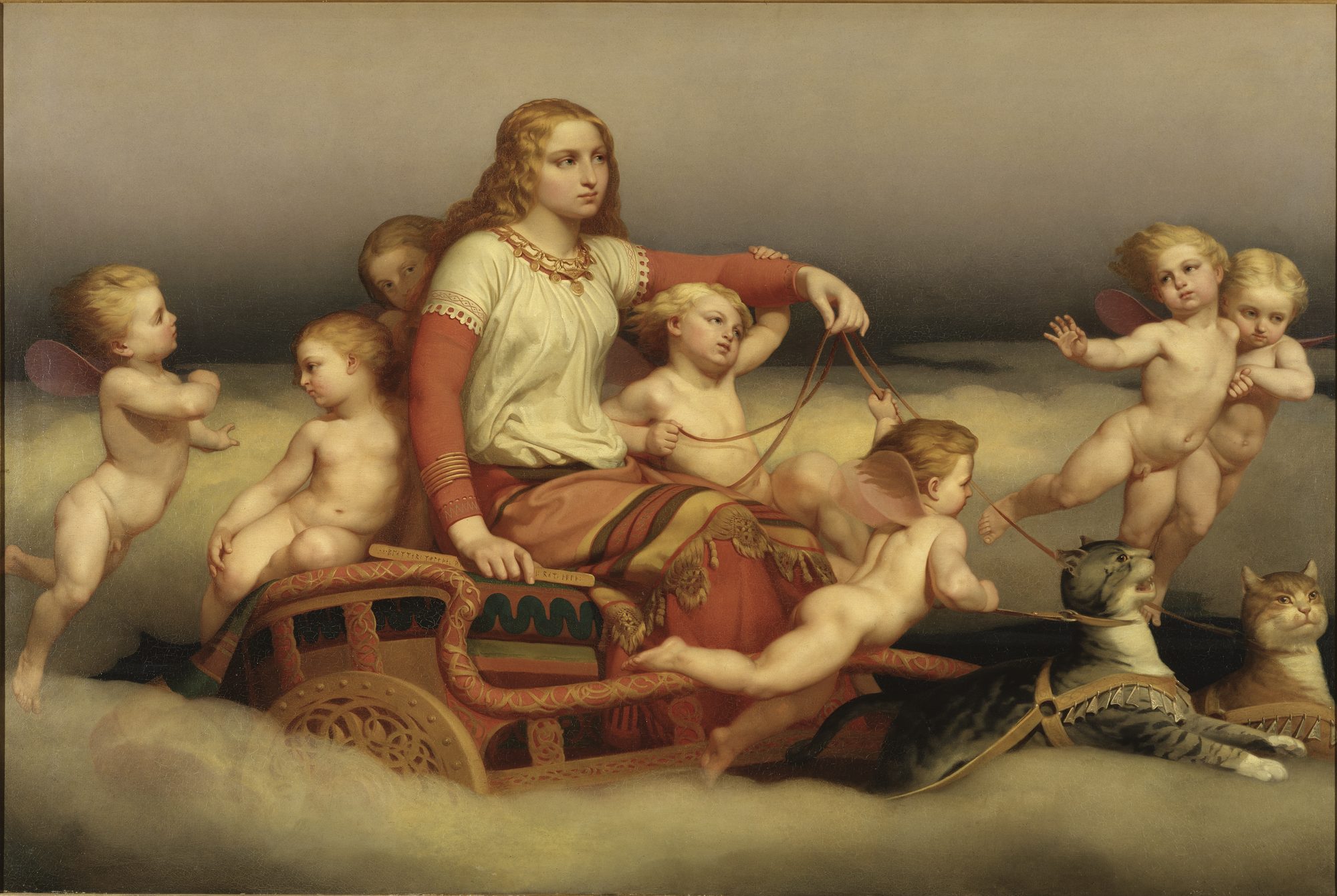
They go together to Freyja’s hall to beg a loan. Loki wants her feather-dress, the whirring cloak of falcon-plumes that carries its wearer through the air, and she gives it gladly, saying she would lend it even were it woven of silver or of gold. So Loki lifts out of Asgard with the feathers singing around him and flies down into the land of the giants, and there he finds the thief.
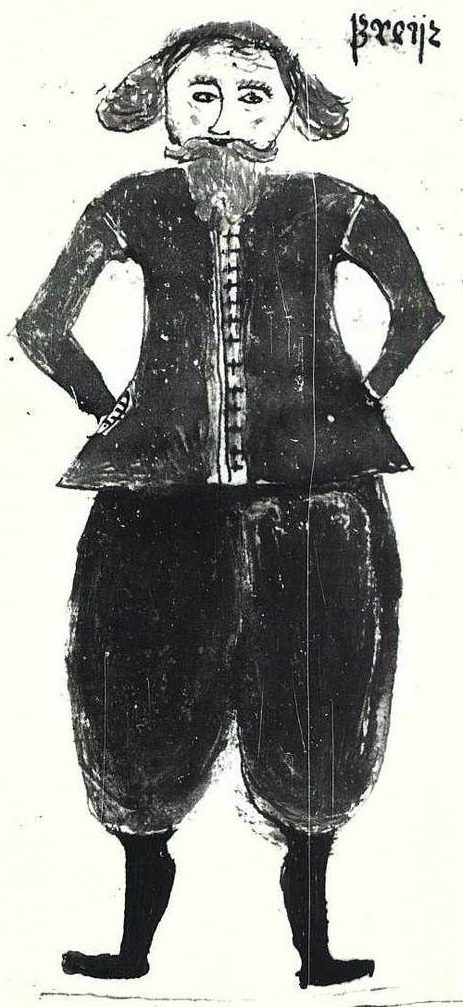
Thrym, master of the giants, is sitting out on a burial-mound in the last domestic hour of his life, plaiting leashes of gold for his hounds and smoothing down the manes of his mares. He is unhurried and unafraid, a giant lord at home, and he tells Loki exactly what he has done. Hlorrithi’s hammer lies eight leagues deep in the earth, and no one will fetch it up again unless they bring him Freyja for his wife.
The Brísingamen bursts from her throat
Loki flies the whole answer back to Asgard, and meets Thor waiting for him in the yard, and the two of them do a rash thing: they take the demand straight to Freyja, and Loki tells her to bind on her bridal linen, because the pair of them must ride at once to the giants’ home. Freyja’s fury is the loudest thing in the poem.
She snorts with such rage that the halls of all the gods shudder on their beams and the BrísingamenThe necklace that is Freyja's best-known treasure., her great necklace of the Brisings, bursts from her throat and falls. She would be reckoned the most man-mad of all the gods, she says, if she went with Loki to JötunheimThe land of the giants in Norse cosmology.. The bride flatly refuses to be traded. Now the gods have a stolen weapon, a giant who will take nothing else, and a goddess who will not go.
Bind the bridal veil on him
So they hold a council, every god and goddess of them, to work out how the hammer might be won home. And it is Heimdall who finds the way, Heimdall the whitest of the gods, who like the VanirThe Norse gods of fertility and prosperity; Njörðr, Freyr and Freyja are the ones the sources name most fully, and came among the Æsir by the settlement that ended the first war in the world. can see forward into what will happen. Let them dress Thor himself as the bride. Bind the bridal veil on him; hang the burst Brísingamen at his neck; let the housewife’s keys jangle at his belt and a woman’s dress fall to his knees; set broad gems on his breast and a neat cap on his head, and send the thunder-god to the wedding in Freyja’s place.
Thor’s objection is the most human line in the story. The gods, he says, will call him unmanly, ergi, the worst word the north has, if he lets a bridal veil be bound on him. It is Loki, Laufey’s son, who talks him down, and he does it with the plain arithmetic of the situation: unless the hammer comes back, the giants will be living in Asgard within the day. That settles it. They dress him.
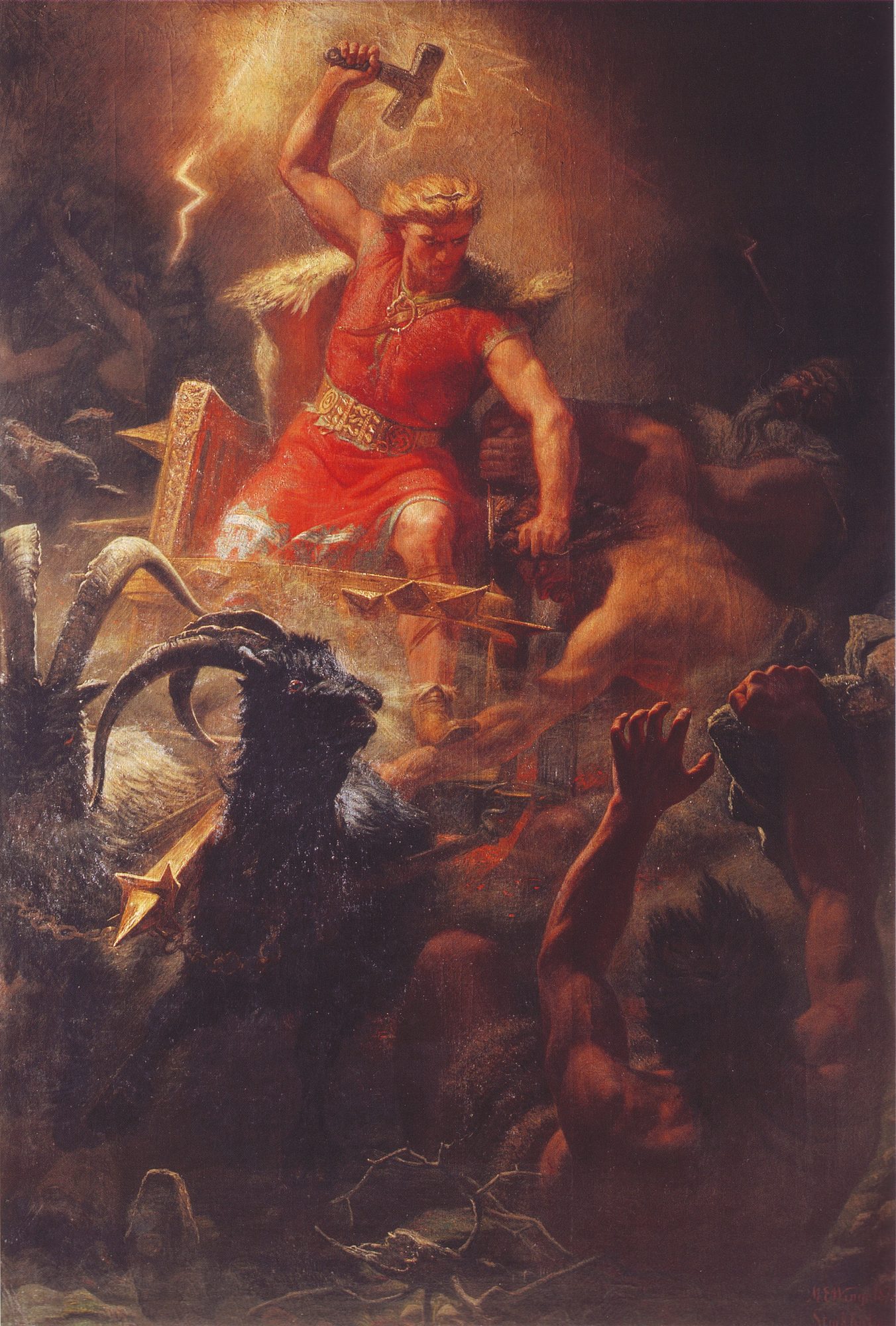
On go the veil and the necklace, the ringing keys, the trailing gown, the jewels, the pretty little cap; and Loki, never one to miss a part, declares that he will ride along as the bride’s handmaid. The goats are harnessed and driven hard, straining at the traces, and as the thunder-god’s chariot runs for Jötunheim the mountains split and the earth goes up in fire beneath the wheels. It is not a subtle arrival.
A bride who eats an ox
Thrym hears them coming and turns lord of the manor, ordering his giants to strew fresh straw along the benches: they are bringing him Freyja, he crows, the daughter of Njörth out of Nóatún, to be his own. He has cattle with gilded horns and oxen black as jet, gems and jewels heaped high, and by his own reckoning the one thing his wealth had ever lacked was Freyja, and now she is at the door. Then they sit down to the wedding feast, and the disguise very nearly walks straight into disaster, because the bride is hungry.
Thor eats an entire ox. He eats eight whole salmon. He clears every sweet and dainty that had been set out for the women, and he drinks three great casks of mead. Thrym stares down the table and says he never in his life saw a bride bite so keenly or a maiden drink so deep. But the handmaid is quick. Freyja, she says, has been so wild with longing for Jötunheim that she has not touched food for eight nights; small wonder she falls on the feast.
The giant is charmed, and leans in under the veil to kiss his bride, and springs the whole length of the hall back from her. The eyes beneath the linen are terrible; they seem to him to burn with fire. Once more the handmaid smooths it over with the same story turned a half-turn: Freyja has not slept for eight nights either, so hot has her longing been for this marriage.
Between the two lies the trap is dressed as courtesy, and the giants believe every word. Even the giant’s old sister comes stumping up to work the bride for a wedding-gift, boldly demanding the rings of red gold off the bride’s own hands in exchange for her love and welcome, never guessing what those hands are about to hold.
Mjöllnir laid on the maiden’s knees
For now Thrym calls for the thing that will finish him. Bring in the hammer, he orders, to hallow the bride: lay Mjöllnir on the maiden’s knees, and let Vör, the goddess who watches over vows, bless the two of them into one. They carry it in and set it down in the veiled bride’s lap, and the heart in Thor’s breast laughs. His hand closes on the shaft it has been groping for since the poem began.
The veil comes off in a swing of iron. He kills Thrym first, and then he fells the whole folk of the giants where they sit, and the greedy old sister who had begged the bride-fee gets her portion after all: not rings of red gold but a hammer-blow, a stroke of Mjöllnir paid into her hand in the coin’s stead. And so the son of Odin got his hammer back, having gone as a bride to fetch it.
What makes the tale is the seam it runs along. The Norse liked their thunder-god best when he was both, terrifying and ridiculous at once, buckled into a gown and gorging like a giant and still, under all of it, the one hand in the nine worlds that the frost-giants had real cause to fear. The joke and the dread are the same figure.
This retelling is the whole tradition: the episode survives in a single poem, the Þrymskvitha of the Codex Regius, and nowhere else. Snorri never touched it, and it does not appear in the Prose Edda at all, so there is no rival version standing behind the joke to sober it. What there is, is one comedy of manners with a killing at the end of it, and a hammer that always comes home.
Wild was Vingthor / when he awoke, / And when his mighty / hammer he missed; / He shook his beard, / his hair was bristling, / As the son of Jorth / about him sought. (Þrymskvitha 1, trans. Bellows)
- Poetic Edda, Þrymskvitha (The Lay of Thrym) 1–33 (trans. Henry Adams Bellows, The Poetic Edda, American-Scandinavian Foundation, New York, 1923; Project Gutenberg #73533, read verbatim)the complete and sole source for the narrative. Vingthor wakes to the hammer’s theft and tells Loki no one on earth or in heaven knows where it lies; Loki borrows Freyja’s feather-dress and flies to Jötunheim, where Thrym, the giants’ master, sits on a mound plaiting gold leashes for his hounds and grooming his mares, and confesses that Hlorrithi’s hammer is buried eight leagues deep and will be ransomed only for Freyja as his wife; Freyja’s refusal is so violent that the Brísingamen bursts from her; the gods’ council; Heimdall’s plan to dress Thor as the bride (veil, Brísingamen, rattling keys, a woman’s dress to the knee, breast-gems, a neat cap); Thor’s fear of the charge of unmanliness (ergi) and Loki’s answer that the giants will otherwise dwell in Asgard; the goat-drawn drive that bursts the mountains and burns the earth; the feast where Thor devours an ox, eight salmon and all the women’s dainties and drinks three casks of mead, covered by the handmaid’s tale of an eight-night fast of longing (and, at the attempted kiss, an eight-night sleeplessness); the sister who begs the bride-fee; the hammer brought in
to hallow the bride
and laid on the maiden’s knees; and Thor’s slaughter of Thrym first, then all the giant-folk, then the begging sister,and so his hammer got Othin’s son
. - Henry Adams Bellows, introductory note and per-stanza notes to Þrymskvitha (same edition and Gutenberg file, read verbatim) — cited as scholarship, not primary textthat the poem survives only in the Codex Regius (GKS 2365 4to), where it follows the Lokasenna, and does not occur in the Prose Edda at all (Snorri does not quote from it,
nor, rather oddly, does the story occur in the Prose Edda
); a probable composition c. 900 CE by an unknown author; the gloss of Vör as goddess of vows between men and women; and the note that Bellows’seight miles
renders Old Norse rastir (a rast, a league or distance-unit), an approximate measure rather than the modern mile — henceeight leagues
in the retelling above.