He was born a snake in JötunheimThe land of the giants in Norse cosmology, where Loki's monstrous children are born., one of three, and none of the three were the kind of children a god wants loose in the world. Loki had fathered them on the giantess AngrboðaThe giantess of Jötunheim who bears Loki's three monstrous children, the wolf, the serpent and Hel.: a wolf, a serpent, and a daughter. Prophecy warned the Aesir that nothing but woe would come of this brood, so Odin had them all brought before him. The other two he dealt with in their turn. The serpent he simply threw away, flinging it into the deep sea that surrounds all lands, as far from Asgard as the world could put it. It was the kind of solution that looks final and is not.
For in the sea the thing grew. It grew past the size of any creature that had ever swum there, grew until it lay stretched along the whole floor of the ocean, grew until its own length ran out of world to cross and it came round upon itself and took its tail in its mouth. That is where it lies still: in the midst of the ocean, ringing the entire earth, a living boundary with its own tail clenched between its jaws.
The Norse called it the Midgard-serpent, the coil around the middle-world, and the poets reached for it in kenningsNorse poetic figures that name a thing by a compressed image, such as 'the foe of gods' for the serpent. when they wanted the largest thing they could name. The encircler beneath of every land. The foe of the gods. The wolf’s own brother. Odin had not disposed of a monster. He had drawn the edge of the world.
A single paw off the ground
There is a strange comedy in how rarely anyone recognises it. Thor met the serpent three times, and the first time he did not even know what he was fighting. In the hall of the giant-king Útgarða-LokiThe giant-king who tricks Thor into trying to lift the world-serpent disguised as a house-cat., mocked as too weak for a proper contest, Thor was handed something small: lift my cat off the floor, said the giant, if the errand is not beneath you. It was a large gray cat, and it should have been nothing.
But the harder Thor heaved, the higher the creature arched its back, until with all his strength he could raise only a single paw from the ground. He left thinking he had failed at a parlour trick. Only afterward did the giant admit the truth: the cat was the Midgard-serpent, laid in a coil around all lands, barely long enough to keep tail and head on the earth. When Thor lifted one paw, he had hauled the boundary of the world nearly up to heaven, and every giant watching had gone cold with fear.
An ox-head on the hook
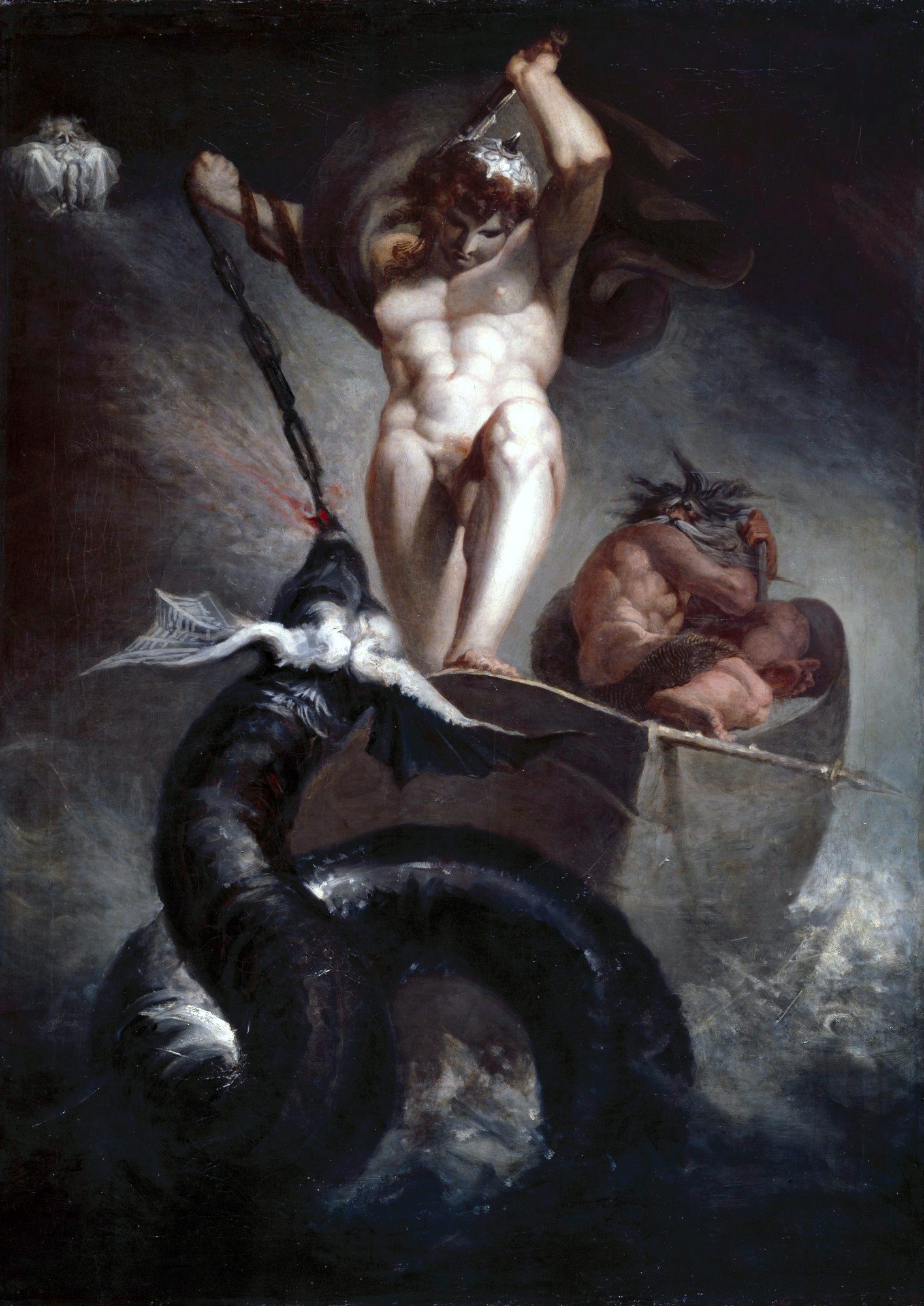
The second meeting was the great one, the fishing trip that Norse poets loved. Thor came disguised to the giant Hymir and talked his way aboard the boat, then rowed them out past every water Hymir dared to fish. For bait he took the largest ox in the giant’s herd, one named Himinbrjót, and wrung its head clean off. He cast the ox-head down on his hook and waited, and the serpent that lay round the world rose to it and swallowed the barb. Then the real contest began.
Thor braced against the pull with such force that both his feet drove straight through the bottom of the boat and planted on the sea-floor, and from there he hauled the coil of the world up hand over hand until the venom-glistening head broke the surface at the gunwale. No one has ever seen a more terrible sight than Thor and the serpent glaring at each other across the boat’s edge, the god whetting his eyes on it and the serpent staring back and spouting venom.
Here the old accounts part ways, and they are worth keeping apart. In the verse of the Hymiskviða, Thor gets his blow in: he brings the hammer down on the serpent’s foul head, and the whole world answers, the icebergs ringing, the caverns howling, the old earth itself shrinking together before the fish sinks back into the ocean. Snorri, telling the same scene in prose, robs Thor of the stroke.
In his version the giant Hymir loses his nerve at the worst moment, changing hue and going pale as the seawater floods in over the ruined hull, and just as Thor grips the hammer Hymir fumbles out his knife and cuts the line, so the serpent drops back unstruck. Snorri knows other men tell it otherwise, that the flung hammer took the head off on the sea-bottom, but he sets that aside: the truth, he says, is that the Midgard-serpent still lives and lies in the ocean. Both traditions agree on the one thing that matters. The serpent survives the fishing trip. It has to. It has an appointment to keep.
Nine paces from the dead coil
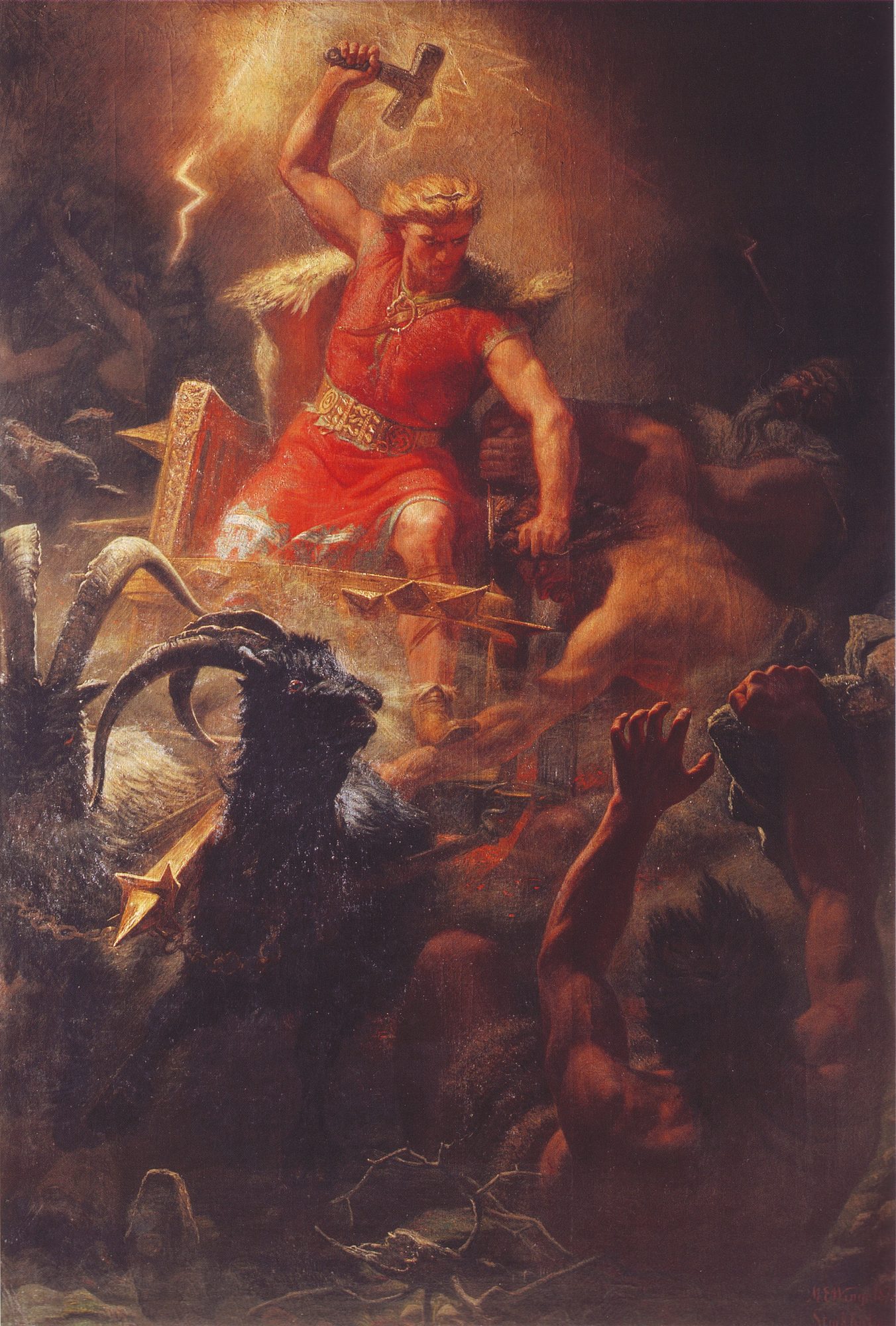
That appointment is the end of the world, the third meeting, and neither of them walks away from it. When Ragnarök comes the serpent writhes in giant rage and heaves itself up out of the sea to gain the land, the ocean rushing in over the earth behind it. It comes on beside its brother the wolf, vomiting venom that fouls all the air and all the sea, and Thor comes to meet it as he was always going to. He kills it.
That much every source grants him, and the slaying wins him great renown. But the serpent has been made of poison from the start, and its last gift is the air itself. Thor turns from the dead coil and gets nine paces, and falls to the earth dead of the venom the serpent breathed on him. The prose counts nine paces; the old prophecy of the Völuspá counts nine feet. Either way the number is small, and the god does not finish the walk.
Nine feet will go Fiörgyn’s son, bowed by the serpent, who feared no foe. (Völuspá 55, trans. Thorpe)
The boundary drawn in living flesh
The reason to hold on to the serpent, past the fishing trip and the doom, is that it is more than Thor’s designated enemy. Strip away the two of them squaring off and you still have the coil in the sea, the thing that makes Midgard an inside by being its outside, the boundary drawn in living flesh with its tail in its teeth.
The Norse imagined the edge of the world not as an emptiness but as a creature, vast and venomous and asleep, and told themselves that the strongest of their gods and the largest of their monsters were bound to die together on the day it finally rose. The wonder of the story is not the fight. It is that they gave the horizon a name and set it breathing.
- Snorri Sturluson, Prose Edda, Gylfaginning 34 (trans. Rasmus B. Anderson, The Younger Edda, Chicago 1880; Project Gutenberg #18947, read verbatim)the origin of Jörmungand the Midgard-serpent as one of Loki’s three children by Angrboða in Jötunheim (with the Fenris-wolf and Hel); the prophecies of woe that make Odin gather the brood; Odin casting the serpent
into the deep sea which surrounds all lands
, where itwaxed
so that itlies in the midst of the ocean, surrounds all the earth, and bites his own tail
. - Snorri Sturluson, Prose Edda, Gylfaginning (the Útgarða-Loki episode) (trans. Anderson, 1880; PG #18947, read verbatim)Útgarða-Loki’s challenge to lift his large gray cat, which Thor can only make arch its back and raise one paw; the reveal that
it was in reality the Midgard-serpent, which surrounds all lands
,scarcely long enough to touch the earth with its tail and head
, and that Thor raised it so highyour hand nearly reached to heaven
. - Snorri Sturluson, Prose Edda, Gylfaginning (the Thor and Hymir fishing episode) (trans. Anderson, 1880; PG #18947, read verbatim)the ox Himinbrjót whose head Thor twists off for bait; Thor’s feet bursting through the hull to stand on the sea-bottom; the serpent hauled to the gunwale, spouting venom, glared eye to eye; Hymir who
changed hue and grew pale from fear
and cut the linejust at the moment when Thor grasped the hammer
; and Snorri’s verdict thatthe Midgard-serpent still lives and lies in the ocean
, against the sub-version in which the hurled hammer struck off its head. - Snorri Sturluson, Prose Edda, Gylfaginning 55–56 (trans. Anderson, 1880; PG #18947, read verbatim)Ragnarök. The serpent writhing
in giant rage
to gain the land and vomiting venom that defilesall the air and the sea
, rising beside the Fenris-wolf; Thor whogets great renown by slaying the Midgard-serpent, but retreats only nine paces when he falls to the earth dead, poisoned by the venom that the serpent blows on him
. - Poetic Edda, Hymiskviða (The Lay of Hymir) 17–24 (trans. Benjamin Thorpe, The Elder Eddas of Saemund Sigfusson, London 1866; Project Gutenberg #14726, read verbatim)the all-black ox whose head is the bait; the serpent-kennings (
the encircler beneath of every land
,the foe of gods
,the wolf’s own brother
,the worm with venom glistening
); Thor drawing the worm to the side and strikingon his foul head’s summit
with his hammer; the climax,the icebergs resounded, the caverns howled, the old earth shrank together
, andthe fish back into ocean sank
; with footnote 31 flagging that Snorri’s prose has Hymir cut the line before the blow. - Poetic Edda, Völuspá (The Vala’s Prophecy) 55, 58 (trans. Thorpe, 1866; PG #14726, read verbatim)
Fiörgyn’s son
(Thor) goingnine feet
,bowed by the serpent, who feared no foe
, his death at Ragnarök; and the later recollection among the Æsir ofthe mighty earth-encircler
.