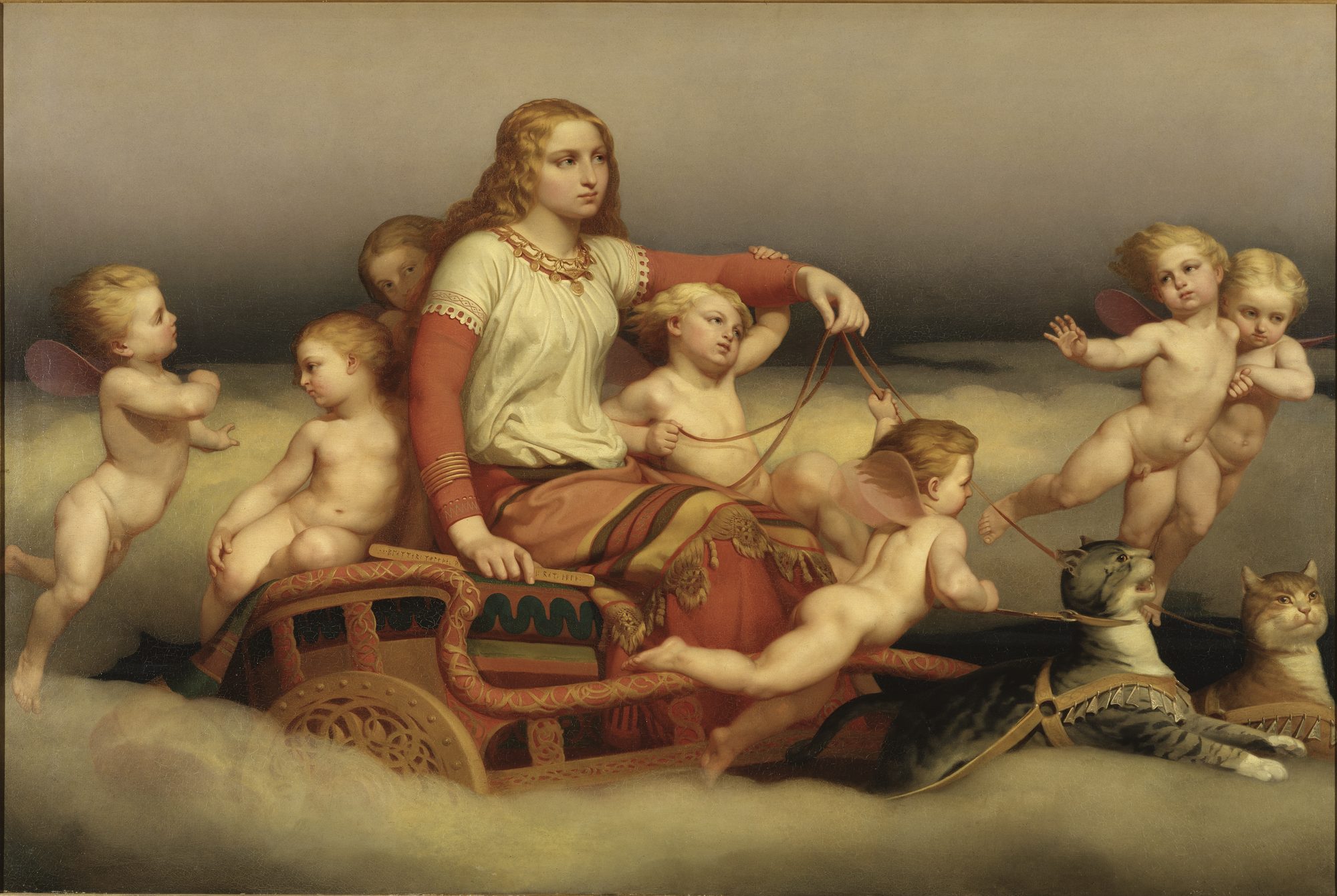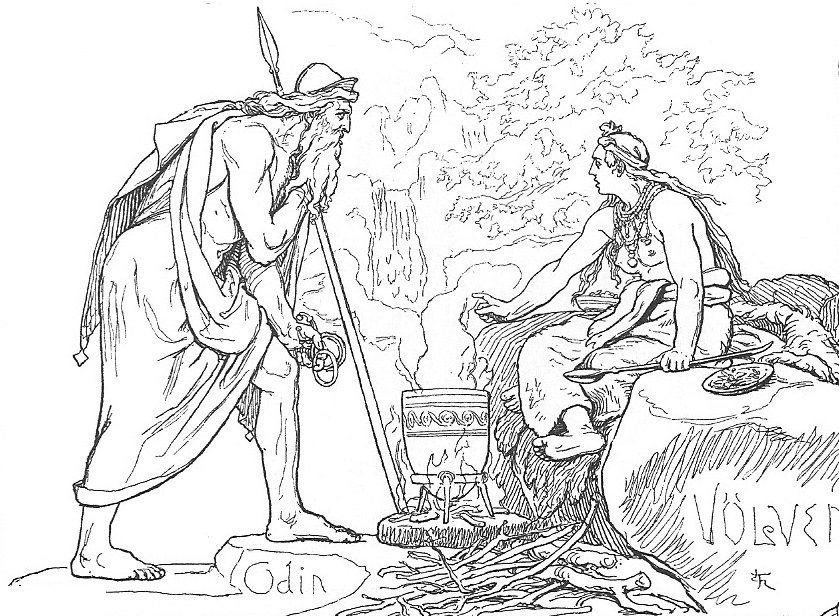
He should not have been sitting there at all. The high seat was Hlithskjolf, the Gate-Shelf, Odin’s own watch-place, from which a god could look out over all the worlds at once; and one day Freyr climbed into it. Whatever he meant by the act, the sources call it overweening pride, presuming to the holy seat, and say it was afterward avenged upon him. What he saw was a giant’s hall far to the north, and a woman crossing the yard. She raised her arms to open a door, and the brightness that came off her hands lit up the whole of sky and sea. Her name was GerthThe giant-maiden, daughter of the hill-giant Gymir, whom Freyr glimpsed from Odin's high seat.. From that moment Freyr was a ruined man. He went home and did not speak, did not sleep, did not drink. The god of plenty had been emptied out by the sight of a single woman, and no one in the hall knew what was wrong with him.
Sun, rain, harvest, peace
This is not how the North usually introduces Freyr. Ordinarily he is the god of the good year, the one you called on when the fields mattered more than the sword. He belongs to the Vanir, the tribe of fertility gods (the poems call them the Wanes) who came to the Æsir out of the settlement that ended the first war ever fought in the world.
Snorri Sturluson, writing his Prose Edda in thirteenth-century Iceland, sets his portfolio out plainly: Freyr rules over the rain and the shining of the sun, and therewithal the fruit of the earth; and it is good to call on him for fruitful seasons and peace. He governs also the prosperity of men.
Sun, rain, harvest, peace, prosperity: the whole quiet machinery of a world that feeds itself. His father is Njörth, the Vanir god of sea and wealth, and his sister is Freyja, goddess of love and the slain, the two of them twin faces of the same gift of increase.
There is a genuine tug in the sources over where he belongs. Snorri, in the passage above, counts him the most renowned of the Æsir.
The Poetic Edda is just as clear that he is one of the Vanir: when Gerth’s household demands to know who this suitor’s envoy serves, the question runs whether he is of the elves, or the offspring of gods, or of the wise Wanes?
Both traditions are true at once, and the tidiest way to hold them is the old one: Freyr is Vanir by birth and dwells among the Æsir by treaty. He is not only tolerated there. He is honoured. The gods gave him Álfheim, the country of the Light-Elves who are fairer to look upon than the sun,
as a tooth-gift when he was still a child cutting his first tooth. Lord of the elves, then, before he was old enough to know it.
A sword that fights of itself
The love-sickness is the myth that defines him, and it turns on a bargain that will cost him everything. Njörth, seeing his son wasting away, sent Freyr’s servant Skírnir to find out the cause and, once he had it, to go and win Gerth on Freyr’s behalf. The errand was dangerous: Gerth lived past bound and snarling dogs and a wall of leaping flame, in the hall of her father the hill-giant Gymir.
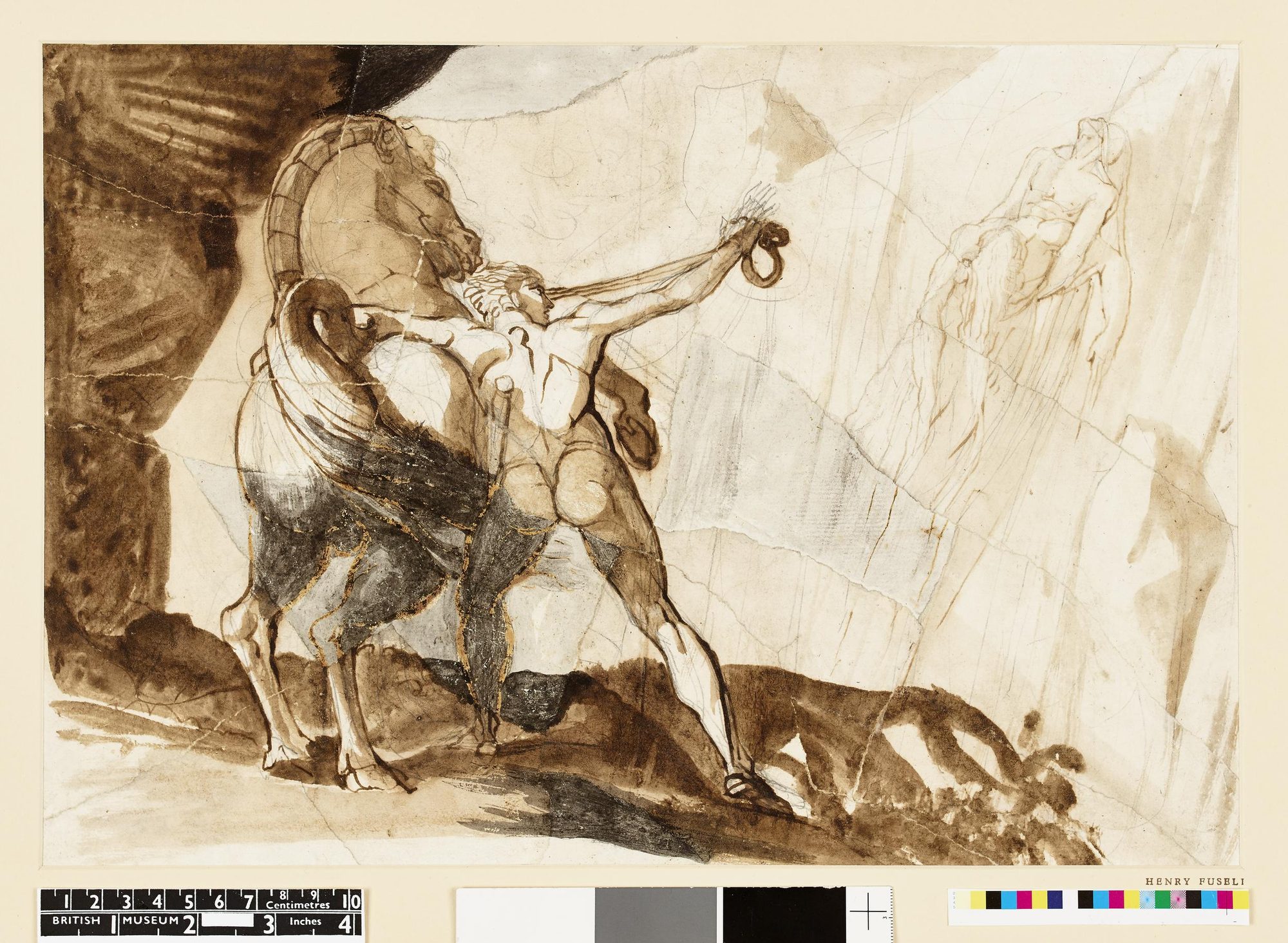
So Freyr paid his man in advance with the two things a god should never let go. He gave Skírnir a horse that could carry a rider through the dark and through magic flickering flame, and he gave him his sword, the one so good that it fights of itself against the giants grim.
A self-swinging blade, and Freyr handed it over for a chance at a woman he had glimpsed once from a stolen seat.
Eleven apples, all of gold
Skírnir rode through the fire and tried everything. He offered Gerth eleven apples, all of gold, the fruit of plenty; she refused them. He offered her the ring Draupnir, from which eight rings of equal weight drip every ninth night; she refused that too, saying she wanted for no gold in her father’s house. He drew the self-fighting sword and threatened to take her head; she was unmoved. And then he turned to the last and worst tool, a magic staff and a carving of runesThe ancient letters of the Germanic futharks, believed to carry magic power when carved., and laid a curse on her so total that she broke.
He promised her a life on the eagle’s hill gazing down at the gates of HelThe Norse realm of the dead, ruled in Snorri's telling by Loki's daughter of the same name., marriage to a three-headed giant, a horn of filth to drink, madness and longing and lust cut into her with the rune he named. Faced with that, Gerth yielded. She would meet Freyr, she said, in nine nights’ time, at a windless wood called Barri, the Leafy. It is an ugly bargain for so bright a god, and the poem does not pretend otherwise: consent won by threat is the shadow across the whole radiant love-story.
Skírnir brought the answer home, and here Snorri quotes the one stanza of the poem he keeps word for word, because it is the truest thing in it. Told he must wait nine nights, the god of the good year, who commands the seasons of the entire world, cannot command his own longing:
Long is one night, longer are two; How then shall I bear three? (Skírnismál 43, trans. Bellows)
An antler is not enough
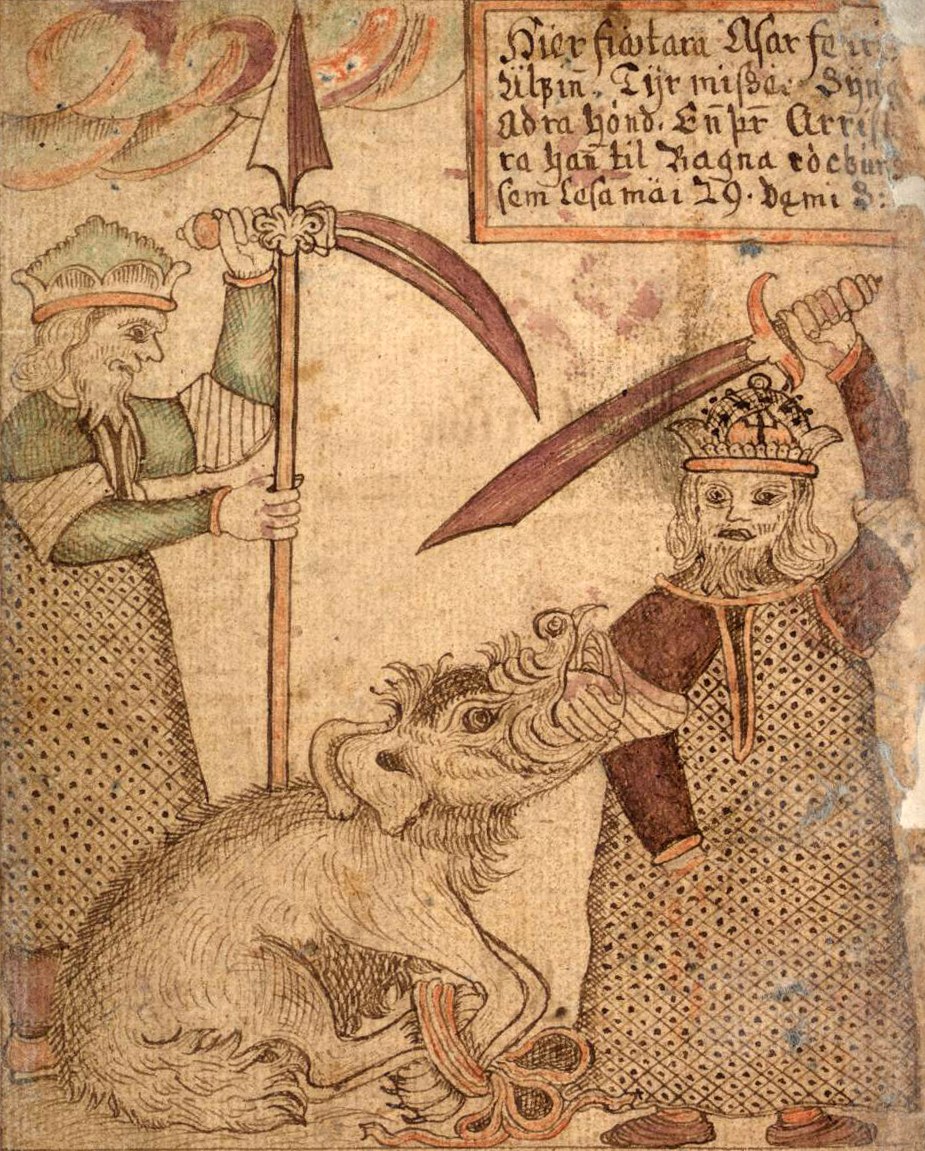
We are not told the wedding, only that it came, and that Gerth became his. What we are told is the reckoning. Because Freyr gave his sword away for love, he will meet the end of the world unarmed. At RagnarökThe prophesied doom of the gods at the end of the world, when the old order falls., when the fire-giant Surt comes burning out of the south, it is Freyr who goes against him, and the encounter is hard, and Freyr falls.
Snorri names the reason exactly: it is to be his death that he lacks that good sword of his, which he gave to Skírnir.
The most peaceable of the gods dies in the last battle, weaponless, killed by a bargain he made for a woman’s hand. He is not defenceless by nature. He once slew the giant Beli, Snorri says, with the horn of a hart,
a stag’s antler snatched up bare of any blade. But the good sword is gone, and against Surt an antler is not enough.
A ship folded into a pouch
For all that, the images the North kept of him are images of abundance and light, not of that last defeat. The dwarves forged him the ship Skíðblaðnir, which always finds a favouring breeze the instant its sail goes up, whichever way it is pointed, and which folds down like a cloth to be carried in a pouch. They forged him the golden boar (Snorri gives it two names in one breath, Gullinbursti, Gold-Mane, and Slíðrugtanni, Fearful-Tusk) which runs through air and water faster than any horse and whose blazing bristles turn the darkest night to day.
Freyr drove that boar in the funeral procession of Baldr, a god of brightness leading a god of brightness to the pyre. Lord of the fruitful season, lord of the elves, lord of the ship that folds and the boar that shines: the North remembered Freyr for what he gave, and then, quietly and exactly, for the one thing he gave away.
- Poetic Edda, Skírnismál (The Ballad of Skirnir), introductory prose and stanzas 1–43 (trans. Henry Adams Bellows, 1923; parallel Old Norse, Völuspá.org, read verbatim)the wooing of Gerth in full — Freyr’s sitting in Hlithskjolf; the first sight of Gerth, whose raised arms lit sky and sea; his silent love-sickness (
he spake not, he slept not, he drank not
); Skírnir’s errand and the price of the self-fighting sword and the flame-passing horse; the eleven golden apples; the ring Draupnir and its eight rings drippingon every ninth night
; the threats and the rune-curse (the eagle’s hill, the three-headed giant, the horn of filth,longing and madness and lust
); the trysting wood Barri; and the nine-nights’ wait. Stanzas 17–18 place Freyr among thewise Wanes
(Vanir). - Poetic Edda, Grímnismál 5 (trans. Bellows, 1923; read verbatim)
And Alfheim the gods to Freyr once gave / As a tooth-gift in ancient times
— the primary source for Freyr as lord of Álfheim. - Poetic Edda, Völuspá 21–24 (trans. Bellows, 1923; read verbatim)the first war in the world, between the Æsir and the
Wanes
(Vanir), out of whose settlement the Vanir came among the gods. - Snorri Sturluson, Prose Edda, Gylfaginning XXIV (trans. Arthur Gilchrist Brodeur, 1916; read verbatim)Freyr as son of Njörth and brother of Freyja; his rule over
the rain and the shining of the sun, and therewithal the fruit of the earth
, and his governance of fruitful seasons, peace and the prosperity of men. Here he is calledthe most renowned of the Æsir
, in tension with the Poetic Edda’s Vanir. - Snorri Sturluson, Prose Edda, Gylfaginning XVII (trans. Brodeur, 1916; read verbatim)Álfheim and the Light-Elves,
fairer to look upon than the sun
. The chapter describes the realm but does not itself name Freyr as its ruler; that link is Grímnismál 5. - Snorri Sturluson, Prose Edda, Gylfaginning XXXVII (trans. Brodeur, 1916; read verbatim)Snorri’s paraphrase of the Gerth wooing; the sitting in Hlithskjolf as pride
avenged upon him
; the slaying of Beliwith the horn of a hart
; Njörth’s sending of Skírnir; and the grief-lament stanza quoted directly. - Snorri Sturluson, Prose Edda, Gylfaginning XLIX (trans. Brodeur, 1916; read verbatim)Freyr in Baldr’s funeral procession, driving a chariot drawn by the golden boar, named there both Gullinbursti and Slíðrugtanni.
- Snorri Sturluson, Prose Edda, Gylfaginning LI (trans. Brodeur, 1916; read verbatim)Ragnarök — the weaponless Freyr’s hard encounter with Surt, and his death
that he lacks that good sword of his, which he gave to Skírnir
. - Snorri Sturluson, Prose Edda, Skáldskaparmál XLIII (trans. Brodeur, 1916; read verbatim)the dwarves’ treasures given to Freyr — the ship Skíðblaðnir, which folds like a napkin and never lacks a favouring breeze, and the boar Gullinbursti, which runs through air and water and whose bristles light the dark; and, separately, that the ring Draupnir was made for and given to Odin.