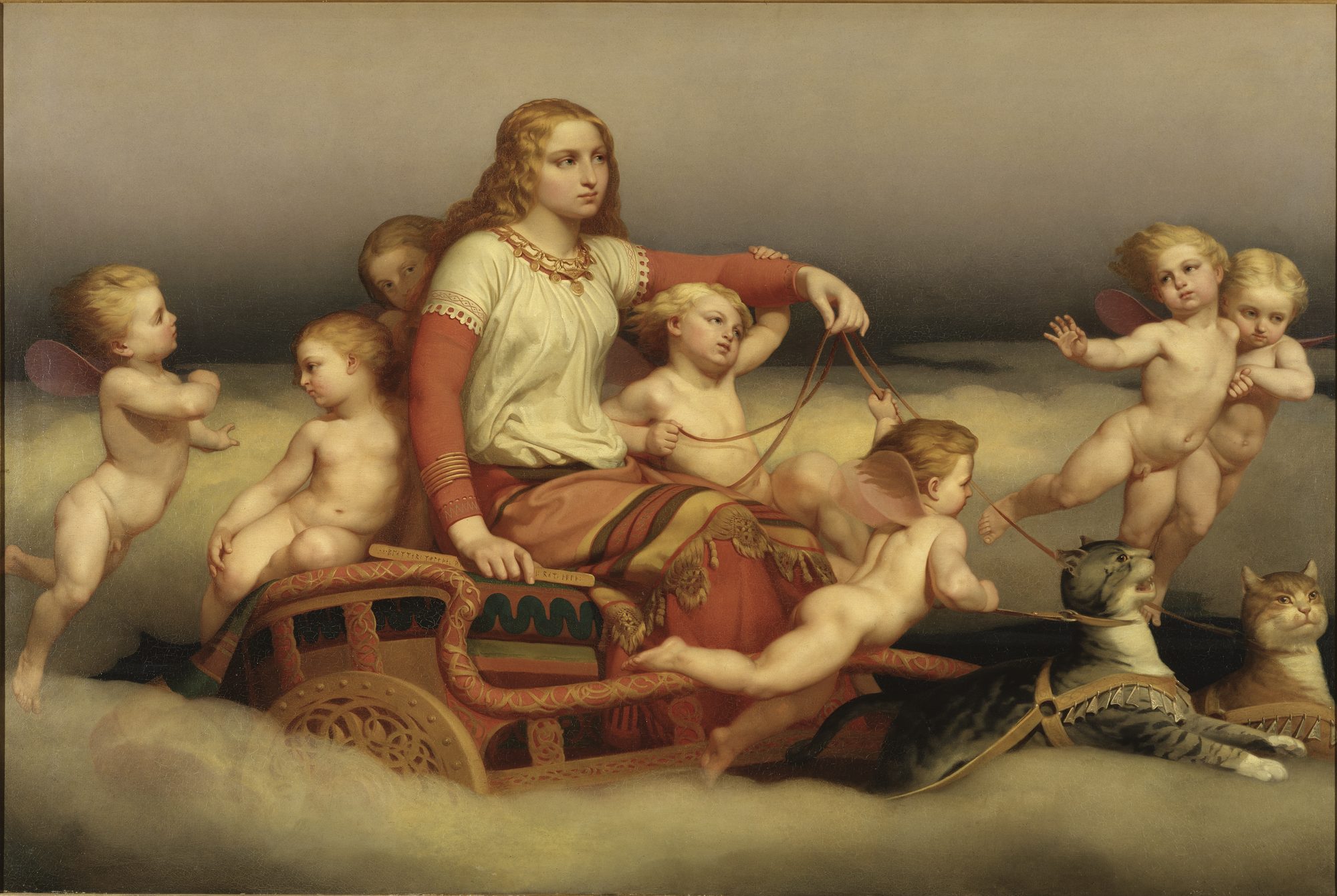
She does not wait at home for the dead to be brought to her. She rides out to the killing-ground herself, in a chariot drawn by cats, and when the fighting is done she takes her share of the corpses off the field. Not all of them, and not the leavings. Half. The Norse poems are precise about this, and precise about the verb: she does not merely receive the slain, she chooses them, every day picking who among the fallen will sit in her hall while the rest go to Odin. This is not the goddess of love as later centuries would soften her, a pretty figure of longing and flowers. She is that too, and men in love did pray to her. But the oldest sources put her first on the battlefield with a claim equal to the Allfather’s own, and her name is Freyja, which means simply the Lady.
She comes from the losing side of the first war ever fought. Before the gods were one household there were two divine tribes, the ÆsirThe gods of Asgard, led by Odin, who fought the Vanir before making peace with them. and the Vanir, and they went to war; the conflict ended not in conquest but in settlement, and Freyja came to the Æsir out of that peace. Snorri Sturluson, writing the Prose Edda in thirteenth-century Iceland, names her father as Njörðr, the Vanir god of sea and wealth, and gives her a brother in the same breath: the son was called Freyr, and the daughter Freyja; they were fair of face and mighty.
Brother and sister run in tandem through the whole tradition, he the god of the fruitful season and she the goddess of love and increase, two faces of the same Vanir gift of fertility. And of all the goddesses gathered into the Æsir’s hall, Snorri says flatly, she is the most renowned.
Half the dead each day
Her domain of the dead has a name and a shape. She dwells in Fólkvangr, the Field of the Host, and the Poetic Edda sets the arrangement out in a single stanza of the Grímnismál: The ninth is Folkvang, where Freyja decrees who shall have seats in the hall; the half of the dead each day does she choose, and half does Othin have.
Within that field stands her own hall, Sessrúmnir, which Snorri calls great and fair
and whose name suggests something like rich in seats, roomy with places for the guests she selects. It is a startling division of the war-dead. We remember Valhalla and forget that half the glorious fallen never went there at all; they went to the Lady, chosen by her hand.
And then the chariot. When Freyja goes forth, Snorri writes, she drives her cats and sits in a chariot.
That is the whole of it in the sources: cats, plural, drawing the wagon of the goddess of love and the slain, unnamed and unnumbered, a detail so odd and so specific that it has survived every retelling. Everything else you may have heard about them, that there are two, that they are a particular northern breed, that they bear names, is later invention with no root in the Eddas. Snorri gives us only the image, and the image is enough: the goddess who chooses the dead rides behind a team of cats.
Tears that are red gold
She is, at the same time, the goddess you called on for love. She is most conformable to man’s prayers,
Snorri writes, and songs of love are well-pleasing to her; it is good to call on her for furtherance in love.
Her name itself entered the language of respect: from it, he notes, comes the name of honor, Frú, by which noblewomen are called.
Yet the goddess of love carries her own grief. She is married to a figure named Óðr, of whom almost nothing is known except the one devastating fact that defines him: he went away on long journeys,
and did not come back.
Freyja weeps for him still, and here the myth turns strange and beautiful, because her tears are not water. Freyja weeps for him,
Snorri says, and her tears are red gold.
She loved him enough to go looking, wandering out among unknown peoples under a string of assumed names, Mardöll and Hörn, Gefn and Sýr, so that the skalds could call gold itself the Tear of Mardöll
and mean the weeping of the Lady. Her sorrow is so much a part of her that the poets made grief and treasure the same word.
A temper that cracks the hall
Not everything she owns was wept into being. Freyja possesses the necklace BrísingamenThe necklace that is Freyja's best-known treasure, which bursts apart in her fury., the most famous of her treasures, though the Eddas tell us only that it is hers and never how she came by it; the lurid tale of four dwarfs and a bargain of the bed belongs to a much later, Christian-era story and not to Snorri’s account. She owns, too, a cloak of falcon feathers that lets its wearer fly, and it whirrs when it takes the air.
Loki borrows it twice when the gods need someone airborne, and once, in the ÞrymskviðaThe Eddic poem of the theft of Thor's hammer, in which Freyja refuses to marry the giant who took it., that cloak is not enough to save Freyja from an insult. When the gods propose packing her off as a bride to the giant Þrymr to recover Thor’s stolen hammer, her answer is not tears but rage: Wrathful was Freyja, and fiercely she snorted, and the dwelling great of the gods was shaken, and burst was the mighty Brisings’ necklace.
The goddess of love has a temper that cracks the hall and snaps her own gold from her throat. She will not be bartered. Thor goes in her dress instead.
There is a war-mount too, kept in a single late poem, the Hyndluljóð, and it shines. Freyja rides a boar named Hildisvíni, Battle-Swine, with bristles of gold, forged for her by the dwarfs Dáinn and Nabbi; and the boar, it turns out, is secretly her human favourite Óttar, whom she has disguised in order to ride him to the hall of the slain and win, in a wager against the giantess Hyndla, the recitation of his ancestry that will make his fortune. A goddess who turns her protégé into a golden pig and rides him to the doors of Valhalla to win a genealogy contest is not a figure any tidy theology invented. She is older and wilder than that.
The witch and the mourning wife
The tradition does not agree on what to make of her. In the flyting of the Lokasenna, Loki turns on her savagely, calling her a witch steeped full sore in sin
and swearing that every god and elf in the hall has been her lover, her own brother among them; Freyja answers only that his tongue is false.
Snorri, elsewhere, paints exactly the opposite portrait, a wife so faithful she wandered the world in tears for her lost husband. The sources hold both pictures at once and never reconcile them, the promiscuous witch and the mourning wife, and it is not our place to flatten one into the other. The oldest goddess of the North was large enough to contain the quarrel.
Wrathful was Freyja, and fiercely she snorted, and the dwelling great of the gods was shaken, and burst was the mighty Brisings’ necklace. (Þrymskviða 12, trans. Bellows)
- Snorri Sturluson, Prose Edda, Gylfaginning XXIV (trans. Arthur Gilchrist Brodeur, 1916; Wikisource, read verbatim)Freyja’s parentage from Njörðr alongside her brother Freyr; her rank as
the most renowned of the goddesses
; the hall Fólkvangr and her claim on one-half of the battle-slain (with Odin taking the other half); her own hall Sessrúmnir,great and fair
; the chariot she drives drawn by cats; her beingmost conformable to man’s prayers
and the pleasure she takes in songs of love, so that it is good to call on her in love; and the honorific Frú, the title of noblewomen, drawn from her name. - Snorri Sturluson, Prose Edda, Gylfaginning XXXV (trans. Arthur Gilchrist Brodeur, 1916; Wikisource, read verbatim)the catalogue of the Ásynjur, giving her marriage to Óðr, who
went away on long journeys
; her weeping of red-gold tears as she sought him among unknown peoples under sundry assumed names; her daughter Hnoss, so fair that precious things (hnossir) are named for her; her ownership of the necklace Brísingamen; and the by-names Mardöll, Hörn, Gefn and Sýr, and the title Lady of the Vanir. - Snorri Sturluson, Prose Edda, Skáldskaparmál XX (trans. Arthur Gilchrist Brodeur, 1916; Wikisource, read verbatim)the definitive list of Freyja-kennings (Daughter of Njördr, Sister of Freyr, Wife of Óðr, Mother of Hnoss, Possessor of the Slain, of Sessrúmnir, of the Gib-Cats and of Brísinga-men, Goddess of the Vanir, Lady of the Vanir, Goddess Beautiful in Tears, Goddess of Love); together with VI (Njörðr as
Father of Freyr and Freyja
), VII (Freyr asBrother of Freyja
), VIII (Heimdallr asSeeker of Freyja’s Necklace
), XVI (Loki as thief of Brísingamen), and the gold-kennings by which gold is called the tears of Mardöll and the weeping of Hörn. - Poetic Edda, Grímnismál 14 (trans. Henry Adams Bellows, 1923; Wikisource, read verbatim)Fólkvangr,
where Freyja decrees who shall have seats in the hall
, and wherethe half of the dead each day does she choose, and half does Othin have.
- Poetic Edda, Þrymskviða 3–4, 12–13 (trans. Henry Adams Bellows, 1923; Wikisource, read verbatim)Loki’s borrowing of Freyja’s feather-cloak, which whirred as he flew; and Freyja’s furious refusal to be sent as Þrymr’s bride, at which the halls of the gods shook and the necklace Brísingamen burst from her.
- Poetic Edda, Hyndluljóð 1–10, 46–47 (trans. Henry Adams Bellows, 1923; Wikisource, read verbatim)the boar Hildisvíni,
the boar with bristles of gold
, forged by the dwarfs Dáinn and Nabbi, who is in truth the disguised Óttar; and Freyja’s ride to Valhöll to win Óttar’s genealogy in a wager against the giantess Hyndla. A late poem, preserved only in Flateyjarbók (c. 1400). - Poetic Edda, Lokasenna 29–36 (with introductory prose and Bellows’ notes; trans. Henry Adams Bellows, 1923; Wikisource, read verbatim)Loki’s accusation that Freyja is a promiscuous
witch, and steeped full sore in sin
who has taken every god and elf as a lover, her own brother among them; her retort that his tongue is false; the contrasting portrait, noted by Bellows from Snorri, of Freyja as a model of fidelity to Óðr; and Loki’s taunt (stanza 36) of the Vanir custom by which Njörðr begot his children on his own sister, a tradition Snorri’s Gylfaginning does not share. - Poetic Edda, Völuspá 21–25 (trans. Henry Adams Bellows, 1923; Wikisource, read verbatim)the first war in the world, between the Æsir and the Vanir, whose settlement brought the Vanir among the gods; and the gods’ debate over who
had given Oth’s bride to the giants’ brood
, where Freyja is named only obliquely as the bride of Óðr.