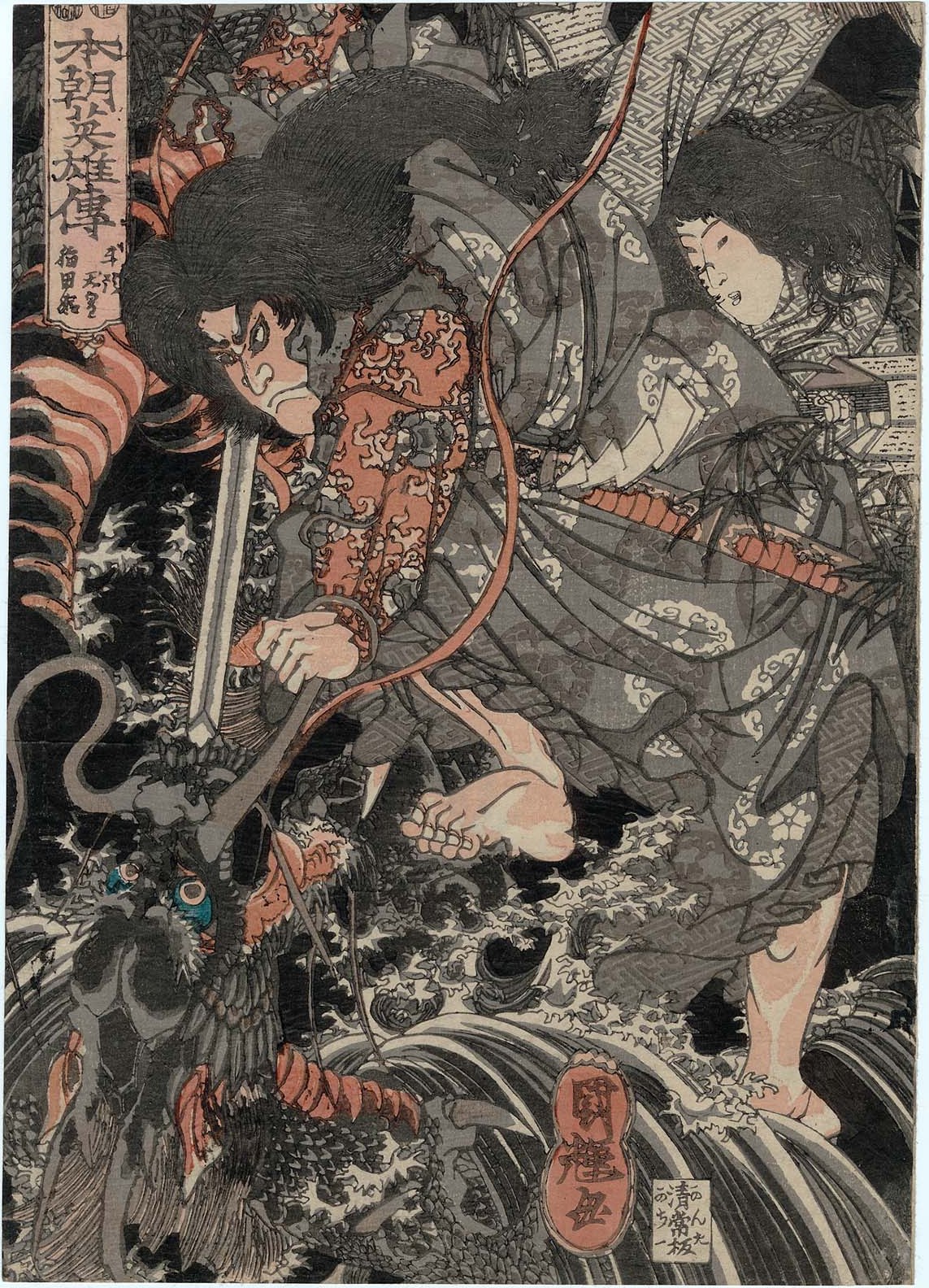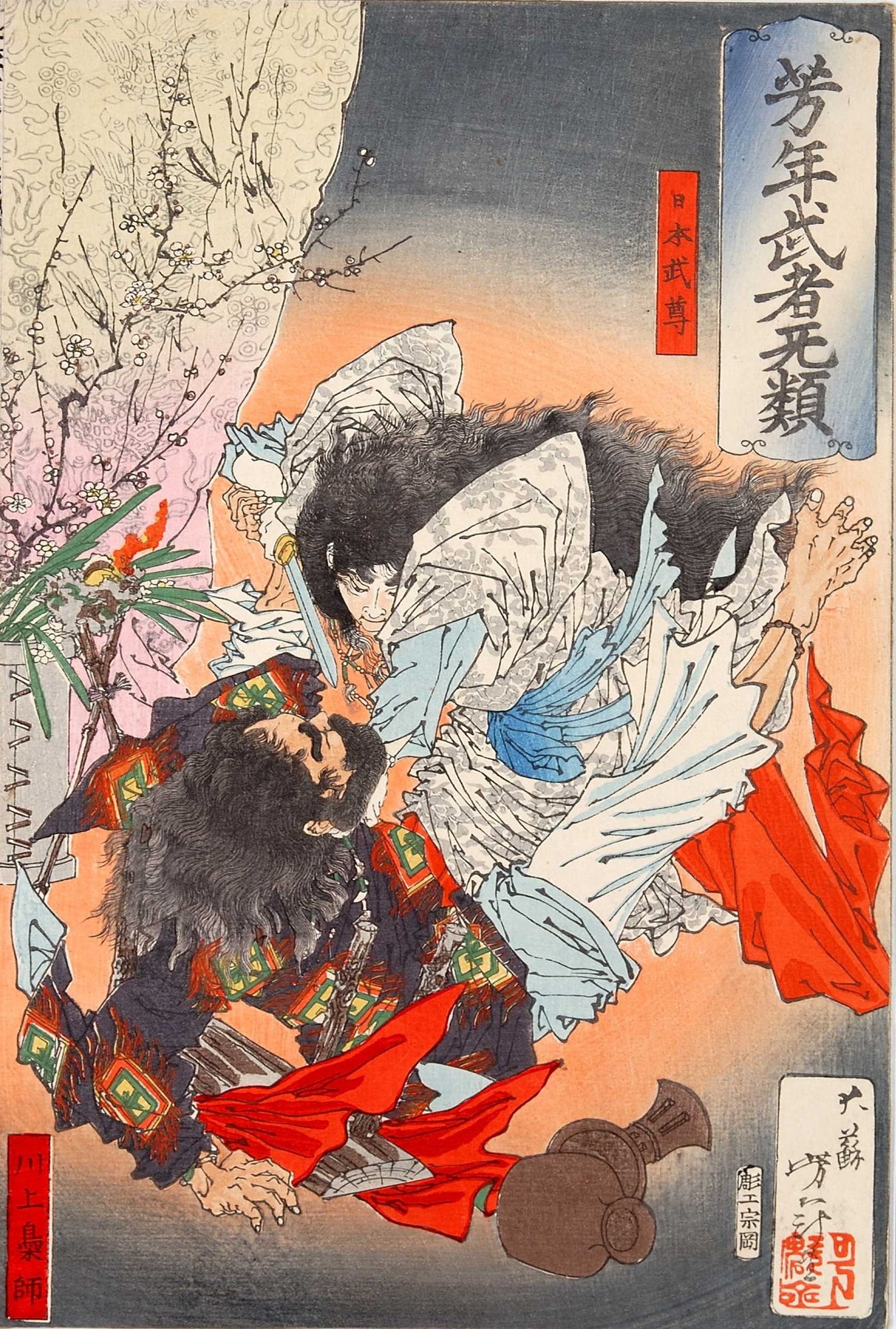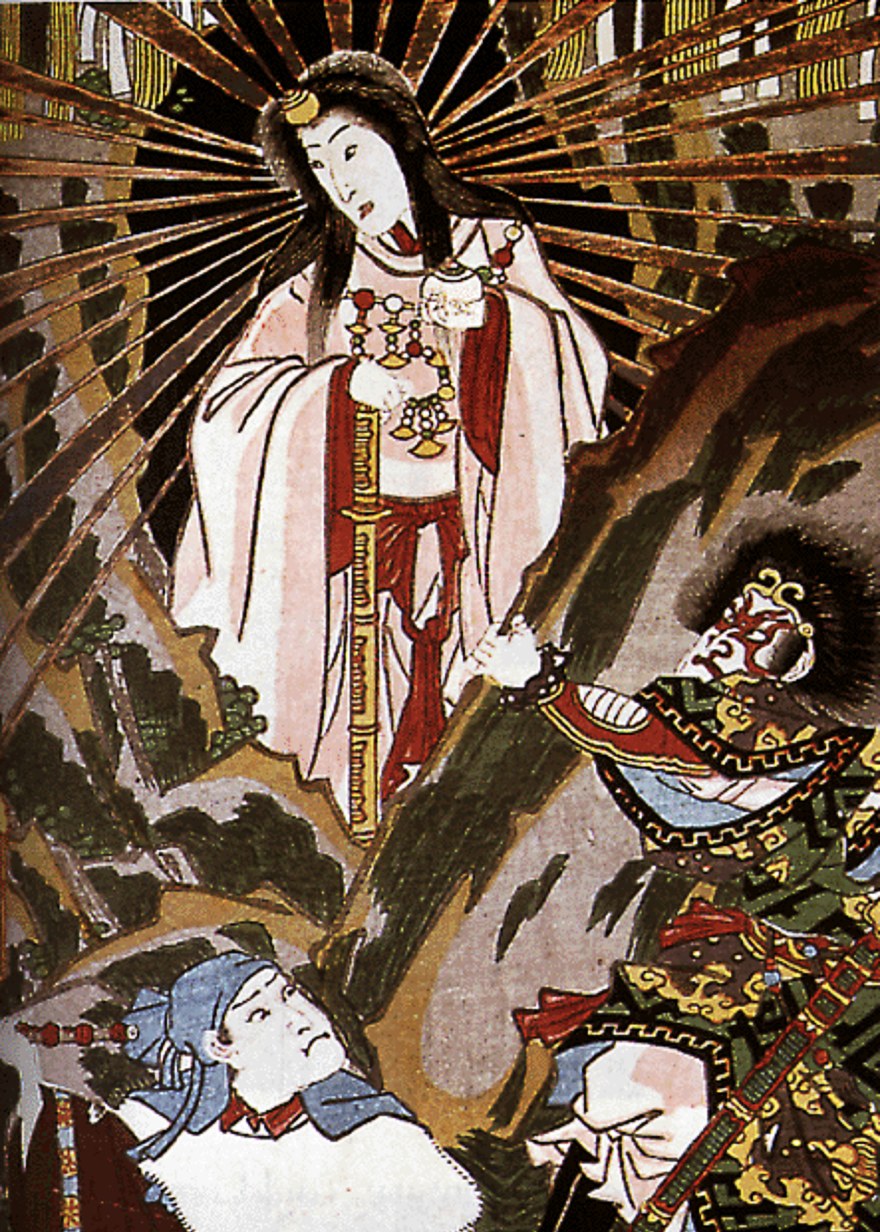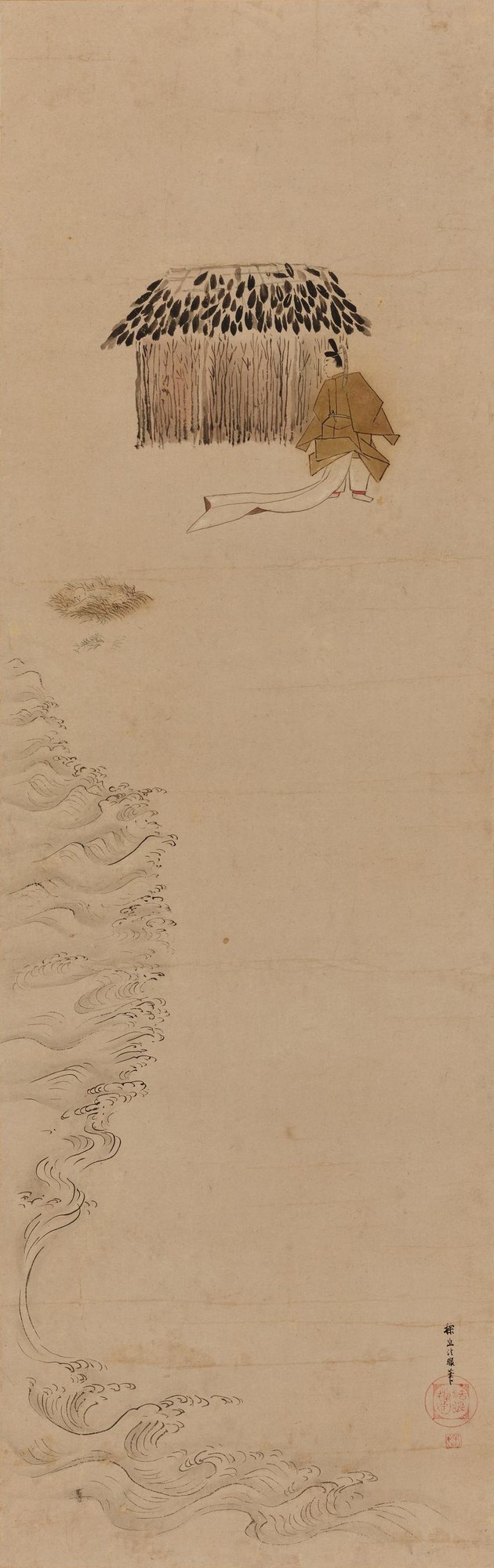
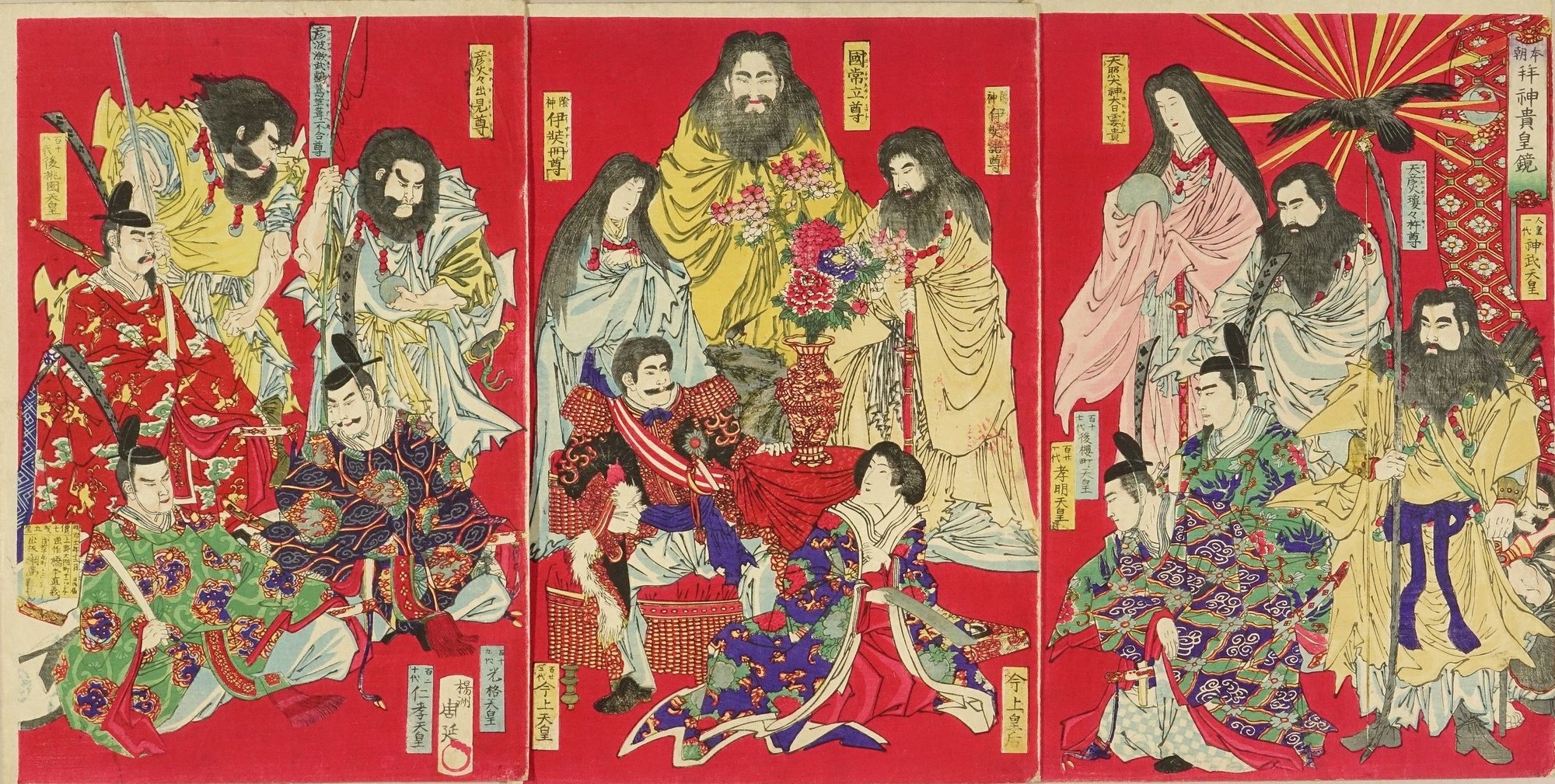
A charter for the throne of Japan can be reduced to a single sentence, and the tradition all but does so. In the fullest telling, the sun-goddess Amaterasu turns to her grandson as she sends him down to the world and says: Go, and rule the land of fresh rice-ears, and may your dynasty endure, like Heaven and Earth, for ever. Everything the emperors of Japan would later claim about why they alone might rule descends from that command. The sentence is less a story than a legal argument dressed as one, and it is worth reading as one, because the texts that carry it were written across roughly eleven hundred years and they do not all say the same thing.
What the line is made of
Before the mandate can mean anything, there must be a line to receive it, and the tradition builds one link by link. The chain runs from Amaterasu to her son Ame-no-Oshiho-mimi, to his son Ninigi, the Heavenly Grandchild who descends, and four generations on to Jimmu, reckoned the first human emperor. The first link is the load-bearing one, and it is fixed by an oath.
In the ukehiThe oath-contest between Amaterasu and her brother in which, by her ruling on parentage, the god born of her jewels is fixed as her son and the line's first link., the contest of vows between Amaterasu and her brother Susanoo, she takes the male gods born from her jewels and rules on their parentage: these five, she declares, are all my children. That ruling makes Oshiho-mimi hers, and so roots the whole succession in the sun herself. The genealogy is the premise on which every mandate-speech that follows quietly rests. Take away the ukehi ruling and the emperors descend from a storm-god’s sword instead, and the argument collapses at its first joint.
The one sentence, in four keys
The command to rule survives in four texts, and each states it in a different register. The differences are small on the page and enormous in what they claim.
The Kojiki, compiled in 712, gives the terse version. Amaterasu and the high creator-god Takami-Musubi lay their charge on the grandchild in plain words: this Luxuriant Reed-Plain-Land-of-Fresh-Rice-ears is the land over which thou shalt rule. He answers, I will descend from Heaven according to your commands, and that is all. The land is named and the right to rule it is granted, but there is no promise of forever anywhere in the charge. The eternity most readers assume is native to this myth is simply absent from its oldest telling.
The Nihon Shoki, closed only eight years later in 720, supplies the missing clause, and supplies it in the grandest possible form. In the variant account the chronicle labels a one writing
, Amaterasu is the commissioner, and she ends her charge with the sentence the whole theme hangs on: Go! and may prosperity attend thy dynasty, and may it, like Heaven and Earth, endure for ever.
Two texts written within a decade of each other at the same court, and one of them adds eternity to the grant while the other never mentions it. The gap between them is not centuries, which makes it the more striking: this is not memory drifting over long distance but a deliberate strengthening of the claim, made almost at once.
The Kogo ShūiA court ritualist's account of 807 CE, arguing his own clan's antiquity, which preserves the mandate in its most explicit 'unbroken' wording., presented in 807, roughly ninety-five years after the Kojiki, states the promise more explicitly still. Here Amaterasu and Takami-Musubi issue the edict together: the Luxuriant Land of Reed Plains is a country which our descendants are to inherit; go, therefore, and rule over it, and may our Imperial lineage continue unbroken and prosperous co-eternal with Heaven and Earth. The word the earlier eternity-clause implied, unbroken, is now spoken outright, and the modern idea of an imperial line without a single break in it can be traced to this line on the page.
The Engishiki noritoThe formal Shinto liturgies recited by the priesthood; in the codified set of 927 the descent-mandate is spoken aloud as a standing state prayer., the ritual prayers codified in 927, some two centuries after the Kojiki, show the argument in its final condition: a formula recited in the present rather than a story told about the past. In the accession liturgy the sovereign’s own divine ancestors bestowed on him the region under Heaven, saying: let the Sovereign Grandchild’s augustness tranquilly rule over the country of fresh spikes which flourishes in the midst of the reed-moor. A god’s command from the dawn of the world had become a sentence spoken aloud at the corners of the Heian capital, the mandate re-performed as prayer every time a new ruler took the throne.
Whose descent confers the right
Read together, those four witnesses expose a quarrel the smooth version hides. It is easy to say Amaterasu sends her grandson to rule, and easy to forget that the earliest full narrative does not say that at all. In the main text of the Nihon Shoki, the prime mover is not the sun-goddess but Takami-Musubi, the high creator-god, who acts alone; Amaterasu is barely in the room. The Kojiki gives the command to the two of them jointly. Only the Nihon Shoki’s one writing
and the later orthodoxy hand it to Amaterasu by herself.
This is not idle textual variance. It is a dispute about whose descent confers the right to rule, and the Kogo Shūi’s own translators point to the reason. Its author, Inbe no Hironari, was a court ritualist of the Imbe clan, whose divine ancestor was Takami-Musubi, and his text is in part a protest on his family’s behalf against the rival Nakatomi.
Where he keeps Takami-Musubi prominent beside Amaterasu, he is arguing for his own house’s standing in the same breath as the emperor’s. The mandate, in other words, was never a settled fact the chronicles merely recorded. It was a claim under active negotiation, and the identity of the god who issued it moved with the fortunes of the clans who served the throne.
Legitimacy you can hold in your hands
The genius of the mandate is that it did not stay on the page. It was made portable, transferred at the descent as a set of sacred objects that reappear at every enthronement as physical proof of legitimate rule. The Kogo Shūi says plainly what they are for: the mirror and sword are the emblems the Imbe family offer to the emperor at his accession as the Divine Imperial Heirloom which protects the legitimate sovereign against the powers of evil. Legitimacy, on this account, is a thing you can carry into the room and place in a ruler’s hands.
One object does more than prove the claim; it keeps the ancestress present. When Amaterasu hands down the mirror, she collapses the distance between the emblem and herself: regard this mirror exactly as if it were our august spirit, and reverence it as if reverencing us. The ruler is never to lose contact with the goddess he descends from, because a fragment of her is always beside him. The land, meanwhile, is named in the same agricultural key every time, a rice-country promised to a prince whose own name means Rice-ear-Ruddy-Plenty. Sun-goddess, rice-land, rice-prince: the mandate binds the throne to the harvest as tightly as it binds it to the sky.
When the first man claims it
The chain closes when a human being invokes it. At his enthronement Jimmu, the first mortal emperor, grounds his conquest not in force but in inheritance, quoting the descent as his title deed: of old, he says, our Heavenly deities, pointing to this land of fair rice-ears of the fertile reed-plain, gave it to our Heavenly ancestor Ninigi. He then reckons dynastic time from the descent in a figure of studied vastness, over 1,792,470 years, a span Aston recognised as borrowed from the enormous reign-lengths of the early Chinese monarchs rather than any real count. The number is chosen for antiquity rather than accuracy: the older the grant, the stronger the claim.
Jimmu extends the mandate one step further, from a single land to the whole world, vowing to extend the line of the Imperial descendants and, in the chronicle’s memorable image, to cover the eight cords so as to form a roof, one roof raised over all the quarters of the earth. The picture is genuinely there in the eighth-century text, and it is worth marking exactly where it stops.
The vision of universal dominion under one roof belongs to the Nihon Shoki. The slogan later built on it, and the imperialist programme that slogan served in the twentieth century, do not; they are a modern reading laid over an ancient line, and the mandate itself asks only that the sun’s descendants rule the land of rice, and rule it without end.
Go! and may prosperity attend thy dynasty, and may it, like Heaven and Earth, endure for ever. (Nihongi I, trans. Aston, p. 76)
- Kojiki (Records of Ancient Matters, 712 CE), Book II,
The August Descent from Heaven of the August Grandchild
, trans. Basil Hall Chamberlain (orig. 1882; 1919 ed.)read verbatim for the terse descent-charge that names the land and the right to rule it (This Luxuriant Reed-Plain-Land-of-Fresh-Rice-ears is the land over which thou shalt rule
;I will descend from Heaven according to your commands
) and carries no eternity-clause, and for the mirror injunction (Regard this mirror exactly as if it were our august spirit, and reverence it as if reverencing us
). Read verbatim at https://sacred-texts.com/shi/kj/kj040.htm. Compiled 712 CE. - Nihon Shoki (Nihongi), Books I–III,
The Age of the Gods
andJimmu
, trans. **W. G. Aston, *NihongiChronicles of Japan from the Earliest Times to A.D. 697*, Vol. I (London: Japan Society, 1896)**: read verbatim for theone writing
charter in which Amaterasu commissions the line and utters the eternity-formula (may it, like Heaven and Earth, endure for ever
, p. 76); the main-text descent in which Takami-Musubi alone is the prime mover (pp. 70–71); Jimmu’s accession invocation of the descent-mandate and the1,792,470 years
reckoning (p. 110); and theeight cords… form a roof
foundation edict (p. 132). archive.org idnihongi1asto. Compiled 720 CE. - Kogo Shūi (
Gleanings from Ancient Stories
, presented 807 CE), by Inbe no Hironari, trans. Genchi Katō & Hikoshirō Hoshino (1926)read verbatim for the joint Amaterasu and Takami-Musubi edict with theunbroken… co-eternal with Heaven and Earth
formula (pp. 26–27); the two Sacred Treasures enumerated at the descent; the regalia as the enthronement heirloomwhich protects the legitimate sovereign
(p. 37); and the translators’ introduction on the Imbe-clan interest behind Takami-Musubi’s prominence (pp. 3–4). archive.org idKogoshui. Presented 807 CE. - Engishiki norito (Shinto ritual prayers, codified 927 CE; the liturgy itself is older), trans. Sir Ernest Satow,
Ancient Japanese Rituals
, as reprinted in The Sacred Books and Early Literature of the East, Vol. XIII (Japan), pp. 166, 169–170read verbatim for the descent-mandate restated as recited state liturgy, the sovereign’s divine progenitors havingbestowed on him the region under Heaven, saying: Let the Sovereign Grandchild’s augustness tranquilly rule over the country of fresh spikes which flourishes in the midst of the reed-moor
. archive.org idTheSacredBooksAndEarlyLiteratureOfTheEast13Japan. Codified 927 CE.