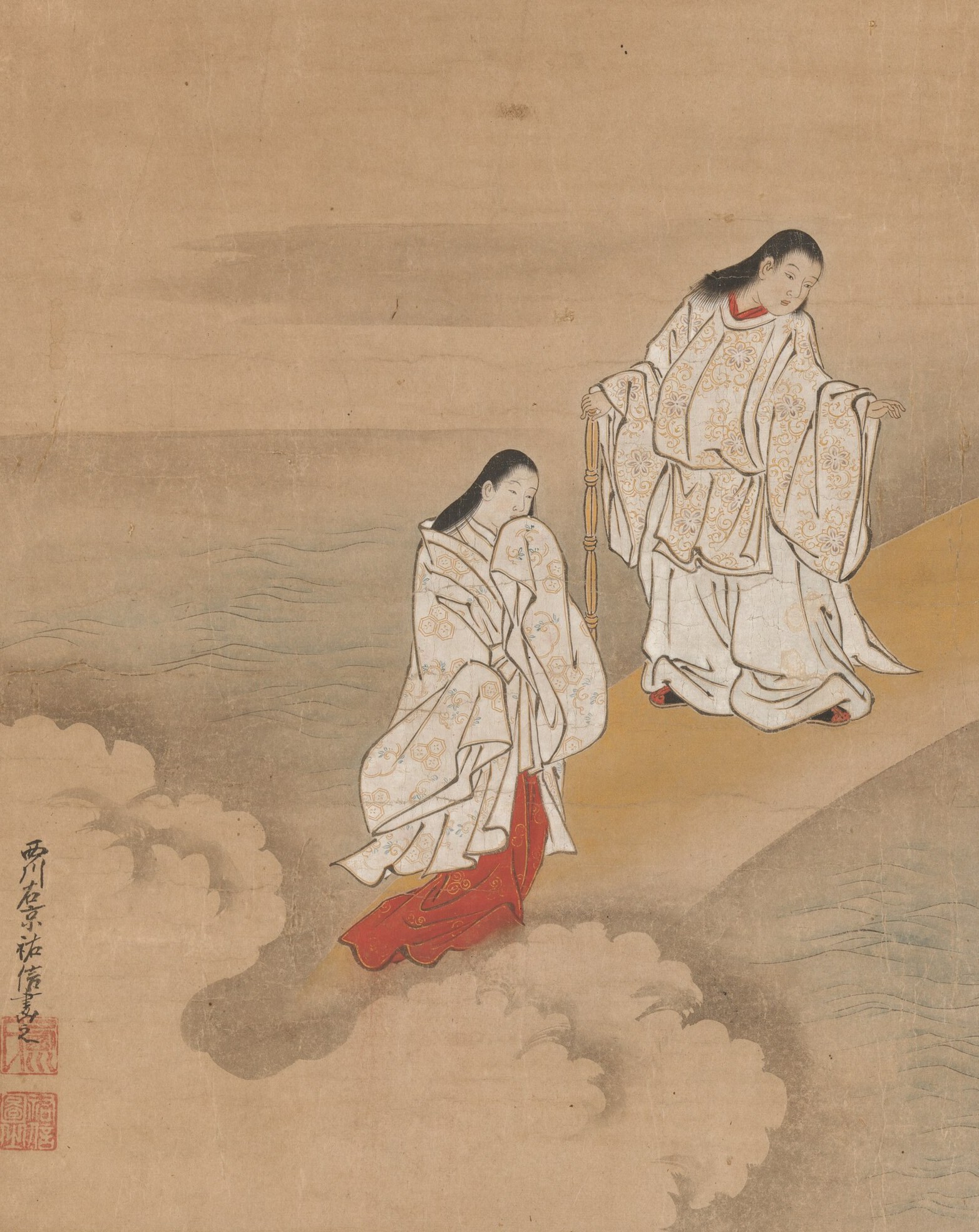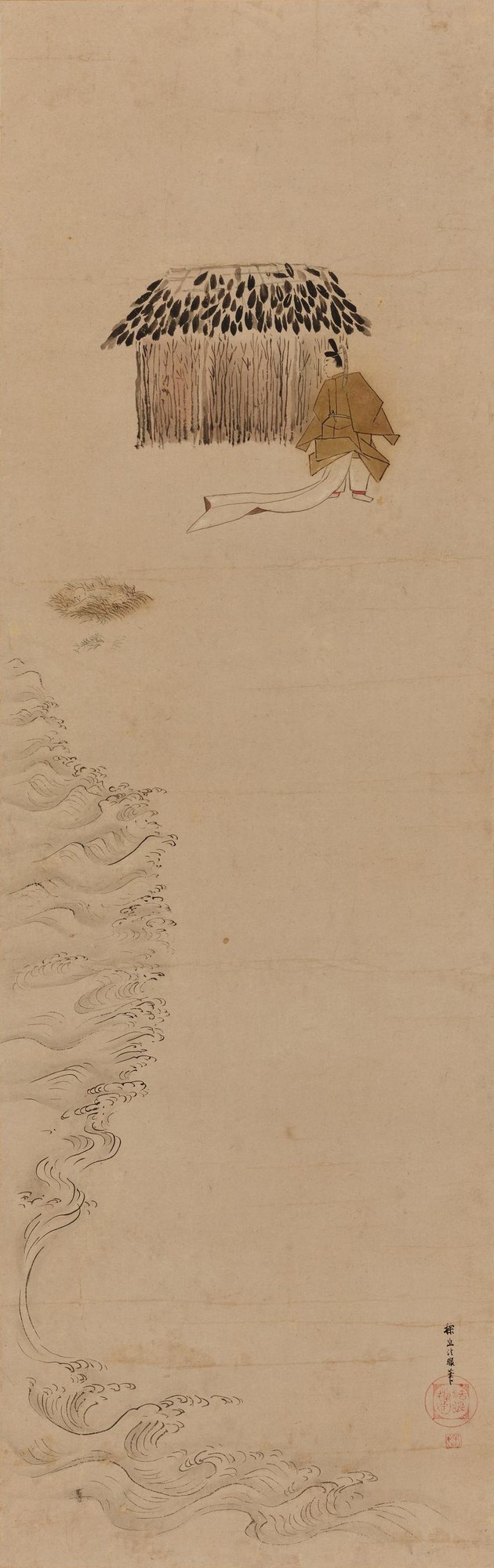
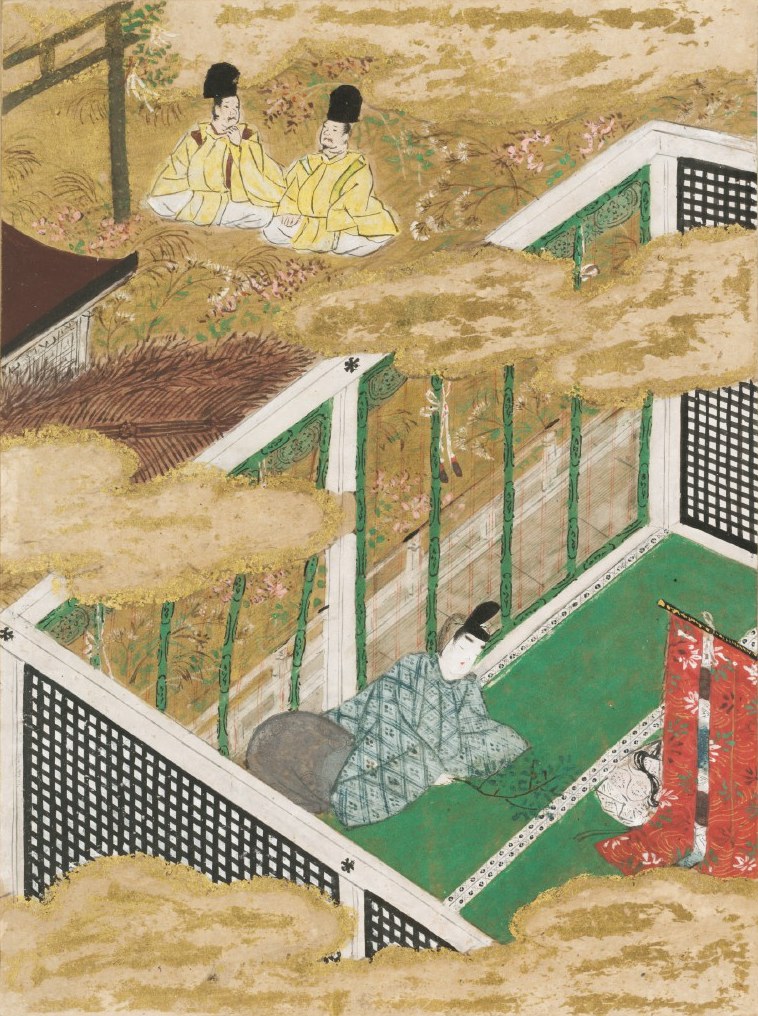
A king lay uneasy in a house he shared with his own gods. Under the sovereign the chronicles call Sujin, the sun goddess Amaterasu and the earth-spirit of Yamato had been worshipped inside the emperor’s Great Hall, under his roof, at his hearth. The chronicle says he dreaded the power of these Gods, and did not feel secure in their dwelling together.
So he did a strange and consequential thing. He sent his ancestress out of his house. He entrusted Amaterasu to his daughter Toyosukiirihime, to be worshipped away from the palace, at the village of Kasanuhi, where he established the sacred enclosure of Shiki.
From that act of holy fear, the tradition says, the whole institution of the consecrated princess begins.
A king afraid of his own goddess
That founding image comes from the Nihon Shoki, the court chronicle compiled in 720. It sets the scene in the reign of Sujin, which its own artificial and long-rejected early chronology places in the first century before our era. No confident date can be hung on it. The chronicle was written down some seven or eight centuries after the events it imagines, and preserves no verifiable history of them; Toyosukiirihime is best read as a legendary founder, not a datable priestess. What survives is the pattern she is made to establish. The goddess is too dangerous to keep at home, and a daughter of the ruling house is set apart to tend her at a distance.
The next reign completes the legend. Under Suinin, the same chronicle says, Amaterasu was taken from Toyosukiirihime no Mikoto, and entrusted to Yamatohime no Mikoto,
the first princess’s niece. Yamatohime sought for a place where she might enshrine the Great Goddess,
wandering through Uda and Ōmi and Mino until she arrived in the province of Ise.
There the goddess herself is made to speak, choosing her own ground in words that became fixed to the place: The province of Ise, of the divine wind, is the land whither repair the waves from the eternal world, the successive waves. It is a secluded and pleasant land. In this land I wish to dwell.
A shrine was raised, and beside the Isuzu river an Abstinence Palace was built,
called the palace of Iso. Yamatohime is counted the second of the line, and the mythic first mistress of the Ise sanctuary.
The staff the emperor leaned on
One variant in the same passage says the emperor made Yamatohime his august staff
and offered her to Amaterasu.
That small phrase carried a large idea. The princess was not merely a caretaker of the shrine. She was the emperor’s instrument reaching toward the goddess, the mitsue-shiroThe princess understood as the emperor's "staff-substitute," the vessel through whom the goddess's will was received on the sovereign's behalf., the medium through whom the divine will was received on the sovereign’s behalf. The saiō was the point where the ruling house touched its own divine ancestress, and the whole apparatus that grew around her existed to keep that point of contact pure.
Between the legend and the record lies a caution the reader deserves. The elaborate office described below belongs to the Heian court and is codified in a rulebook of the tenth century. The chain the tradition draws, from Toyosukiirihime to Yamatohime to the historical princesses to the mature institution, is a genealogy of its own devising, not a documented continuity of practice. Roughly a thousand years separate the legendary founding, as the chronicle sets it, from the codified rite. It is one story told across an enormous span, and it should not be mistaken for one seamless custom running unbroken through the centuries.
The first princess we can actually name
The earliest saiō we can hold as a real, breathing woman is Princess Ōku, daughter of the sovereign Tenmu, born in the middle of the seventh century. A late chronicle, the Fusō Ryakki, compiled some four hundred years after her life, credits Tenmu with founding the reign-by-reign office and offering Ōku to Ise in thanks for his victory in the civil war of 672. That is a distant tradition, not a contemporary record, and its founding claim should be held loosely.
But Ōku herself is no legend. She is documented within living memory of her service, in the Man’yōshū, the great poetry anthology whose relevant poems were composed in 686 and gathered around 759, and in the Nihon Shoki, which records her recall from Ise. Between the goddess’s imagined speech and this princess’s attested grief lie the better part of seven hundred years, and the two belong to different registers entirely: one is a myth of origins, the other a woman whose voice we still have.
Read out of the cracks in a shell
By the time the Engishiki was compiled in 927, the making of a saiō had become a long and exacting machine, and the rulebook set it down. On a new emperor’s accession, an unmarried imperial princess was selected by tortoise-shell divination. The shell was scorched over fire, and the next servant of the sun goddess was read out of the heat-cracks that spidered across it: a life chosen by the pattern of a burn. This selection is called bokujōThe selection of the princess by tortoise-shell divination, the shell scorched over fire and its verdict read from the heat-cracks., and once the verdict was announced the princess entered ritual abstinence at once.
Then came the years of purification, for she could not simply travel to Ise. First she withdrew into a hall fixed by divination within the greater palace enclosure, the Shosaiin, where she passed a period of abstinent seclusion nominally reckoned at a year, though in practice it was often shorter. In the eighth month of the following year she moved again, out of the capital, to a temporary shrine-residence called the Nonomiya, its site also chosen by divination and, in the Heian period, usually set in the pure country at Sagano near the capital.
The Nonomiya was built for one princess and one term. When her service ended it was pulled down: a shrine with the lifespan of a single vocation, remembered by its unbarked black torii and its low fence of brushwood. Only after these stages, on the order of two or three years of consecration, did the ceremonial procession carry her at last to Ise. There, at her permanent seat some twenty kilometres from the Grand Shrine, she lived in continual abstinence, worshipping the goddess from afar and attending the shrine at the great seasonal festivals of the year.
A world where you may not say death
The purity demanded of her reached into her mouth. The Engishiki preserves the saiō’s imikotobaThe saiō's taboo-vocabulary, in which forbidden words for death, blood and the Buddha were replaced with euphemisms during her service., her taboo-vocabulary, and it is one of the most vivid records the tradition left of what a consecrated life was thought to require.
Because she had to be kept clear of both death-pollution and the foreign creed of Buddhism, whole classes of ordinary words were forbidden her and replaced with euphemisms. The Buddha she must call the middle-child
; a sutra became dyed paper,
a temple a tile-roof,
a monk a long-hair,
a nun a female long-hair.
And death she might not name at all. To die was to recover.
Illness was resting.
Weeping was dripping brine,
blood was sweat,
meat was mushroom,
and a grave was a clod of earth.
Read that list slowly and a whole interior world opens. Here was a woman kept so far from decay and defilement that the very sounds of mortality were sanded out of her speech, a princess for whom getting sick was called resting and dying was called getting well. The euphemisms are not squeamishness. They are the shape of a purity so total that language itself had to be purged of what might stain her.
The princess who came home too late
What that purity cost is written nowhere so plainly as in the four poems of Princess Ōku. While she served at Ise, her younger brother, Prince Ōtsu, a gifted young man at the centre of the court, came to her in secret at the shrine. She saw him off before dawn, standing in the dark until she was wet with dew, and let him go back to the capital. There, after their father’s death, he was accused of treason and put to death, aged twenty-four. Ōku was recalled from Ise to a home where her brother was already dead. The Nihon Shoki gives the bare dates; the Man’yōshū gives her voice, and it is unbearable.
To speed my brother Parting for Yamato, In the deep of night I stood Till wet with the dew of dawn. (Man’yōshū II.105)
Then, arriving in the capital only to find him gone: Would that I had stayed / In the land of Ise / Of the Divine Wind. / Why have I come / Now that he is dead!
And at the last, watching his remains carried to their tomb on the twin-peaked mountain of Futagami, she wrote that from tomorrow she would look on that mountain and see her brother in it.
This is the saiō made human. All the fire-cracked shells and forbidden words and demolished shrines resolve, in the end, into a young woman who had given herself to the goddess and could not be at her brother’s side, arriving home to a clod of earth she was not even permitted to call by its name.
- Nihon Shoki (Chronicles of Japan), compiled 720 CE — trans. W. G. Aston, Nihongi (Japan Society, London, 1896; public domain). Vol. I, Sujin 6 (pp. 151-152)the emperor
dreaded the power of these Gods,
entrusts Amaterasu to Toyosukiirihime, and establishesthe sacred enclosure of Shiki
at Kasanuhi. Vol. I, Suinin 25 (pp. 175-176): the goddess is passed to Yamatohime, whosought for a place where she might enshrine the Great Goddess
andarrived in the province of Ise
; the goddess’s own speech choosing Ise; theAbstinence Palace
of Iso at Isuzu; and theaugust staff
variant, seed of the mitsue-shiro. Vol. II: the Tenmu consort-list (Ōta bears Ōki and Ōtsu) and the pre-accession year 686 (Ōtsu executed in his house at Wosadatwenty-four years of age,
Princess Ōku recalled from Ise). The chronicle’s early-reign dating (placing Sujin and Suinin in the first century BCE) is artificial and scholarly-rejected; the founding is given above as legend, not as datable history. - Man’yōshū, poems 686 CE, anthology compiled c. 759 CE — Nippon Gakujutsu Shinkōkai, The Manyōshū (One Thousand Poems), 1940 (public domain). Book II105-106 (on Ōtsu’s departure after his secret visit to Ise), 163-164 (on Ōku’s arrival at the capital after his death), 165-166 (on the removal of his remains to Futagami). The four laments are read verbatim; the block-quotation above is this translation’s own English. The earliest contemporary attestation of a historical saiō.
- Engishiki (延喜式), Book 5
Saigū-shiki
(斎宮式), compiled 927 CE (effective 967) — the rulebook of the mature Heian officeselection by scorched-tortoise divination (bokujō), the Shosaiin and Nonomiya purification stages, the seat at Ise, and the imikotoba. The two lists of taboo-words (theinner seven
Buddhist terms and theouter seven
death-pollution terms) are read verbatim; the parenthetical glosses of their literal sense are the writer’s. The stage-structure (the nominal year in the Shosaiin, the eighth-month move to the Nonomiya, the Sagano siting, the roughly twenty-kilometre distance) follows the standard Japanese reference apparatus, not the raw kanbun, and no exact count of days is asserted. Felicia G. Bock’s English translation (1970) is in copyright and is not quoted here. This code is roughly 250 years later than Princess Ōku and about a thousand years after the legendary founding, and does not describe their installations. - Fusō Ryakki (扶桑略記), late Heian (c. late 11th-12th century) — names Princess Ōku as the first saiō of the formal Tenmu-era institution, offered to Ise for the Jinshin War victory of 672. A late secondary tradition, roughly four hundred years after the event, cited as such and not as a contemporary record.