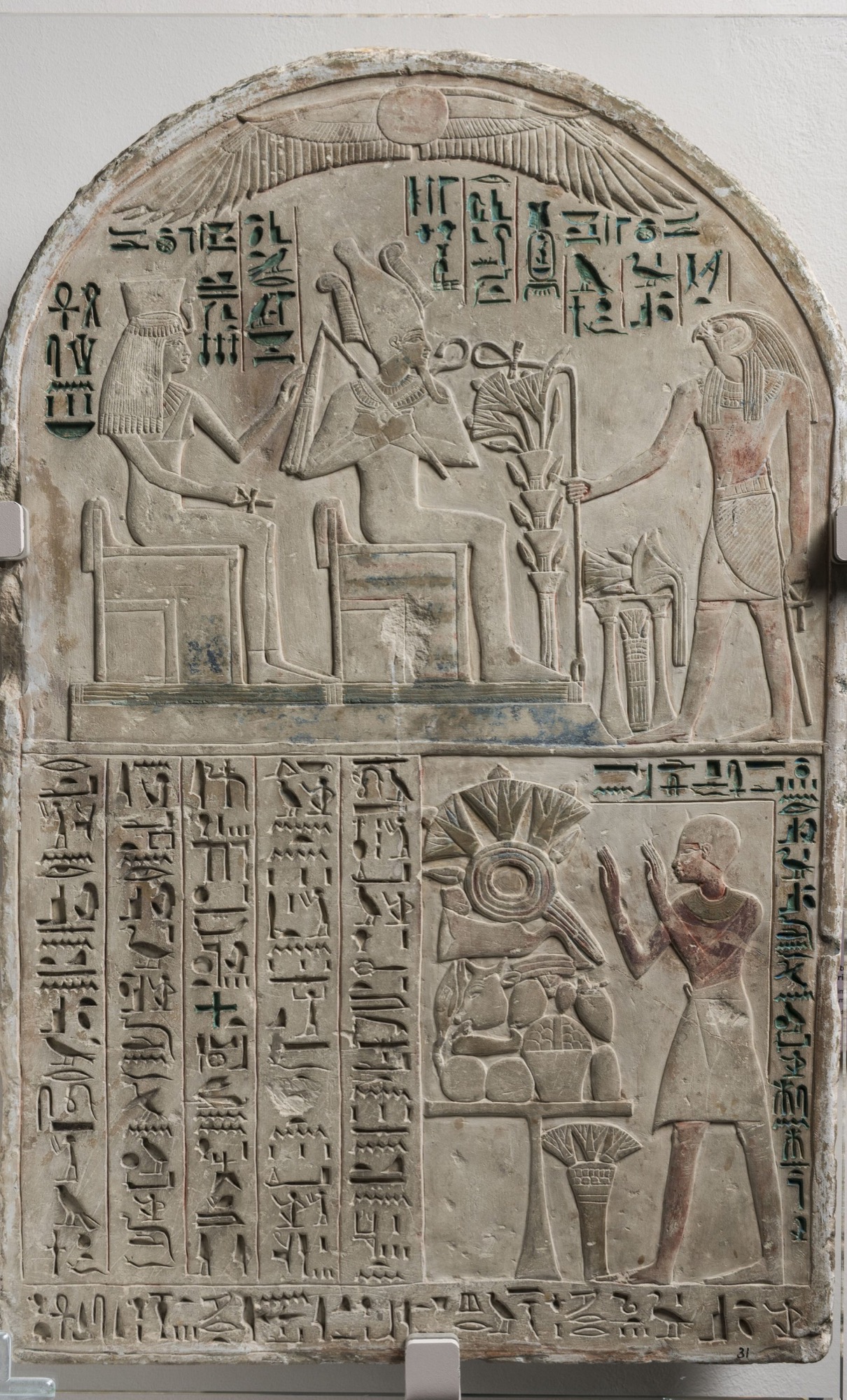
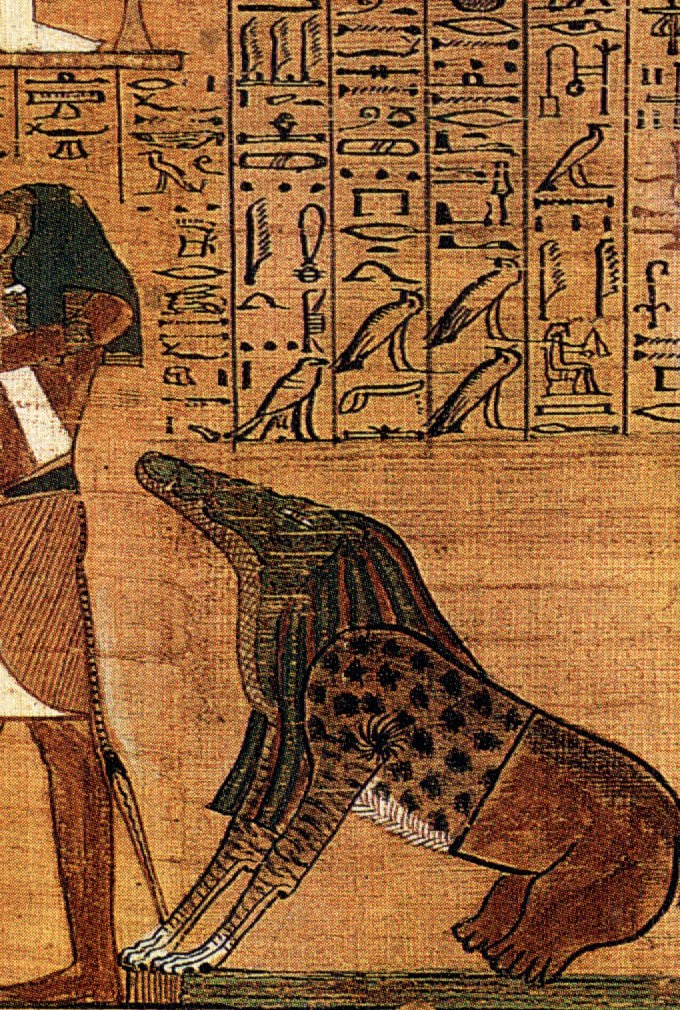
She does nothing. That is the terrible part. Across the whole judgment scene everyone else is busy: jackal-headed Anubis tests the tongue of the balance, ibis-headed Thoth stands ready with his reed-pen to write the verdict, and enthroned at the head of the hall Osiris waits in his tall crown to receive whoever passes. Only she is still. She sits by the beam of the great scales with her jaws parted, and she waits to see which way the heart will fall. In the papyri her whole existence is that one poised instant. The Egyptians gave her a name that is also a sentence: the Eater of the Dead.
This is the Hall of the Two Truths, the barren place the dead man reaches after crossing into the underworld, where the acacia does not grow and the ground yields neither herb nor grass. He has come to be weighed. His heart, which held the whole record of a life and could be called on to testify to it, is set in one pan of the balance; in the other stands a single feather, the emblem of Maat, of right and truth.
So much rests on that heart that the dead man pleads with it directly, calling it his mother, his very coming into being, and begging that there be no parting of it from him in the presence of the one who keeps the scales. The heart does not have to be virtuous beyond measure. It only has to balance the feather, not outweigh it. Level is enough. And everything the man ever was rests on whether one human heart can be made as light as a feather.
If it can, the gods say so out loud, and part of what they say is about her. When the beam holds true, the tribunal ratifies the acquittal and issues a specific ruling, almost a restraining order: It shall not be allowed to the devourer Amemet to prevail over him.
The vindicated dead are then granted meat-offerings, entrance into the presence of Osiris, and a homestead for ever in the Field of Offerings, the green farmland beyond the dark. The verdict has two halves, and the second half is simply the promise that she will not be permitted to touch him. That is how central she is to the scene: even a soul that passes has to be formally protected from her.
For the soul that fails, there is no such sentence. Budge’s commentary on the Ani papyrus is blunt about what waits: the heart that could not balance the feather was given to the monster Am-mit to devour,
and the punishment consisted of instant annihilation.
That is the whole of it. Not torture, not a burning, not an eternity of anything. The heart is eaten, and with it goes the person and any afterlife they might have had. Where other traditions built elaborate hells, the Egyptian threat at the scales is colder and shorter. You are simply consumed, and you stop.
What she is, and what the text won’t say
Ask what she looks like and the honest answer is that the words are careful and the pictures are not. Budge calls her a tri-formed beast,
and the museum caption everyone knows fills that in: part crocodile, part lion, part hippopotamus, three of the most dangerous animals in the Egyptian world fused into one body.
But that composite, and the exact join of it, which third is crocodile and which is lion, is how later scholarship reads the painted figure in the Ani vignette, not a description the text spells out. The text is content to leave her a hungry shape beside the beam. The reticence makes her worse, not better. She is defined entirely by function: the thing that is there to eat you if you fail.
Her name wanders too, in the way Egyptian names do across different rolls and different scribes. Budge alone gives her as Am-mit, Am-met, Amemet, and Smam, treating Smam, the Devourer
and Am-mit, the Eater of the Dead
as two names for a single monster; modern editions settle on Ammit, or Ammut, or Ahemait. The wandering is not confusion so much as the mark of a figure who lived in the margins of many manuscripts, drawn again and again beside the scales, labelled slightly differently each time.
Pictured, not invoked
Here is the fact that most retellings get wrong. Spell 125, the great chapter of the judgment, is a speech. The dead man stands before forty-two divine assessors and denies to each, in turn, one particular sin: I have not done iniquity, I have not robbed with violence, I have not slain man or woman. That recital, the famous Negative Confession, never once names her. She belongs to the picture beside the words, the judgment vignette that Egyptian scribes drew alongside the chapter, not to the spoken formula itself.
She is depicted, not invoked. The dead man does not address her, argue with her, or so much as acknowledge her; he pleads with his own heart not to betray him, and he answers to the forty-two gods, and all the while she simply waits at the edge of the scene where the scribe has painted her. Her power is that she needs no lines. She is the consequence, standing in the room.
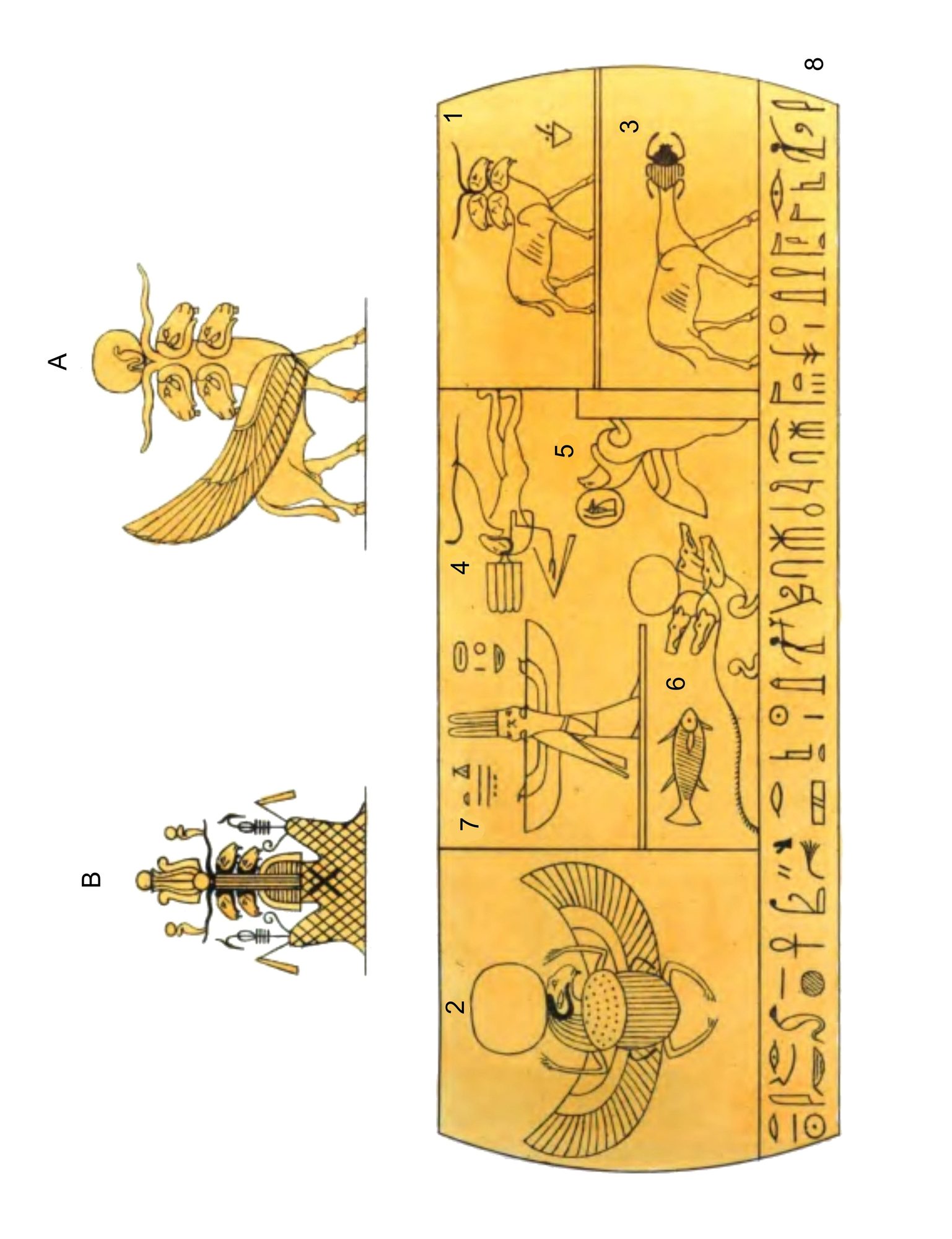
It is worth keeping her separate from another eater who prowls the same corpus. Elsewhere in the Book of the Dead, in Chapter 17, there is a different devourer: a god whose face is like unto that of a greyhound,
who watches at the Bight of the Lake of Fire and swallows the hearts of the dead, carrying his own tangle of names, Mates, Beba, Heri-sep-f. He is not Ammit.
The crocodile-lion-hippopotamus beast of the weighing and the greyhound-faced watcher at the lake are two separate entities the corpus keeps apart, and the fiery lake belongs to him, not to her. In the passages that actually describe her, Ammit has no lake and no fire. She has only the scales, the parted jaws, and the patience of something that knows the odds.
…the tri-formed beast Am-mit, the “Eater of the Dead,” who is waiting to devour the heart of Ani should it be found light. (Book of the Dead, Papyrus of Ani, trans. Budge)
- The Egyptian Book of the Dead (Book of Coming Forth by Day, Theban Recension), Chapter/Spell 125, trans. **E. A. Wallis Budge, *The Book of the DeadAn English Translation of the Chapters, Hymns, Etc., of the Theban Recension* (London, 1898/1901)**: the Hall of the Two Truths and its barren threshold, the forty-two-part Negative Confession before the assessor-gods, and the judgment vignette that accompanies the chapter, in which the devourer is depicted beside the scales but is never named in the recited denials.
- The Papyrus of Ani (British Museum No. 10,470),
The Judgment of the Dead,
in Budge 1898/1901thetri-formed beast Am-mit / Amemet, the Eater of the Dead,
waiting to devour the heart of Ani should it be found light; the requirement that the heart balance the feather of Maat and not outweigh it; Budge’s commentary that the failed heart wasgiven to the monster Am-mit to devour,
constitutinginstant annihilation
; and the gods’ acquittal decree,It shall not be allowed to the devourer Amemet to prevail over him,
with the grant of the Field of Offerings to the justified dead. - The Papyrus of Nebseni, in Budge 1898/1901Budge’s base text for the Negative Confession of Chapter 125 (confirming that
Am-met
occurs only in the vignette caption, not in the forty-two spoken denials); and, in Chapter 17, the distinct greyhound-facedDevourer for millions of years
who watches at the Bight of the Lake of Fire and swallows hearts — a separate entity from the judgment-scene Ammit, offered here only to keep the two devourers apart.