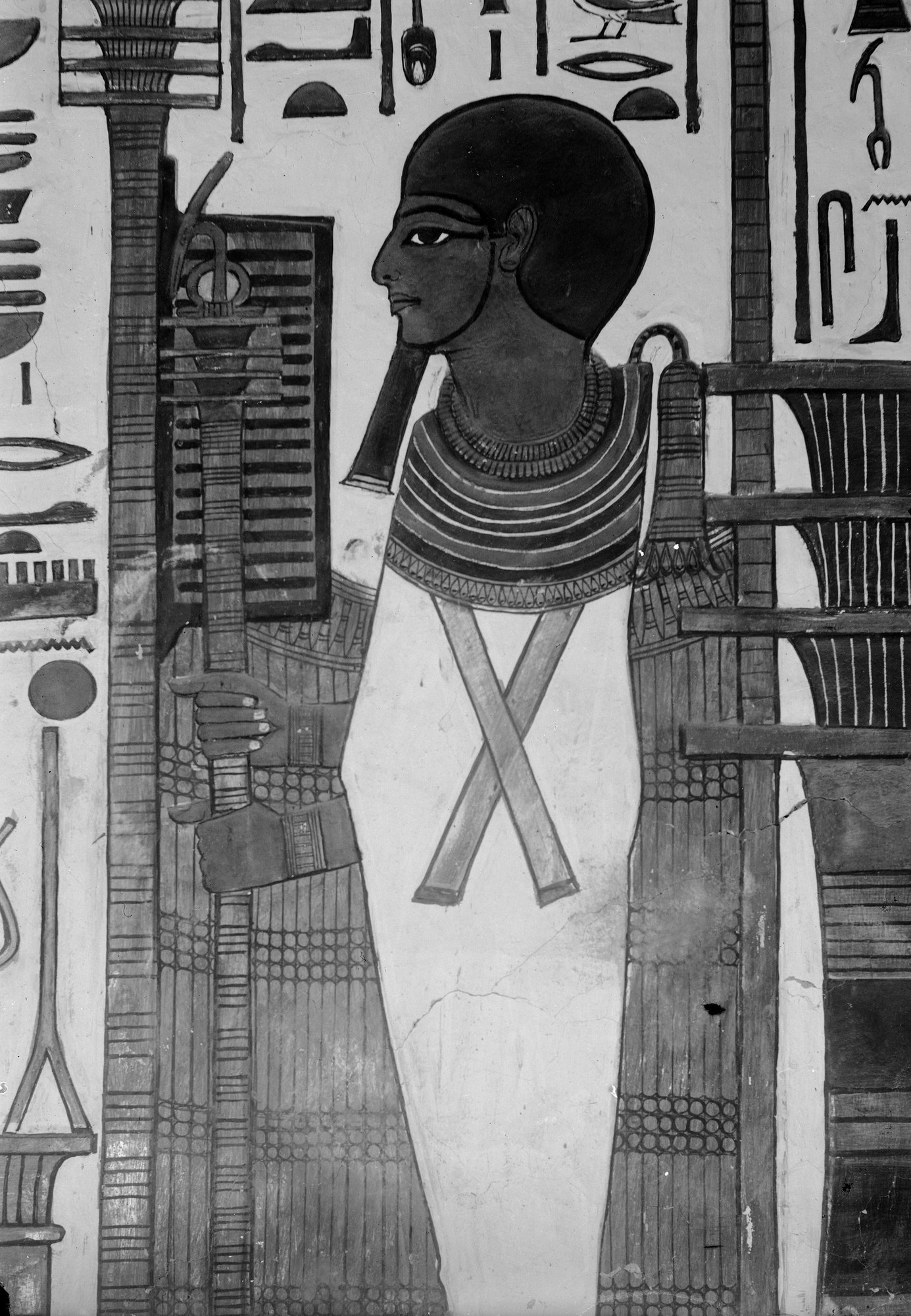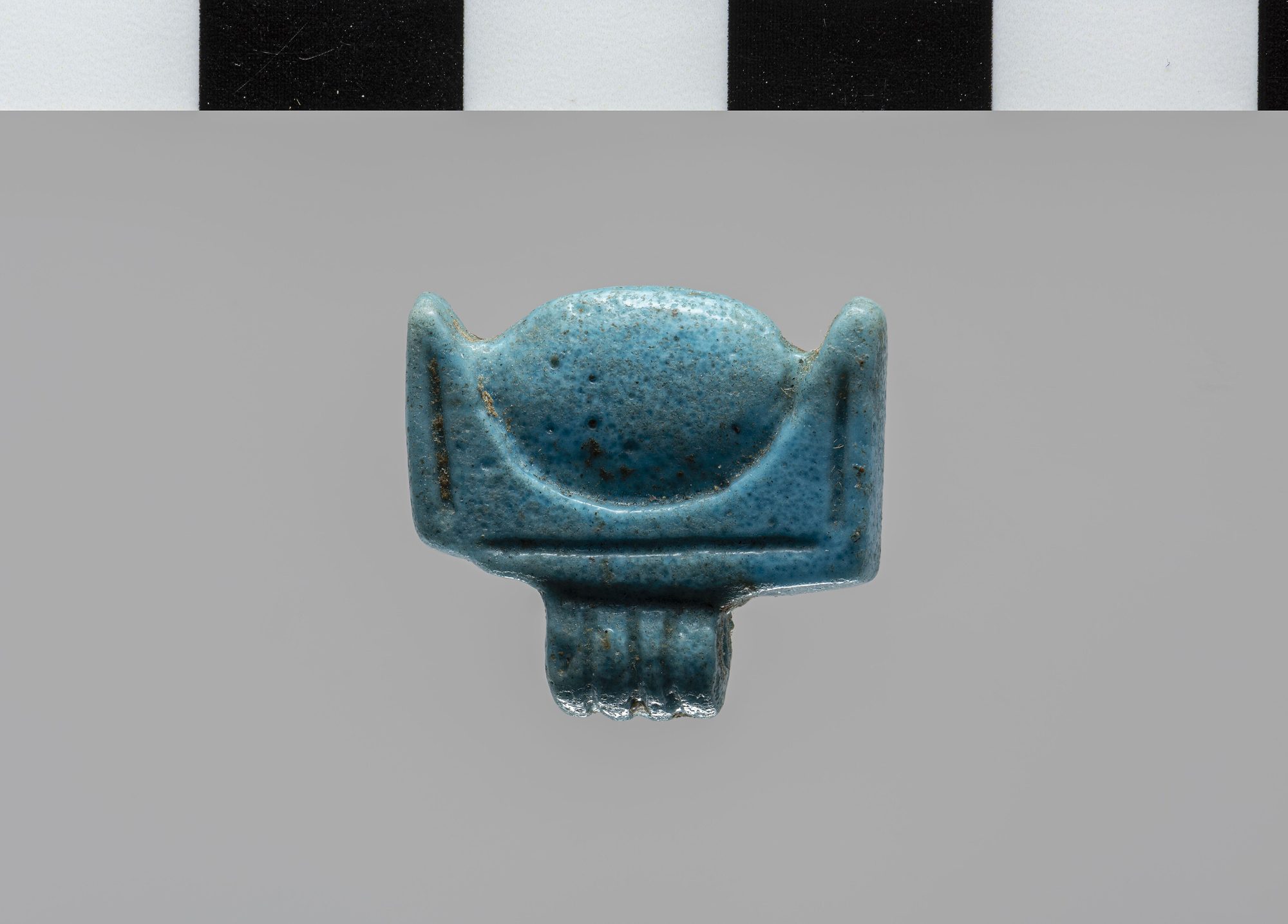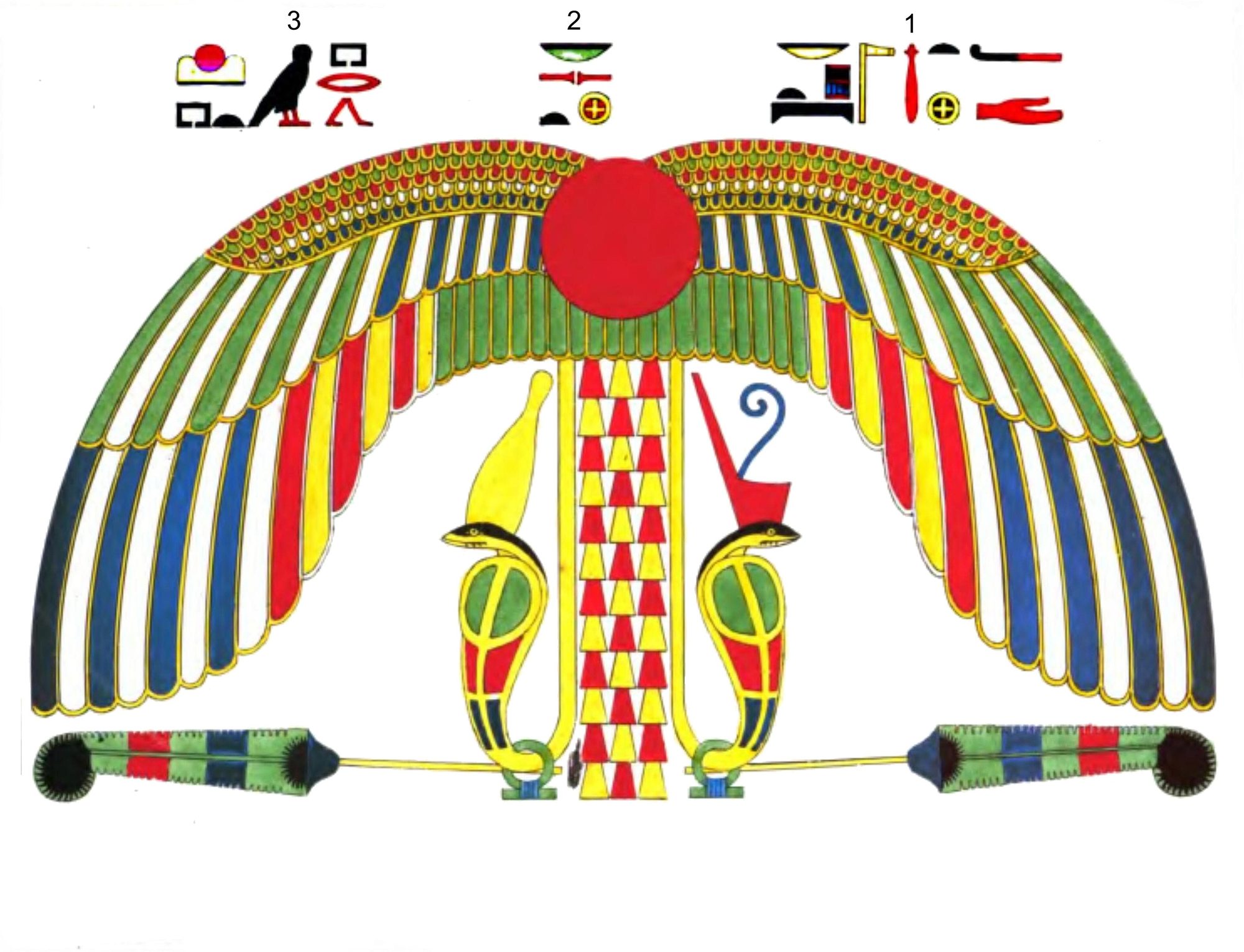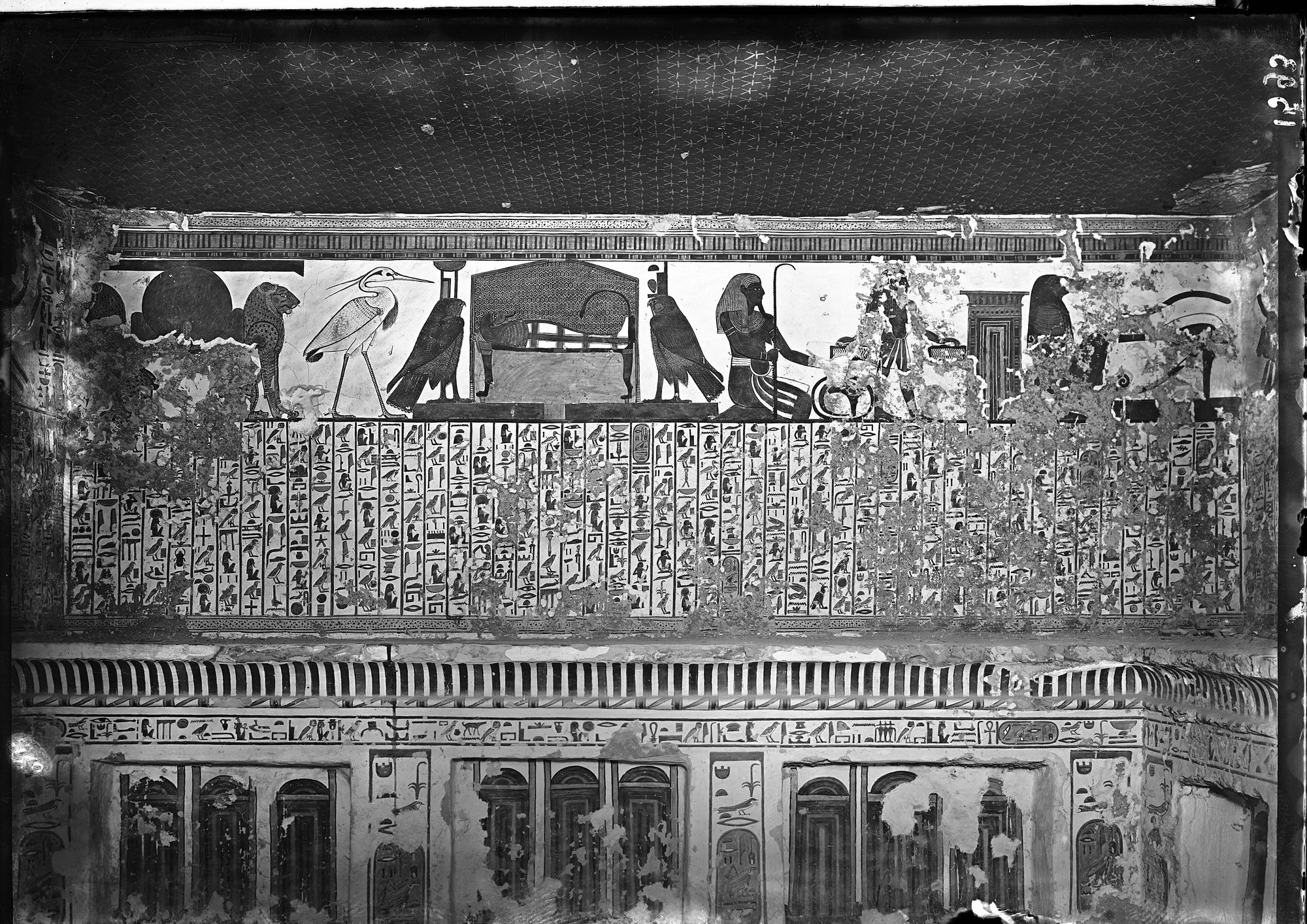
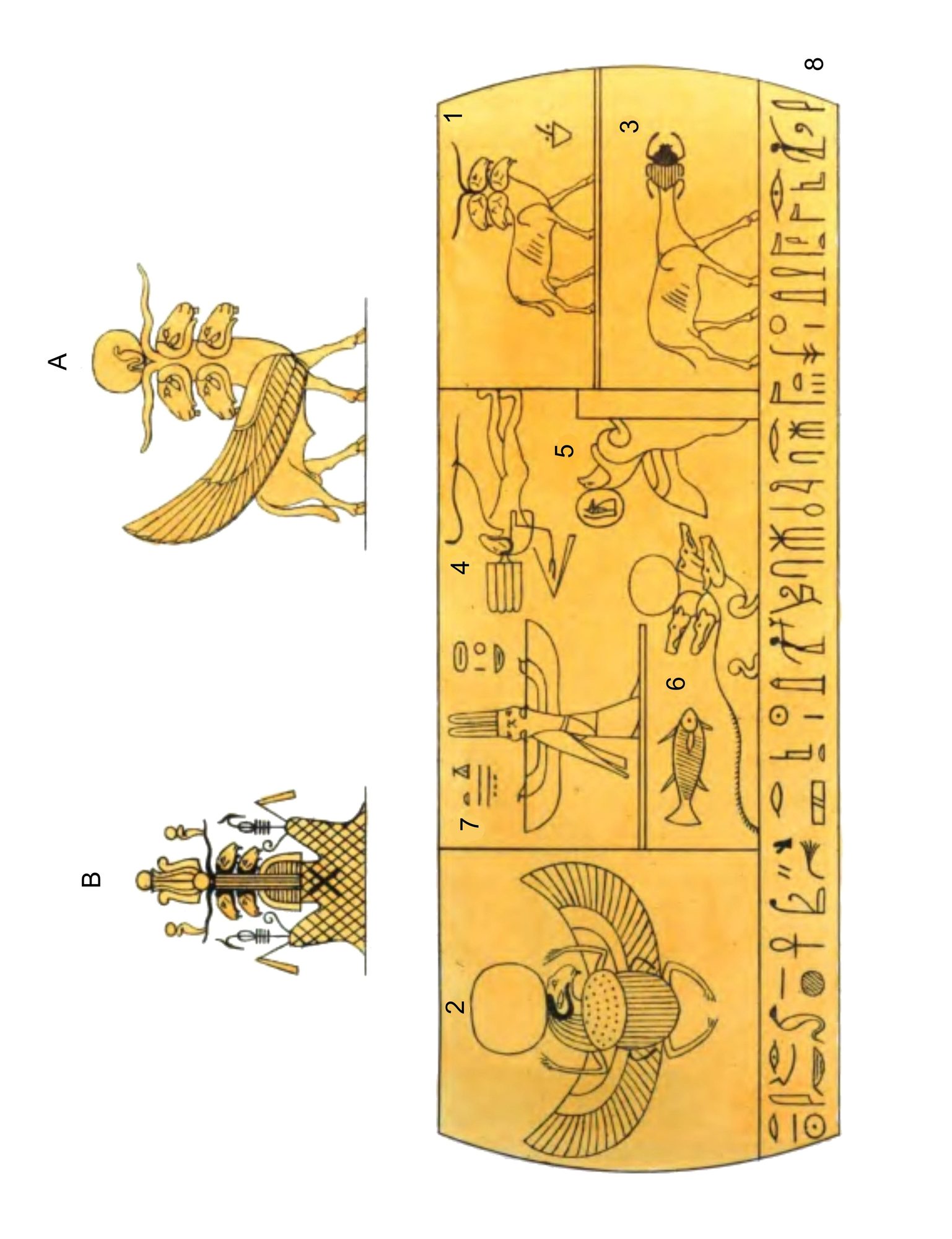
You cannot see him, and that is the point. He is a god of the moving air, and the two tall feathers of his crown are there to tell you so: the wind can be felt but not seen, known only by what it stirs, the way a breath of it passes through a rank of plumes and lifts them without ever showing its face. His name is built from the same idea. In Egyptian it is a form of the verb imn, which means both to conceal and to be hidden, so that the god’s name is not a title he was given but a description of what he is. He is the Hidden One. Even among the priests who served him at Thebes, one of his oldest epithets was imn-rn.f, he whose name is hidden,
a god whose real identity is a secret the gods themselves cannot open.
The New Kingdom hymn-cycle copied onto a papyrus now in Leiden pushes that secrecy to its furthest edge. One is Amun, it says, who keeps himself concealed from them, who hides himself from the gods, no one knowing his nature. He is more remote than the sky, deeper than the netherworld. None of the gods knows his true form.
His image is not unfolded in the papyrus rolls; nothing certain is testified about him. He is too great to be enquired after, too powerful to be known. This is not modesty about a minor deity. It is a claim of radical transcendence: the highest god is precisely the one who withdraws past the reach of knowing, and the other gods, for all their power, stand outside the hiddenness with everyone else.
Who formed his own egg
The same cycle traces that hidden god back before the beginning of things. He is the one who initiated existence on the first occasion, the hymn says, Amun, who developed in the beginning, whose origin is unknown. No god came into being prior to him. He had no mother who created his name; he had no father to beget him. He formed his own egg.
He is the power of secret birth, who created his own beauty, the most divine god, who came into being alone, and every other god came into being only since he began himself. Here the concealment turns into a statement about first causes. A god who fathers and mothers himself has no story behind him to tell, no genealogy to recite; his birth is secret because there was no one else present at it. He is his own origin, and the whole population of heaven is downstream of him.
That self-made creator is also, in the older Cairo hymn preserved on Papyrus Boulaq 17, the maker of the ordinary living world. The praise runs to Amun-Re, lord of Karnak, who presides in Thebes, Bull of his Mother, greatest of heaven and eldest of earth, lord of what exists. He is the Lord of Truth, father of the gods, who made mankind and created beasts. Then the hymn turns from cosmic titles to the field and the pasture: he is the one who creates the fruit-tree, who made the green herb, and who sustains the cattle.
The hidden god of the wind is at the same time the plainest sort of provider, the power behind the orchard and the grass and the animals that feed on it. Bull of his Mother,
a phrase the Egyptians read as the self-renewing generative principle, folds him together with the fertility god Min, so that in the Second Canto he can be hailed as Min, Amun, the lord of Eternity, who created Everlastingness.
Three gods with one hidden face
The most startling thing the Leiden hymns say about him is a piece of theology, not a myth. All the gods are three, one chapter declares: Amun, Re and Ptah, without their second. His identity is hidden as Amun; he is Re as the face; his body is Ptah. Their towns are fixed on earth for all time: Thebes, Heliopolis and Memphis, established for ever.
The scheme reads like a diagram of a single divine presence seen three ways. Amun is the concealed identity behind everything, the hidden name; Re is that god made visible, the sun as the face turned toward the world; Ptah is the same power given a body, the craftsman-god of Memphis. Three great cult cities, three great gods, one hiddenness underlying them.
It is worth being exact about what the text claims and what it does not. The ancient line says that all the gods are threefold, sorted into hidden identity, visible face and physical body; it is a way of ordering the whole divine world under Amun’s concealment, not a statement that one god exists as three persons.
The famous comparison of this passage to the Christian Trinity belongs to its modern editors, not to the Egyptian scribes. Nor is this the exclusive monotheism that Akhenaten would later force on Egypt in the name of the Aten, the doctrine that there is no god but the one. Amun’s theology keeps the other gods; it simply makes them his manifestations, faces and bodies of a hiddenness that stands behind them all.
The ram behind the fleece
By the New Kingdom this Theban god had risen from a local city-deity to king of the gods, his great temple at Karnak the richest in Egypt, his name carved across the empire. The rise was not smooth. Akhenaten had Amun’s name hacked out of the monuments wherever it appeared, an erasure later reversed by the boy-king Tutankhamun, whose own name carries the god’s. The cult only grew stronger afterward, until in time the High Priests of Amun ruled the south of Egypt in the god’s name while a separate line of kings held the Delta.
When Greek travellers reached Egypt they translated this supreme god into their own. The historian Herodotus reports that the Thebans hold rams sacred, and that the Egyptians call Zeus Amun.
He even supplies a story for the ram-headed images: Heracles longed to see Zeus, and Zeus did not wish to be seen; at last the god flayed a ram, held its severed head before his own and drew the fleece over himself, and only so let himself be seen.
Once a year, Herodotus says, the Thebans flay a single ram, dress the divine image in its skin, then beat themselves in mourning for the ram and bury it in a sacred tomb. It should be read for what it is: a Greek observer’s account, an interpretation of Egyptian practice through Greek gods and Greek storytelling. The ram truly is Amun’s sacred animal; the tale of Heracles and the fleece is Herodotus’s framing, not an Egyptian text. Even at the one point where a foreign eye tries to fix his shape, the god is glimpsed only through a borrowed skin, his own face turned away.
One is Amun, who keeps himself concealed from them, who hides himself from the gods, no one knowing his nature. He is more remote than the sky, he is deeper than the netherworld. None of the gods knows his true form. (Hymns to Amun, Papyrus Leiden I 350, ch. 200, trans. Zandee)
- Hymns to Amun, Papyrus Leiden I 350 (New Kingdom, Ramesside, 19th Dynasty), Jan Zandee, De Hymnen aan Amon van Papyrus Leiden I 350 (Brill, Leiden, 1948); English of the chapters read via Wim van den Dungen’s edition and commentary (sofiatopia.org/maat/amun.htm), read verbatim from the chapter texts on the page. Chapter 100Amun the self-created One,
who developed in the beginning, whose origin is unknown … He had no mother … He had no father … Who formed His own egg … who came into being Alone.
Chapter 200: the Hidden One,who keeps Himself concealed … no one knowing His nature … more remote than the sky … deeper than the netherworld. None of the gods knows His true form.
Chapter 300:All the gods are three: Amun, Re and Ptah … His identity is hidden as Amun, He is Re as face, His body is Ptah … Thebes, Heliopolis and Memphis.
Chapter 600: Amun who precedes and produces the Ogdoad. The comparison of ch. 300 to the Christian Trinity is the modern editor’s gloss (van den Dungen), not the ancient claim; the ancient text says all the neteru are threefold, and this is flagged in the prose. - Great Hymn to Amun-Re, Papyrus Boulaq 17 (Cairo Museum CG 58038; 18th-Dynasty copy of a Middle Kingdom original), read verbatim in Adolf Erman, The Literature of the Ancient Egyptians, trans. Aylward M. Blackman (Methuen, London, 1927), pp. 283–284the Title (
Amunre, Bull of Heliopolis, chiefest of all gods … who giveth life to all that is warm
); the First Canto (lord of Karnak, who presideth in Thebes! Bull of his Mother … Lord of Truth, father of the gods, who made mankind, and created beasts … who createth the fruit-tree, who made the green herb, and sustaineth the cattle
); and the Second-Canto opening (Min, Amun, the lord of Eternity, who created Everlastingness!
). Erman/Blackman spell the nameAmunre
(Amun-Re); the archaic spelling is preserved where quoted. - Herodotus, Histories 2.42 (G. C. Macaulay trans., The History of Herodotus, Vol. 1; Project Gutenberg ebook 2707), read verbatimthe Greek reception (
the Egyptians call Zeus Amun
), the Heracles-and-flayed-ram etiology of the ram-headed image, and the annual Theban ram rite (flay one ram, clothe the image, lament, bury it in a sacred tomb). This is a Greek author’s interpretatio graeca and etiology, attributed in the prose to Herodotus and explicitly not treated as an Egyptian myth-text; the ram is a genuine Egyptian sacred animal of Amun, but the fleece story is Herodotus’s framing. - Etymology and iconographythe name Amun (imn,
to conceal / be hidden
) and the epithet imn-rn.f,he whose name is hidden,
together with the air-god, two-plume and blue-flesh iconography, read at the commentary level in van den Dungen’s edition of Papyrus Leiden I 350 (sofiatopia.org/maat/amun.htm; the vocalisation after Osing 1976). Cited as scholarly interpretation, though the imn =hidden
root is standard. - Pyramid Texts, Utterance 301 §446c (Old Kingdom), Samuel A. B. Mercer trans., The Pyramid Texts (1952; archive.org
THEPYRAMIDTEXTSTRANSLATION)Amun paired with Amaunet as a primeval pair (two sources of the gods
), the earliest attestation of the god, read verbatim in the companion Ogdoad account. The widerhidden of name
Pyramid- and Coffin-Text spell lists (PT 399a, 276c; CT 132, 147, 148, 682, VII 469–470) are known here only as quoted in van den Dungen’s commentary, not from Faulkner or Mercer directly, and are treated as scholar-mediated rather than printed as verbatim quotations.