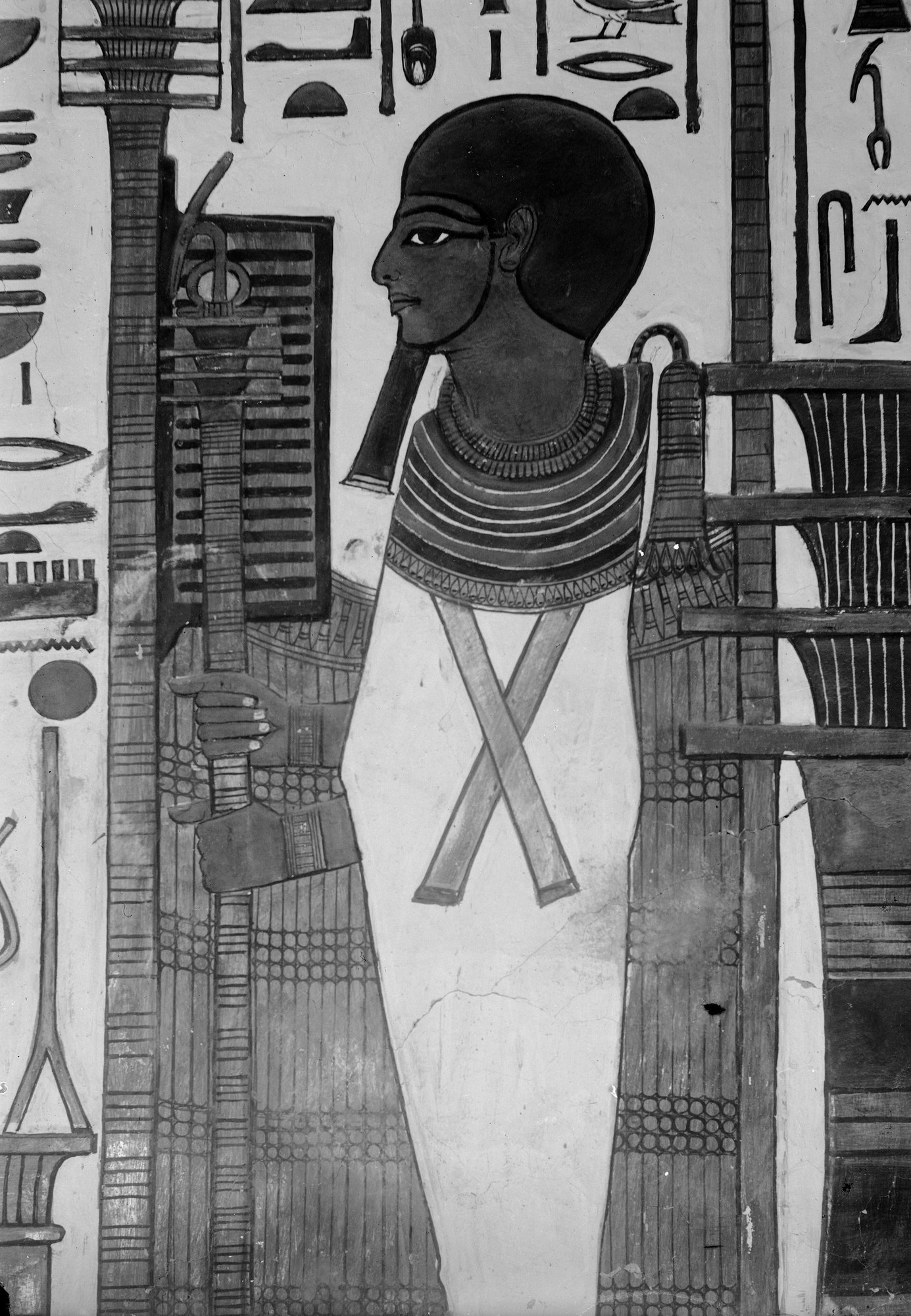
He does not reach for clay, and he does not spill his seed into the water. He thinks. In the heart, which the Egyptians held to be the seat of the mind, a plan takes shape; then the tongue says it, and the plan is a world. This is Ptah of Memphis, whom the priests called the master craftsman of the gods, and the strange thing about his creation is not that a god made everything. Almost every god does. It is that he made it the way a maker means a thing before his hands ever touch it: he devised it inwardly and commanded it outwardly, and out of that two-stroke motion of thought and voice the whole company of the gods came to be.
The heart that plans, the tongue that commands
The doctrine that makes Ptah a thinking, speaking creator survives on a single slab of hard dark stone in the British Museum, carved for the Nubian pharaoh Shabaka of the twenty-fifth dynasty, who claimed he was rescuing the text from a worm-eaten papyrus already crumbling with age. Its cleverest stroke is a small grammatical one.
The Heliopolitan priests taught that the sun-god Atum was the immediate creator of the world; the Memphite theologians conceded the point and then swallowed it whole, appending to one member of their divine ennead the name Ptah the Great
and the remarkable gloss that he is the heart and tongue of the ennead.
Since the Egyptian had no separate word for mind and used heart
for it, this made Ptah the very faculty of thought and speech at work in all gods, all men, all animals, and all reptiles.
Atum could keep his role. He would simply turn out to have been Ptah’s thought all along.
The stone is unusually precise about how it works. When the eyes see, the ears hear, and the nose breathes, they transmit to the heart,
Breasted’s 1912 rendering runs; it is he, the heart, who brings forth every issue, and it is the tongue which repeats the thought of the heart.
First the conception, in silence; then the utterance, aloud.
From that ordering comes the line the whole theology is built to deliver: Every divine word came into existence by the thought of the heart and the commandment of the tongue.
It is two stages and not one. A god who merely booms an order over the waters is a common figure; the Memphite distinctive is the inner step that comes first, so that the spoken word carries out a prior design rather than working as a bare magic charm.
Bodies of every wood and stone and metal
For a god of pure thought, Ptah is astonishingly hands-on, and the text keeps returning to the vocabulary of the workshop. His making reaches past the gods and into the material grain of things: he made every work, every handicraft, which the hands make, the going of the feet, the movement of every limb,
all of it according to his command, through the thought of the heart that came forth from the tongue.
It reaches into morality as flatly as into matter: it was he who gave life to the peaceful and death to the guilty.
Then, his devising done, the maker rests the way a craftsman sets down his tools: Then Ptah was satisfied, after he had made all things and every divine word.
The most vivid image is saved for the furnishing of the world, where Ptah behaves exactly like an artisan fitting out a temple. He fashioned the gods, he made the cities, he settled the nomes. He installed the gods in their holy places… He made likenesses of their bodies to the satisfaction of their hearts. Then the gods entered into their bodies of every wood and every stone and every metal.
That last line is the whole of his character. The other gods do not simply exist; Ptah carves the statues they come to inhabit, and only then do they move in. No wonder his fuller cult-name fuses him with Tatenen, the primeval mound of risen land, so that Atum himself can say of Ptah-Tatenen that he is the fashioner of the gods, he, from whom all things went forth.
A creation-hymn worn down to grind grain
The slab that carries all this has an object-history worth the telling. The British Museum acquired the stone in 1805, and it long rested in obscurity,
Breasted noted. The reason was written into the stone itself: at some point in its afterlife the monument had been laid flat and put to work as a nether millstone, the surface turned against grain year after year, almost abrading the inscription and rendering it so illegible that the process of copying was excessively difficult.
The hymn of how the world was thought into being had been nearly ground away by the daily grinding of bread.
A caution the text itself demands: this is not creation out of nothing. The primeval waters are presupposed, Ptah has his own ring of emanations, and Tatenen is the land that rises from a sea already there. The Memphite achievement is ordering by command, the bringing-forth of shape into a formless deep, not the summoning of being from absolute void.
The god the Greeks called Hephaistos
By the time Greek travellers reached Memphis they had a ready name for its craftsman-god. They called him Hephaistos, the divine smith of Olympus (the Romans, Vulcan), and the match is so exact it is almost translation. Herodotus, who took much of his Egyptian information from the priests of that Hephaistos who dwells at Memphis,
makes Ptah’s temple the founding monument of the city.
Min, the first king of Egypt, dammed the Nile and dried the ground for Memphis, then established in the city the temple of Hephaistos, a great work and most worthy of mention.
Of the long roll of kings after him, only the last, Moeris, left a comparable mark: the temple’s north gateway, which is turned towards the North Wind.
One story caught there is too good to leave in the citation block. Herodotus tells of a later priest-king of Ptah named Sethos, so contemptuous of his soldiers that when Sanacharib of the Arabians and Assyrians marched on Egypt, the warrior class refused to fight for him. Abandoned, the priest-king prayed to the god’s image in the sanctuary, and the god promised him aid in a dream. That night field-mice gnawed the Assyrians’ bowstrings and shield-handles, so that at dawn the invaders fled.
A stone statue of that king, mouse in hand, still stood in Ptah’s temple in Herodotus’s own day, inscribed with a line that reads like the god’s own signature: Let him who looks upon me learn to fear the gods.
The same temple is where Diodorus places the enthronement of the Apis bull, the living creature honoured as the herald of Ptah. Egyptian priest, Greek historian and later chronicler frame the god differently, but they meet at one address: the great temple at Memphis.
Ptah the Great: he is the heart and tongue of the ennead… Every divine word came into existence by the thought of the heart and the commandment of the tongue. (Memphite Theology, Shabaka Stone, ll. 48–61, tr. Breasted 1912)
- Memphite Theology, on the Shabaka Stone, British Museum Stela No. 797 (formerly No. 135; modern reg. EA 498; 25th Dynasty, reign of Shabaka; the monument claims to copy a worm-eaten older papyrus) — English rendering and commentary read here from J. H. Breasted, Development of Religion and Thought in Ancient Egypt (1912), pp. 43–47 (public-domain scan, archive.org id
developmentofrel00breauoft), which gives Breasted’s own referenceBritish Museum, Stela No. 797, formerly No. 135, ll. 48–61
. Read verbatim for Ptah asthe master craftsman of the gods, whose temple was at Memphis
; the Memphite enneadmade up of a primeval Ptah and eight emanations
;Ptah the Great … he is the heart and tongue of the ennead
;the power of mind and tongue… all gods, all men, all animals, and all reptiles
; the eyes/ears/nose-to-heart mechanism;Every divine word came into existence by the thought of the heart and the commandment of the tongue
;It was he who gave life to the peaceful and death to the guilty
;every work, every handicraft, which the hands make
; the Ptah-Tatenenfashioner of the gods
saying;Then Ptah was satisfied, after he had made all things and every divine word
;He fashioned the gods, he made the cities, he settled the nomes… the gods entered into their bodies of every wood and every stone and every metal
; and the object-history footnote (acquired 1805, re-used as a nether millstone). First deciphermentJ. H. Breasted,The Philosophy of a Memphite Priest,
Zeitschrift für ägyptische Sprache 39 (1901), 39–54. Modern standard English: Miriam Lichtheim, Ancient Egyptian Literature, vol. I (1973), pp. 51–57 (in-copyright; wording differs — the creation quotes above are Breasted’s, not Lichtheim’s). The date of the underlying composition is disputed: the older consensus (Breasted, Sethe, Junker, Frankfort, Wilson, Lichtheim) read the text as a genuinely archaic original, while most scholars now date the composition to the 25th Dynasty of the monument itself, or at earliest the Ramesside period. - Herodotus, Histories, Book 2 (Euterpe), §§ 2.3, 2.99, 2.101, 2.141 — G. C. Macaulay translation (Project Gutenberg ebook 2707, The History of Herodotus, vol. 1). Read verbatim for Ptah identified with
Hephaistos who dwells at Memphis
and his priests as Herodotus’s chief Egyptian informants (2.3); Min founding Memphis and establishingthe temple of Hephaistos, a great work and most worthy of mention
(2.99); Moeris (Moris
) addingthe gateway of the temple of Hephaistos which is turned towards the North Wind
(2.101); and the priest-king Sethos, the Sanacharib campaign, the field-mice that gnawed the Assyrian bowstrings and shield-handles, and the statue holding a mouse inscribedLet him who looks upon me learn to fear the gods
(2.141). Herodotus’sHephaistos
is the Greek interpretatio of Ptah, used here for cult and temple realia and for the Greek reception, not as an Egyptian theological source. - Diodorus Siculus, Bibliotheca Historica 1.85.2 — C. H. Oldfather translation (Loeb, 1933). The Apis bull enthroned at
the sanctuary of Hephaestus
(that is, Ptah) at Memphis, the classical link between Ptah’s Memphite temple and the Apis cult. Read in full for the sibling apis-bull-of-memphis via ToposText; cited here as framed for the Ptah–Apis connection.