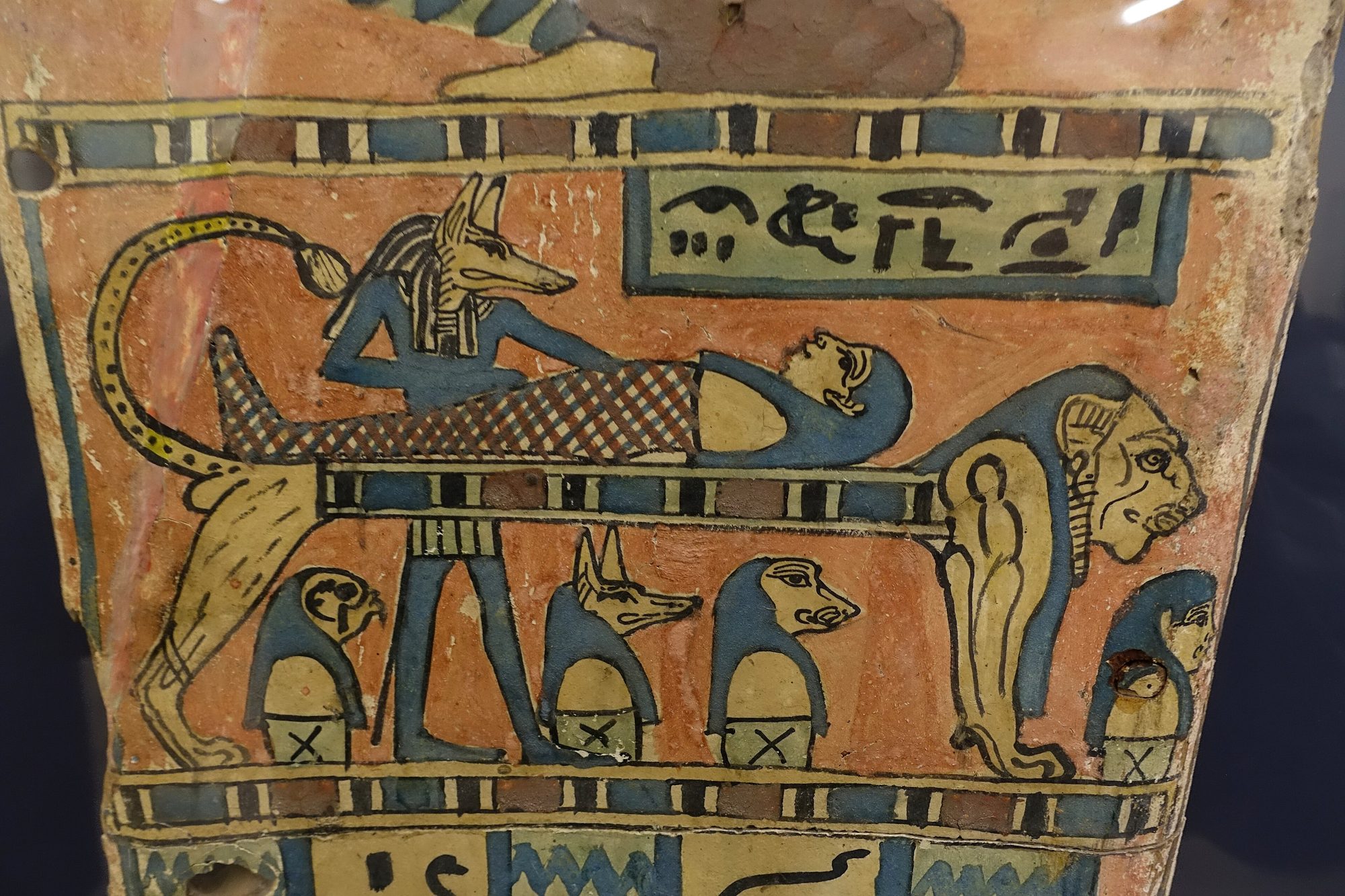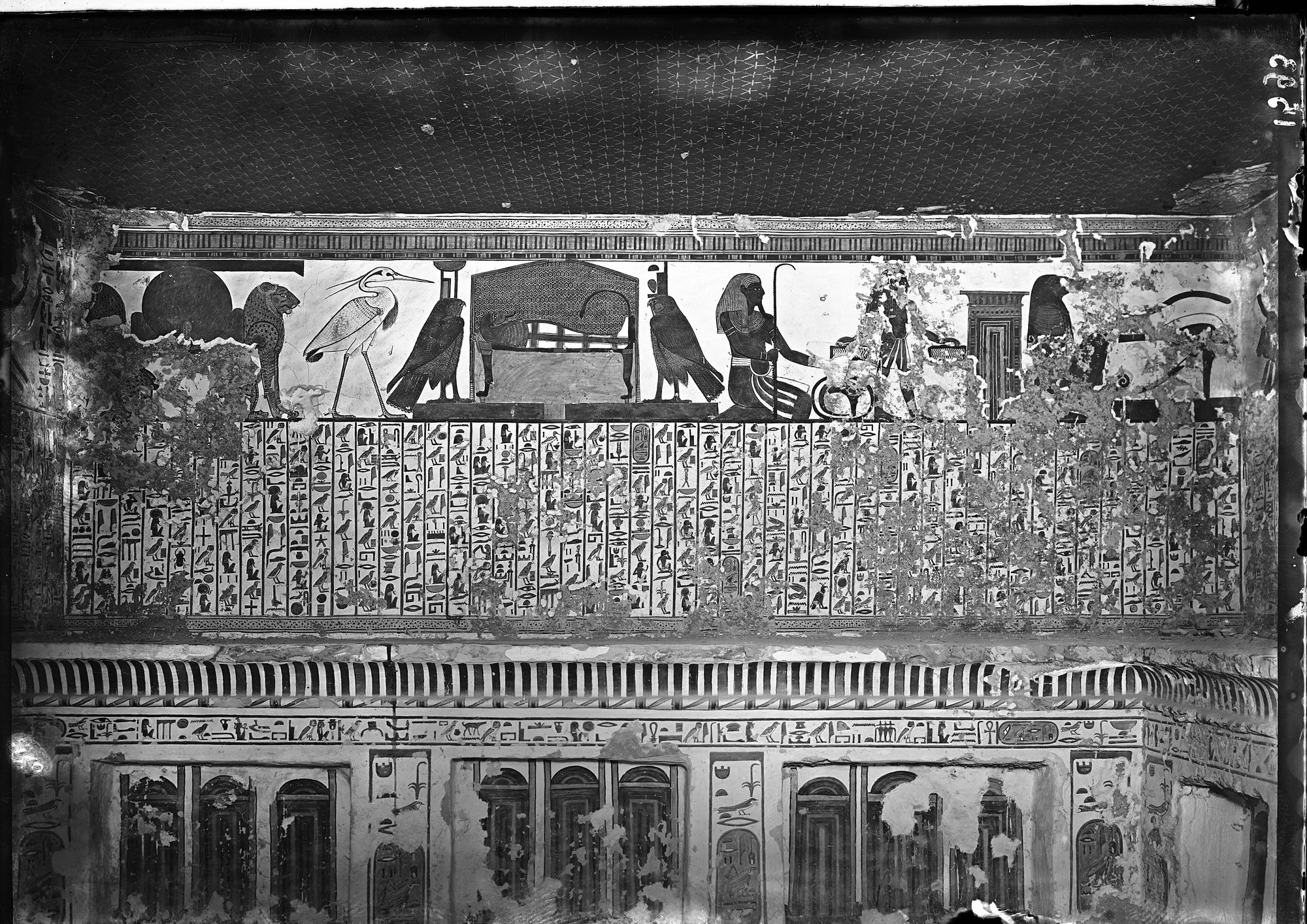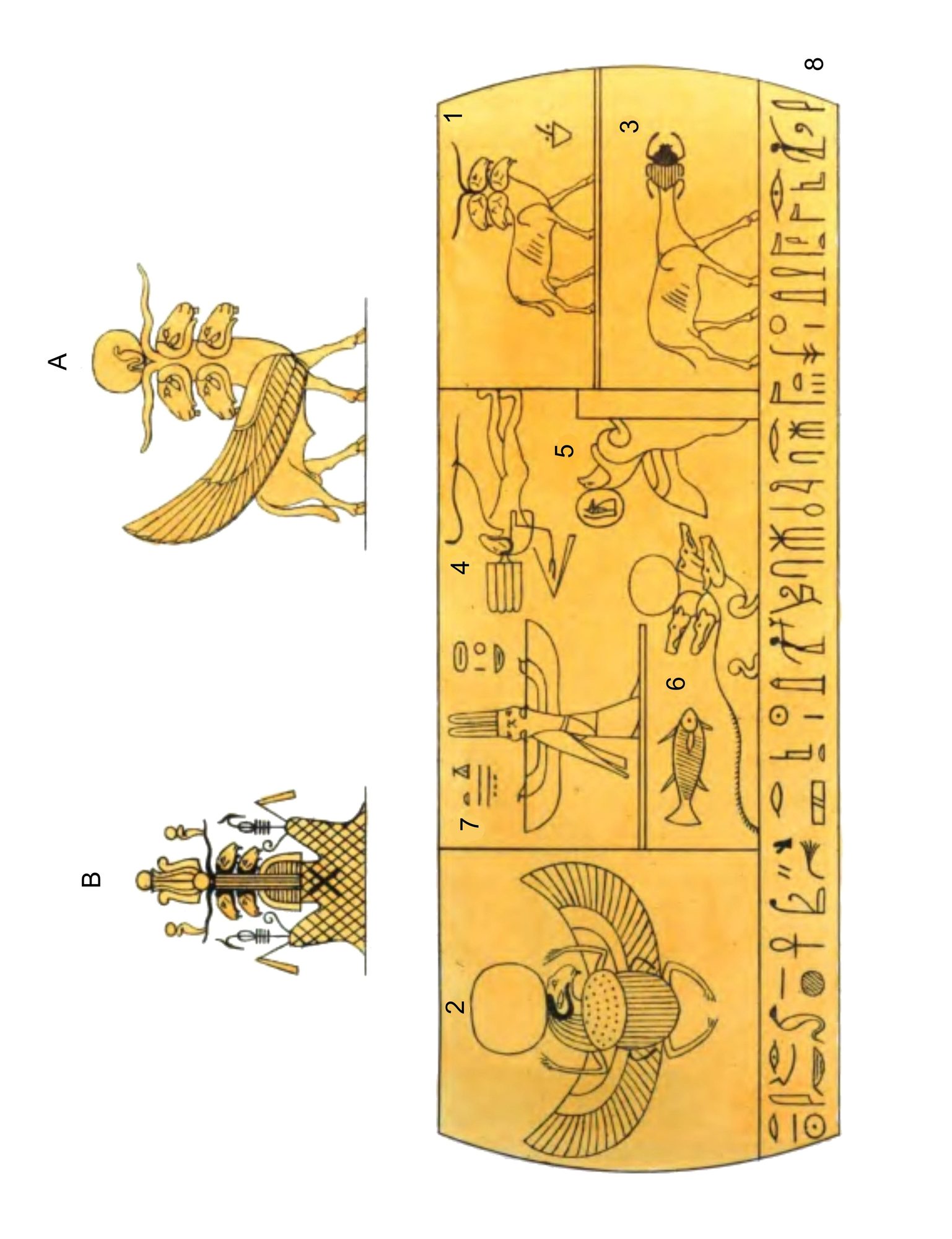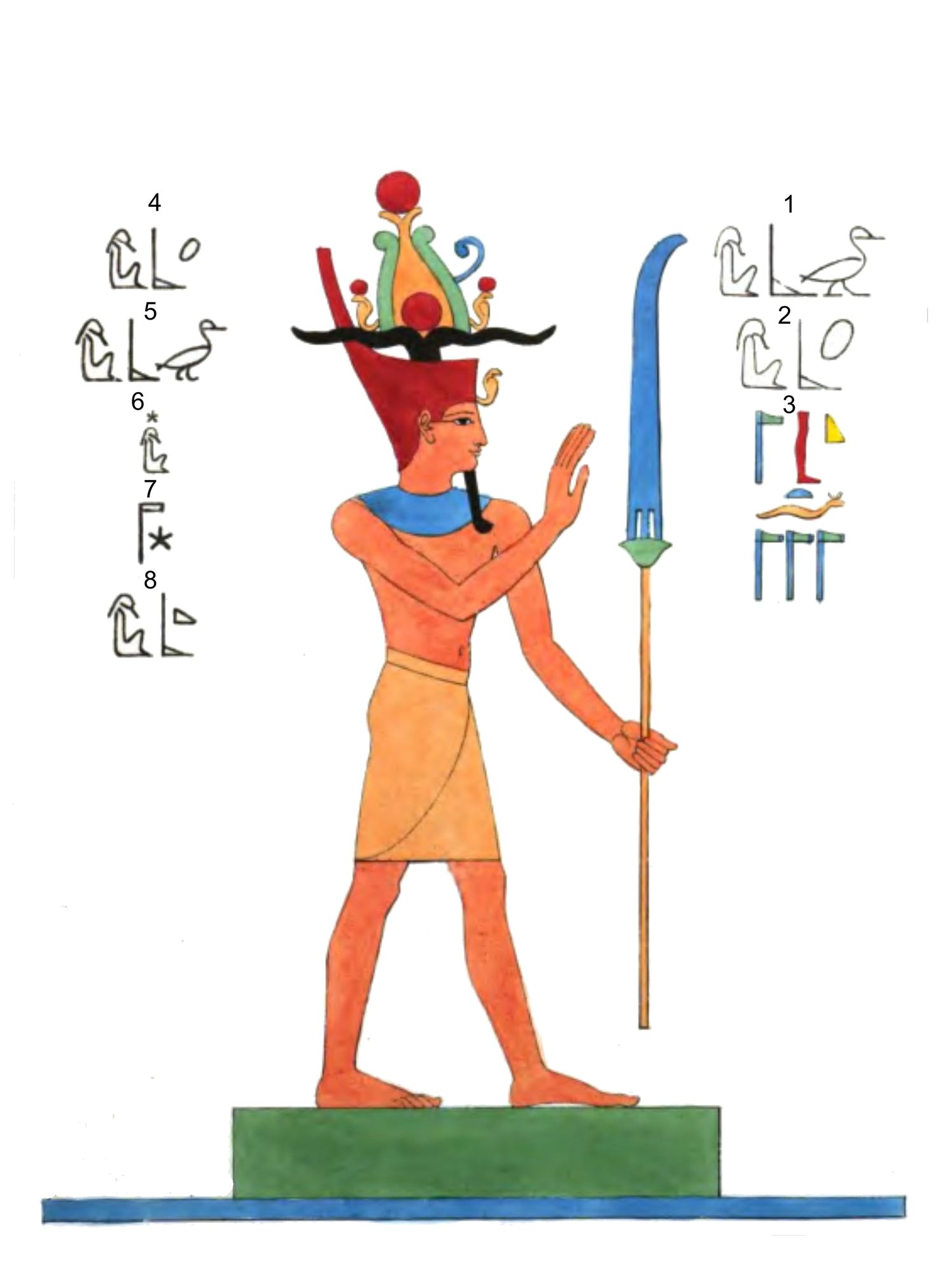
There was water, and nothing that was not water. No sky above it, no ground beneath it, no light to show its surface, no shore to break its reach. The Egyptians called this Nun, the inert and boundless deep, and they were careful to say that it was not made: it simply was, before making began, dark and still and everywhere at once. Into that flat immensity the creator would later describe his own first helplessness in a single unforgettable line. He had willed some things into being, he says, and set them down in the water as Inert Ones, because he could as yet find no place where he could stand. Picture it exactly as the text asks: a god awake in an ocean that has no bottom and no top, holding the beginnings of a world, and nowhere to put his feet.
A god who fathered himself
He had not been made either. This is the strangest and most insisted-upon fact about him, that the first god fathered himself. The old spell calls him the great god who gave birth to himself, and in his own voice he says it plainly: I am the only One; I came to existence in Nu.
Egyptian has no comfortable way to say a thing came from nothing, so the texts reach instead for the image of self-generation, a god who is his own parent and his own child, the single point at which the endless sameness of the water first knows itself to be someone. His name was Atum, the only One, the whole of what will exist folded up inside a being who is, for now, entirely alone.
Blazing up as the bennu
Then the water lifted. Where there had been only the level deep, a hill broke the surface, the first dry place in creation, and on it stood the god. Every Egyptian who watched the Nile flood recede each year and leave black mounds of mud steaming above the sinking water was watching this again in miniature, the primeval hill returning.
At Heliopolis, the city they called Iunu, this first mound had a name, the benben, and a stone that stood for it in the temple. There the creator did not merely stand: he shone. He mounted as the hill and blazed up as the bennu, the heron the Greeks would later call the phoenix, alighting in the house of the phoenix at Heliopolis. Before there was a sun in the sky there was this, the first light, a bird of fire on the first hill above the first water.
His phallus in his fist
One god, one hill, one point of light, and no one else in all the deep. If the world was to be peopled, the maker would have to draw it out of his own body, and the oldest texts describe him doing exactly that, without flinching from how physical it was. He put his phallus in his fist, the Pyramid Texts say, to excite desire, and the twins were born, Shu and Tefnut.
There is no consort, no second god to help him; the creator is mother and father at once, and life comes from him the only way it can, alone. The Egyptians even personified the hand he used as a goddess in her own right, the Hand of Atum, so that the solitary act was not quite so solitary as it looked.
They loved to tell the same moment a second way, through the mouth rather than the hand, and they did not think the two accounts quarrelled. In the fuller telling the seed is taken up into the mouth, and the twins come out of him as breath and spittle. I spat out Shu and expectorated Tefenet, he says, and my father Nun brought them up. It is a marvel of fitness: Shu is the god of air, and he is expelled as a puff of breath; Tefnut is the goddess of moisture, and she comes out as spittle.
The Pyramid Texts render it the same way, that the god spewed out Shu and spat out Tefnut, and later Egyptians heard in the very names a pun on sneezing and spitting. Air and water, the first two things a world needs after light, blown and dribbled from the creator’s own mouth, and then reared, tenderly, by the old water Nun, who cradles the newborn twins as a foster-father though he is the very abyss they were born above.
Pouring himself into his children
What the lonely god does next is the most human gesture in the whole cosmogony. He reaches out and gathers the two of them into his arms. He put his arms about them, the text says, as the arms of a ka, that his ka might be in them.
The ka is the Egyptian life-force, the vital double that makes a living thing alive, and in that embrace the creator is not merely holding his children but pouring himself into them, seeding the world’s first family with his own animating spark. From here the chain runs on and the water empties of its loneliness. Shu and Tefnut bring forth Geb, the earth, and Nut, the sky; and from Geb and Nut come the four who close the circle, Osiris and Isis, Seth and Nephthys.
Nine, and not always the same nine
Count them: Atum, Shu, Tefnut, Geb, Nut, Osiris, Isis, Seth, Nephthys. Nine. This is the Ennead of Heliopolis, the psedjet, the Nine
, the great family tree of the cosmos hung entire from the one god who stood alone in the deep, and the oldest texts recite the Nine in a single glad breath, naming them in their generations and calling them the children of Atum. It is worth saying, though, that the Egyptians were less rigid about the number than the tidy roll-call suggests.
Their word for the group could mean simply the company of gods
, they spoke of a Great Ennead and a Little Ennead as distinct assemblies, and the membership was not everywhere the same nine. The Nine of Heliopolis is a beautiful and deliberate shape, one creator unfolding into four generations, but it was one arrangement of the divine world rather than a fixed board that every Egyptian would have drawn the same way.
Even the hill was contested
Even the hill was contested. Heliopolis said the first mound rose in its own precinct and marked the spot with the benben stone, but Heracleopolis and Hermopolis told the same rising-god story of their own high ground, each city claiming to stand on the place where the water first broke. That is the honest texture of Egyptian creation: not one settled scripture but a family of overlapping images, the hand and the mouth, the phoenix and the sun, Atum and Khepri and Re, all circling the same astonishment. Before anything, there was dark water and no place to stand. Then a god who had made himself found a hill, and shone, and out of his own body drew a world.
O Atum-Khepri, when thou didst mount as a hill, and didst shine as the bennu of the benben in the temple of the phoenix in Heliopolis… thou didst spew out as Shu, and did spit out as Tefnut, and didst put thine arms about them, as the arms of a ka, that thy ka might be in them. (Pyramid Texts, Utterance 600, §1652–1653, trans. Mercer; gloss forms bennu and benben set for Mercer’s bnw and ben)
- Pyramid Texts, Utterance 527 (§1248a–d), trans. Samuel A. B. Mercer, The Pyramid Texts (1952), read verbatimthe creation of the first pair by the god’s own hand at Heliopolis —
He put his phallus in his fist, to excite desire thereby. The twins were born, Shu and Tefnut.
The oldest and starkest statement of the solitary creator making life from his own body, and the primary spine of this account (Old Kingdom, c. 2400–2300 BCE). - Pyramid Texts, Utterance 600 (§1652a–1655c), trans. Mercer (1952), read verbatimAtum-Khepri mounting as the primeval hill and shining as the bennu (the ben/benben) in the
temple of the phoenix
at Heliopolis; the twins spewed out as Shu and spat out as Tefnut; the embrace that transfers the ka (as the arm(s) of a ka, that thy ka might be in them
); and the Great Ennead named in descent order — Atum, Shu, Tefnut, Geb, Nut, Osiris, Isis, Set, Nephthys,children of Atum
. Supplies the pull-quote. - Pyramid Texts, Utterance 219 (§167–188), from the pyramid of Unas (pyramidtextsonline.com, Unas texts, read verbatim)the gods addressed in strict descent order (Atum → Shu → Tefnut → Geb → Nut → Osiris/Isis/Seth/Nephthys), and the invocation of both a Great Ennead and a Little Ennead — the textual warrant for not reading
the Nine
as a single rigid roster. - Book of the Dead, Spell 17 (Theban recension) = Coffin Texts Spell 335, trans. E. A. Wallis Budge (1898/1901), read verbatimthe self-born god,
the great god who gave birth to himself, even Nu
, andI am the god Tem in rising; I am the only One. I came to existence in Nu
; with the gloss placing the primeval moment also at Suten-henen (Heracleopolis) and amongthe high ground of him that dwelleth in Khemennu
(Hermopolis) — the Heracleopolitan/Hermopolitan variants on the Heliopolitan claim. (Tem
= Atum.) - Bremner-Rhind Papyrus,
The Book of Knowing the Creations of Re and of Felling Apep
, trans. R. O. Faulkner, JEA 23 (1937) 166–185 and JEA 24 (1938) 41–53, read verbatimthe fullest first-person cosmogony — coming into being as Khepri in Nun; theInert Ones
set in the water where there wasno place where I could stand
;I spat out Shu and expectorated Tefenet, and my father Nun brought them up
; andmine Eye following after them
. A Late-Period papyrus (c. 4th c. BCE) preserving a far older Heliopolitan tradition; its neat first-personthen I did X
narrative flow is the latest witness here, not Old Kingdom prose. (Tefenet
= Tefnut;Khepri
= the one who comes into being.)