Lay a dead king on his back in the burial chamber and paint a woman across the ceiling above him, naked and enormous, her body bent from horizon to horizon so that her fingertips touch the earth in the west and her toes touch it in the east. That is where he will spend forever, looking up into her. She is the whole sky made into one body, and the Egyptians called her Nut. In the oldest funerary spells the earth is simply hers, taken by right: The whole earth lies under thee; thou hast taken possession of it… thou encompassest the earth and all things (therein) in thine arms.
She does not merely cover the world. She holds it.
Nut is the sky-goddess of Heliopolis, daughter of Shu the air and Tefnut the moisture, sister and wife of Geb the earth, and mother of the gods around whom the whole Osirian drama turns. But before she is any of those relations she is a shape: the arch. The Pyramid Texts address her as the heaven she became, filling the world with herself, Great lady, who didst become heaven… thou hast filled every place with thy beauty.
Geb the earth beneath her calls up to her, I have fertilized thee as Geb, in thy name of ‘Heaven’.
She is stretched high over Shu, the air that separates earth from sky, and the text sets her plainly above him: High one over the earth, thou art above thy father Shu, who hast the mastery over him.
The sky is not a lid laid on the world. It is a living woman arched over it, and everything else happens under her belly.
She of a thousand souls
Look up at her at night and you are looking into her body, and the stars are inside it. The Egyptians read the whole night sky as Nut having taken the heavenly bodies into herself, each god sailing his boat across her: Thou hast taken each god to thyself with his boat… thou hast educated them as ‘She of a thousand souls,’ so that they will not disappear from thee like stars.
She is the container that keeps them from being lost.
And because she holds the stars, she can make a man into one. The great hope pressed on her in the funerary texts is that she will set the dead king among the circumpolar stars that never sink below the horizon, the ones that wheel round the pole and never go out: mayest thou establish this N. in thee as an imperishable star.
To be gathered into Nut is to be hung in the sky and never to disappear.
Her titles in these spells are the sky imagined as household objects, homely and vast at once. She is the Granary
, the great store into which everything is gathered; she is the Great Sieve
, the strainer of the heavens. The sky is a barn and a winnowing-screen, and the goddess is both.
Spread thyself over thy son
Because she is the ceiling of the tomb as well as the ceiling of the world, Nut has a second office that is darker and more tender. She is asked to lie over the dead like a lid and hide them. When Osiris is murdered and his body is in danger from his brother Set, it is Nut who is summoned to cover him: Nut, spread thyself over thy son, Osiris N.; hide him from Set; protect him, Nut.
The next spell repeats the plea more urgently still: Nut, fall upon thy son… protect him.
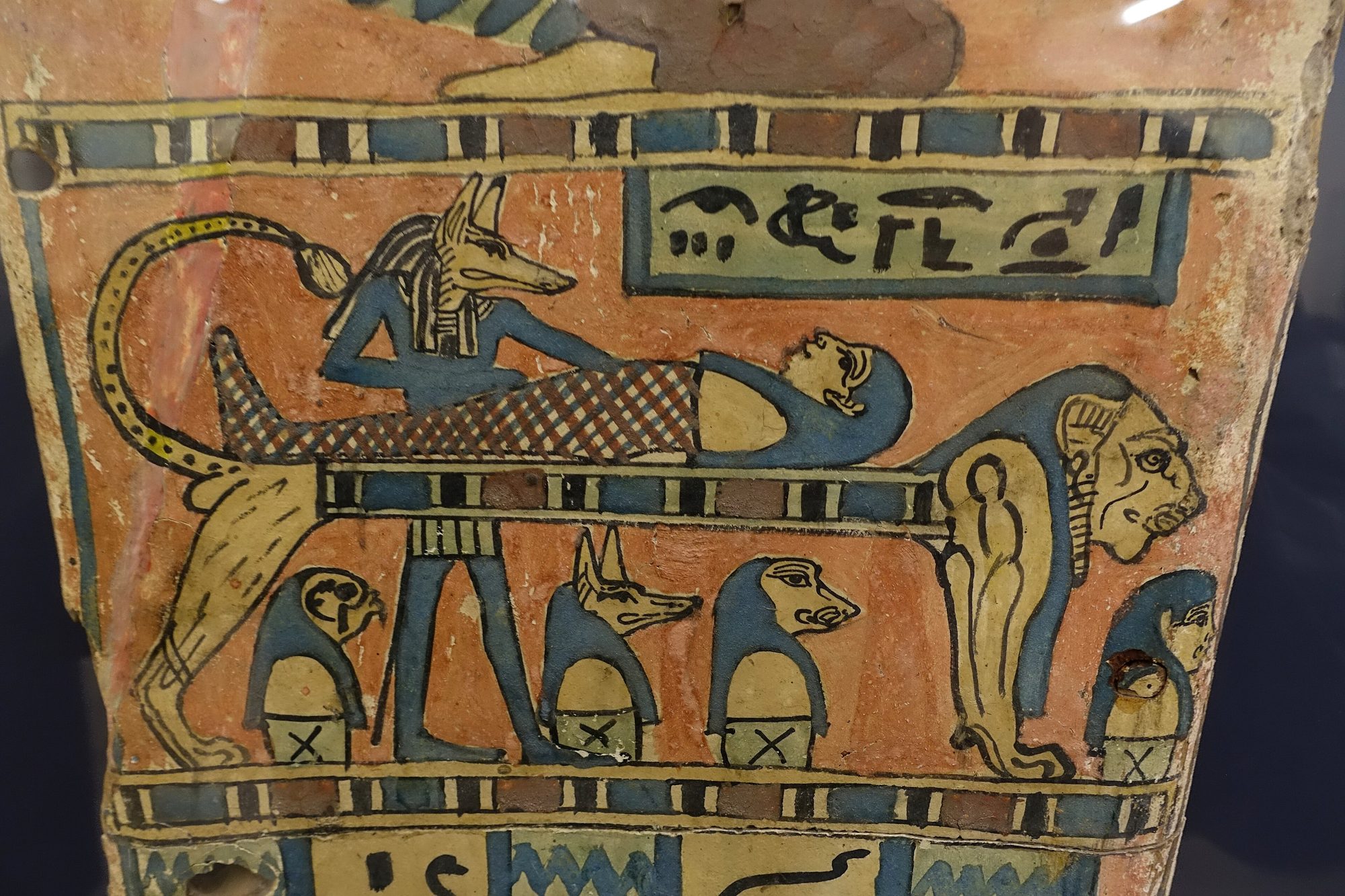
This is why she was painted on the undersides of coffin lids and across burial-chamber ceilings. The dead man was laid inside her the way Osiris was, so that he looked up not into stone but into the goddess herself, wrapped in her protecting body.
And she does not receive him as a stranger. At the very opening of the Pyramid Texts she speaks over the dead king and claims him as her own child, born of her: This is (my) son, (my) first born, N., opener of (my) womb; this is (my) beloved, with whom I have been satisfied.
The same goddess who is the sky and the coffin is also the mother, welcoming the dead as her firstborn, and out of her body she brings him the help he will need in the underworld, giving him thy sister Isis
and thy sister Nephthys
to mourn and mend him.
Water poured from the sycamore
There is a gentler picture of her too, and it survives in the funerary vignettes of the New Kingdom. Nut leans out of a sycamore tree over a pool, and the parched soul of the dead comes to her for the two things a corpse most lacks. She pours out cool water and hands over cakes, and the dead man prays to the tree that is the goddess: “Hail, thou sycamore tree of the goddess Nut!
Grant thou to me of [the water and of] the air which dwell in thee.” The sky-mother is here a shade tree at the edge of a garden, giving air to the airless and drink to the thirsty. It is the same goddess who holds the whole earth in her arms, brought down to the scale of a single frightened traveller wanting a cup of water.
What the Book of Nut says she does
One image of Nut is more famous than any of these, and it needs a careful hand. In the ceiling texts of the cenotaph of Seti I, in the composition Egyptologists call the Book of Nut, the goddess performs a daily act: the sun disc travels along her body through the day, is swallowed into her mouth at dusk, passes through her interior in the darkness, and is born again from between her thighs at dawn, emerging red as at a birth. This is the she swallows the sun each night and gives it back each morning
cosmology named in every modern account of her, and it is genuinely ancient and standard. It is worth being exact about where it comes from.
The Pyramid Texts and the public-domain Book of the Dead give her the sky, the stars, the coffin and the sycamore, but not this daily swallowing of the solar disc in so many words; the swallow-and-rebirth narration belongs to the Book of Nut and its companion Books of the Day and the Night, best read today through the modern critical edition rather than any public-domain ancient line. So it is set down here as the meaning of those texts and not dressed up as a quotation from the older spells. It is also the reason Nut wears the shapes she does in later art beyond the arched woman: she is drawn as a great cow whose belly is the star-field, and in one tradition as an enormous sow who swallows her piglets, the stars, and bears them again, the sky-mother eating and birthing her own children of light on an endless turn.
The children she is remembered for, though, are the four the oldest texts name around her: Osiris, Isis, Nephthys and Set, the generation on whom the great cycle of murder, mourning and kingship depends.
A later, Graeco-Egyptian telling would add Horus as a fifth child and give Nut a famous birth story, the five days won from the moon so she could bear her children outside the ordinary year; but that belongs to Plutarch and to the later tradition, not to the pharaonic spells in which she first arches over the dead. In those, she is simpler and stranger: a woman the size of the sky, holding the earth in her arms and gathering her dead children up into her body to shine.
Nut, spread thyself over thy son, Osiris N.; hide him from Set; protect him, Nut. (Pyramid Texts, Utterance 427, §777a-777b, tr. Mercer)
- Pyramid Texts, Utterances 1-5, §1a-3d — Samuel A. B. Mercer tr., The Pyramid Texts (Longmans, Green & Co., 1952); public-domain scan, archive.org id
THEPYRAMIDTEXTSTRANSLATION. Read verbatim for Nut’s welcome of the dead king as her firstborn (This is (my) son, (my) first born, N., opener of (my) womb; this is (my) beloved, with whom I have been satisfied
) and her gift to him ofthy sister Isis
andthy sister Nephthys
. Mercer prints the dead king asN.
, the placeholder for the royal name, and glossesOsiris N.
as the deceased identified with Osiris. - Pyramid Texts, Utterances 427-435, §777-787 (
In Praise of Nut
) — Mercer 1952, same volume and scan. Read verbatim for Nut spread over the dead Osiris as sky and coffin (Nut, spread thyself over thy son, Osiris N.; hide him from Set; protect him, Nut
;Nut, fall upon thy son… protect him
); her holding of the whole earth (The whole earth lies under thee… thou encompassest the earth and all things (therein) in thine arms
); her personified heaven (Great lady, who didst become heaven… thou hast filled every place with thy beauty
; Geb’sI have fertilized thee as Geb, in thy name of ‘Heaven’
); her place above Shu (High one over the earth, thou art above thy father Shu
); her body as container of the stars (thou hast educated them as ‘She of a thousand souls,’ so that they will not disappear from thee like stars
); the dead set among herimperishable
stars (mayest thou establish this N. in thee as an imperishable star
); her parentage naming Tefnut (§779b) and Shu (§784a); and the epithetsthe Granary
andGreat Sieve
. - Book of the Dead (Theban / Papyrus of Ani recension), Chapter of snuffing the air and dominion over the waters (Ch. LIX in Budge’s numbering) — E. A. Wallis Budge tr., *The Book of the DeadAn English Translation of the Chapters, Hymns, etc., of the Theban Recension* (London, 1898); public-domain scan, archive.org id
bookdeadanengli01budggoog. Read verbatim for the sycamore-tree-of-Nut passage (Hail, thou sycamore tree of the goddess Nut! Grant thou to me of the water and of the air which dwell in thee
), with its accompanying vignette of the goddess leaning from the tree to pour water and give cakes to the deceased. - Book of Nut (Fundamentals of the Course of the Stars) and the Book of the Day / Book of the Night, ceiling of the cenotaph of Seti I at Abydos — the sun-swallowing and night-passage cosmology (the sun swallowed at dusk, carried through Nut’s body by night, reborn at dawn). Critical editionA. von Lieven, Grundriss des Laufes der Sterne: Das sogenannte Nutbuch (Carsten Niebuhr Institute, Copenhagen, 2007). NOT read verbatim (in copyright, German). The daily swallow-and-rebirth image is presented in the body as the meaning of these texts, drawn from the secondary scholarship below, and is deliberately not quoted as a line from the older public-domain spells, which do not narrate it in those words.
- Secondary / interpretive (not a primary source; never quoted as ancient) — G. Hart, The Routledge Dictionary of Egyptian Gods and Goddesses, 2nd ed. (Routledge, 2005), pp. 110-111. Used only as scholarship for the sun-swallowing cosmology of the Book of Nut, Nut’s cow and sow forms (the sow who swallows and bears her star-piglets), and the later Graeco-Egyptian tradition that adds Horus as a fifth child. The five-epagomenal-days birth story is Greek (Plutarch, De Iside et Osiride 12), not a pharaonic primary text, and is named in the body only as later tradition.